LARGE SCALE PRODUCTION OF
ANTIBIOTICS – PENICILLIN
Antibiotics (anti-against, bios-killing) are chemical substances produced by
microorganisms that inhibits the growth or kills other microorganisms.
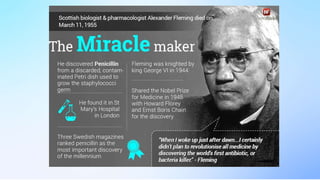
Alexander Fleming discovered penicillin, the first natural antibiotic, in 1928.
History
• In the 1920s, British scientist Alexander Fleming was working in his laboratory at St.
Mary’s Hospital in London when almost by accident, he discovered a naturally growing
substance that could attack certain bacteria.
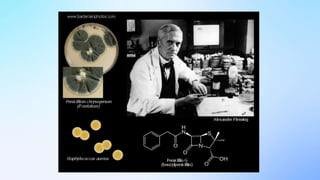
• In one of his experiments in 1928, Fleming observed colonies of the common
Staphylococcus aureus bacteria that had been worn down or killed by mold growing on
the same plate or petri dish.
• He determined that the mold made a substance that could dissolve the bacteria. He
called this substance penicillin, named after the Penicillium mold that made it.
• Fleming and others conducted a series of experiments over the next 2
decades using penicillin removed from mold cultures that showed its ability
to destroy infectious bacteria.
• Starting in 1941, they found that even low levels of penicillin cured very
serious infections and saved many lives. For his discoveries, Alexander
Fleming won the Nobel Prize in Physiology and Medicine.
Penicillin
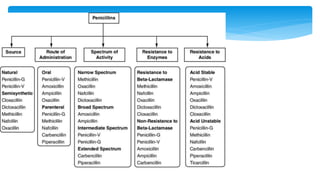
• It is beta-lactam antibiotic.
• Produced by many fungi particularly Penicillium and Aspergillus species.
• Natural penicillins act on numerous gram +ve bacteria.
• They are acid labile and can be deactivated by B-lactamase produced by bacteria.
• Because of low toxicity, large doses could be used. Only 0.5-2% develop allergies.
• The basic structure is 6-APA(6-aminopenicillanic acid).
• If the penicillin fermentation is carried out without addition of side chain precursors,
the natural penicillins are produced.
• From this mixture only benzylpenicillin is therapeutically useful; other compounds
must be removed during product recovery.
 The basic chemical structure of all penicillins consists of a beta-lactam ring,
a thiazolidine ring, and a side chain (6-aminopenicillanic acid).
 The antibacterial activity of the penicillins lies within the beta-lactam ring.
Structure
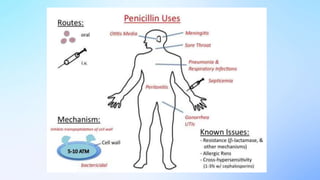
 Penicillins are bactericidal antibiotics as they kill the microorganisms when used
at therapeutic dose.
 The synthesis of cell wall of bacteria is completely depended upon an enzyme
named as transpeptidase.
 Primarily, Penicillin inhibits the cell wall of bacteria by blocking transpeptidase
after binding to penicillin-binding protein (PBP) and prevents its synthesis.
 Result: bacteria cells die from cell lysis.
 As human cells do not have cell walls, penicillin does not affect them.
How penicillin works?
 Penicillin is a secondary metabolite, thus is only produced in the stationary
phase.
 The industrial production of penicillin was generally classified into 2
processes:
PRODUCTION OF ANTIBIOTICS – PENICILLIN
Upstream processing
Technology that leads to the
synthesis of a product and
includes the development and
production.
Downstream processing
The extraction and
purification of all
biotechnological product
from fermentation process.
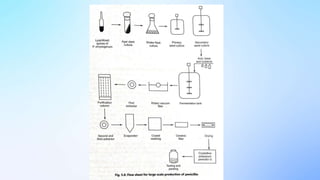
 Fermentation is the technique used for the commercial production of penicillin.
 It is a fed-batch process that is carried out aseptically in stainless steel tank reactors
with a capacity of 30 to 100 thousand gallons.
 The fermentation involves two to three initial seed growth phases, followed by a
fermentation production phase with a time cycle ranging from 120 to 200 hours.
 Penicillin production mainly consists of three steps:
1. Inoculum preparation
2. Production fermentation
3. Product recovery
 Inoculum: Penicillium chrysogenum.
 For inoculum production, spores from heavily sporulated working stocks (special
agar sporulation) are suspended in water or in a dilute solution of a nontoxic
wetting agent, such as 1:10,000 sodium lauryl sulfonate.
 These spores are then poured in the flask which contains wheat bran and
nutrient solution for heavy sporulation.
 Incubate for at 24°C for 5-7 days to provide heavy sporulation.
 The culture is then transferred to inoculum tanks, and grown for 1-2 days under
aeration; this supports heavy mycelial growth.
 The inoculum is now added to very large fermentors containing the production
medium.
 Resulting spores are directly inoculated into inoculation tanks.
1. INOCULUM PREPARATION
 The medium: Jackson in 1958 prepared a media for penicillin production.
The major constituent of typical medium includes,
Fermentation media
 Aeration (oxygen supply): supply of oxygen in a bioreactor is the limiting factor
in penicillin biosynthesis. Aeration speed is between 3.0 to 1.5.
 Temperature: Temperature plays an important role in penicillin production it
should be mentioned at 28° C.
 Biomass production: production of penicillin depends upon biomass production
therefore, it is describe to have a high biomass concentration in the vessel. It is
achieved by increasing the agitation rate and power.
 PH: It is maintained early neutrality by calcium and magnesium carbonate in the
medium by phosphate buffer. It is also controlled by adding sodium hydroxide or
sulphuric acid in the medium.
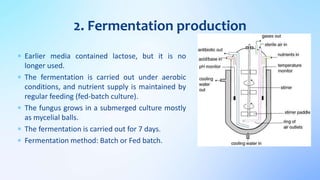
 Earlier media contained lactose, but it is no
longer used.
 The fermentation is carried out under aerobic
conditions, and nutrient supply is maintained by
regular feeding (fed-batch culture).
 The fungus grows in a submerged culture mostly
as mycelial balls.
 The fermentation is carried out for 7 days.
 Fermentation method: Batch or Fed batch.
2. Fermentation production
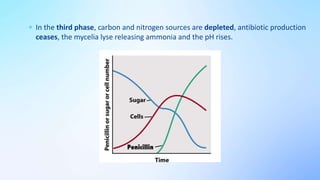
 Penicillin fermentation can be divided into three phases.
1. The first phase (trophophase) during which rapid growth occurs, lasts for about
30 hours during which mycelia are produced. Mycelial growth occurs, and
carbohydrates are used up.
2. The second phase (idiophase) lasts for five to seven days; growth is reduced and
penicillin is produced.
 Reduction of carbohydrate level in the medium favours penicillin production, which
begins from the second day of fermentation.
 The pH of medium rises to 8.0 by the 7th day, and penicillin production stops at this
stage.
Fermentation kinetics
 In the third phase, carbon and nitrogen sources are depleted, antibiotic production
ceases, the mycelia lyse releasing ammonia and the pH rises.
 At the end of fermentation period, the fungal biomass is separated by
filtration and used as animal feed supplement.
 Penicillin is highly reactive and is easily destroyed by alkali conditions (pH
7.5-8.0) or by enzymes.
 It is therefore cooled rapidly to 5-10°C. Since penicillins are monobasic
carboxylic acids they are easily separated by solvent extraction.
3. Down stream processing
 The fermentation broth is filtered with a rotary vacuum filter to remove mycelia
and other solids and the resulting broth is adjusted to about pH 2 using a mineral
acid.
 It is then extracted with a smaller volume of an organic solvent such as amyl
acetate or butyl acetate, keeping it at this very low pH for as short a time as
possible.
 The aqueous phase is separated from the organic solvent.
 The organic solvent containing the penicillin is then typically passed through
charcoal to remove impurities and penicillin concentrated by repeated back
extraction in phosphate buffer (pH 2) and extraction in organic solvent.
Steps
 When it is sufficiently concentrated the penicillin may be converted to a
stable salt form in one of several ways which employ the fact that penicillin
is an acid:
(a) it can be reacted with a calcium carbonate slurry to give the calcium salt
which may be filtered, lyophilized or spray dried.
(b) it may be reacted with sodium or potassium buffers to give the salts of
these metals which can also be freeze or spray dried
(c) It may be precipitated with an organic base such as triethylamine.
1. Birol, G., Undey, C., & Cinar, A. (2002). A modular simulation package for
fed-batch fermentation: penicillin production. Computers & Chemical
Engineering, 26(11), 1553–1565.
2. https://www.news-medical.net/health/Penicillin-Production.aspx
3. https://microbiologynotes.org/penicillin-history-structure-production-
and-recovery/amp/
4. https://biologyreader.com/production-of-penicillin.html
REFERENCE
THANK YOU