Dr. Manikandan Kathirvel M.Sc., Ph.D., (NET)
Assistant Professor,
Department of Life Sciences,
Kristu Jayanti College (Autonomous),
Reaccredited with "A++" Grade by NAAC
K. Narayanapura, Kothanur (PO)
Bengaluru
Bacterial Artificial Chromosomes (BACs)
YAC (Yeast Artificial Chromosome)
Bacterial Artificial Chromosomes (BACs)
Definition:
1. Bacterial Artificial Chromosomes or BACs are plasmids (circular DNA molecules)
constructed with the replication origin of E. coli F’ Factor, can be maintained in a single
copy per cell.
2. It is derived from naturally occurring F’ plasmid (The F (fertility) factor is a plasmid that
can be mobilized). F’ is involved in E. coli conjugative ability and chromosomal transfer,
which can exist as an extra-chromosomal element.
3. Bacterial artificial chromosomes are similar to E. coli plasmid vectors.
4. They contain ori and genes which encode ori binding proteins. These proteins are critical
for BAC replication.
5. The DNA insert size varies between 150 to 350 kb.
6. It was first developed as a large insert cloning system to facilitate the construction of
DNA libraries to analyze genomic structure.
7. Technology was developed to carry out genetic and functional studies of viruses (herpes
virus especially).
8. Since then BACs application have grown intensely and have benefited the research
community in many fields, such as in genomic fingerprinting, sequencing of the human
genome, in vaccine development and in vitro transgenesis.
Characteristic features of BAC vectors
pBAC108L
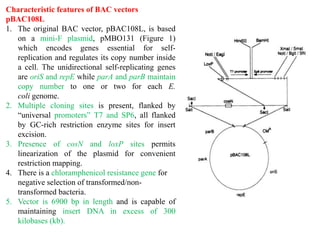
1. The original BAC vector, pBAC108L, is based
on a mini-F plasmid, pMBO131 (Figure 1)
which encodes genes essential for self-
replication and regulates its copy number inside
a cell. The unidirectional self-replicating genes
are oriS and repE while parA and parB maintain
copy number to one or two for each E.
coli genome.
2. Multiple cloning sites is present, flanked by
“universal promoters” T7 and SP6, all flanked
by GC-rich restriction enzyme sites for insert
excision.
3. Presence of cosN and loxP sites permits
linearization of the plasmid for convenient
restriction mapping.
4. There is a chloramphenicol resistance gene for
negative selection of transformed/non-
transformed bacteria.
5. Vector is 6900 bp in length and is capable of
maintaining insert DNA in excess of 300
kilobases (kb).
Other BAC Vectors
There have been many modifications done to
increase the ease-of-use as well as for use in
specific systems and situations.
pBeloBAC11 2 and pBACe3.6 are modified
BAC vectors based on pBAC108L and are
commonly used as a basis for further
modification.
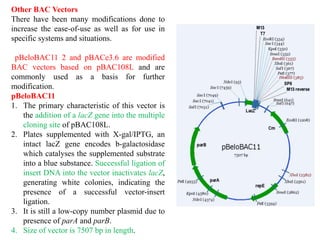
pBeloBAC11
1. The primary characteristic of this vector is
the addition of a lacZ gene into the multiple
cloning site of pBAC108L.
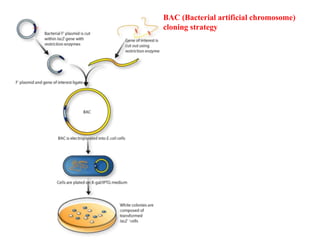
2. Plates supplemented with X-gal/IPTG, an
intact lacZ gene encodes b-galactosidase
which catalyses the supplemented substrate
into a blue substance. Successful ligation of
insert DNA into the vector inactivates lacZ,
generating white colonies, indicating the
presence of a successful vector-insert
ligation.
3. It is still a low-copy number plasmid due to
presence of parA and parB.
4. Size of vector is 7507 bp in length.
pBACe3.6
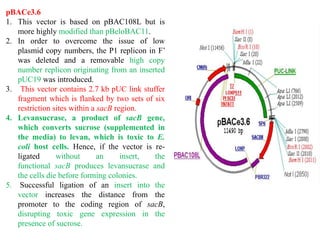
1. This vector is based on pBAC108L but is
more highly modified than pBeloBAC11.
2. In order to overcome the issue of low
plasmid copy numbers, the P1 replicon in F’
was deleted and a removable high copy
number replicon originating from an inserted
pUC19 was introduced.
3. This vector contains 2.7 kb pUC link stuffer
fragment which is flanked by two sets of six
restriction sites within a sacB region.
4. Levansucrase, a product of sacB gene,
which converts sucrose (supplemented in
the media) to levan, which is toxic to E.
coli host cells. Hence, if the vector is re-
ligated without an insert, the
functional sacB produces levansucrase and
the cells die before forming colonies.
5. Successful ligation of an insert into the
vector increases the distance from the
promoter to the coding region of sacB,
disrupting toxic gene expression in the
presence of sucrose.
In addition to this vectors, there are many specialized BAC vectors carrying a variety of
different combinations of drug resistance genes. Besides, many different selection
mechanisms and markers are available. Modifications of cloning sites (unique
restriction endonuclease sites) are also common as per the addition of genes and
promoters specific to different strains of bacteria.
Advantages of BAC
1. BACs are useful for the construction of genomic libraries
2. The ability of BAC vectors to accommodate large inserts has allowed the study of
entire bacterial pathways.
3. By isolating DNA directly from soil or from marine environments, the “metagenomes”
of those organisms which are either uncultureable or are termed viable but
uncultureable can be cloned into BAC vectors and indirectly studied.
4. In industrial research fields where BAC vectors are invaluable tools in cataloguing
novel genomes is in the discovery of novel enzymes.
5. BACs are frequently used for studies of genetic or infectious disorders.
Disadvantages of BAC
1. They are present in low copy number.
2. The eukaryotic DNA inserts with repetitive sequences are structurally unstable in
BACs often resulting in deletion or rearrangement.
BAC (Bacterial artificial chromosome)
cloning strategy
YAC (yeast artificial chromosome) vectors
Definition:
1. Yeast artificial chromosomes (YACs) are plasmid shuttle vectors capable of replicating
and being selected in common bacterial hosts such as Escherichia coli, as well as in the
budding yeast Saccharomyces cerevisiae. Both yeast and bacterial cells can be used as
hosts. The presence of ori/ARS from both bacteria and yeast respectively.
2. They are of relatively small size (approximately 12 kb) and of circular form when they
are amplified or manipulated in E. coli, but are rendered linear, when introduced as
cloning vectors in yeast.
3. A large DNA insert of up to 200 kb can be cloned.
4. They are used for cloning inside eukaryotic cells. These act as eukaryotic chromosomes
inside the host eukaryotic cell.
• It possesses the yeast telomere at each end.
• A yeast centromere sequence (CEN) is present which allows proper
segregation during meiosis.
5. Many different yeast artificial chromosomes exist as ongoing refinements of the initial
pYAC3 and pYAC4 plasmids constructed by Burke et al. (1987).
6. Basic structural features of YACs were developed from the yeast centromere shuttle-
plasmids (YCp) series.
7. These are composed of double-stranded circular DNA sequences carrying the b-
lactamase gene (bla) and the bacterial pMB1 origin of replication, thus conferring
resistance to ampicillin and the ability to replicate in bacteria, respectively.
Biological Features of YACs
The stability of YAC vectors in yeast is similar to that of natural chromosomes provided
that all three structural elements (ARS, CEN and TEL) are present and functional, in
addition, insertion of larger exogenous DNA.
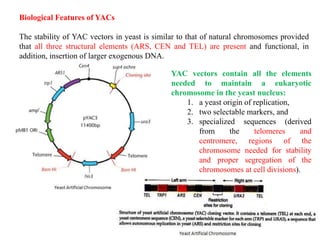
YAC vectors contain all the elements
needed to maintain a eukaryotic
chromosome in the yeast nucleus:
1. a yeast origin of replication,
2. two selectable markers, and
3. specialized sequences (derived
from the telomeres and
centromere, regions of the
chromosome needed for stability
and proper segregation of the
chromosomes at cell divisions).
1. YACs also contain the cloning site in the
middle of the SUP4 suppressor of an ochre
allele of a tyrosine transfer RNA gene; this
enables restoration of the normal white
color phenotype in otherwise red ade1
and/or ade2 nonsense mutants.
2. Accordingly, in the insertional inactivation
cloning process, the SUP4 gene is disrupted
by the DNA insert, thus removing the
suppression of the ade mutations and
allowing their phenotypic expression as
red color.
YAC (yeast artificial chromosome)
cloning strategy
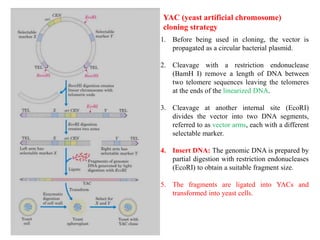
1. Before being used in cloning, the vector is
propagated as a circular bacterial plasmid.
2. Cleavage with a restriction endonuclease
(BamH I) remove a length of DNA between
two telomere sequences leaving the telomeres
at the ends of the linearized DNA.
3. Cleavage at another internal site (EcoRI)
divides the vector into two DNA segments,
referred to as vector arms, each with a different
selectable marker.
4. Insert DNA: The genomic DNA is prepared by
partial digestion with restriction endonucleases
(EcoRI) to obtain a suitable fragment size.
5. The fragments are ligated into YACs and
transformed into yeast cells.
Applications of YACs
1. Applications of YACs range from generating whole DNA libraries of the genomes of
higher organisms to identifying essential mammalian chromosomal sequences
necessary for the future construction of specialized mammalian artificial chromosomes
(MACs).
2. Helps in the study of regulation of gene expression.
3. Comparatively stable.
4. Easy to transform.
5. Simple purification required.
6. User- friendly.
7. Aid in the development of vaccines.
Advantages of using YACs:
1. A large amount of DNA can be cloned.
2. Physical maps of large genomes like the human genome can be constructed.
Disadvantages of using YACs:
1. Overall transformation efficiency is low.
2. The yield of cloned DNA is also low.

Lecture BAC YAC.pptx

  • 1.
    Dr. Manikandan KathirvelM.Sc., Ph.D., (NET) Assistant Professor, Department of Life Sciences, Kristu Jayanti College (Autonomous), Reaccredited with "A++" Grade by NAAC K. Narayanapura, Kothanur (PO) Bengaluru Bacterial Artificial Chromosomes (BACs) YAC (Yeast Artificial Chromosome)
  • 2.
    Bacterial Artificial Chromosomes(BACs) Definition: 1. Bacterial Artificial Chromosomes or BACs are plasmids (circular DNA molecules) constructed with the replication origin of E. coli F’ Factor, can be maintained in a single copy per cell. 2. It is derived from naturally occurring F’ plasmid (The F (fertility) factor is a plasmid that can be mobilized). F’ is involved in E. coli conjugative ability and chromosomal transfer, which can exist as an extra-chromosomal element. 3. Bacterial artificial chromosomes are similar to E. coli plasmid vectors. 4. They contain ori and genes which encode ori binding proteins. These proteins are critical for BAC replication. 5. The DNA insert size varies between 150 to 350 kb. 6. It was first developed as a large insert cloning system to facilitate the construction of DNA libraries to analyze genomic structure. 7. Technology was developed to carry out genetic and functional studies of viruses (herpes virus especially). 8. Since then BACs application have grown intensely and have benefited the research community in many fields, such as in genomic fingerprinting, sequencing of the human genome, in vaccine development and in vitro transgenesis.
  • 4.
    Characteristic features ofBAC vectors pBAC108L 1. The original BAC vector, pBAC108L, is based on a mini-F plasmid, pMBO131 (Figure 1) which encodes genes essential for self- replication and regulates its copy number inside a cell. The unidirectional self-replicating genes are oriS and repE while parA and parB maintain copy number to one or two for each E. coli genome. 2. Multiple cloning sites is present, flanked by “universal promoters” T7 and SP6, all flanked by GC-rich restriction enzyme sites for insert excision. 3. Presence of cosN and loxP sites permits linearization of the plasmid for convenient restriction mapping. 4. There is a chloramphenicol resistance gene for negative selection of transformed/non- transformed bacteria. 5. Vector is 6900 bp in length and is capable of maintaining insert DNA in excess of 300 kilobases (kb).
  • 5.
    Other BAC Vectors Therehave been many modifications done to increase the ease-of-use as well as for use in specific systems and situations. pBeloBAC11 2 and pBACe3.6 are modified BAC vectors based on pBAC108L and are commonly used as a basis for further modification. pBeloBAC11 1. The primary characteristic of this vector is the addition of a lacZ gene into the multiple cloning site of pBAC108L. 2. Plates supplemented with X-gal/IPTG, an intact lacZ gene encodes b-galactosidase which catalyses the supplemented substrate into a blue substance. Successful ligation of insert DNA into the vector inactivates lacZ, generating white colonies, indicating the presence of a successful vector-insert ligation. 3. It is still a low-copy number plasmid due to presence of parA and parB. 4. Size of vector is 7507 bp in length.
  • 6.
    pBACe3.6 1. This vectoris based on pBAC108L but is more highly modified than pBeloBAC11. 2. In order to overcome the issue of low plasmid copy numbers, the P1 replicon in F’ was deleted and a removable high copy number replicon originating from an inserted pUC19 was introduced. 3. This vector contains 2.7 kb pUC link stuffer fragment which is flanked by two sets of six restriction sites within a sacB region. 4. Levansucrase, a product of sacB gene, which converts sucrose (supplemented in the media) to levan, which is toxic to E. coli host cells. Hence, if the vector is re- ligated without an insert, the functional sacB produces levansucrase and the cells die before forming colonies. 5. Successful ligation of an insert into the vector increases the distance from the promoter to the coding region of sacB, disrupting toxic gene expression in the presence of sucrose.
  • 7.
    In addition tothis vectors, there are many specialized BAC vectors carrying a variety of different combinations of drug resistance genes. Besides, many different selection mechanisms and markers are available. Modifications of cloning sites (unique restriction endonuclease sites) are also common as per the addition of genes and promoters specific to different strains of bacteria. Advantages of BAC 1. BACs are useful for the construction of genomic libraries 2. The ability of BAC vectors to accommodate large inserts has allowed the study of entire bacterial pathways. 3. By isolating DNA directly from soil or from marine environments, the “metagenomes” of those organisms which are either uncultureable or are termed viable but uncultureable can be cloned into BAC vectors and indirectly studied. 4. In industrial research fields where BAC vectors are invaluable tools in cataloguing novel genomes is in the discovery of novel enzymes. 5. BACs are frequently used for studies of genetic or infectious disorders. Disadvantages of BAC 1. They are present in low copy number. 2. The eukaryotic DNA inserts with repetitive sequences are structurally unstable in BACs often resulting in deletion or rearrangement.
  • 8.
    BAC (Bacterial artificialchromosome) cloning strategy
  • 9.
    YAC (yeast artificialchromosome) vectors Definition: 1. Yeast artificial chromosomes (YACs) are plasmid shuttle vectors capable of replicating and being selected in common bacterial hosts such as Escherichia coli, as well as in the budding yeast Saccharomyces cerevisiae. Both yeast and bacterial cells can be used as hosts. The presence of ori/ARS from both bacteria and yeast respectively. 2. They are of relatively small size (approximately 12 kb) and of circular form when they are amplified or manipulated in E. coli, but are rendered linear, when introduced as cloning vectors in yeast. 3. A large DNA insert of up to 200 kb can be cloned. 4. They are used for cloning inside eukaryotic cells. These act as eukaryotic chromosomes inside the host eukaryotic cell. • It possesses the yeast telomere at each end. • A yeast centromere sequence (CEN) is present which allows proper segregation during meiosis. 5. Many different yeast artificial chromosomes exist as ongoing refinements of the initial pYAC3 and pYAC4 plasmids constructed by Burke et al. (1987). 6. Basic structural features of YACs were developed from the yeast centromere shuttle- plasmids (YCp) series. 7. These are composed of double-stranded circular DNA sequences carrying the b- lactamase gene (bla) and the bacterial pMB1 origin of replication, thus conferring resistance to ampicillin and the ability to replicate in bacteria, respectively.
  • 10.
    Biological Features ofYACs The stability of YAC vectors in yeast is similar to that of natural chromosomes provided that all three structural elements (ARS, CEN and TEL) are present and functional, in addition, insertion of larger exogenous DNA. YAC vectors contain all the elements needed to maintain a eukaryotic chromosome in the yeast nucleus: 1. a yeast origin of replication, 2. two selectable markers, and 3. specialized sequences (derived from the telomeres and centromere, regions of the chromosome needed for stability and proper segregation of the chromosomes at cell divisions).
  • 11.
    1. YACs alsocontain the cloning site in the middle of the SUP4 suppressor of an ochre allele of a tyrosine transfer RNA gene; this enables restoration of the normal white color phenotype in otherwise red ade1 and/or ade2 nonsense mutants. 2. Accordingly, in the insertional inactivation cloning process, the SUP4 gene is disrupted by the DNA insert, thus removing the suppression of the ade mutations and allowing their phenotypic expression as red color.
  • 12.
    YAC (yeast artificialchromosome) cloning strategy 1. Before being used in cloning, the vector is propagated as a circular bacterial plasmid. 2. Cleavage with a restriction endonuclease (BamH I) remove a length of DNA between two telomere sequences leaving the telomeres at the ends of the linearized DNA. 3. Cleavage at another internal site (EcoRI) divides the vector into two DNA segments, referred to as vector arms, each with a different selectable marker. 4. Insert DNA: The genomic DNA is prepared by partial digestion with restriction endonucleases (EcoRI) to obtain a suitable fragment size. 5. The fragments are ligated into YACs and transformed into yeast cells.
  • 13.
    Applications of YACs 1.Applications of YACs range from generating whole DNA libraries of the genomes of higher organisms to identifying essential mammalian chromosomal sequences necessary for the future construction of specialized mammalian artificial chromosomes (MACs). 2. Helps in the study of regulation of gene expression. 3. Comparatively stable. 4. Easy to transform. 5. Simple purification required. 6. User- friendly. 7. Aid in the development of vaccines. Advantages of using YACs: 1. A large amount of DNA can be cloned. 2. Physical maps of large genomes like the human genome can be constructed. Disadvantages of using YACs: 1. Overall transformation efficiency is low. 2. The yield of cloned DNA is also low.