INSERTIONAL INACTIVATION
SUBJECT : GENETIC ENGINEERING
BY : S. DASH
INTRODUCTION
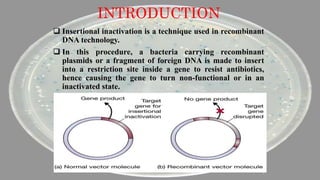
 Insertional inactivation is a technique used in recombinant
DNA technology.
 In this procedure, a bacteria carrying recombinant
plasmids or a fragment of foreign DNA is made to insert
into a restriction site inside a gene to resist antibiotics,
hence causing the gene to turn non-functional or in an
inactivated state.
EXPLANATION
 Insertional inactivation is one of the screening methods, which is a
fundamental process involved in the recombinant DNA
technology.
 It is used in the detection of cells (host cells) that has received the
foreign DNA molecule.
 There are several examples of insertional inactivation, few of
them are mentioned below :-
• Blue white screening method.
• Antibiotic resistance.
BLUE WHITE SCREENING
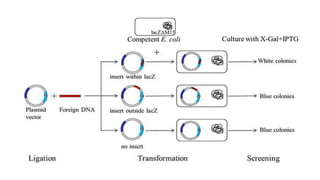
 The lacZ gene encodes for an enzyme beta-galactosidase. This gene is
inserted into the vector.
 The enzyme beta-galactosidase has the ability to split a synthetic substrate,
X-gal, which is an organic compound abbreviated as BCIG.(5-BROMO-4-
CHLORO-INDOYL-BETA-D-GALACTOPYRANOSIDE) into an
insoluble product, that is blue in colour.
 If the foreign gene is introduced into the gene lacZ, the gene will be
disrupted and hence it’s activity will be inhibited. Thus, no blue colour will
develop as beta-galactosidase is not produced due to deactivation of the
lacZ gene.
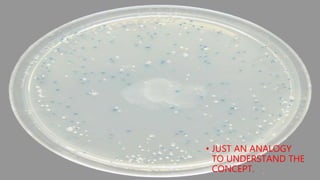
 Consequently, the host cell comprising the rDNA will create white
background colonies on the medium containing X-gal, whereas other cells
bearing non-recombinant DNA will tend to develop blue coloured colonies.
 Therefore, the recombinants are selected on the basis of the colour of the
colony.
ANTIBIOTIC RESISTANCE
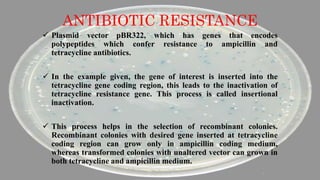
 Plasmid vector pBR322, which has genes that encodes
polypeptides which confer resistance to ampicillin and
tetracycline antibiotics.
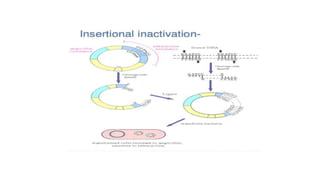
 In the example given, the gene of interest is inserted into the
tetracycline gene coding region, this leads to the inactivation of
tetracycline resistance gene. This process is called insertional
inactivation.
 This process helps in the selection of recombinant colonies.
Recombinant colonies with desired gene inserted at tetracycline
coding region can grow only in ampicillin coding medium,
whereas transformed colonies with unaltered vector can grown in
both tetracycline and ampicillin medium.
EXTRA INFORMATION
An alternative strategy for insertional inactivation has been used in
vertebrate animals to find genes that cause cancer.
In this case a transposon e.g., Sleeping beauty, is designed to interrupt
a gene in such a way that it causes maximal genetic havoc !
MERITS :
1. Easy screening procedure i.e., it is inexpensive and does not need
very skilled people to perform this experiment.
2. The whole setup is very easy to handle.
3. The changes can be observed very easily and quickly.
DEMERITS
1. There are chances of non-specific insertion.
2. The normal functioning of the gene is disrupted.
REFERENCES :
• Gene cloning and DNA analysis (Edition-VII) by T.A. Brown.
Publisher: Wiley Blackwell
• Principles of gene manipulation (Edition-VI) by S.B. Primrose,
R.M. Twyman and R.W. Old.
Publisher : Wiley Blackwell
• www.wikipedia.com
• JUST AN ANALOGY
TO UNDERSTAND THE
CONCEPT.
THANK YOU

Insertional inactivation

  • 1.
    INSERTIONAL INACTIVATION SUBJECT :GENETIC ENGINEERING BY : S. DASH
  • 3.
    INTRODUCTION  Insertional inactivationis a technique used in recombinant DNA technology.  In this procedure, a bacteria carrying recombinant plasmids or a fragment of foreign DNA is made to insert into a restriction site inside a gene to resist antibiotics, hence causing the gene to turn non-functional or in an inactivated state.
  • 4.
    EXPLANATION  Insertional inactivationis one of the screening methods, which is a fundamental process involved in the recombinant DNA technology.  It is used in the detection of cells (host cells) that has received the foreign DNA molecule.  There are several examples of insertional inactivation, few of them are mentioned below :- • Blue white screening method. • Antibiotic resistance.
  • 5.
    BLUE WHITE SCREENING The lacZ gene encodes for an enzyme beta-galactosidase. This gene is inserted into the vector.  The enzyme beta-galactosidase has the ability to split a synthetic substrate, X-gal, which is an organic compound abbreviated as BCIG.(5-BROMO-4- CHLORO-INDOYL-BETA-D-GALACTOPYRANOSIDE) into an insoluble product, that is blue in colour.  If the foreign gene is introduced into the gene lacZ, the gene will be disrupted and hence it’s activity will be inhibited. Thus, no blue colour will develop as beta-galactosidase is not produced due to deactivation of the lacZ gene.  Consequently, the host cell comprising the rDNA will create white background colonies on the medium containing X-gal, whereas other cells bearing non-recombinant DNA will tend to develop blue coloured colonies.  Therefore, the recombinants are selected on the basis of the colour of the colony.
  • 8.
    ANTIBIOTIC RESISTANCE  Plasmidvector pBR322, which has genes that encodes polypeptides which confer resistance to ampicillin and tetracycline antibiotics.  In the example given, the gene of interest is inserted into the tetracycline gene coding region, this leads to the inactivation of tetracycline resistance gene. This process is called insertional inactivation.  This process helps in the selection of recombinant colonies. Recombinant colonies with desired gene inserted at tetracycline coding region can grow only in ampicillin coding medium, whereas transformed colonies with unaltered vector can grown in both tetracycline and ampicillin medium.
  • 10.
    EXTRA INFORMATION An alternativestrategy for insertional inactivation has been used in vertebrate animals to find genes that cause cancer. In this case a transposon e.g., Sleeping beauty, is designed to interrupt a gene in such a way that it causes maximal genetic havoc !
  • 11.
    MERITS : 1. Easyscreening procedure i.e., it is inexpensive and does not need very skilled people to perform this experiment. 2. The whole setup is very easy to handle. 3. The changes can be observed very easily and quickly. DEMERITS 1. There are chances of non-specific insertion. 2. The normal functioning of the gene is disrupted.
  • 12.
    REFERENCES : • Genecloning and DNA analysis (Edition-VII) by T.A. Brown. Publisher: Wiley Blackwell • Principles of gene manipulation (Edition-VI) by S.B. Primrose, R.M. Twyman and R.W. Old. Publisher : Wiley Blackwell • www.wikipedia.com
  • 13.
    • JUST ANANALOGY TO UNDERSTAND THE CONCEPT.
  • 14.