R E P O R T E
R
S Y S T E M S
REPORTER SYSTEMS
L A C Z S Y S T E M , G F P
• Reporter genes
• Features
• Types
• Lac Z system
• GFP
• Measurement of expression
C O N T E N T S
2
R E P O R T E R G E N E S
• A reporter or marker gene is a gene, which produces a specific phenotype, in
turn enables the differentiation of the cells possessing this particular gene
from those without this gene. Hence, the transformed cells can be selected
easily among the thousands of non transformed cells.
• They form specific protein products, which are easily detectable and
quantifiable, sometimes even without destroying the tissue.
• They are an invaluable tool to track and study another associated gene in
bacterial and mammalian cell culture, animals and plants. One can easily find
out the expression patterns of a gene within the cell by fusing its promoter
with one of the several reporter genes and transfecting inside the living cells.
3
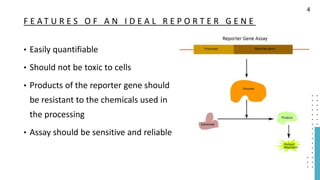
F E A T U R E S O F A N I D E A L R E P O R T E R G E N E
• Easily quantifiable
• Should not be toxic to cells
• Products of the reporter gene should
be resistant to the chemicals used in
the processing
• Assay should be sensitive and reliable
4
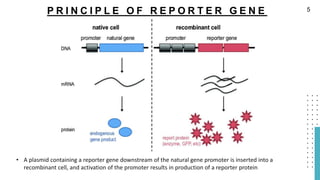
P R I N C I P L E O F R E P O R T E R G E N E
• A plasmid containing a reporter gene downstream of the natural gene promoter is inserted into a
recombinant cell, and activation of the promoter results in production of a reporter protein
5
6
T Y P E S O F R E P O R T E R G E N E S
Reporter genes are mainly two types
• Selectable reporter gene
• Scorable reporter gene
7
1. Selectable Reporter Gene
• The cells that contain this type of marker gene show the ability to
survive under selective conditions. These selective conditions would
otherwise result in the death of the cells lacking that specific gene.
• Most commonly used selective agents are antibiotics. Out of the
millions and billions of cells, only few of them get transformed by the
foreign DNA. It is practically impossible to check every individual cell,
so a selective agent is required to eliminate the non- transformed cells,
leaving only the desired ones.
• Example: Lac Z gene
8
L A C Z S Y S T E M
• The lactose operon designated as lac operon.
• The lac operon codes for enzymes involved in the catabolism
(degradation) of lactose.
• Lactose is the disaccharide which is made up of glucose & galactose.
• It is the inducible operon since the presence of lactose induce the
operon to switched on.
Thelac
Operon
9
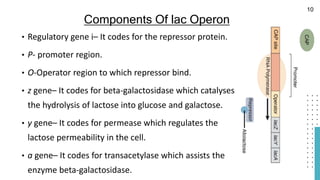
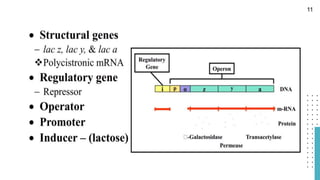
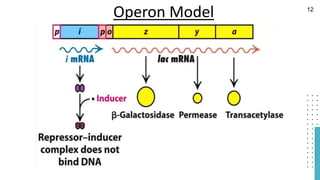
• Regulatory gene i– It codes for the repressor protein.
• P- promoter region.
• O-Operator region to which repressor bind.
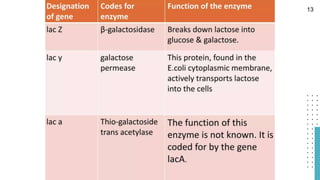
• z gene– It codes for beta-galactosidase which catalyses
the hydrolysis of lactose into glucose and galactose.
• y gene– It codes for permease which regulates the
lactose permeability in the cell.
• a gene– It codes for transacetylase which assists the
enzyme beta-galactosidase.
Components Of lac Operon
10
11
Operon Model 12
13
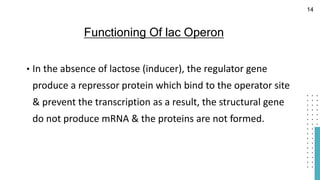
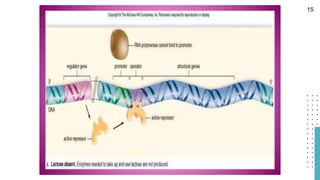
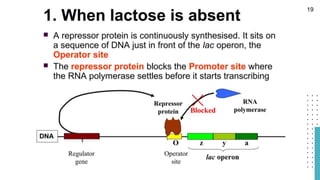
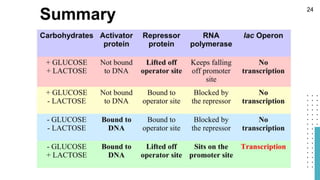
• In the absence of lactose (inducer), the regulator gene
produce a repressor protein which bind to the operator site
& prevent the transcription as a result, the structural gene
do not produce mRNA & the proteins are not formed.
Functioning Of lac Operon
14
15
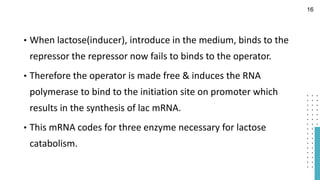
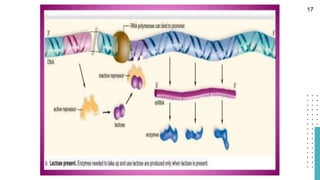
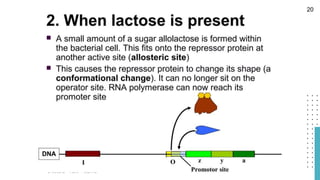
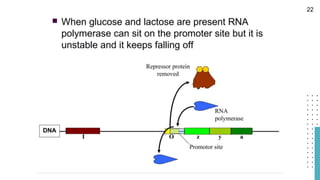
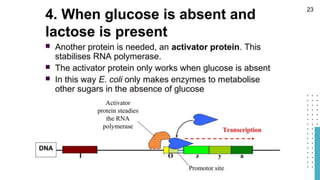
• When lactose(inducer), introduce in the medium, binds to the
repressor the repressor now fails to binds to the operator.
• Therefore the operator is made free & induces the RNA
polymerase to bind to the initiation site on promoter which
results in the synthesis of lac mRNA.
• This mRNA codes for three enzyme necessary for lactose
catabolism.
16
17
18
19
20
21
22
23
24
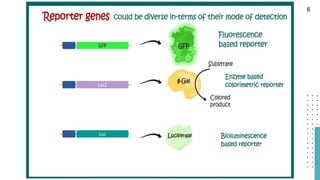
2. Scorable Reporter Gene
• Expression of this kind of marker gene results in a quantifiable
phenotype i.e., it will make the cells containing it to look different.
• The main principle behind the use of these reporter genes for the
study of molecular processes in living cells means that in natural
genes, synthetic modification have introduced in order to either
simplify the detection of the product or to distinguish it from similar
genes in the genome.
• Example: GFP and Luciferase.
25
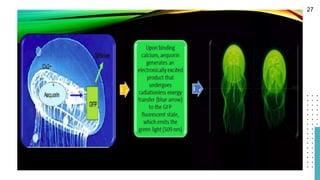
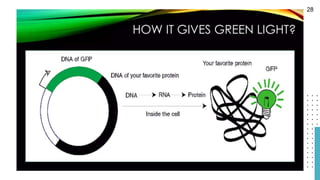
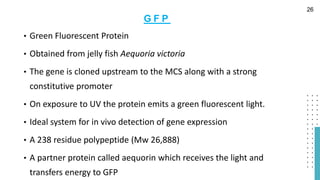
• Green Fluorescent Protein
• Obtained from jelly fish Aequoria victoria
• The gene is cloned upstream to the MCS along with a strong
constitutive promoter
• On exposure to UV the protein emits a green fluorescent light.
• Ideal system for in vivo detection of gene expression
• A 238 residue polypeptide (Mw 26,888)
• A partner protein called aequorin which receives the light and
transfers energy to GFP
G F P
26
27
28
• No special biosynthetic pathways; can be synthesized by any cell
system
• The protein structure contains a barrel of 11 ẞ strands with a
chromophore in the centre
• This is a post-translational modification
• Mainly used as a reporter as well as a tag system
• Used to locate proteins within cells / tissues
• Also used to measure the levels of expression
29
M E A S U R E M E N T O F E X P R E S S I O N O F R E P O R T E R
G E N E
• Enzyme activity assay of the expressed enzyme encoded by the
reporter gene using chromo, fluoro, luminogenic substrate.
• Immunological assay of the expressed protein encoded by the
reporter gene.

• Histochemical staining of cells or tissue typically to localize
enzymatic activity expressed from reporter gene construct cells.
30
THANK YOU

Reporter genes.......................pptx

  • 1.
    R E PO R T E R S Y S T E M S REPORTER SYSTEMS L A C Z S Y S T E M , G F P
  • 2.
    • Reporter genes •Features • Types • Lac Z system • GFP • Measurement of expression C O N T E N T S 2
  • 3.
    R E PO R T E R G E N E S • A reporter or marker gene is a gene, which produces a specific phenotype, in turn enables the differentiation of the cells possessing this particular gene from those without this gene. Hence, the transformed cells can be selected easily among the thousands of non transformed cells. • They form specific protein products, which are easily detectable and quantifiable, sometimes even without destroying the tissue. • They are an invaluable tool to track and study another associated gene in bacterial and mammalian cell culture, animals and plants. One can easily find out the expression patterns of a gene within the cell by fusing its promoter with one of the several reporter genes and transfecting inside the living cells. 3
  • 4.
    F E AT U R E S O F A N I D E A L R E P O R T E R G E N E • Easily quantifiable • Should not be toxic to cells • Products of the reporter gene should be resistant to the chemicals used in the processing • Assay should be sensitive and reliable 4
  • 5.
    P R IN C I P L E O F R E P O R T E R G E N E • A plasmid containing a reporter gene downstream of the natural gene promoter is inserted into a recombinant cell, and activation of the promoter results in production of a reporter protein 5
  • 6.
  • 7.
    T Y PE S O F R E P O R T E R G E N E S Reporter genes are mainly two types • Selectable reporter gene • Scorable reporter gene 7
  • 8.
    1. Selectable ReporterGene • The cells that contain this type of marker gene show the ability to survive under selective conditions. These selective conditions would otherwise result in the death of the cells lacking that specific gene. • Most commonly used selective agents are antibiotics. Out of the millions and billions of cells, only few of them get transformed by the foreign DNA. It is practically impossible to check every individual cell, so a selective agent is required to eliminate the non- transformed cells, leaving only the desired ones. • Example: Lac Z gene 8
  • 9.
    L A CZ S Y S T E M • The lactose operon designated as lac operon. • The lac operon codes for enzymes involved in the catabolism (degradation) of lactose. • Lactose is the disaccharide which is made up of glucose & galactose. • It is the inducible operon since the presence of lactose induce the operon to switched on. Thelac Operon 9
  • 10.
    • Regulatory genei– It codes for the repressor protein. • P- promoter region. • O-Operator region to which repressor bind. • z gene– It codes for beta-galactosidase which catalyses the hydrolysis of lactose into glucose and galactose. • y gene– It codes for permease which regulates the lactose permeability in the cell. • a gene– It codes for transacetylase which assists the enzyme beta-galactosidase. Components Of lac Operon 10
  • 11.
  • 12.
  • 13.
  • 14.
    • In theabsence of lactose (inducer), the regulator gene produce a repressor protein which bind to the operator site & prevent the transcription as a result, the structural gene do not produce mRNA & the proteins are not formed. Functioning Of lac Operon 14
  • 15.
  • 16.
    • When lactose(inducer),introduce in the medium, binds to the repressor the repressor now fails to binds to the operator. • Therefore the operator is made free & induces the RNA polymerase to bind to the initiation site on promoter which results in the synthesis of lac mRNA. • This mRNA codes for three enzyme necessary for lactose catabolism. 16
  • 17.
  • 18.
  • 19.
  • 20.
  • 21.
  • 22.
  • 23.
  • 24.
  • 25.
    2. Scorable ReporterGene • Expression of this kind of marker gene results in a quantifiable phenotype i.e., it will make the cells containing it to look different. • The main principle behind the use of these reporter genes for the study of molecular processes in living cells means that in natural genes, synthetic modification have introduced in order to either simplify the detection of the product or to distinguish it from similar genes in the genome. • Example: GFP and Luciferase. 25
  • 26.
    • Green FluorescentProtein • Obtained from jelly fish Aequoria victoria • The gene is cloned upstream to the MCS along with a strong constitutive promoter • On exposure to UV the protein emits a green fluorescent light. • Ideal system for in vivo detection of gene expression • A 238 residue polypeptide (Mw 26,888) • A partner protein called aequorin which receives the light and transfers energy to GFP G F P 26
  • 27.
  • 28.
  • 29.
    • No specialbiosynthetic pathways; can be synthesized by any cell system • The protein structure contains a barrel of 11 ẞ strands with a chromophore in the centre • This is a post-translational modification • Mainly used as a reporter as well as a tag system • Used to locate proteins within cells / tissues • Also used to measure the levels of expression 29
  • 30.
    M E AS U R E M E N T O F E X P R E S S I O N O F R E P O R T E R G E N E • Enzyme activity assay of the expressed enzyme encoded by the reporter gene using chromo, fluoro, luminogenic substrate. • Immunological assay of the expressed protein encoded by the reporter gene. • Histochemical staining of cells or tissue typically to localize enzymatic activity expressed from reporter gene construct cells. 30
  • 31.