
INQUIRY TRAINING MODEL


              jangidml@rediff.com
INTRODUCTION
 Developed by Richard Suchman,1962.
 The model is useful for investigating & explaining
  unusual phenomena.
 Process including :
  Puzzle,Motivate,Stategies,Explore,Data,Logical,Co
  operate, Explanation etc.

               The general goal of inquiry training is to


                                                                    Jangid ML
       help students develop intellectual discipline & skills
       necessary to raise questions & search out answers
       stemming from curiosity. – Joyce, Weil & Calhoun
                                                                2
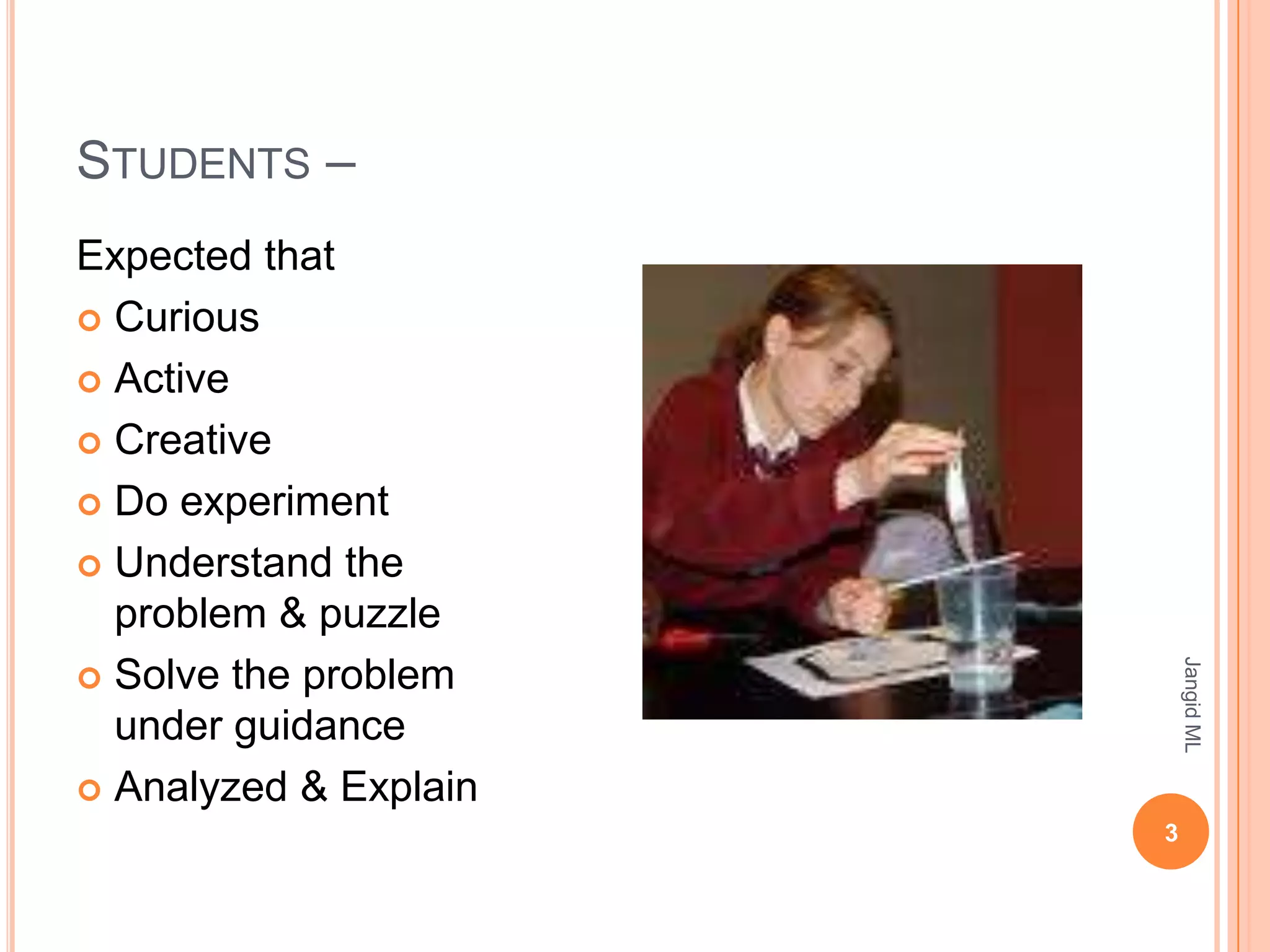
STUDENTS –
Expected that
 Curious

 Active

 Creative

 Do experiment

 Understand the
  problem & puzzle


                           Jangid ML
 Solve the problem
  under guidance
 Analyzed & Explain
                       3
ITM - STEPS
 Objectives
 Syntax
 Social System
 Principles of Reaction
 Support System
 Evaluation
 Application


                                Jangid ML
       Dark as per Joyce   4
SYNTAX
 Phase I     : Confrontation the Problem
 Phase II    : Data gathering - verification
 Phase III   : Data gathering -Experimentation
 Phase IV    : Organizing & Formulating
 Phase V     : Analysis of the inquiry Process


                                                      Jangid ML
                                                  5
SOCIAL SYSTEM
Environment     Role of teacher

 Cooperative    Controller
 Rigorous       Active

 Friendly       Facilitator

 Encourage      Guide

 Interaction    Resourceful

 Open-ended     Helper


                                      Jangid ML
                                  6
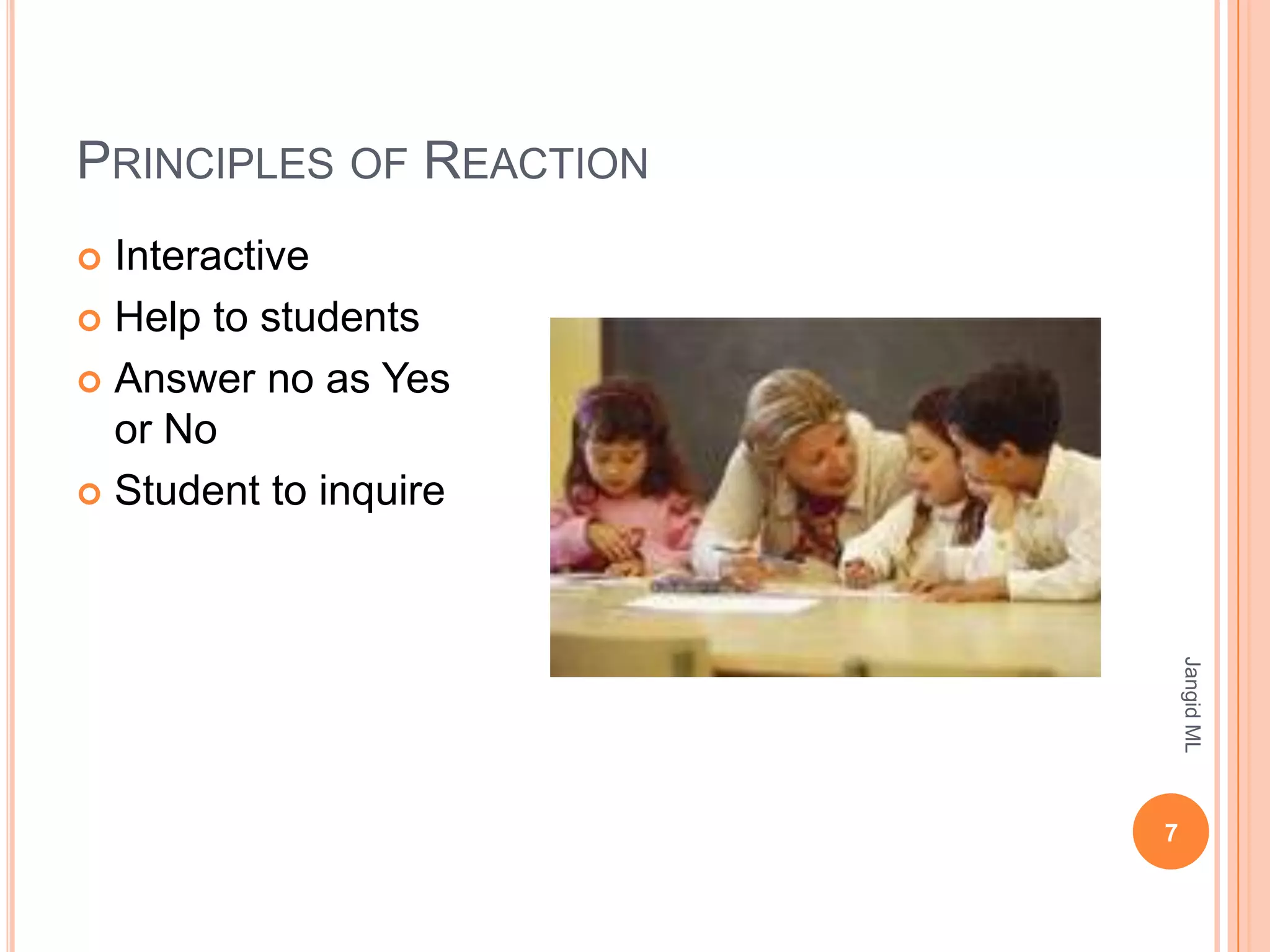
PRINCIPLES OF REACTION
 Interactive
 Help to students

 Answer no as Yes
  or No
 Student to inquire


                             Jangid ML
                         7
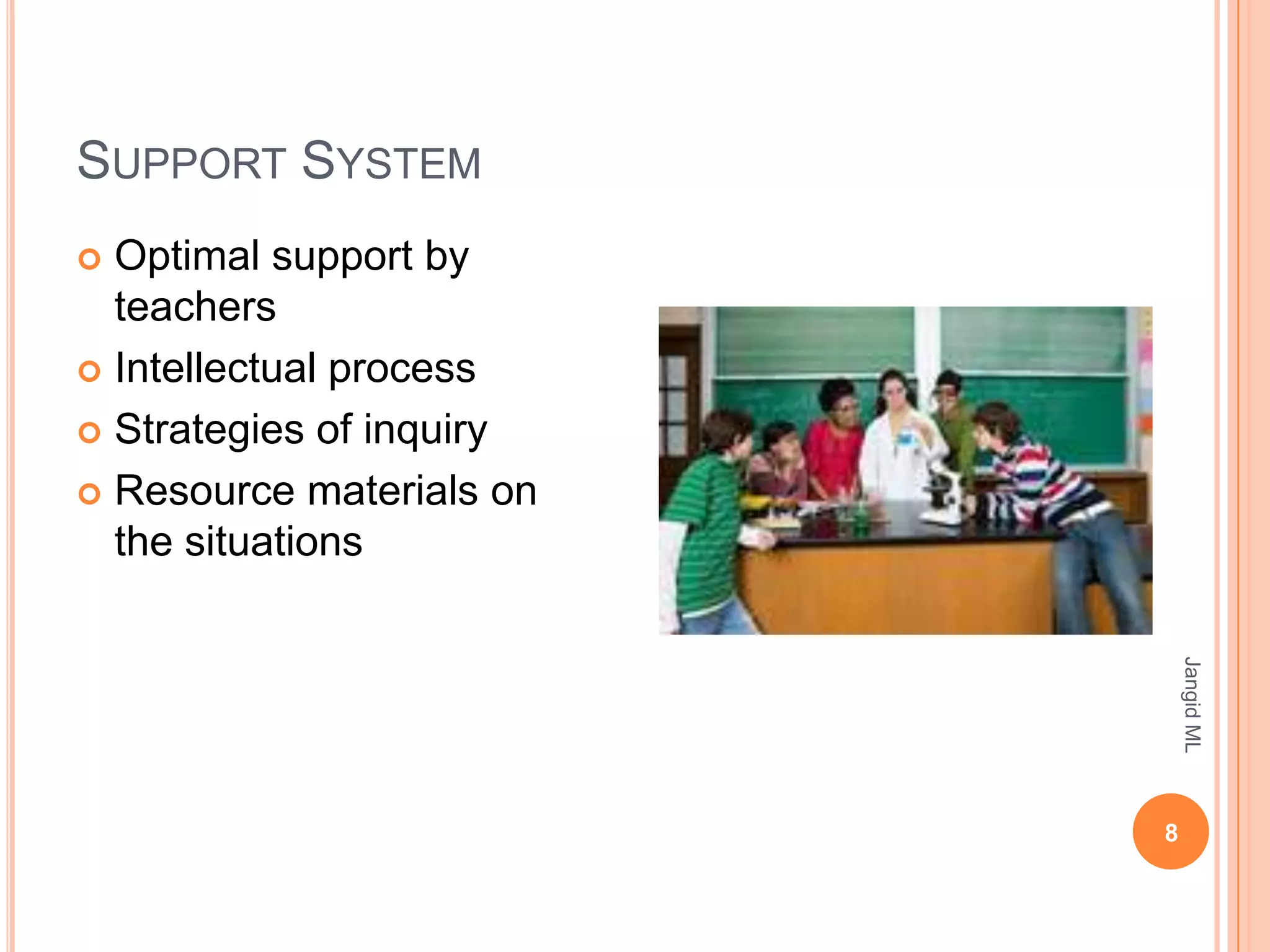
SUPPORT SYSTEM
 Optimal support by
  teachers
 Intellectual process

 Strategies of inquiry

 Resource materials on
  the situations


                              Jangid ML
                          8
ADVANTAGES OF INQUIRY TRAINING MODEL
 Active role of students
 Learning by doing

 Experimental

 Self confident

 Elaborate the problem

 Critical thinking

 Explanations


                                           Jangid ML
                                       9
THANKS !

Inquiry training model by jangid ml

  • 1.
    INQUIRY TRAINING MODEL jangidml@rediff.com
  • 2.
    INTRODUCTION  Developed byRichard Suchman,1962.  The model is useful for investigating & explaining unusual phenomena.  Process including : Puzzle,Motivate,Stategies,Explore,Data,Logical,Co operate, Explanation etc. The general goal of inquiry training is to Jangid ML help students develop intellectual discipline & skills necessary to raise questions & search out answers stemming from curiosity. – Joyce, Weil & Calhoun 2
  • 3.
    STUDENTS – Expected that Curious  Active  Creative  Do experiment  Understand the problem & puzzle Jangid ML  Solve the problem under guidance  Analyzed & Explain 3
  • 4.
    ITM - STEPS Objectives  Syntax  Social System  Principles of Reaction  Support System  Evaluation  Application Jangid ML  Dark as per Joyce 4
  • 5.
    SYNTAX  Phase I : Confrontation the Problem  Phase II : Data gathering - verification  Phase III : Data gathering -Experimentation  Phase IV : Organizing & Formulating  Phase V : Analysis of the inquiry Process Jangid ML 5
  • 6.
    SOCIAL SYSTEM Environment Role of teacher  Cooperative  Controller  Rigorous  Active  Friendly  Facilitator  Encourage  Guide  Interaction  Resourceful  Open-ended  Helper Jangid ML 6
  • 7.
    PRINCIPLES OF REACTION Interactive  Help to students  Answer no as Yes or No  Student to inquire Jangid ML 7
  • 8.
    SUPPORT SYSTEM  Optimalsupport by teachers  Intellectual process  Strategies of inquiry  Resource materials on the situations Jangid ML 8
  • 9.
    ADVANTAGES OF INQUIRYTRAINING MODEL  Active role of students  Learning by doing  Experimental  Self confident  Elaborate the problem  Critical thinking  Explanations Jangid ML 9
  • 10.