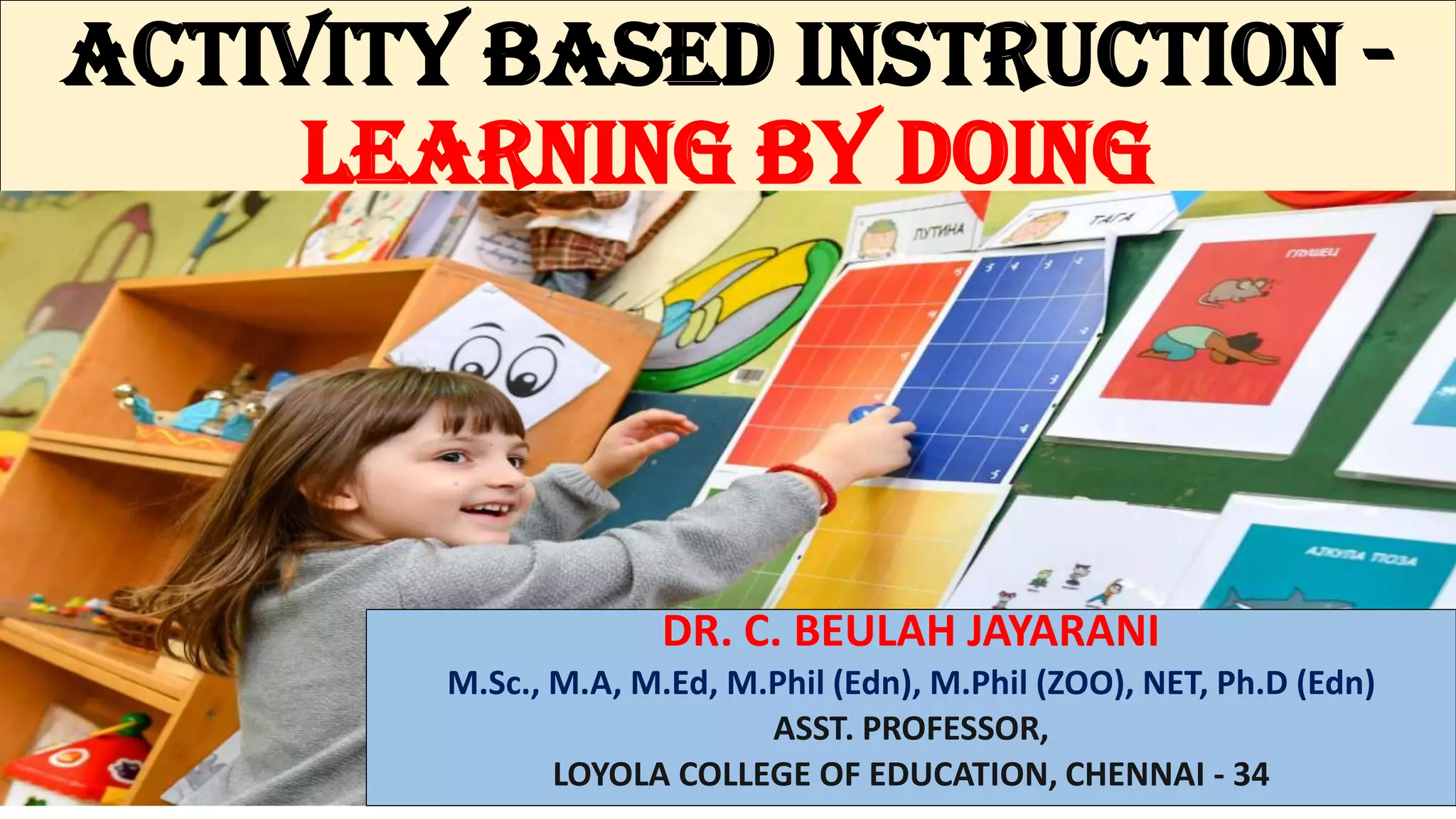
ACTIVITY BASED INSTRUCTION -
LEARNING BY DOING
DR. C. BEULAH JAYARANI
M.Sc., M.A, M.Ed, M.Phil (Edn), M.Phil (ZOO), NET, Ph.D (Edn)
ASST. PROFESSOR,
LOYOLA COLLEGE OF EDUCATION, CHENNAI - 34
INTRODUCTION
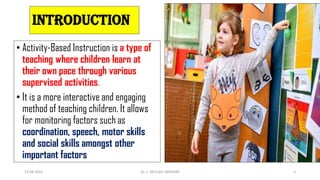
• Activity-Based Instruction is a type of
teaching where children learn at
their own pace through various
supervised activities.
• It is a more interactive and engaging
method of teaching children. It allows
for monitoring factors such as
coordination, speech, motor skills
and social skills amongst other
important factors
13-04-2022 Dr. C. BEULAH JAYARANI 2
Meaning of Activity
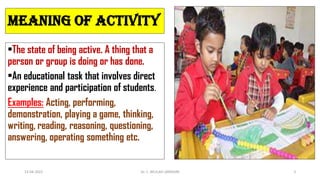
•The state of being active. A thing that a
person or group is doing or has done.
•An educational task that involves direct
experience and participation of students.
Examples: Acting, performing,
demonstration, playing a game, thinking,
writing, reading, reasoning, questioning,
answering, operating something etc.
13-04-2022 Dr. C. BEULAH JAYARANI 3
Meaning of ABI
• An activity or activities used in an
educational process to make students
learn - (Learning through and from
activities as a base).
• Activity based Instruction means that the
teacher incorporates activities of some
type in teaching to make students learn.
13-04-2022 Dr. C. BEULAH JAYARANI 4
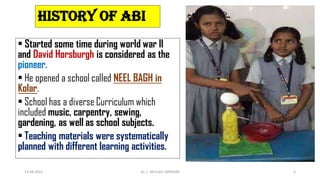
History of ABI
• Started some time during world war II
and David Horsburgh is considered as the
pioneer.
• He opened a school called NEEL BAGH in
Kolar.
• School has a diverse Curriculum which
included music, carpentry, sewing,
gardening, as well as school subjects.
• Teaching materials were systematically
planned with different learning activities.
13-04-2022 Dr. C. BEULAH JAYARANI 5
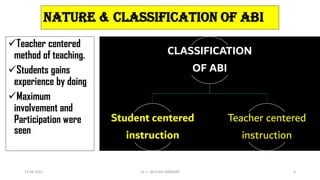
CLASSIFICATION
OF ABI
Student centered
instruction
Teacher centered
instruction
13-04-2022 Dr. C. BEULAH JAYARANI 6
Nature & CLASSIFICATION OF ABI
Teacher centered
method of teaching.
Students gains
experience by doing
Maximum
involvement and
Participation were
seen
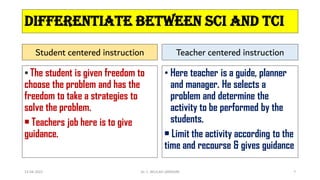
DIFFERENTIATE BETWEEN SCI AND TCI
Student centered instruction
• The student is given freedom to
choose the problem and has the
freedom to take a strategies to
solve the problem.
• Teachers job here is to give
guidance.
Teacher centered instruction
• Here teacher is a guide, planner
and manager. He selects a
problem and determine the
activity to be performed by the
students.
• Limit the activity according to the
time and recourse & gives guidance
13-04-2022 Dr. C. BEULAH JAYARANI 7
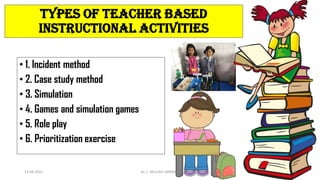
• 1. Incident method
• 2. Case study method
• 3. Simulation
• 4. Games and simulation games
• 5. Role play
• 6. Prioritization exercise
types of teacher based
instructional activities
13-04-2022 Dr. C. BEULAH JAYARANI 8
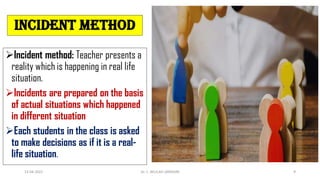
Incident method
Incident method: Teacher presents a
reality which is happening in real life
situation.
Incidents are prepared on the basis
of actual situations which happened
in different situation
Each students in the class is asked
to make decisions as if it is a real-
life situation.
13-04-2022 Dr. C. BEULAH JAYARANI 9
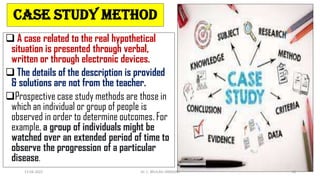
Case study method
 A case related to the real hypothetical
situation is presented through verbal,
written or through electronic devices.
 The details of the description is provided
& solutions are not from the teacher.
Prospective case study methods are those in
which an individual or group of people is
observed in order to determine outcomes. For
example, a group of individuals might be
watched over an extended period of time to
observe the progression of a particular
disease.
13-04-2022 Dr. C. BEULAH JAYARANI 10
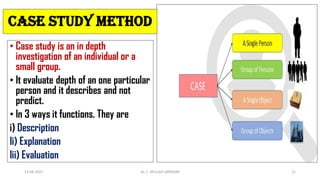
• Case study is an in depth
investigation of an individual or a
small group.
• It evaluate depth of an one particular
person and it describes and not
predict.
• In 3 ways it functions. They are
i) Description
Ii) Explanation
Iii) Evaluation
Case study method
13-04-2022 Dr. C. BEULAH JAYARANI 11
simulation
 Students perform a task in an
artificial situation as similar to the
real situation. This teaching
technique that reproduces actual
events and processes under test
conditions.
 It is a working model reality.
Simulation-based education is an
educational or training method that
is used to “replace or amplify real
experience with guided
experiences”
13-04-2022 Dr. C. BEULAH JAYARANI 12
• A simulation is a way of seeing a thing
happen without it actually taking place
in the same way.
• A simulation can be used to predict
what might happen without doing it, in
case it is dangerous or too expensive
or difficult.
• It can also be used to show people what
will happen next, or what happened in
the past.
simulation
13-04-2022 Dr. C. BEULAH JAYARANI 13
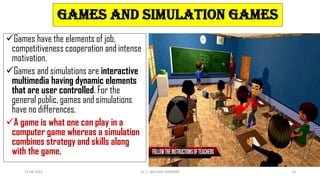
Games and simulation games
Games have the elements of job,
competitiveness cooperation and intense
motivation.
Games and simulations are interactive
multimedia having dynamic elements
that are user controlled. For the
general public, games and simulations
have no differences.
A game is what one can play in a
computer game whereas a simulation
combines strategy and skills along
with the game.
13-04-2022 Dr. C. BEULAH JAYARANI 14
Games and simulations promote
collaborative work as they allow students
to reconstruct and co-construct
knowledge, encouraging problem-solving
through peer discussion and dialogue
It increase students' motivation for
science learning, deepen their
understanding of important science
concepts, improve their science process
skills, and advance other important
learning goals.
13-04-2022 Dr. C. BEULAH JAYARANI 15
Games and simulation games
Role play
Participants are asked to accept
different roles in a learning situation to
act.
Role play is the act of imitating the
character and behaviour of someone
who is different from yourself, for
example as a training exercise.
Group members have to
communicate with each other
through role-play.
13-04-2022 Dr. C. BEULAH JAYARANI 16
Role play exercises give students the
opportunity to assume the role of a
person or act out a given situation.
These roles can be performed by
individual students, in pairs, or in groups
which can play out a more complex
scenario.
It also develops independence,
problem solving skills and have the
opportunity to use new language they
have learned
13-04-2022 Dr. C. BEULAH JAYARANI 17
Role play
Prioritization exercise
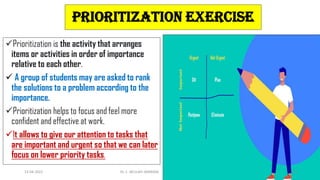
Prioritization is the activity that arranges
items or activities in order of importance
relative to each other.
 A group of students may are asked to rank
the solutions to a problem according to the
importance.
Prioritization helps to focus and feel more
confident and effective at work.
It allows to give our attention to tasks that
are important and urgent so that we can later
focus on lower priority tasks.
13-04-2022 Dr. C. BEULAH JAYARANI 18
CONCLUSION
• Activity Based Instruction is defined as a setup
where students actively participate in the learning
experience rather than sit as passive listeners.
• Activity-based instruction encourages students to
actively participate in their own learning
experience through practically engaging in
activities such as independent investigation
and in learning process students are constantly
engaged.
• It plays an important role in teaching the students
to collaborate, communicate, interact and work
in teams.
• Peers the other learners who are a part of the
social environment contribute to the knowledge
construction by sharing as well as identifying
the affordances within the tasks at hand.
13-04-2022 Dr. C. BEULAH JAYARANI 19
REFERENCES
Boud, D. Feletti, G (1991)The challenge of
problem based learning. New York: St.
Martin’s Press
Learning by Doing: A Guide to
Teaching and Learning Methods
Gibbs, G. (1988) Learning by doing: A
guide to teaching and learning methods.
Further Educational Unit, Oxford
Polytechnic, Oxford.
13-04-2022 Dr. C. BEULAH JAYARANI 20

ACTIVITY BASED INSTRUCTION - Learning by doing.pdf

  • 1.
    ACTIVITY BASED INSTRUCTION- LEARNING BY DOING DR. C. BEULAH JAYARANI M.Sc., M.A, M.Ed, M.Phil (Edn), M.Phil (ZOO), NET, Ph.D (Edn) ASST. PROFESSOR, LOYOLA COLLEGE OF EDUCATION, CHENNAI - 34
  • 2.
    INTRODUCTION • Activity-Based Instructionis a type of teaching where children learn at their own pace through various supervised activities. • It is a more interactive and engaging method of teaching children. It allows for monitoring factors such as coordination, speech, motor skills and social skills amongst other important factors 13-04-2022 Dr. C. BEULAH JAYARANI 2
  • 3.
    Meaning of Activity •Thestate of being active. A thing that a person or group is doing or has done. •An educational task that involves direct experience and participation of students. Examples: Acting, performing, demonstration, playing a game, thinking, writing, reading, reasoning, questioning, answering, operating something etc. 13-04-2022 Dr. C. BEULAH JAYARANI 3
  • 4.
    Meaning of ABI •An activity or activities used in an educational process to make students learn - (Learning through and from activities as a base). • Activity based Instruction means that the teacher incorporates activities of some type in teaching to make students learn. 13-04-2022 Dr. C. BEULAH JAYARANI 4
  • 5.
    History of ABI •Started some time during world war II and David Horsburgh is considered as the pioneer. • He opened a school called NEEL BAGH in Kolar. • School has a diverse Curriculum which included music, carpentry, sewing, gardening, as well as school subjects. • Teaching materials were systematically planned with different learning activities. 13-04-2022 Dr. C. BEULAH JAYARANI 5
  • 6.
    CLASSIFICATION OF ABI Student centered instruction Teachercentered instruction 13-04-2022 Dr. C. BEULAH JAYARANI 6 Nature & CLASSIFICATION OF ABI Teacher centered method of teaching. Students gains experience by doing Maximum involvement and Participation were seen
  • 7.
    DIFFERENTIATE BETWEEN SCIAND TCI Student centered instruction • The student is given freedom to choose the problem and has the freedom to take a strategies to solve the problem. • Teachers job here is to give guidance. Teacher centered instruction • Here teacher is a guide, planner and manager. He selects a problem and determine the activity to be performed by the students. • Limit the activity according to the time and recourse & gives guidance 13-04-2022 Dr. C. BEULAH JAYARANI 7
  • 8.
    • 1. Incidentmethod • 2. Case study method • 3. Simulation • 4. Games and simulation games • 5. Role play • 6. Prioritization exercise types of teacher based instructional activities 13-04-2022 Dr. C. BEULAH JAYARANI 8
  • 9.
    Incident method Incident method:Teacher presents a reality which is happening in real life situation. Incidents are prepared on the basis of actual situations which happened in different situation Each students in the class is asked to make decisions as if it is a real- life situation. 13-04-2022 Dr. C. BEULAH JAYARANI 9
  • 10.
    Case study method A case related to the real hypothetical situation is presented through verbal, written or through electronic devices.  The details of the description is provided & solutions are not from the teacher. Prospective case study methods are those in which an individual or group of people is observed in order to determine outcomes. For example, a group of individuals might be watched over an extended period of time to observe the progression of a particular disease. 13-04-2022 Dr. C. BEULAH JAYARANI 10
  • 11.
    • Case studyis an in depth investigation of an individual or a small group. • It evaluate depth of an one particular person and it describes and not predict. • In 3 ways it functions. They are i) Description Ii) Explanation Iii) Evaluation Case study method 13-04-2022 Dr. C. BEULAH JAYARANI 11
  • 12.
    simulation  Students performa task in an artificial situation as similar to the real situation. This teaching technique that reproduces actual events and processes under test conditions.  It is a working model reality. Simulation-based education is an educational or training method that is used to “replace or amplify real experience with guided experiences” 13-04-2022 Dr. C. BEULAH JAYARANI 12
  • 13.
    • A simulationis a way of seeing a thing happen without it actually taking place in the same way. • A simulation can be used to predict what might happen without doing it, in case it is dangerous or too expensive or difficult. • It can also be used to show people what will happen next, or what happened in the past. simulation 13-04-2022 Dr. C. BEULAH JAYARANI 13
  • 14.
    Games and simulationgames Games have the elements of job, competitiveness cooperation and intense motivation. Games and simulations are interactive multimedia having dynamic elements that are user controlled. For the general public, games and simulations have no differences. A game is what one can play in a computer game whereas a simulation combines strategy and skills along with the game. 13-04-2022 Dr. C. BEULAH JAYARANI 14
  • 15.
    Games and simulationspromote collaborative work as they allow students to reconstruct and co-construct knowledge, encouraging problem-solving through peer discussion and dialogue It increase students' motivation for science learning, deepen their understanding of important science concepts, improve their science process skills, and advance other important learning goals. 13-04-2022 Dr. C. BEULAH JAYARANI 15 Games and simulation games
  • 16.
    Role play Participants areasked to accept different roles in a learning situation to act. Role play is the act of imitating the character and behaviour of someone who is different from yourself, for example as a training exercise. Group members have to communicate with each other through role-play. 13-04-2022 Dr. C. BEULAH JAYARANI 16
  • 17.
    Role play exercisesgive students the opportunity to assume the role of a person or act out a given situation. These roles can be performed by individual students, in pairs, or in groups which can play out a more complex scenario. It also develops independence, problem solving skills and have the opportunity to use new language they have learned 13-04-2022 Dr. C. BEULAH JAYARANI 17 Role play
  • 18.
    Prioritization exercise Prioritization isthe activity that arranges items or activities in order of importance relative to each other.  A group of students may are asked to rank the solutions to a problem according to the importance. Prioritization helps to focus and feel more confident and effective at work. It allows to give our attention to tasks that are important and urgent so that we can later focus on lower priority tasks. 13-04-2022 Dr. C. BEULAH JAYARANI 18
  • 19.
    CONCLUSION • Activity BasedInstruction is defined as a setup where students actively participate in the learning experience rather than sit as passive listeners. • Activity-based instruction encourages students to actively participate in their own learning experience through practically engaging in activities such as independent investigation and in learning process students are constantly engaged. • It plays an important role in teaching the students to collaborate, communicate, interact and work in teams. • Peers the other learners who are a part of the social environment contribute to the knowledge construction by sharing as well as identifying the affordances within the tasks at hand. 13-04-2022 Dr. C. BEULAH JAYARANI 19
  • 20.
    REFERENCES Boud, D. Feletti,G (1991)The challenge of problem based learning. New York: St. Martin’s Press Learning by Doing: A Guide to Teaching and Learning Methods Gibbs, G. (1988) Learning by doing: A guide to teaching and learning methods. Further Educational Unit, Oxford Polytechnic, Oxford. 13-04-2022 Dr. C. BEULAH JAYARANI 20