Inquiry Training ModelInquiry Training Model
Dr. Kiran DammaniDr. Kiran Dammani
PrincipalPrincipal
S.G.S.B.Ed. College,IndoreS.G.S.B.Ed. College,Indore
Developed byDeveloped by
Richard SuchmanRichard Suchman
AssumptionsAssumptions
• An individual has a natural motivation to inquire.
• Students can be taught scientific procedures of
inquiry.
• Convey the attitude that all knowledge is
tentative.
• There is no permanent to solve the problem.
• Student should consider the point of view of
other persons.
• Cooperative inquiry enriches thinking.
• Students are always eager to solve problems.
• Scientific inquiry process require independent
learning and active participation.
3Dr. Kiran Dammani
Instructional EffectInstructional Effect
Scientific Process skills
Strategies for creative inquiries
4Dr. Kiran Dammani
Nurturant effectsNurturant effects
Spirit of creativity
Independence or autonomy in learning
Tolerance of ambiguity
5Dr. Kiran Dammani
SyntaxSyntax
Phase I: Presentation of discrepant event
Phase II: Data gathering - Verification
Phase III: Data gathering –
Experimentation
Phase IV: Formulation of explanation
Phase V: Analysis of inquiry process
6Dr. Kiran Dammani
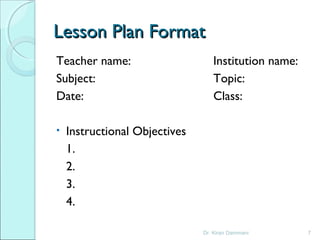
Lesson Plan FormatLesson Plan Format
Teacher name: Institution name:
Subject: Topic:
Date: Class:
• Instructional Objectives
1.
2.
3.
4.
7Dr. Kiran Dammani
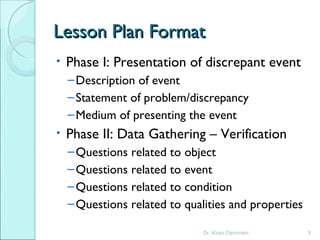
Lesson Plan FormatLesson Plan Format
• Phase I: Presentation of discrepant event
–Description of event
–Statement of problem/discrepancy
–Medium of presenting the event
• Phase II: Data Gathering – Verification
–Questions related to object
–Questions related to event
–Questions related to condition
–Questions related to qualities and properties
8Dr. Kiran Dammani
Lesson Plan FormatLesson Plan Format
• Phase III: Data Gathering – Experimentation
– Questions related to object
– Questions related to event
– Questions related to condition
– Questions related to properties
• Phase IV: Formulation of explanation
– Principle of linear causation
– Principle of properties
– Principle of analogies
– Principle of generalization
9Dr. Kiran Dammani
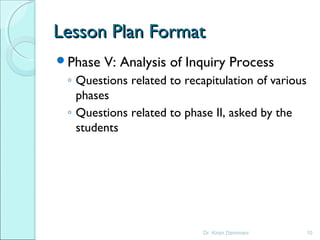
Lesson Plan FormatLesson Plan Format
Phase V: Analysis of Inquiry Process
◦ Questions related to recapitulation of various
phases
◦ Questions related to phase II, asked by the
students
10Dr. Kiran Dammani
WorksheetWorksheet
Name of the student: Class:
Teacher name: Name of the institute:
Subject: Topic:
Data Gathering – Verification Data Gathering – Experimentation
Questions Answers Questions Answers
1.
2.
3.
4.
5.
6.
7.
8.
1.
2.
3.
4.
5.
6.
7.
8.
11Dr. Kiran Dammani
Explanation………………………………
……………………………………………
……………………………………………
…
Principle and reason…………………...
………………… ............................................
..............................
12Dr. Kiran Dammani

Inquiry training model [compatible]

  • 1.
    Inquiry Training ModelInquiryTraining Model Dr. Kiran DammaniDr. Kiran Dammani PrincipalPrincipal S.G.S.B.Ed. College,IndoreS.G.S.B.Ed. College,Indore
  • 2.
    Developed byDeveloped by RichardSuchmanRichard Suchman
  • 3.
    AssumptionsAssumptions • An individualhas a natural motivation to inquire. • Students can be taught scientific procedures of inquiry. • Convey the attitude that all knowledge is tentative. • There is no permanent to solve the problem. • Student should consider the point of view of other persons. • Cooperative inquiry enriches thinking. • Students are always eager to solve problems. • Scientific inquiry process require independent learning and active participation. 3Dr. Kiran Dammani
  • 4.
    Instructional EffectInstructional Effect ScientificProcess skills Strategies for creative inquiries 4Dr. Kiran Dammani
  • 5.
    Nurturant effectsNurturant effects Spiritof creativity Independence or autonomy in learning Tolerance of ambiguity 5Dr. Kiran Dammani
  • 6.
    SyntaxSyntax Phase I: Presentationof discrepant event Phase II: Data gathering - Verification Phase III: Data gathering – Experimentation Phase IV: Formulation of explanation Phase V: Analysis of inquiry process 6Dr. Kiran Dammani
  • 7.
    Lesson Plan FormatLessonPlan Format Teacher name: Institution name: Subject: Topic: Date: Class: • Instructional Objectives 1. 2. 3. 4. 7Dr. Kiran Dammani
  • 8.
    Lesson Plan FormatLessonPlan Format • Phase I: Presentation of discrepant event –Description of event –Statement of problem/discrepancy –Medium of presenting the event • Phase II: Data Gathering – Verification –Questions related to object –Questions related to event –Questions related to condition –Questions related to qualities and properties 8Dr. Kiran Dammani
  • 9.
    Lesson Plan FormatLessonPlan Format • Phase III: Data Gathering – Experimentation – Questions related to object – Questions related to event – Questions related to condition – Questions related to properties • Phase IV: Formulation of explanation – Principle of linear causation – Principle of properties – Principle of analogies – Principle of generalization 9Dr. Kiran Dammani
  • 10.
    Lesson Plan FormatLessonPlan Format Phase V: Analysis of Inquiry Process ◦ Questions related to recapitulation of various phases ◦ Questions related to phase II, asked by the students 10Dr. Kiran Dammani
  • 11.
    WorksheetWorksheet Name of thestudent: Class: Teacher name: Name of the institute: Subject: Topic: Data Gathering – Verification Data Gathering – Experimentation Questions Answers Questions Answers 1. 2. 3. 4. 5. 6. 7. 8. 1. 2. 3. 4. 5. 6. 7. 8. 11Dr. Kiran Dammani
  • 12.