SOCIAL INQUIRY
MODEL OF
TEACHING
SOCIAL
INQUIRY
MODEL
KANWARJEET KAUR NANGLI
M .ED SEM IV
EDUCATION DEPARTMENT
GURU NANAK DEV
UNIVERSITY AMRITSAR
THE SOCIAL INTERACTION TEACHING
MODEL :
The teaching models of this family aim to develop
social efficiency among the pupils . The social
interaction sources emphasize the relationship
between the persons and his society.
THE MODELS BELONGING TO THIS FAMILY :
 GROUP INVESTIGATION MODEL
 ROLE PLAYING MODEL
 JURISPRUDENTIAL INQUIRY MODEL
 LAB TRAINING MODEL
 SOCIAL STIMULATION MODEL
 SOCIAL INQUIRY MODEL
THE SOCIAL INQUIRY MODEL :
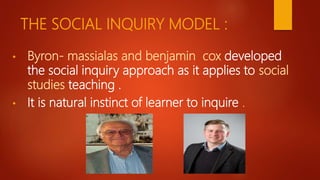
• Byron- massialas and benjamin cox developed
the social inquiry approach as it applies to social
studies teaching .
• It is natural instinct of learner to inquire .
Hilda Taba utilised this
academic feature of inquiry
to develop “the inductive
model of teaching’’.
Richard Suchman used the
same concept of inquiry to
develop “the inquiry training
model “to teach science
subject
For teaching via social inquiry model , MASSIALAS
and cox stressed on 3 characteristics of a reflective
classroom :
 open climate of discussion
 hypothesis as the focus of inquiry
 use of facts and evidence
PHASES OF SOCIAL INQUIRY MODEL :
Phase 1 Orientation
Phase 2 Hypothesis
Phase 3 Definition
Phase 4 Exploration
Phase 5 Evidencing
Phase 6 Generalization
ASPECTS OF SOCIAL INQUIRY MODEL :
1. FOCUS
 main objective is to develop social and cultural
characteristics among students.
 second focus is to generate reflective classroom
environment
2. SYNTAX: MODEL CONSISTS OF 6
PHASES
PHASE 1 orientation of a problem and development of a general statement of
a problem.
PHASE 2 hypothesis are developed ,which can guide to inquiry.
PHASE 3 definitions of terms in the hypothesis.
PHASE 4 verification of hypothesis in terms of their logical validity.
PHASE 5 collecting evidences and facts for verification of hypothesis.
PHASE 6 generalization or statements for the solution of the problem.
PHASE I :
The teacher introduces to the students the case ,
which may be a historical event or a political event or
narrate a story depicting a social issue/cause , show a
film highlighting a social evil and so on .
PHASE II :
Students synthesize the facts and organize them
into a policy issue . They bring out the values
inherent in the issue like freedom of speech or
freedom of religion and also bring out conflicting
values .
PHASE III :
Students state their own stand on the issue ,
which is based on reasoning .
PHASE IV :
The questions raised by students are further
discussed , debated and argued in the group . The
student can be confronted and probed by teachers
and peer group .
PHASE V :
Students further refine their positions by
restating and clarifying the stand taken and give
reasons .
PHASE VI :
Their positions are further tested by identifying
and examining the underlying factual assumptions
.
3. SOCIAL SYSTEM :
It is moderately structured .The teacher is more
active and is generally initiator of inquiry and
observes that pupils move phase to phase .
Students are responsible for its developments and
the social norms .There is an open discussion among
equals .
4. SUPPORT SYSTEM :
In this teaching model,problem solving approach is
used , open –ended library-resources and access by
experts opinions are needed . The main resources for
evidence are utilized so that hypothesis may be
tested.
4 CLASSROOM APPLICATION :
A social studies class may be oriented by a problem. it
helps the learning to examine certain facts on the basis
of evidences. The syntax of this model is based upon
scientific and reflective thinking. Thus, it provides an
opportunity to the students to develop scientific attitude
for finding out the solution of a problem.
Social inquiry model of teaching ppt