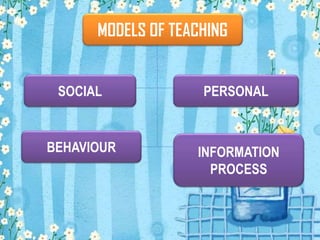
Concepts:
Information Processing Model
Behavioural Model
Social Model
Personal Model
What is Teaching Model?
A model of teaching is a plan or
pattern that can be used to
shape curriculums (long-term
courses of studies), to design
instructional materials, and to
guide instruction in the
classroom and other settings
based on Joyce and Weil
(1980).
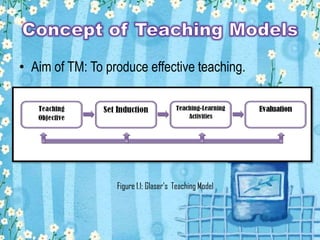
• Aim of TM: To produce effective teaching.

Figure 1.1: Glaser’s Teaching Model
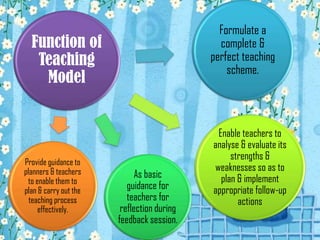
Formulate a
complete &
perfect teaching
scheme.

Function of
Teaching
Model

Provide guidance to
planners & teachers
to enable them to
plan & carry out the
teaching process
effectively.

As basic
guidance for
teachers for
reflection during
feedback session.

Enable teachers to
analyse & evaluate its
strengths &
weaknesses so as to
plan & implement
appropriate follow-up
actions
MODELS OF TEACHING
SOCIAL

PERSONAL

BEHAVIOUR

INFORMATION
PROCESS
Information
Processing
Model
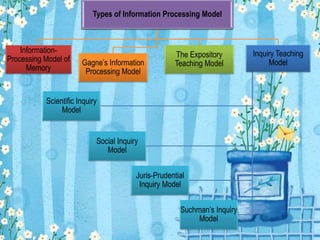
Types of Information Processing Model

InformationProcessing Model of
Memory

Gagne’s Information
Processing Model

The Expository
Teaching Model

Scientific Inquiry
Model

Social Inquiry
Model
Juris-Prudential
Inquiry Model
Suchman’s Inquiry
Model

Inquiry Teaching
Model
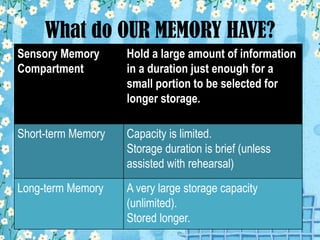
What do OUR MEMORY HAVE?
Sensory Memory
Compartment

Hold a large amount of information
in a duration just enough for a
small portion to be selected for
longer storage.

Short-term Memory

Capacity is limited.
Storage duration is brief (unless
assisted with rehearsal)

Long-term Memory

A very large storage capacity
(unlimited).
Stored longer.
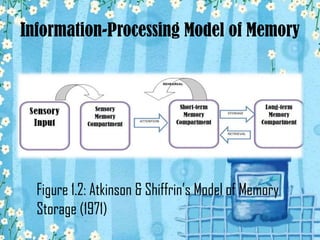
Information-Processing Model of Memory

Figure 1.2: Atkinson & Shiffrin’s Model of Memory
Storage (1971)
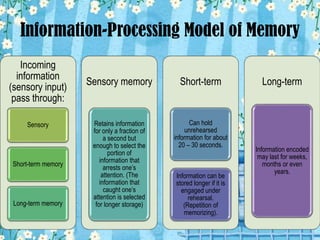
Information-Processing Model of Memory
Incoming
information
(sensory input)
pass through:
Sensory

Short-term memory

Long-term memory

Sensory memory

Short-term

Retains information
for only a fraction of
a second but
enough to select the
portion of
information that
arrests one’s
attention. (The
information that
caught one’s
attention is selected
for longer storage)

Can hold
unrehearsed
information for about
20 – 30 seconds.

Information can be
stored longer if it is
engaged under
rehearsal.
(Repetition of
memorizing).

Long-term

Information encoded
may last for weeks,
months or even
years.
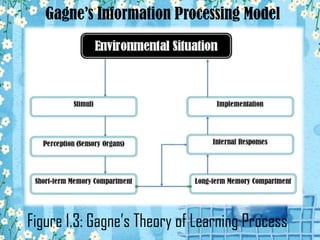
Gagne’s Information Processing Model

Figure 1.3: Gagne’s Theory of Learning Process
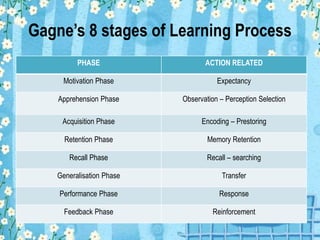
Gagne’s 8 stages of Learning Process
PHASE

ACTION RELATED

Motivation Phase

Expectancy

Apprehension Phase

Observation – Perception Selection

Acquisition Phase

Encoding – Prestoring

Retention Phase

Memory Retention

Recall Phase

Recall – searching

Generalisation Phase

Transfer

Performance Phase

Response

Feedback Phase

Reinforcement
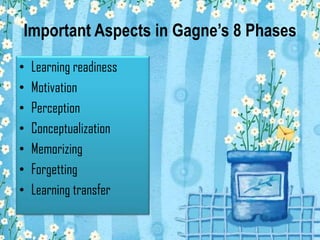
Important Aspects in Gagne’s 8 Phases
•
•
•
•
•
•
•

Learning readiness
Motivation
Perception
Conceptualization
Memorizing
Forgetting
Learning transfer
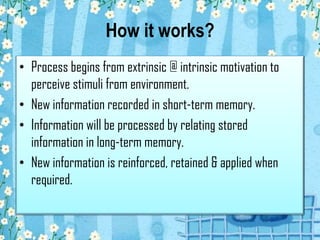
How it works?
• Process begins from extrinsic @ intrinsic motivation to
perceive stimuli from environment.
• New information recorded in short-term memory.
• Information will be processed by relating stored
information in long-term memory.
• New information is reinforced, retained & applied when
required.
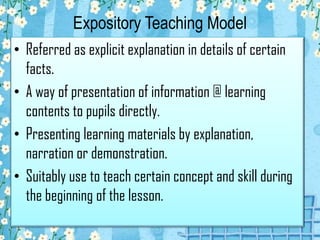
Expository Teaching Model
• Referred as explicit explanation in details of certain
facts.
• A way of presentation of information @ learning
contents to pupils directly.
• Presenting learning materials by explanation,
narration or demonstration.
• Suitably use to teach certain concept and skill during
the beginning of the lesson.
..continue..
• Principle and concept are explained
verbally, as all the facts are written on
the board, showed on the screen.
• Time saving: Enables teacher to finish all
related concepts in a shorter period &
pupils merely listen quietly.
• More to a lecturing method. (Less
effective for primary schools).
Inquiry Teaching Model
• Scientific Inquiry Model:
–Used to study principles, phenomena &
characteristics of scientific knowledge.
–Research process based on 5 stages:
• Identify the problem.
• Ascertain relevant information.
• Determine hypothesis.
• Testing hypothesis.
• Evaluate, interpret, infer & conclude.
• Social Inquiry Model:
– Used to study topics related to social & humanity aspects.
– Based on activities such as observation, interview, @
questionnaire.
– Emphasizes on social interaction process.
– 6 steps:
•
•
•
•
•
•

Formulation of problem by teacher.
Formulation of hypothesis by pupils.
Define hypothesis.
Discuss & confirm validity of the hypothesis.
Collect & analyse evidences for the hypothesis.
Interpret & derive inference @ conclusion.
• Juris-prudential Inquiry Model:
– Used to look for reality & accuracy in current issues
(learning science is more useful than learning arts).
– Concerns with science & philosophy of human law.
– Based on activities, discussions and debates.
– Two types:
• Guided inquiry: Teacher guides pupils to carry out the whole
discussion process.
• Open Inquiry: No guidelines given. Students have to do the
discussion themselves.
• Suchman’s Inquiry Model:
– Based on assumption that strategies used by scientists can be
used as a teaching model especially in the study of science.
– Procedures:
• Teacher determines & indicates the problem.
• Teacher explains the inquiry process to solve the previous problem.
• Students are guided to form hypothesis, follows by the collection of
relevant data.
• Students use collected data to test hypothesis, aim to formulate
theorem, law, principle or theory.
• Discussion & making inferences.
• Teacher & students discuss together and analyse.
The Importance of Information
Processing Model
• Students are prepared with better equipments and
information for learning.
• Students are enforced with good mental exercises through
different methods and approaches.
• Students are informed of the objectives and learning
outcomes that should be achieved.
• Help students to remember the information for a longer
period of time.
Behavioural
Model
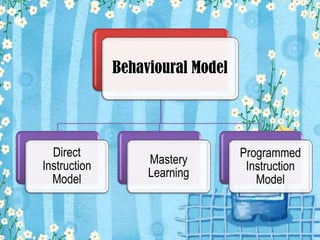
Behavioural Model

Direct
Instruction
Model

Mastery
Learning

Programmed
Instruction
Model
Direct Instruction Model
• Demonstration:
– A teaching technique involves the use of a teacher’s skill to
demonstrate @ perform a certain activity in the class.
– Teacher has a strong control over what is learnt in the
classroom, provides feedback, monitoring students, grading
work and strict classroom rules & regulations. (Teachercentered).
Mastery learning
• Refers to a theory & practice of using remedial teaching based on
feedback of pupil’s performance to assist them to achieve the learning
objectives.
• Procedures:
– Determine learning outcomes by planning explicit learning objective (based
on students’ performance).
– Teach pupils with effective teaching method & technique (use of suitable
learning materials to suit different learning styles)
– Evaluate learning result by diagnostic test & summative test (level of
mastering & achievement)
– Carry out remedial activities for pupils who have not fully mastered certain
skills & provide enrichment activities for pupils who have mastered the
lesson.
Programmed Instruction Model
• Computer Assisted Instruction (CIA)
– The application of technology & computer system in
teaching.
– Pupils follow designed learning materials in software
without teacher’s help.
– Teacher has to facilitate the pupils to have interest in
manipulating computer.
Personal
Model
Personal Model
• Non-directive Teaching Model
• Developing Positive Self-concepts
• Project Model
– Research Project
– Handicraft Project
– Educational Visit
Non-directive Teaching Model
• Based on Carl Rogers’ work, he
believes that positive human
relationships enable people to
grow.
• Therefore instruction should be
based on concepts of human
relations.
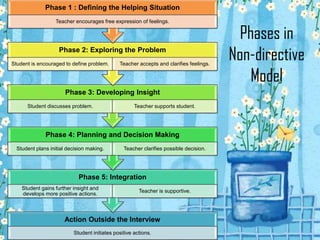
Phase 1 : Defining the Helping Situation
Teacher encourages free expression of feelings.

Phase 2: Exploring the Problem
Student is encouraged to define problem.

Teacher accepts and clarifies feelings.

Phase 3: Developing Insight
Student discusses problem.

Teacher supports student.

Phase 4: Planning and Decision Making
Student plans initial decision making.

Teacher clarifies possible decision.

Phase 5: Integration
Student gains further insight and
develops more positive actions.

Teacher is supportive.

Action Outside the Interview
Student initiates positive actions.

Phases in
Non-directive
Model
The Importance of Non-directive
Teaching Model
•
•
•
•
•

Teacher helps students to explore new ideas.
Students have freedom to making decisions and choices.
Teacher and students are partners in learning.
Nurtures and moulds students to be the way they are.
Encourages students to think and reflect their uncertain
feelings and become better and be positive.
Developing Positive Self-concepts
• Appreciate the abilities and talents one
possesses.
• Positive self-concepts evolves with the
moral values that should be emphasised
among students.
• Activities that help: Group/Individual
Presentation, musical performances,
stage performances.
The Importance of Positive Self-concepts
• Gain knowledge and experiences by
enhancing their interests in learning
through self-concepts.
• Teacher shows positive approaches
and optimistic reinforcements.
• Boost their confidence.
• Provide opportunities for students to
express their ideas and listen to
other’s opinions.
Project Model
• Based on the belief that learning would be
effective if pupils are interested and ready
to carry out learning activities.
• Examples of Project Model:
– Research Project.
– Handicraft Project.
– Educational Visit.
1. Research Project (Principles)
• Teacher determines suitable research
topic in accordance to the pupils’
experience, ability and interest.
• Aims and procedures must be determined
first and pupils are informed about this.
• Teacher prepares relevant materials
(check list, questions to be answered, etc.)
to facilitate pupils.
Continued…
• Research should be carried out safely
& every pupil should actively involve in
group activities.
• Teacher supervises and provides
guidance to pupils.
• Teacher discusses the outcomes of
research & evaluation should be
conducted after research is
completed.
2. Handicraft Project (Principles)
• Planning of the project is based on pupils’
interest and ability.
• Prepare sufficient materials.
• Explain procedure precisely.
• Show examples of correct ways to do the
project.
• Time period is required!
• Discussion is carried out to assess the work
when it is done.
• Display good quality work to the other
students.
3. Educational Visit (Principles)
• Before the Visit:
– Identify the place of visit.
– Obtain permission.
– Arrange for transport.
– Conduct briefing session regarding safety,
precautions, behaviours, aims of visit and
regulations.
– Prepare sufficient equipments.
….continued
• During the Visit:
– Divide pupils into several small groups.
– Every pupil should actively involve.
– Watch out for pupils’ safety.
– Give appropriate response to pupils’ inquiry.

• After the Visit:
– Hold discussion session with pupils regarding their
observations.
– Plan follow-up activity (making model, draw plan
or model, display things)
The Importance of Project Model
• Students able to relate their previous experiences to what
they are studying.
• Able to understand objectives of the projects before and after
lesson.
• Fun activities that attract students’ interests in learning more
& apply what they have learnt.
• Moral values are applied.
• Theories, facts & hypotheses are brought into practices (I do,
I remember & understand).
• Co-operations among students.
• Direct experiences & additional knowledge.
Social
Model
Social Model

• Model of Group Teaching & Co-operative
Learning
• Simulation Model
–Sociodrama
–Role play
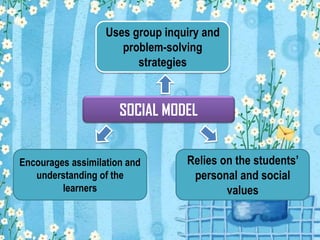
Uses group inquiry and
problem-solving
strategies

SOCIAL MODEL
Encourages assimilation and
understanding of the
learners

Relies on the students’
personal and social
values
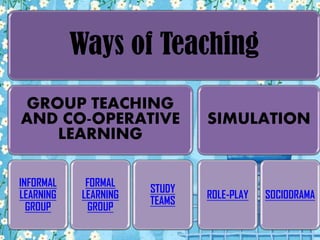
Ways of Teaching
GROUP TEACHING
AND CO-OPERATIVE
LEARNING

SIMULATION

INFORMAL
LEARNING
GROUP

ROLE-PLAY

FORMAL
LEARNING
GROUP

STUDY
TEAMS

SOCIODRAMA
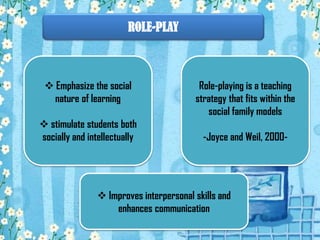
ROLE-PLAY

 Emphasize the social
nature of learning

 stimulate students both
socially and intellectually

Role-playing is a teaching
strategy that fits within the
social family models
-Joyce and Weil, 2000-

 Improves interpersonal skills and
enhances communication
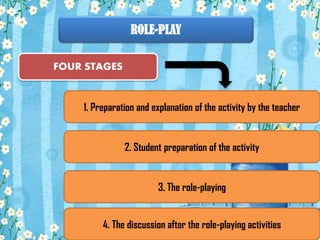
ROLE-PLAY
FOUR STAGES

1. Preparation and explanation of the activity by the teacher

2. Student preparation of the activity

3. The role-playing
4. The discussion after the role-playing activities
SOCIODRAMA

More like an acting activity
Based on a story which reflects a certain situation
involving conflicting issue, for example, Hang Tuah and

Hang Jebat

Script should be prepared earlier
Next
ADVANTAGES

Helps them to become aware of the typical ways
they solve problems
Increases both social and personal awareness

Promote acceptance, cooperation in classroom
Back
Informal learning group

Basically
temporary within a
single class
session
Formal learning group
Being formed to complete
a specific tasks, such as
to carry a project,
performing a lab
experiment, etc
Study Teams

Long-term
groups with a
stable
membership
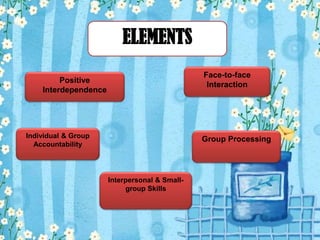
ELEMENTS
Face-to-face
Interaction

Positive
Interdependence

Individual & Group
Accountability

Group Processing

Interpersonal & Smallgroup Skills
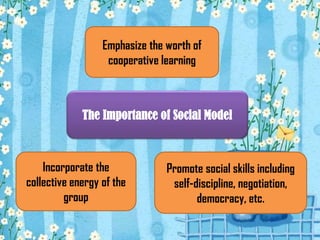
Emphasize the worth of
cooperative learning

The Importance of Social Model

Incorporate the
collective energy of the
group

Promote social skills including
self-discipline, negotiation,
democracy, etc.
Teaching
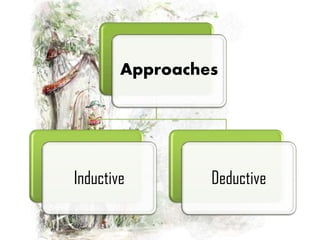
Approaches
Approaches

Inductive

Deductive
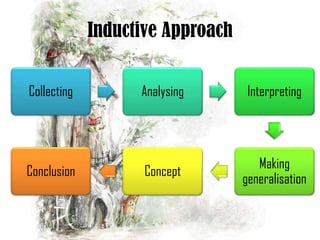
Inductive Approach
Collecting

Conclusion

Analysing

Interpreting

Concept

Making
generalisation
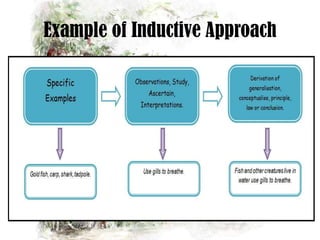
Example of Inductive Approach
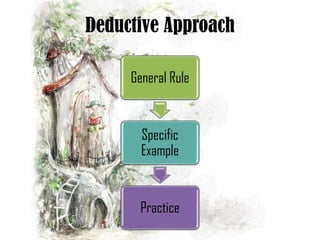
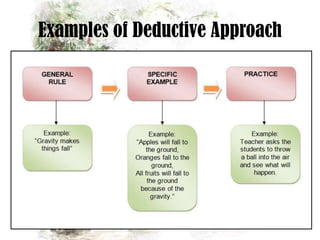
Deductive Approach
General Rule

Specific
Example

Practice
Examples of Deductive Approach
Any
questions?

Presented by:
Aileen
Yohanieca

Models of teaching

  • 1.
    Concepts: Information Processing Model BehaviouralModel Social Model Personal Model
  • 2.
    What is TeachingModel? A model of teaching is a plan or pattern that can be used to shape curriculums (long-term courses of studies), to design instructional materials, and to guide instruction in the classroom and other settings based on Joyce and Weil (1980).
  • 3.
    • Aim ofTM: To produce effective teaching. Figure 1.1: Glaser’s Teaching Model
  • 4.
    Formulate a complete & perfectteaching scheme. Function of Teaching Model Provide guidance to planners & teachers to enable them to plan & carry out the teaching process effectively. As basic guidance for teachers for reflection during feedback session. Enable teachers to analyse & evaluate its strengths & weaknesses so as to plan & implement appropriate follow-up actions
  • 5.
  • 6.
  • 7.
    Types of InformationProcessing Model InformationProcessing Model of Memory Gagne’s Information Processing Model The Expository Teaching Model Scientific Inquiry Model Social Inquiry Model Juris-Prudential Inquiry Model Suchman’s Inquiry Model Inquiry Teaching Model
  • 8.
    What do OURMEMORY HAVE? Sensory Memory Compartment Hold a large amount of information in a duration just enough for a small portion to be selected for longer storage. Short-term Memory Capacity is limited. Storage duration is brief (unless assisted with rehearsal) Long-term Memory A very large storage capacity (unlimited). Stored longer.
  • 9.
    Information-Processing Model ofMemory Figure 1.2: Atkinson & Shiffrin’s Model of Memory Storage (1971)
  • 10.
    Information-Processing Model ofMemory Incoming information (sensory input) pass through: Sensory Short-term memory Long-term memory Sensory memory Short-term Retains information for only a fraction of a second but enough to select the portion of information that arrests one’s attention. (The information that caught one’s attention is selected for longer storage) Can hold unrehearsed information for about 20 – 30 seconds. Information can be stored longer if it is engaged under rehearsal. (Repetition of memorizing). Long-term Information encoded may last for weeks, months or even years.
  • 11.
    Gagne’s Information ProcessingModel Figure 1.3: Gagne’s Theory of Learning Process
  • 12.
    Gagne’s 8 stagesof Learning Process PHASE ACTION RELATED Motivation Phase Expectancy Apprehension Phase Observation – Perception Selection Acquisition Phase Encoding – Prestoring Retention Phase Memory Retention Recall Phase Recall – searching Generalisation Phase Transfer Performance Phase Response Feedback Phase Reinforcement
  • 13.
    Important Aspects inGagne’s 8 Phases • • • • • • • Learning readiness Motivation Perception Conceptualization Memorizing Forgetting Learning transfer
  • 14.
    How it works? •Process begins from extrinsic @ intrinsic motivation to perceive stimuli from environment. • New information recorded in short-term memory. • Information will be processed by relating stored information in long-term memory. • New information is reinforced, retained & applied when required.
  • 15.
    Expository Teaching Model •Referred as explicit explanation in details of certain facts. • A way of presentation of information @ learning contents to pupils directly. • Presenting learning materials by explanation, narration or demonstration. • Suitably use to teach certain concept and skill during the beginning of the lesson.
  • 16.
    ..continue.. • Principle andconcept are explained verbally, as all the facts are written on the board, showed on the screen. • Time saving: Enables teacher to finish all related concepts in a shorter period & pupils merely listen quietly. • More to a lecturing method. (Less effective for primary schools).
  • 17.
    Inquiry Teaching Model •Scientific Inquiry Model: –Used to study principles, phenomena & characteristics of scientific knowledge. –Research process based on 5 stages: • Identify the problem. • Ascertain relevant information. • Determine hypothesis. • Testing hypothesis. • Evaluate, interpret, infer & conclude.
  • 18.
    • Social InquiryModel: – Used to study topics related to social & humanity aspects. – Based on activities such as observation, interview, @ questionnaire. – Emphasizes on social interaction process. – 6 steps: • • • • • • Formulation of problem by teacher. Formulation of hypothesis by pupils. Define hypothesis. Discuss & confirm validity of the hypothesis. Collect & analyse evidences for the hypothesis. Interpret & derive inference @ conclusion.
  • 19.
    • Juris-prudential InquiryModel: – Used to look for reality & accuracy in current issues (learning science is more useful than learning arts). – Concerns with science & philosophy of human law. – Based on activities, discussions and debates. – Two types: • Guided inquiry: Teacher guides pupils to carry out the whole discussion process. • Open Inquiry: No guidelines given. Students have to do the discussion themselves.
  • 20.
    • Suchman’s InquiryModel: – Based on assumption that strategies used by scientists can be used as a teaching model especially in the study of science. – Procedures: • Teacher determines & indicates the problem. • Teacher explains the inquiry process to solve the previous problem. • Students are guided to form hypothesis, follows by the collection of relevant data. • Students use collected data to test hypothesis, aim to formulate theorem, law, principle or theory. • Discussion & making inferences. • Teacher & students discuss together and analyse.
  • 21.
    The Importance ofInformation Processing Model • Students are prepared with better equipments and information for learning. • Students are enforced with good mental exercises through different methods and approaches. • Students are informed of the objectives and learning outcomes that should be achieved. • Help students to remember the information for a longer period of time.
  • 22.
  • 23.
  • 24.
    Direct Instruction Model •Demonstration: – A teaching technique involves the use of a teacher’s skill to demonstrate @ perform a certain activity in the class. – Teacher has a strong control over what is learnt in the classroom, provides feedback, monitoring students, grading work and strict classroom rules & regulations. (Teachercentered).
  • 25.
    Mastery learning • Refersto a theory & practice of using remedial teaching based on feedback of pupil’s performance to assist them to achieve the learning objectives. • Procedures: – Determine learning outcomes by planning explicit learning objective (based on students’ performance). – Teach pupils with effective teaching method & technique (use of suitable learning materials to suit different learning styles) – Evaluate learning result by diagnostic test & summative test (level of mastering & achievement) – Carry out remedial activities for pupils who have not fully mastered certain skills & provide enrichment activities for pupils who have mastered the lesson.
  • 26.
    Programmed Instruction Model •Computer Assisted Instruction (CIA) – The application of technology & computer system in teaching. – Pupils follow designed learning materials in software without teacher’s help. – Teacher has to facilitate the pupils to have interest in manipulating computer.
  • 27.
  • 28.
    Personal Model • Non-directiveTeaching Model • Developing Positive Self-concepts • Project Model – Research Project – Handicraft Project – Educational Visit
  • 29.
    Non-directive Teaching Model •Based on Carl Rogers’ work, he believes that positive human relationships enable people to grow. • Therefore instruction should be based on concepts of human relations.
  • 30.
    Phase 1 :Defining the Helping Situation Teacher encourages free expression of feelings. Phase 2: Exploring the Problem Student is encouraged to define problem. Teacher accepts and clarifies feelings. Phase 3: Developing Insight Student discusses problem. Teacher supports student. Phase 4: Planning and Decision Making Student plans initial decision making. Teacher clarifies possible decision. Phase 5: Integration Student gains further insight and develops more positive actions. Teacher is supportive. Action Outside the Interview Student initiates positive actions. Phases in Non-directive Model
  • 31.
    The Importance ofNon-directive Teaching Model • • • • • Teacher helps students to explore new ideas. Students have freedom to making decisions and choices. Teacher and students are partners in learning. Nurtures and moulds students to be the way they are. Encourages students to think and reflect their uncertain feelings and become better and be positive.
  • 32.
    Developing Positive Self-concepts •Appreciate the abilities and talents one possesses. • Positive self-concepts evolves with the moral values that should be emphasised among students. • Activities that help: Group/Individual Presentation, musical performances, stage performances.
  • 33.
    The Importance ofPositive Self-concepts • Gain knowledge and experiences by enhancing their interests in learning through self-concepts. • Teacher shows positive approaches and optimistic reinforcements. • Boost their confidence. • Provide opportunities for students to express their ideas and listen to other’s opinions.
  • 34.
    Project Model • Basedon the belief that learning would be effective if pupils are interested and ready to carry out learning activities. • Examples of Project Model: – Research Project. – Handicraft Project. – Educational Visit.
  • 35.
    1. Research Project(Principles) • Teacher determines suitable research topic in accordance to the pupils’ experience, ability and interest. • Aims and procedures must be determined first and pupils are informed about this. • Teacher prepares relevant materials (check list, questions to be answered, etc.) to facilitate pupils.
  • 36.
    Continued… • Research shouldbe carried out safely & every pupil should actively involve in group activities. • Teacher supervises and provides guidance to pupils. • Teacher discusses the outcomes of research & evaluation should be conducted after research is completed.
  • 37.
    2. Handicraft Project(Principles) • Planning of the project is based on pupils’ interest and ability. • Prepare sufficient materials. • Explain procedure precisely. • Show examples of correct ways to do the project. • Time period is required! • Discussion is carried out to assess the work when it is done. • Display good quality work to the other students.
  • 38.
    3. Educational Visit(Principles) • Before the Visit: – Identify the place of visit. – Obtain permission. – Arrange for transport. – Conduct briefing session regarding safety, precautions, behaviours, aims of visit and regulations. – Prepare sufficient equipments.
  • 39.
    ….continued • During theVisit: – Divide pupils into several small groups. – Every pupil should actively involve. – Watch out for pupils’ safety. – Give appropriate response to pupils’ inquiry. • After the Visit: – Hold discussion session with pupils regarding their observations. – Plan follow-up activity (making model, draw plan or model, display things)
  • 40.
    The Importance ofProject Model • Students able to relate their previous experiences to what they are studying. • Able to understand objectives of the projects before and after lesson. • Fun activities that attract students’ interests in learning more & apply what they have learnt. • Moral values are applied. • Theories, facts & hypotheses are brought into practices (I do, I remember & understand). • Co-operations among students. • Direct experiences & additional knowledge.
  • 41.
  • 42.
    Social Model • Modelof Group Teaching & Co-operative Learning • Simulation Model –Sociodrama –Role play
  • 43.
    Uses group inquiryand problem-solving strategies SOCIAL MODEL Encourages assimilation and understanding of the learners Relies on the students’ personal and social values
  • 44.
    Ways of Teaching GROUPTEACHING AND CO-OPERATIVE LEARNING SIMULATION INFORMAL LEARNING GROUP ROLE-PLAY FORMAL LEARNING GROUP STUDY TEAMS SOCIODRAMA
  • 45.
    ROLE-PLAY  Emphasize thesocial nature of learning  stimulate students both socially and intellectually Role-playing is a teaching strategy that fits within the social family models -Joyce and Weil, 2000-  Improves interpersonal skills and enhances communication
  • 46.
    ROLE-PLAY FOUR STAGES 1. Preparationand explanation of the activity by the teacher 2. Student preparation of the activity 3. The role-playing 4. The discussion after the role-playing activities
  • 47.
    SOCIODRAMA More like anacting activity Based on a story which reflects a certain situation involving conflicting issue, for example, Hang Tuah and Hang Jebat Script should be prepared earlier Next
  • 48.
    ADVANTAGES Helps them tobecome aware of the typical ways they solve problems Increases both social and personal awareness Promote acceptance, cooperation in classroom Back
  • 49.
    Informal learning group Basically temporarywithin a single class session
  • 50.
    Formal learning group Beingformed to complete a specific tasks, such as to carry a project, performing a lab experiment, etc
  • 51.
  • 52.
  • 53.
    Emphasize the worthof cooperative learning The Importance of Social Model Incorporate the collective energy of the group Promote social skills including self-discipline, negotiation, democracy, etc.
  • 54.
  • 55.
  • 56.
  • 57.
  • 58.
  • 59.
  • 60.