THE INFORMATION
PROCESSING MODEL
(INQUIRY TRAINING)
Presented By:
Abhimanyu Sharma
(MA Education Department, NEHU)
MODEL OF TEACHING
“A model of teaching can be used to
design face-to-face teaching in classrooms
or tutorial settings to shape instructional
materials, including books, films, and
computer media led programmes and
curricula and long term courses of study.”
- Joyce, Weil and Shawers (1992)
CHARACTERISTICS OF
MODELS OF TEACHING
• Systematic Procedure
• Criteria of Performance
• Specification of Environment
• Strategies of Teaching
• Presenting Appropriate Experiences
ASSUMPTIONS OF
MODELS OF TEACHING
• Teaching is the creation of appropriate environment;
• Content, skills, instructional roles, social relationships,
types of activities, physical qualities and their use, all
form an environmental system whose parts interact with
each other to constrain the behaviour of all participant
teachers as well as students;
• Various combinations of the different elements of the
environment create different types of environments and
elicit different outcomes;
• Models of teaching create environment, they provide
rough specification for classroom environment in the
classroom teaching.
ELEMENTS OF A
TEACHING MODEL
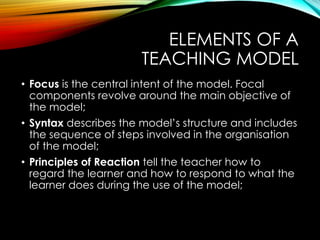
• Focus is the central intent of the model. Focal
components revolve around the main objective of
the model;
• Syntax describes the model’s structure and includes
the sequence of steps involved in the organisation
of the model;
• Principles of Reaction tell the teacher how to
regard the learner and how to respond to what the
learner does during the use of the model;
ELEMENTS OF A
TEACHING MODEL
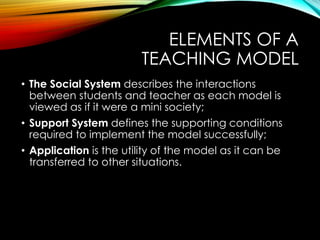
• The Social System describes the interactions
between students and teacher as each model is
viewed as if it were a mini society;
• Support System defines the supporting conditions
required to implement the model successfully;
• Application is the utility of the model as it can be
transferred to other situations.
FUNCTION OF MODELS
OF TEACHING
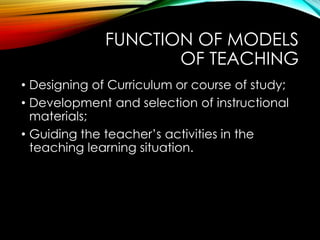
• Designing of Curriculum or course of study;
• Development and selection of instructional
materials;
• Guiding the teacher’s activities in the
teaching learning situation.
CLASSIFICATION OF
MODELS OF TEACHING
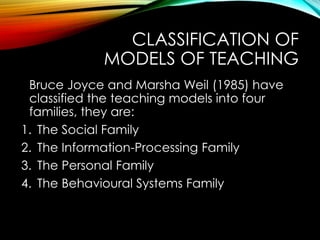
Bruce Joyce and Marsha Weil (1985) have
classified the teaching models into four
families, they are:
1. The Social Family
2. The Information-Processing Family
3. The Personal Family
4. The Behavioural Systems Family
THE INFORMATION
PROCESSING FAMILY
“Information-processing models emphasise
ways of enhancing the human being’s
innate drive to make sense of the world by
acquiring and organising data, sensing
problems and generating solutions to them,
and developing concepts and language for
conveying them. Information-Processing
Family consists of seven models, including
Inquiry Training Model.”
INQUIRY TRAINING
MODEL
This model was designed by Richard Suchman to
teach students to engage in casual reasoning and
to become more fluent and precise in asking
questions, building concepts and hypotheses, and
testing them.
Inquiry learning provides opportunities for students
to experience and acquire processes through
which they can gather information about the world.
This requires a high level of interaction among the
learner, the teacher, area of study, available
resources, and the learning environment, students
become actively involved in the learning process as
they:
INQUIRY TRAINING
MODEL
• Act upon their curiosity and interests;
• Develop questions;
• Think their way through controversies or
dilemmas;
• Look at problems analytically;
• Inquire into their preconceptions and what
they already know;
• Develop, clarify and test hypotheses;
• Draw inferences and generate possible
solutions.
ASSUMPTIONS OF THE
MODEL
• All knowledge is tentative;
• Most of the problems are amenable to several equally
plausible explanations. There is no one particular answer to a
problem;
• Inquiry is natural. All of us often inquire when confronted with a
problematic situation or puzzle;
• An individual can be made amenable to the process of
inquiry. He can be made to learn to analyse his thinking
strategies;
• In addition to what is already known to an individual, he may
be taught the new strategies to enquire and explore things;
• The inquiry process is a co-operative effort. It is always
facilitated by the ‘give and take’ of ideas.
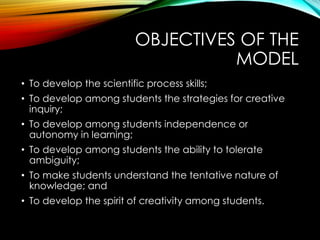
OBJECTIVES OF THE
MODEL
• To develop the scientific process skills;
• To develop among students the strategies for creative
inquiry;
• To develop among students independence or
autonomy in learning;
• To develop among students the ability to tolerate
ambiguity;
• To make students understand the tentative nature of
knowledge; and
• To develop the spirit of creativity among students.
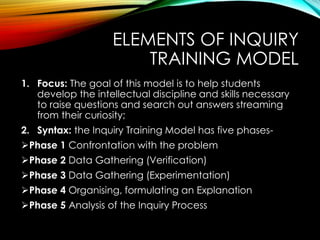
ELEMENTS OF INQUIRY
TRAINING MODEL
1. Focus: The goal of this model is to help students
develop the intellectual discipline and skills necessary
to raise questions and search out answers streaming
from their curiosity;
2. Syntax: the Inquiry Training Model has five phases-
Phase 1 Confrontation with the problem
Phase 2 Data Gathering (Verification)
Phase 3 Data Gathering (Experimentation)
Phase 4 Organising, formulating an Explanation
Phase 5 Analysis of the Inquiry Process
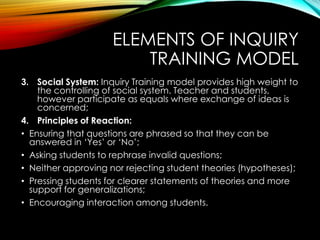
ELEMENTS OF INQUIRY
TRAINING MODEL
3. Social System: Inquiry Training model provides high weight to
the controlling of social system. Teacher and students,
however participate as equals where exchange of ideas is
concerned;
4. Principles of Reaction:
• Ensuring that questions are phrased so that they can be
answered in ‘Yes’ or ‘No’;
• Asking students to rephrase invalid questions;
• Neither approving nor rejecting student theories (hypotheses);
• Pressing students for clearer statements of theories and more
support for generalizations;
• Encouraging interaction among students.
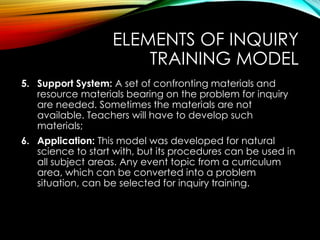
ELEMENTS OF INQUIRY
TRAINING MODEL
5. Support System: A set of confronting materials and
resource materials bearing on the problem for inquiry
are needed. Sometimes the materials are not
available. Teachers will have to develop such
materials;
6. Application: This model was developed for natural
science to start with, but its procedures can be used in
all subject areas. Any event topic from a curriculum
area, which can be converted into a problem
situation, can be selected for inquiry training.
ADVANTAGES OF INQUIRY
TRAINING MODEL
• It develops the scientific process skills;
• It develops among students the strategies for creative
inquiry;
• It develops among students independence or autonomy
in learning;
• It develops among students the ability to tolerate
ambiguity;
• It make students understand the tentative nature of
knowledge; and
• It develops the spirit of creativity among students.
LIMITATIONS OF INQUIRY
TRAINING MODEL
• This model does not help in teaching primary content or
subject matter, for example, ne concepts and formula;
• If the information about the puzzle is not presented in the
form of a problem requiring explanation, the student
cannot effectively arrive at generalisation through
inquiry. In such cases simulation may be more useful;
• It cannot be applied to puzzles which do not have a
cause-effect relationship.
CONCLUSION
A model of teaching is basically designed to achieve a
particular set of objectives. It is not a substitute to
teaching skill; rather, it creates conducive teaching-
learning environment in which teachers teach more
effectively, by making the teaching act more systematic
and efficient.
The Inquiry Training model promotes the processing skills
which are helpful for inquiring. The process skills therefore
include the observing, collecting and organising data,
identifying the variables in a situation, formulating
hypothesis based on cause-effect relationship,
experimenting or otherwise listing the hypothesis,
inferring and drawing conclusions.
REFRENCES
• Chandra, SS & Advance Educational
Sharma, R.N Technology
• Joyce, Bruce & Models of Teaching
Weil, Masha
• Rather, AR Creativity: It’s Recognition &
Development
• Singh, YK; Encyclopaedia of Educational
Sharma, TK & Technology: VOLUM- 1
Upadhya, Brijesh
The information processing model (inquiry training)

The information processing model (inquiry training)

  • 1.
    THE INFORMATION PROCESSING MODEL (INQUIRYTRAINING) Presented By: Abhimanyu Sharma (MA Education Department, NEHU)
  • 2.
    MODEL OF TEACHING “Amodel of teaching can be used to design face-to-face teaching in classrooms or tutorial settings to shape instructional materials, including books, films, and computer media led programmes and curricula and long term courses of study.” - Joyce, Weil and Shawers (1992)
  • 3.
    CHARACTERISTICS OF MODELS OFTEACHING • Systematic Procedure • Criteria of Performance • Specification of Environment • Strategies of Teaching • Presenting Appropriate Experiences
  • 4.
    ASSUMPTIONS OF MODELS OFTEACHING • Teaching is the creation of appropriate environment; • Content, skills, instructional roles, social relationships, types of activities, physical qualities and their use, all form an environmental system whose parts interact with each other to constrain the behaviour of all participant teachers as well as students; • Various combinations of the different elements of the environment create different types of environments and elicit different outcomes; • Models of teaching create environment, they provide rough specification for classroom environment in the classroom teaching.
  • 5.
    ELEMENTS OF A TEACHINGMODEL • Focus is the central intent of the model. Focal components revolve around the main objective of the model; • Syntax describes the model’s structure and includes the sequence of steps involved in the organisation of the model; • Principles of Reaction tell the teacher how to regard the learner and how to respond to what the learner does during the use of the model;
  • 6.
    ELEMENTS OF A TEACHINGMODEL • The Social System describes the interactions between students and teacher as each model is viewed as if it were a mini society; • Support System defines the supporting conditions required to implement the model successfully; • Application is the utility of the model as it can be transferred to other situations.
  • 7.
    FUNCTION OF MODELS OFTEACHING • Designing of Curriculum or course of study; • Development and selection of instructional materials; • Guiding the teacher’s activities in the teaching learning situation.
  • 8.
    CLASSIFICATION OF MODELS OFTEACHING Bruce Joyce and Marsha Weil (1985) have classified the teaching models into four families, they are: 1. The Social Family 2. The Information-Processing Family 3. The Personal Family 4. The Behavioural Systems Family
  • 9.
  • 10.
    “Information-processing models emphasise waysof enhancing the human being’s innate drive to make sense of the world by acquiring and organising data, sensing problems and generating solutions to them, and developing concepts and language for conveying them. Information-Processing Family consists of seven models, including Inquiry Training Model.”
  • 11.
    INQUIRY TRAINING MODEL This modelwas designed by Richard Suchman to teach students to engage in casual reasoning and to become more fluent and precise in asking questions, building concepts and hypotheses, and testing them. Inquiry learning provides opportunities for students to experience and acquire processes through which they can gather information about the world. This requires a high level of interaction among the learner, the teacher, area of study, available resources, and the learning environment, students become actively involved in the learning process as they:
  • 12.
    INQUIRY TRAINING MODEL • Actupon their curiosity and interests; • Develop questions; • Think their way through controversies or dilemmas; • Look at problems analytically; • Inquire into their preconceptions and what they already know; • Develop, clarify and test hypotheses; • Draw inferences and generate possible solutions.
  • 13.
    ASSUMPTIONS OF THE MODEL •All knowledge is tentative; • Most of the problems are amenable to several equally plausible explanations. There is no one particular answer to a problem; • Inquiry is natural. All of us often inquire when confronted with a problematic situation or puzzle; • An individual can be made amenable to the process of inquiry. He can be made to learn to analyse his thinking strategies; • In addition to what is already known to an individual, he may be taught the new strategies to enquire and explore things; • The inquiry process is a co-operative effort. It is always facilitated by the ‘give and take’ of ideas.
  • 14.
    OBJECTIVES OF THE MODEL •To develop the scientific process skills; • To develop among students the strategies for creative inquiry; • To develop among students independence or autonomy in learning; • To develop among students the ability to tolerate ambiguity; • To make students understand the tentative nature of knowledge; and • To develop the spirit of creativity among students.
  • 15.
    ELEMENTS OF INQUIRY TRAININGMODEL 1. Focus: The goal of this model is to help students develop the intellectual discipline and skills necessary to raise questions and search out answers streaming from their curiosity; 2. Syntax: the Inquiry Training Model has five phases- Phase 1 Confrontation with the problem Phase 2 Data Gathering (Verification) Phase 3 Data Gathering (Experimentation) Phase 4 Organising, formulating an Explanation Phase 5 Analysis of the Inquiry Process
  • 16.
    ELEMENTS OF INQUIRY TRAININGMODEL 3. Social System: Inquiry Training model provides high weight to the controlling of social system. Teacher and students, however participate as equals where exchange of ideas is concerned; 4. Principles of Reaction: • Ensuring that questions are phrased so that they can be answered in ‘Yes’ or ‘No’; • Asking students to rephrase invalid questions; • Neither approving nor rejecting student theories (hypotheses); • Pressing students for clearer statements of theories and more support for generalizations; • Encouraging interaction among students.
  • 17.
    ELEMENTS OF INQUIRY TRAININGMODEL 5. Support System: A set of confronting materials and resource materials bearing on the problem for inquiry are needed. Sometimes the materials are not available. Teachers will have to develop such materials; 6. Application: This model was developed for natural science to start with, but its procedures can be used in all subject areas. Any event topic from a curriculum area, which can be converted into a problem situation, can be selected for inquiry training.
  • 18.
    ADVANTAGES OF INQUIRY TRAININGMODEL • It develops the scientific process skills; • It develops among students the strategies for creative inquiry; • It develops among students independence or autonomy in learning; • It develops among students the ability to tolerate ambiguity; • It make students understand the tentative nature of knowledge; and • It develops the spirit of creativity among students.
  • 19.
    LIMITATIONS OF INQUIRY TRAININGMODEL • This model does not help in teaching primary content or subject matter, for example, ne concepts and formula; • If the information about the puzzle is not presented in the form of a problem requiring explanation, the student cannot effectively arrive at generalisation through inquiry. In such cases simulation may be more useful; • It cannot be applied to puzzles which do not have a cause-effect relationship.
  • 20.
    CONCLUSION A model ofteaching is basically designed to achieve a particular set of objectives. It is not a substitute to teaching skill; rather, it creates conducive teaching- learning environment in which teachers teach more effectively, by making the teaching act more systematic and efficient. The Inquiry Training model promotes the processing skills which are helpful for inquiring. The process skills therefore include the observing, collecting and organising data, identifying the variables in a situation, formulating hypothesis based on cause-effect relationship, experimenting or otherwise listing the hypothesis, inferring and drawing conclusions.
  • 21.
    REFRENCES • Chandra, SS& Advance Educational Sharma, R.N Technology • Joyce, Bruce & Models of Teaching Weil, Masha • Rather, AR Creativity: It’s Recognition & Development • Singh, YK; Encyclopaedia of Educational Sharma, TK & Technology: VOLUM- 1 Upadhya, Brijesh