Benjamin Bloom’s Mastery
learning
DR. C. BEULAH JAYARANI
M.Sc., M.A, M.Ed, M.Phil (Edn), M.Phil (ZOO), NET, Ph.D
ASST. PROFESSOR,
LOYOLA COLLEGE OF EDUCATION, CHENNAI - 34
INTRODUCTION
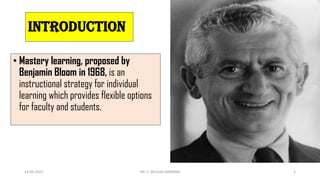
• Mastery learning, proposed by
Benjamin Bloom in 1968, is an
instructional strategy for individual
learning which provides flexible options
for faculty and students.
14-06-2022 DR. C. BEULAH JAYARANI 2
• Mastery learning is an approach to organizing
instructions. This approach was formulated by
John B. Carroll and B.S. Bloom.
 Mastery learning helps in attaining a satisfactory
level of performance in school subjects.
 It belongs to the behavioral systems family of
models as classified by Joyce and Weil.
 Mastery learning provides a compact and interesting
way to increase the likelihood that more students
will attain a satisfactory level of performance in
school subjects.
14-06-2022 DR. C. BEULAH JAYARANI 3
INSTRUCTION
• Mastery-based learning is an
instructional approach where students
need to demonstrate a deep level of
understanding of a topic or subject area
before progressing onto another topic or
subject area.
• Mastery learning model was developed to
help the students for gaining mastery
over all the aspects of the learning
tasks in sufficient time.
• According to this model of every child can
store 90 to 100% and if the child fails it
is the failure of system and teacher
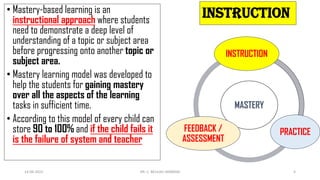
MASTERY
INSTRUCTION
PRACTICE
FEEDBACK /
ASSESSMENT
14-06-2022 DR. C. BEULAH JAYARANI 4
PRACTICE & FEEDBACK
• The teacher should provide enough time and
employ an instructional strategy to help all
students achieving mastery level of learning.
• Time spent on learning is the key to mastery.
• The student should not be allowed to learn next
to the next unit until and unless they have
achieved mastery over the present unit with
training
• Learning tasks or content is divided into
small parts of size, contentment and time
according to the learner.
• The teacher should be child-centric.
14-06-2022 DR. C. BEULAH JAYARANI 5
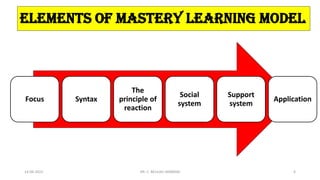
Elements of mastery learning model
Focus Syntax
The
principle of
reaction
Social
system
Support
system
Application
14-06-2022 DR. C. BEULAH JAYARANI 6
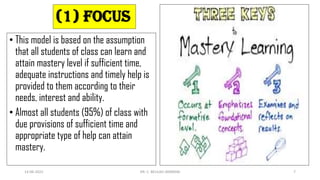
(1) Focus
• This model is based on the assumption
that all students of class can learn and
attain mastery level if sufficient time,
adequate instructions and timely help is
provided to them according to their
needs, interest and ability.
• Almost all students (95%) of class with
due provisions of sufficient time and
appropriate type of help can attain
mastery.
14-06-2022 DR. C. BEULAH JAYARANI 7
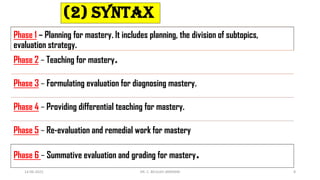
(2) Syntax
Phase 1 – Planning for mastery. It includes planning, the division of subtopics,
evaluation strategy.
Phase 2 – Teaching for mastery.
Phase 3 – Formulating evaluation for diagnosing mastery.
Phase 4 – Providing differential teaching for mastery.
Phase 5 – Re-evaluation and remedial work for mastery
Phase 6 – Summative evaluation and grading for mastery.
14-06-2022 DR. C. BEULAH JAYARANI 8
3) The principle of reaction
• The main emphasis in the mode is on helping the student to attain mastery over
the material thought.
• Here the speed of the learner is not taken into consideration.
• With formative evaluation, the teacher gets to know the nature of difficulties
faced by the individual.
• The teacher remains conscious in reminding the student that learning
completely is more important than by just finishing the task.
• The one who masters the concepts late is in no way inferior to the easy
masters.
• Every student works at his own pace.
• Helps slow-learners in gaining self-confidence and hope for success.
• Encourages self-analysis and inspiration.
• Any child can
master any
subject given
enough time
and a variety
of
instructional
methods.
14-06-2022 DR. C. BEULAH JAYARANI 9
(4) Social system
• For the attainment of mastery by all
students of the class, the teacher has to
organize the class in the small group, take
the help of early masters as monitors and
help the students individual as tutors.
• Thus the model provides opportunities for
pupil-pupil interaction in the class room
14-06-2022 DR. C. BEULAH JAYARANI 10
5) Support system
• Ample content or resource
availability.
• Aids for differential teaching.
14-06-2022 DR. C. BEULAH JAYARANI 11
6) Application
• It has advantages in terms of
cognitive and affective
consequences.
• This model is workable in higher
classes.
14-06-2022 DR. C. BEULAH JAYARANI 12
REFERENCE
TNTEU – Study Material
Ram Publications
Sri Krishna Publications
Kaviyamala Publications
Mangal, s.k., Mangal, U. (2011). Essentials of educational
technology. New Delhi: PHI learning private limited.
Google Images
14-06-2022 DR. C. BEULAH JAYARANI 13

BLOOMS' MASTERY LEARNING.pdf

  • 1.
    Benjamin Bloom’s Mastery learning DR.C. BEULAH JAYARANI M.Sc., M.A, M.Ed, M.Phil (Edn), M.Phil (ZOO), NET, Ph.D ASST. PROFESSOR, LOYOLA COLLEGE OF EDUCATION, CHENNAI - 34
  • 2.
    INTRODUCTION • Mastery learning,proposed by Benjamin Bloom in 1968, is an instructional strategy for individual learning which provides flexible options for faculty and students. 14-06-2022 DR. C. BEULAH JAYARANI 2
  • 3.
    • Mastery learningis an approach to organizing instructions. This approach was formulated by John B. Carroll and B.S. Bloom.  Mastery learning helps in attaining a satisfactory level of performance in school subjects.  It belongs to the behavioral systems family of models as classified by Joyce and Weil.  Mastery learning provides a compact and interesting way to increase the likelihood that more students will attain a satisfactory level of performance in school subjects. 14-06-2022 DR. C. BEULAH JAYARANI 3
  • 4.
    INSTRUCTION • Mastery-based learningis an instructional approach where students need to demonstrate a deep level of understanding of a topic or subject area before progressing onto another topic or subject area. • Mastery learning model was developed to help the students for gaining mastery over all the aspects of the learning tasks in sufficient time. • According to this model of every child can store 90 to 100% and if the child fails it is the failure of system and teacher MASTERY INSTRUCTION PRACTICE FEEDBACK / ASSESSMENT 14-06-2022 DR. C. BEULAH JAYARANI 4
  • 5.
    PRACTICE & FEEDBACK •The teacher should provide enough time and employ an instructional strategy to help all students achieving mastery level of learning. • Time spent on learning is the key to mastery. • The student should not be allowed to learn next to the next unit until and unless they have achieved mastery over the present unit with training • Learning tasks or content is divided into small parts of size, contentment and time according to the learner. • The teacher should be child-centric. 14-06-2022 DR. C. BEULAH JAYARANI 5
  • 6.
    Elements of masterylearning model Focus Syntax The principle of reaction Social system Support system Application 14-06-2022 DR. C. BEULAH JAYARANI 6
  • 7.
    (1) Focus • Thismodel is based on the assumption that all students of class can learn and attain mastery level if sufficient time, adequate instructions and timely help is provided to them according to their needs, interest and ability. • Almost all students (95%) of class with due provisions of sufficient time and appropriate type of help can attain mastery. 14-06-2022 DR. C. BEULAH JAYARANI 7
  • 8.
    (2) Syntax Phase 1– Planning for mastery. It includes planning, the division of subtopics, evaluation strategy. Phase 2 – Teaching for mastery. Phase 3 – Formulating evaluation for diagnosing mastery. Phase 4 – Providing differential teaching for mastery. Phase 5 – Re-evaluation and remedial work for mastery Phase 6 – Summative evaluation and grading for mastery. 14-06-2022 DR. C. BEULAH JAYARANI 8
  • 9.
    3) The principleof reaction • The main emphasis in the mode is on helping the student to attain mastery over the material thought. • Here the speed of the learner is not taken into consideration. • With formative evaluation, the teacher gets to know the nature of difficulties faced by the individual. • The teacher remains conscious in reminding the student that learning completely is more important than by just finishing the task. • The one who masters the concepts late is in no way inferior to the easy masters. • Every student works at his own pace. • Helps slow-learners in gaining self-confidence and hope for success. • Encourages self-analysis and inspiration. • Any child can master any subject given enough time and a variety of instructional methods. 14-06-2022 DR. C. BEULAH JAYARANI 9
  • 10.
    (4) Social system •For the attainment of mastery by all students of the class, the teacher has to organize the class in the small group, take the help of early masters as monitors and help the students individual as tutors. • Thus the model provides opportunities for pupil-pupil interaction in the class room 14-06-2022 DR. C. BEULAH JAYARANI 10
  • 11.
    5) Support system •Ample content or resource availability. • Aids for differential teaching. 14-06-2022 DR. C. BEULAH JAYARANI 11
  • 12.
    6) Application • Ithas advantages in terms of cognitive and affective consequences. • This model is workable in higher classes. 14-06-2022 DR. C. BEULAH JAYARANI 12
  • 13.
    REFERENCE TNTEU – StudyMaterial Ram Publications Sri Krishna Publications Kaviyamala Publications Mangal, s.k., Mangal, U. (2011). Essentials of educational technology. New Delhi: PHI learning private limited. Google Images 14-06-2022 DR. C. BEULAH JAYARANI 13