[HYDRAULICS AND PNEUMATICS]
 It is the technology that deals with the generation,
control, and transmission of power using
pressurized fluids.
 HYDRAULICS-when fluid is liquid.
Ex: petroleum oils, synthetic oils and water.
 PNEUMATICS-when fluid is gas.
Ex: air.
 Electrical
 Mechanical
 Fluid power
Advantages :
1. Ease and accuracy of control
2. Multiplication of force
3. Constant force or torque
4. Simplicity, safety, economy.
 Hydraulic oils are messy.
 Leakage is impossible to eliminate.
 Possibility of fire accidents.
 System slows down when leakage occurs.
 Heavier in weight.
 Valve operations are difficult.
 Based on the control system
Open loop system
Closed loop system
 Based on the type of control
1. Fluid logic control- using logic gates
2. Electrical control- electrical devices
3. Electronic control- micro electronic device
 Actuator-fluid power to mechanical power
 Pump-to pump fluid from reservoir
 Valves- control the direction
 Power supply- motor to drive the pump
 Reservoir- to store fluid
 Piping- to carry fluid
 Filters- remove dust and foreign particles
 Pressure regulator- to maintain pressure
 Good lubricity
 Ideal viscosity
 Chemical stability
 High degree of incompressibility
 Fire resistance
 Good heat transfer capability
 Low density
 Foam resistance
 Non toxicity
Fluid refers to both gases and liquids.
Fluids
 A liquid is fluid that for a given mass it will take the
shape of its container.
 Liquids are incompressible.
Gases
 Air is the only commonly used gas in fluid systems
because its inexpensive and readily available.
 Its compressible
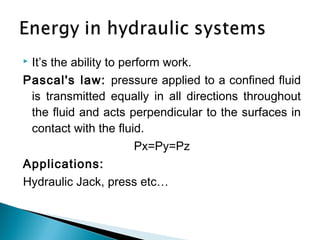
 It’s the ability to perform work.
Pascal's law: pressure applied to a confined fluid
is transmitted equally in all directions throughout
the fluid and acts perpendicular to the surfaces in
contact with the fluid.
Px=Py=Pz
Applications:
Hydraulic Jack, press etc…
 It states that for steady flow in a pipe line the fluid
flow rate is same for all locations of the pipe.
Q=a1v1=a2v2
Bernoulli’s EquationBernoulli’s Equation
 By conservation of energy, the total energy
possessed by the fluid at point 1 is equal to the
energy possessed by fluid at point 2.
 Z1+P1/Ƴ+V2/2g = C
 Losses in pipe valves and fittings.
Laminar and turbulent flow:
fluid flowing in smooth layers or laminae is laminar
flow and fluid flowing in random and fluctuated is
known as turbulent.
Reynold’s Number[NR]
If NR less than 2000 its laminar.
If NR greater than 2000 its turbulent.
 HL =fLv2/2gd

Fluid power

  • 1.
  • 2.
     It isthe technology that deals with the generation, control, and transmission of power using pressurized fluids.  HYDRAULICS-when fluid is liquid. Ex: petroleum oils, synthetic oils and water.  PNEUMATICS-when fluid is gas. Ex: air.
  • 3.
     Electrical  Mechanical Fluid power Advantages : 1. Ease and accuracy of control 2. Multiplication of force 3. Constant force or torque 4. Simplicity, safety, economy.
  • 4.
     Hydraulic oilsare messy.  Leakage is impossible to eliminate.  Possibility of fire accidents.  System slows down when leakage occurs.  Heavier in weight.  Valve operations are difficult.
  • 5.
     Based onthe control system Open loop system Closed loop system  Based on the type of control 1. Fluid logic control- using logic gates 2. Electrical control- electrical devices 3. Electronic control- micro electronic device
  • 6.
     Actuator-fluid powerto mechanical power  Pump-to pump fluid from reservoir  Valves- control the direction  Power supply- motor to drive the pump  Reservoir- to store fluid  Piping- to carry fluid  Filters- remove dust and foreign particles  Pressure regulator- to maintain pressure
  • 7.
     Good lubricity Ideal viscosity  Chemical stability  High degree of incompressibility  Fire resistance  Good heat transfer capability  Low density  Foam resistance  Non toxicity
  • 8.
    Fluid refers toboth gases and liquids. Fluids  A liquid is fluid that for a given mass it will take the shape of its container.  Liquids are incompressible. Gases  Air is the only commonly used gas in fluid systems because its inexpensive and readily available.  Its compressible
  • 9.
     It’s theability to perform work. Pascal's law: pressure applied to a confined fluid is transmitted equally in all directions throughout the fluid and acts perpendicular to the surfaces in contact with the fluid. Px=Py=Pz Applications: Hydraulic Jack, press etc…
  • 10.
     It statesthat for steady flow in a pipe line the fluid flow rate is same for all locations of the pipe. Q=a1v1=a2v2 Bernoulli’s EquationBernoulli’s Equation  By conservation of energy, the total energy possessed by the fluid at point 1 is equal to the energy possessed by fluid at point 2.  Z1+P1/Ƴ+V2/2g = C
  • 11.
     Losses inpipe valves and fittings. Laminar and turbulent flow: fluid flowing in smooth layers or laminae is laminar flow and fluid flowing in random and fluctuated is known as turbulent. Reynold’s Number[NR] If NR less than 2000 its laminar. If NR greater than 2000 its turbulent.
  • 12.