Presentation on hydraulic
control systems
CONTROL ENGINEERING (2151908)
NAME:- Vadgama sumit himmatbhai
ENROLLMENT NO:- 180053119059
guided by -NIRMAL KUSHWAHA SIR
Content
• Introduction
• Basic elements of hydraulic circuit
• Components of hydraulic control systems
• Pressure control valves
• Flow control valve
• Direction control valve
• Sources of hydraulic power
• Hydraulic cylinder and piston
• Hydraulic controllers
Introduction
• Before going into the advantages of fluid power system, it is essential
to discuss the principle and the functions of hydraulic system.
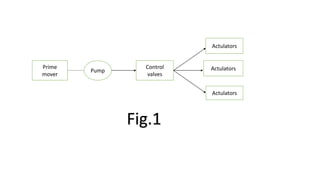
• The systematic layout of hydraulic system is shown in fig.1 in this a
prime mover supplies the mechanical energy to a pump which is used
to pressurise a fluid. Therefore the mechanical energy supplied by the
prime mover is converted into pressure energy by the pump and it is
stored in fluid.
Prime
mover
Pump
Control
valves
Actulators
Actulators
Actulators
Fig.1
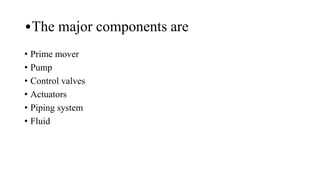
•The major components are
• Prime mover
• Pump
• Control valves
• Actuators
• Piping system
• Fluid
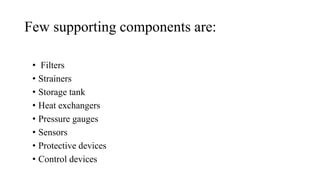
Few supporting components are:
• Filters
• Strainers
• Storage tank
• Heat exchangers
• Pressure gauges
• Sensors
• Protective devices
• Control devices
Prime mover
• It is the device which develops the mechanical power. It is a
power producing device. The type of prime mover will
depend on the system. After passing through fluid power
system this power is again available as mechanical power.
pump
• Hydraulic pumps are used in hydraulic drive systems and can be
hydrostatic or hydrodynamic.
• A hydraulic pump is a mechanical source of power that converts
mechanical power into hydraulic energy (hydrostatic energy i.e. flow,
pressure).
• It generates flow with enough power to overcome pressure induced by
the load at the pump outlet. When a hydraulic pump operates, it
creates a vacuum at the pump inlet, which forces liquid from the
reservoir into the inlet line to the pump and by mechanical action
delivers this liquid to the pump outlet and forces it into the hydraulic
system.
Control valves
• The pressurised fluid supplied by the pump is required to diverted to
various parts of the system.
• Also controls various parameter of flowing fluid. • Classified into
three types:
• 1.Pressure control valves
• 2.Flow control valves
• 3.Direction control valves
• 4. As name suggests , these valves control the respective parameter of
fluid.
Actuators
• Actuators convert the fluid power contained in pressurized fluid to
mechanical energy. They are the muscles of the system. • They provide
the mechanical motion to the desired part and the desired actuating
force. • The actuators can be divided into linear and rotary actuators. •
Example of linear actuators is single acting cylinders and rotary
actuator is limited rotation motor.
Piping system
• They carry fluid containing the energy to various parts of system. •
After transmitting energy, the return oil is brought back to the
reservoir. • Due to the high pressure involved, design of piping system
require extreme care. • Bursting of piping could prove to be a serious
matter leading to damage of equipment or injury to personnel.
Filters:
• Hydraulic filters remove dirt and particles from fluid in a hydraulic
system.
• A hydraulic filter helps to remove these particles and clean the oil on
a continuous basis. The performance for every hydraulic filter is
measured by its contamination removal efficiency, i.e. high dirt-
holding capacities. Almost every hydraulic system contains more than
one hydraulic filter.
Accumulators
• These are storage devices. They can cater for small time fluctuations
in the energy. This may be due to power failures. They provide a small
pool of pressurized oil which can be used during emergencies.
Electrical devices
• They provide much flexibility in operation.
• • They are used in control of fluid power. Electrical control
enables us the remote operation, automation and sequencing.
Some of the electrical components include solenoids, torque
motors, and limit switchers.
Measuring gauges
• In addition to the various functional components mentioned there is a
need to measure certain parameters for monitoring the proper
functioning of the system.
• For this a fluid power system incorporates a number of measuring
gauges e.g. pressure gauge, temperature gauges, position sensor etc.
these are basically safety devices.
Pressure-control valves
• Pressure-control valves are found in virtually every hydraulic system,
and they assist in a variety of functions, from keeping system
pressures safely below a desired upper limit to maintaining a set
pressure in part of a circuit.
• Types include relief, reducing, sequence, counterbalance, and
unloading. All of these are normally closed valves, except for reducing
valves, which are normally open. For most of these valves, a
restriction is necessary to produce the required pressure control. One
exception is the externally piloted unloading valve, which depends on
an external signal for its actuation
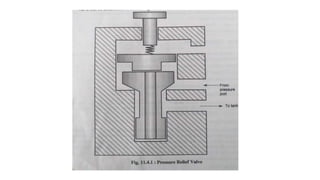
Pressure relief valves
• Most fluid power systems are designed to operate within a present
pressure range. This range is a function of the forces the actuators in
the system must generate to do the required work. Without controlling
or limiting these forces, the fluid power components (and expensive
equipment) could be damaged. Relief valves avoid this hazard. They
are the safeguards which limit maximum pressure in a system by
diverting excess oil when pressures get too high.
Flow control valves
• Flow control valves manage the flow by decreasing or increasing
the opening at the throttling point. This helps to determine speed
of movement for the actuators. The simplest design for a flow
control valve is a needle or longitudinal slot mounted in the
pipeline and connected to a screw that adjusts the opening at the
throttling point.
• These are called throttle valves and they are regularly used in
combination with a check valve, i.e. the throttle check valve for
speed control in one direction of flow. A disadvantage of throttle
valves is that at varying loads a change in pressure drop will
change the flow; thus, the speed of the moving actuator will also
be affected.
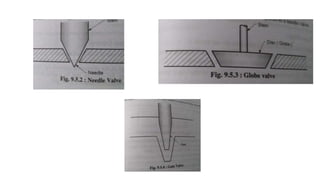
Classification of flow control valves
• 1. Needle valves : Needle controls the area of orifice , which
causes change in flow rate through the valve.
• 2. Globe valves : Controlling element is disc or globe.
• 3. Gate valves : Flow control achieved by the movement of
the gate
Direction control valves
• Direction control valve is used for distribution of energy to
various actuators by controlling the direction of flow of the
pressurized oil in system. Therfore, it has the direct influence
on start, stop and the flow direction of the actuators
Classsification of [dcvs]
•Three way two positon
•Four way two position
•Four way three position
Sources of hydraulic power
• In fluid power actuators are those devices which convert the fluid
power into the mechanical power at desired place. They produce
the required working force and provide the necessary type of
motion.
• By using the actuator we are able to get the motion in any
convenient form. By using the hydraulic actuators we can generate
and apply large quantum of forces.
Classification of actuators
Depending upon the nature of motion given by the actuator, they can be
classied as:
1. Linear actuators : To provide linear motion as output
2. Rotary actuators :To provide rotary motion as the output
Pump classification
• Postivite displacement pump
• Rotodynamic pump
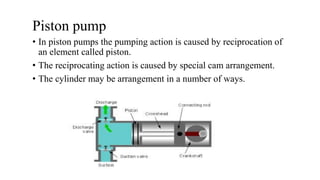
Piston pump
• In piston pumps the pumping action is caused by reciprocation of
an element called piston.
• The reciprocating action is caused by special cam arrangement.
• The cylinder may be arrangement in a number of ways.
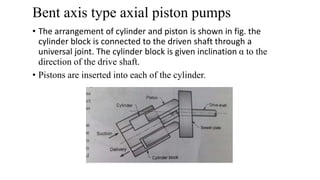
Bent axis type axial piston pumps
• The arrangement of cylinder and piston is shown in fig. the
cylinder block is connected to the driven shaft through a
universal joint. The cylinder block is given inclination α to the
direction of the drive shaft.
• Pistons are inserted into each of the cylinder.
Swash plate type of axial piston pump
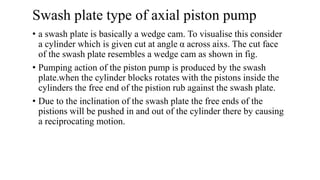
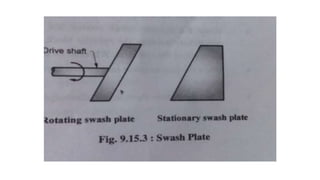
• a swash plate is basically a wedge cam. To visualise this consider
a cylinder which is given cut at angle α across aixs. The cut face
of the swash plate resembles a wedge cam as shown in fig.
• Pumping action of the piston pump is produced by the swash
plate.when the cylinder blocks rotates with the pistons inside the
cylinders the free end of the pistion rub against the swash plate.
• Due to the inclination of the swash plate the free ends of the
pistions will be pushed in and out of the cylinder there by causing
a reciprocating motion.
Radial pistion pumps
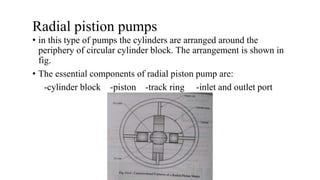
• in this type of pumps the cylinders are arranged around the
periphery of circular cylinder block. The arrangement is shown in
fig.
• The essential components of radial piston pump are:
-cylinder block -piston -track ring -inlet and outlet port
vane pumps
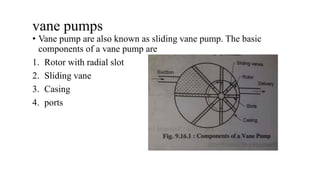
• Vane pump are also known as sliding vane pump. The basic
components of a vane pump are
1. Rotor with radial slot
2. Sliding vane
3. Casing
4. ports
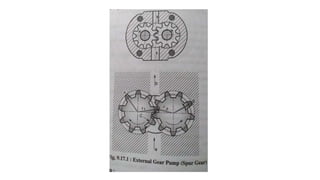
gear pump
• Gear pump is positive displacement pump used in hydraulic
system.
• It can developed high pressure at low discharge.
• It is simpe in design, cheap and it can handle a variety of fluids,
e.g. petroleum oil, synthetic oil and water based emulsions
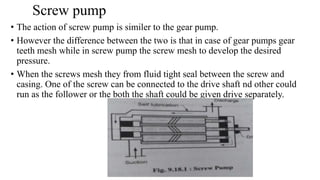
Screw pump
• The action of screw pump is similer to the gear pump.
• However the difference between the two is that in case of gear pumps gear
teeth mesh while in screw pump the screw mesh to develop the desired
pressure.
• When the screws mesh they from fluid tight seal between the screw and
casing. One of the screw can be connected to the drive shaft nd other could
run as the follower or the both the shaft could be given drive separately.
Advantages of screw pumps
• Wide range of flow and pressure.
• Wide range of liquids can be handled.
• Low internal velocity.
• Low vibration and noise.
• High speed capability.
Hydraulic cylinders
• Hydraulic cylinders are linear actuators which provide linear motion
and force. They can develop very large quantum of force and very
long strokes obtained through cylinders
• Hydraulic cylinders could be classified into two broad categories as:
1. Sinle acting.
2. Double acting.
Single acting cylinder
• A single acting cylinder is shown in fig.
• The pressurised fluid is supplied from the pump through the
control valves. It can enter into the cylinder through a port
provided at the piston end of the cylinder.
• When oil under pressures enters the cylinder through the inlet port
it pushes the piston forward.
• after reaching the forward most position the return motion is due
to a spring force. The oil moves out of the cylinder through the
same port to the tank.
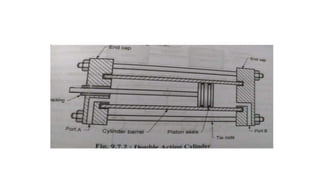
Double acting cylinder
• The double acting cylinder is shown in fig.
• It has two ports. Port A at the rod end and port B at the end of the
piston end.
• For the forward motion of the piston pressurised oil enters through
port A and pushes the piston forwards.
• For the return motion oil enters through port B and pushes the piston
backwards.
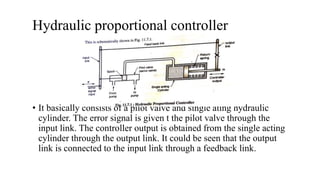
Hydraulic proportional controller
• It basically consists of a pilot valve and single ating hydraulic
cylinder. The error signal is given t the pilot valve through the
input link. The controller output is obtained from the single acting
cylinder through the output link. It could be seen that the output
link is connected to the input link through a feedback link.
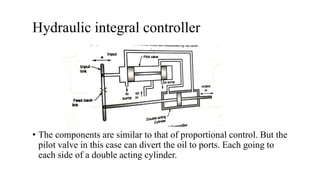
Hydraulic integral controller
• The components are similar to that of proportional control. But the
pilot valve in this case can divert the oil to ports. Each going to
each side of a double acting cylinder.
• In double acting cylinder the motion to both sides are controlled
by oil flow.
• The input and feedback link are same. If an error input e is given
to the input link it moves the spool of the pilot valve. Oil would be
send to the corresponding port of the double acting cylinder when
pressurised oil goes to double acting cylinder it moves the piston
to one side.
• This movement of the piston is feedback to the feedback link thus
an output motion of the cylinder is produced corresponding to the
error input
• Q α e
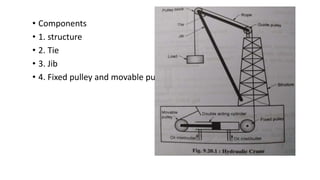
Hydraulic crane
• Hydraulic cranes are used to lift heavy weights and place them at
a higher or lower level. This is used in all types of material
handling applications such as docks, harbours, factories,
construction sites etc. the basic construction is shown in fig.
• Components
• 1. structure
• 2. Tie
• 3. Jib
• 4. Fixed pulley and movable pulley
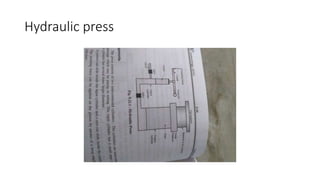
Hydraulic press
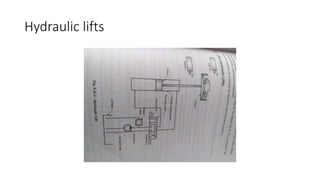
Hydraulic lifts
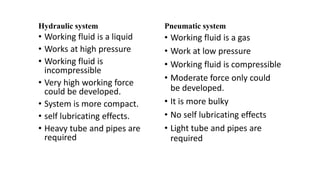
Hydraulic system
• Working fluid is a liquid
• Works at high pressure
• Working fluid is
incompressible
• Very high working force
could be developed.
• System is more compact.
• self lubricating effects.
• Heavy tube and pipes are
required
Pneumatic system
• Working fluid is a gas
• Work at low pressure
• Working fluid is compressible
• Moderate force only could
be developed.
• It is more bulky
• No self lubricating effects
• Light tube and pipes are
required
Thank you

Ce.pptx 2

  • 1.
    Presentation on hydraulic controlsystems CONTROL ENGINEERING (2151908) NAME:- Vadgama sumit himmatbhai ENROLLMENT NO:- 180053119059 guided by -NIRMAL KUSHWAHA SIR
  • 2.
    Content • Introduction • Basicelements of hydraulic circuit • Components of hydraulic control systems • Pressure control valves • Flow control valve • Direction control valve • Sources of hydraulic power • Hydraulic cylinder and piston • Hydraulic controllers
  • 3.
    Introduction • Before goinginto the advantages of fluid power system, it is essential to discuss the principle and the functions of hydraulic system. • The systematic layout of hydraulic system is shown in fig.1 in this a prime mover supplies the mechanical energy to a pump which is used to pressurise a fluid. Therefore the mechanical energy supplied by the prime mover is converted into pressure energy by the pump and it is stored in fluid.
  • 4.
  • 5.
    •The major componentsare • Prime mover • Pump • Control valves • Actuators • Piping system • Fluid
  • 6.
    Few supporting componentsare: • Filters • Strainers • Storage tank • Heat exchangers • Pressure gauges • Sensors • Protective devices • Control devices
  • 7.
    Prime mover • Itis the device which develops the mechanical power. It is a power producing device. The type of prime mover will depend on the system. After passing through fluid power system this power is again available as mechanical power.
  • 8.
    pump • Hydraulic pumpsare used in hydraulic drive systems and can be hydrostatic or hydrodynamic. • A hydraulic pump is a mechanical source of power that converts mechanical power into hydraulic energy (hydrostatic energy i.e. flow, pressure). • It generates flow with enough power to overcome pressure induced by the load at the pump outlet. When a hydraulic pump operates, it creates a vacuum at the pump inlet, which forces liquid from the reservoir into the inlet line to the pump and by mechanical action delivers this liquid to the pump outlet and forces it into the hydraulic system.
  • 9.
    Control valves • Thepressurised fluid supplied by the pump is required to diverted to various parts of the system. • Also controls various parameter of flowing fluid. • Classified into three types: • 1.Pressure control valves • 2.Flow control valves • 3.Direction control valves • 4. As name suggests , these valves control the respective parameter of fluid.
  • 10.
    Actuators • Actuators convertthe fluid power contained in pressurized fluid to mechanical energy. They are the muscles of the system. • They provide the mechanical motion to the desired part and the desired actuating force. • The actuators can be divided into linear and rotary actuators. • Example of linear actuators is single acting cylinders and rotary actuator is limited rotation motor.
  • 11.
    Piping system • Theycarry fluid containing the energy to various parts of system. • After transmitting energy, the return oil is brought back to the reservoir. • Due to the high pressure involved, design of piping system require extreme care. • Bursting of piping could prove to be a serious matter leading to damage of equipment or injury to personnel.
  • 12.
    Filters: • Hydraulic filtersremove dirt and particles from fluid in a hydraulic system. • A hydraulic filter helps to remove these particles and clean the oil on a continuous basis. The performance for every hydraulic filter is measured by its contamination removal efficiency, i.e. high dirt- holding capacities. Almost every hydraulic system contains more than one hydraulic filter.
  • 13.
    Accumulators • These arestorage devices. They can cater for small time fluctuations in the energy. This may be due to power failures. They provide a small pool of pressurized oil which can be used during emergencies.
  • 14.
    Electrical devices • Theyprovide much flexibility in operation. • • They are used in control of fluid power. Electrical control enables us the remote operation, automation and sequencing. Some of the electrical components include solenoids, torque motors, and limit switchers.
  • 15.
    Measuring gauges • Inaddition to the various functional components mentioned there is a need to measure certain parameters for monitoring the proper functioning of the system. • For this a fluid power system incorporates a number of measuring gauges e.g. pressure gauge, temperature gauges, position sensor etc. these are basically safety devices.
  • 16.
    Pressure-control valves • Pressure-controlvalves are found in virtually every hydraulic system, and they assist in a variety of functions, from keeping system pressures safely below a desired upper limit to maintaining a set pressure in part of a circuit. • Types include relief, reducing, sequence, counterbalance, and unloading. All of these are normally closed valves, except for reducing valves, which are normally open. For most of these valves, a restriction is necessary to produce the required pressure control. One exception is the externally piloted unloading valve, which depends on an external signal for its actuation
  • 17.
    Pressure relief valves •Most fluid power systems are designed to operate within a present pressure range. This range is a function of the forces the actuators in the system must generate to do the required work. Without controlling or limiting these forces, the fluid power components (and expensive equipment) could be damaged. Relief valves avoid this hazard. They are the safeguards which limit maximum pressure in a system by diverting excess oil when pressures get too high.
  • 19.
    Flow control valves •Flow control valves manage the flow by decreasing or increasing the opening at the throttling point. This helps to determine speed of movement for the actuators. The simplest design for a flow control valve is a needle or longitudinal slot mounted in the pipeline and connected to a screw that adjusts the opening at the throttling point. • These are called throttle valves and they are regularly used in combination with a check valve, i.e. the throttle check valve for speed control in one direction of flow. A disadvantage of throttle valves is that at varying loads a change in pressure drop will change the flow; thus, the speed of the moving actuator will also be affected.
  • 20.
    Classification of flowcontrol valves • 1. Needle valves : Needle controls the area of orifice , which causes change in flow rate through the valve. • 2. Globe valves : Controlling element is disc or globe. • 3. Gate valves : Flow control achieved by the movement of the gate
  • 22.
    Direction control valves •Direction control valve is used for distribution of energy to various actuators by controlling the direction of flow of the pressurized oil in system. Therfore, it has the direct influence on start, stop and the flow direction of the actuators
  • 23.
    Classsification of [dcvs] •Threeway two positon •Four way two position •Four way three position
  • 24.
    Sources of hydraulicpower • In fluid power actuators are those devices which convert the fluid power into the mechanical power at desired place. They produce the required working force and provide the necessary type of motion. • By using the actuator we are able to get the motion in any convenient form. By using the hydraulic actuators we can generate and apply large quantum of forces.
  • 25.
    Classification of actuators Dependingupon the nature of motion given by the actuator, they can be classied as: 1. Linear actuators : To provide linear motion as output 2. Rotary actuators :To provide rotary motion as the output
  • 26.
    Pump classification • Postivitedisplacement pump • Rotodynamic pump
  • 27.
    Piston pump • Inpiston pumps the pumping action is caused by reciprocation of an element called piston. • The reciprocating action is caused by special cam arrangement. • The cylinder may be arrangement in a number of ways.
  • 28.
    Bent axis typeaxial piston pumps • The arrangement of cylinder and piston is shown in fig. the cylinder block is connected to the driven shaft through a universal joint. The cylinder block is given inclination α to the direction of the drive shaft. • Pistons are inserted into each of the cylinder.
  • 29.
    Swash plate typeof axial piston pump • a swash plate is basically a wedge cam. To visualise this consider a cylinder which is given cut at angle α across aixs. The cut face of the swash plate resembles a wedge cam as shown in fig. • Pumping action of the piston pump is produced by the swash plate.when the cylinder blocks rotates with the pistons inside the cylinders the free end of the pistion rub against the swash plate. • Due to the inclination of the swash plate the free ends of the pistions will be pushed in and out of the cylinder there by causing a reciprocating motion.
  • 31.
    Radial pistion pumps •in this type of pumps the cylinders are arranged around the periphery of circular cylinder block. The arrangement is shown in fig. • The essential components of radial piston pump are: -cylinder block -piston -track ring -inlet and outlet port
  • 32.
    vane pumps • Vanepump are also known as sliding vane pump. The basic components of a vane pump are 1. Rotor with radial slot 2. Sliding vane 3. Casing 4. ports
  • 33.
    gear pump • Gearpump is positive displacement pump used in hydraulic system. • It can developed high pressure at low discharge. • It is simpe in design, cheap and it can handle a variety of fluids, e.g. petroleum oil, synthetic oil and water based emulsions
  • 35.
    Screw pump • Theaction of screw pump is similer to the gear pump. • However the difference between the two is that in case of gear pumps gear teeth mesh while in screw pump the screw mesh to develop the desired pressure. • When the screws mesh they from fluid tight seal between the screw and casing. One of the screw can be connected to the drive shaft nd other could run as the follower or the both the shaft could be given drive separately.
  • 36.
    Advantages of screwpumps • Wide range of flow and pressure. • Wide range of liquids can be handled. • Low internal velocity. • Low vibration and noise. • High speed capability.
  • 37.
    Hydraulic cylinders • Hydrauliccylinders are linear actuators which provide linear motion and force. They can develop very large quantum of force and very long strokes obtained through cylinders • Hydraulic cylinders could be classified into two broad categories as: 1. Sinle acting. 2. Double acting.
  • 38.
    Single acting cylinder •A single acting cylinder is shown in fig. • The pressurised fluid is supplied from the pump through the control valves. It can enter into the cylinder through a port provided at the piston end of the cylinder. • When oil under pressures enters the cylinder through the inlet port it pushes the piston forward. • after reaching the forward most position the return motion is due to a spring force. The oil moves out of the cylinder through the same port to the tank.
  • 40.
    Double acting cylinder •The double acting cylinder is shown in fig. • It has two ports. Port A at the rod end and port B at the end of the piston end. • For the forward motion of the piston pressurised oil enters through port A and pushes the piston forwards. • For the return motion oil enters through port B and pushes the piston backwards.
  • 41.
    Hydraulic proportional controller •It basically consists of a pilot valve and single ating hydraulic cylinder. The error signal is given t the pilot valve through the input link. The controller output is obtained from the single acting cylinder through the output link. It could be seen that the output link is connected to the input link through a feedback link.
  • 42.
    Hydraulic integral controller •The components are similar to that of proportional control. But the pilot valve in this case can divert the oil to ports. Each going to each side of a double acting cylinder.
  • 43.
    • In doubleacting cylinder the motion to both sides are controlled by oil flow. • The input and feedback link are same. If an error input e is given to the input link it moves the spool of the pilot valve. Oil would be send to the corresponding port of the double acting cylinder when pressurised oil goes to double acting cylinder it moves the piston to one side. • This movement of the piston is feedback to the feedback link thus an output motion of the cylinder is produced corresponding to the error input • Q α e
  • 44.
    Hydraulic crane • Hydrauliccranes are used to lift heavy weights and place them at a higher or lower level. This is used in all types of material handling applications such as docks, harbours, factories, construction sites etc. the basic construction is shown in fig.
  • 45.
    • Components • 1.structure • 2. Tie • 3. Jib • 4. Fixed pulley and movable pulley
  • 46.
  • 47.
  • 48.
    Hydraulic system • Workingfluid is a liquid • Works at high pressure • Working fluid is incompressible • Very high working force could be developed. • System is more compact. • self lubricating effects. • Heavy tube and pipes are required Pneumatic system • Working fluid is a gas • Work at low pressure • Working fluid is compressible • Moderate force only could be developed. • It is more bulky • No self lubricating effects • Light tube and pipes are required
  • 49.