I.T.S. Engineering College
• Sumit Lakhera
• Branch- Mechanical
• 3rd year
• Section - B-2
•
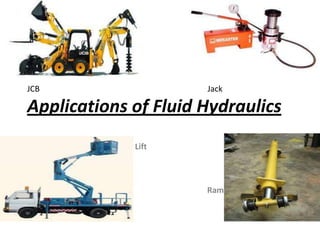
JCB Jack
Applications of Fluid Hydraulics
Lift
Ram
Contents
• 1.Introduction
• 2.Formulas
• 3.Hydraulic brake system
• 4.Hydraulic elevator
• 5.Shock absorber
• 6.Hydraulic ram
• 7.Crane
• 8.Hydraulic press
• 9Advantages and disadvantages
• 10.Conclusion
Introduction
Hydraulics is used for the generation, control, and transmission of fluids in
order to produce some mechanical work .
Formulas :
• Hydraulic power is defined as flow times pressure. The hydraulic power
supplied by a pump : Power = (P x Q) ÷ 600where power is in kilowatts
[kW], P pressure in bars, and Q is the flow in liters per minute.
• For example, a pump delivers 180 lit/min and the pressure equals 250
bar, therefore the power of the pump is 75 kW.
• Power input = Power output ÷ ηtotal. For example,the average for axial
piston pumps, ηtotal = 0.87 , the diesel engine or an electric motor, must
be capable of delivering at least 75 ÷ 0.87 = 86 kW.
• ηtotal = ηvol ηhm.
• ηvol =volumetric efficiency , ηhm=hydromechanical efficiency .
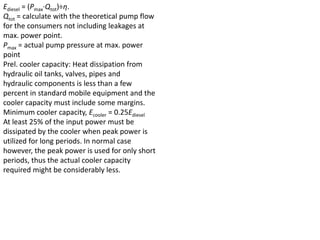
Ediesel = (Pmax·Qtot)÷η.
Qtot = calculate with the theoretical pump flow
for the consumers not including leakages at
max. power point.
Pmax = actual pump pressure at max. power
point
Prel. cooler capacity: Heat dissipation from
hydraulic oil tanks, valves, pipes and
hydraulic components is less than a few
percent in standard mobile equipment and the
cooler capacity must include some margins.
Minimum cooler capacity, Ecooler = 0.25Ediesel
At least 25% of the input power must be
dissipated by the cooler when peak power is
utilized for long periods. In normal case
however, the peak power is used for only short
periods, thus the actual cooler capacity
required might be considerably less.
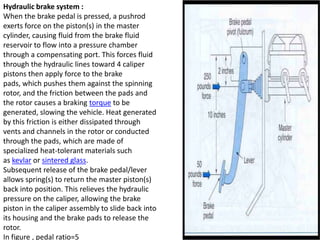
Hydraulic brake system :
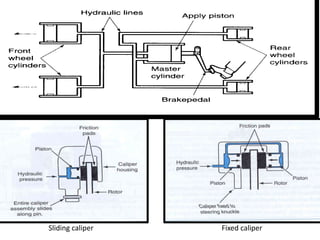
When the brake pedal is pressed, a pushrod
exerts force on the piston(s) in the master
cylinder, causing fluid from the brake fluid
reservoir to flow into a pressure chamber
through a compensating port. This forces fluid
through the hydraulic lines toward 4 caliper
pistons then apply force to the brake
pads, which pushes them against the spinning
rotor, and the friction between the pads and
the rotor causes a braking torque to be
generated, slowing the vehicle. Heat generated
by this friction is either dissipated through
vents and channels in the rotor or conducted
through the pads, which are made of
specialized heat-tolerant materials such
as kevlar or sintered glass.
Subsequent release of the brake pedal/lever
allows spring(s) to return the master piston(s)
back into position. This relieves the hydraulic
pressure on the caliper, allowing the brake
piston in the caliper assembly to slide back into
its housing and the brake pads to release the
rotor.
In figure , pedal ratio=5
Sliding caliper Fixed caliper
Hydraulic elevator
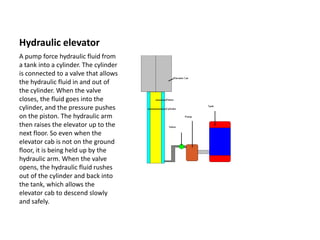
A pump force hydraulic fluid from
a tank into a cylinder. The cylinder
is connected to a valve that allows
the hydraulic fluid in and out of
the cylinder. When the valve
closes, the fluid goes into the
cylinder, and the pressure pushes
on the piston. The hydraulic arm
then raises the elevator up to the
next floor. So even when the
elevator cab is not on the ground
floor, it is being held up by the
hydraulic arm. When the valve
opens, the hydraulic fluid rushes
out of the cylinder and back into
the tank, which allows the
elevator cab to descend slowly
and safely.
Hydraulic shock absorber
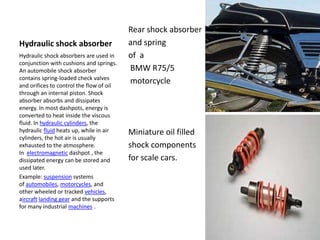
Rear shock absorber
and spring
of a
BMW R75/5
motorcycle
Miniature oil filled
shock components
for scale cars.
Hydraulic shock absorbers are used in
conjunction with cushions and springs.
An automobile shock absorber
contains spring-loaded check valves
and orifices to control the flow of oil
through an internal piston. Shock
absorber absorbs and dissipates
energy. In most dashpots, energy is
converted to heat inside the viscous
fluid. In hydraulic cylinders, the
hydraulic fluid heats up, while in air
cylinders, the hot air is usually
exhausted to the atmosphere.
In electromagnetic dashpot , the
dissipated energy can be stored and
used later.
Example: suspension systems
of automobiles, motorcycles, and
other wheeled or tracked vehicles,
aircraft landing gear and the supports
for many industrial machines .
Hydaulic Ram
The hydraulic ram pump is a
self-acting device that uses the
energy of a large volume of
water falling from a higher
location (relative to the ram)
and passing through it, to lift a
small volume to a location
significantly higher than the ram
and the source of water .
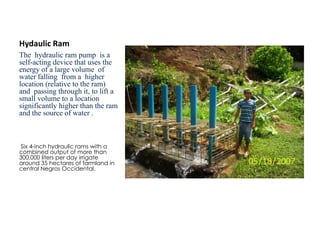
Six 4-inch hydraulic rams with a
combined output of more than
300,000 liters per day irrigate
around 35 hectares of farmland in
central Negros Occidental.
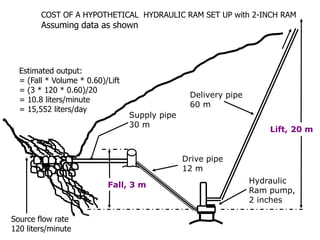
COST OF A HYPOTHETICAL HYDRAULIC RAM SET UP with 2-INCH RAM
Assuming data as shown
Fall, 3 m
Lift, 20 m
Supply pipe
30 m
Drive pipe
12 m
Hydraulic
Ram pump,
2 inches
Delivery pipe
60 m
Source flow rate
120 liters/minute
Estimated output:
= (Fall * Volume * 0.60)/Lift
= (3 * 120 * 0.60)/20
= 10.8 liters/minute
= 15,552 liters/day
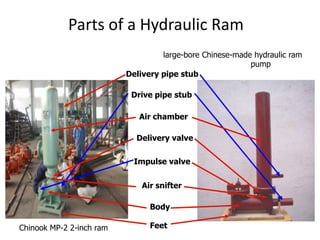
Parts of a Hydraulic Ram
Air chamber
Impulse valve
Body
Feet
Delivery pipe stub
Delivery valve
Drive pipe stub
Air snifter
Chinook MP-2 2-inch ram
large-bore Chinese-made hydraulic ram
pump
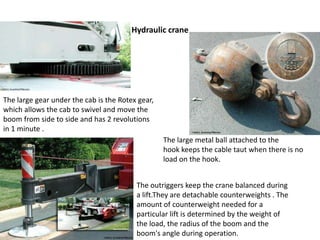
Hydraulic crane
The large metal ball attached to the
hook keeps the cable taut when there is no
load on the hook.
The large gear under the cab is the Rotex gear,
which allows the cab to swivel and move the
boom from side to side and has 2 revolutions
in 1 minute .
The outriggers keep the crane balanced during
a lift.They are detachable counterweights . The
amount of counterweight needed for a
particular lift is determined by the weight of
the load, the radius of the boom and the
boom's angle during operation.
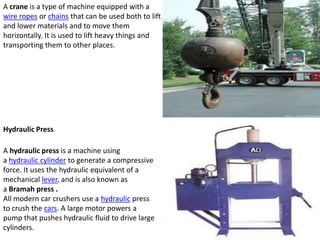
A crane is a type of machine equipped with a
wire ropes or chains that can be used both to lift
and lower materials and to move them
horizontally. It is used to lift heavy things and
transporting them to other places.
A hydraulic press is a machine using
a hydraulic cylinder to generate a compressive
force. It uses the hydraulic equivalent of a
mechanical lever, and is also known as
a Bramah press .
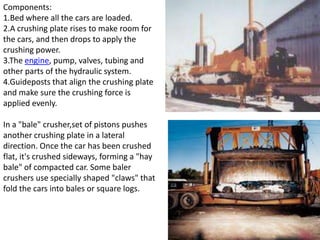
All modern car crushers use a hydraulic press
to crush the cars. A large motor powers a
pump that pushes hydraulic fluid to drive large
cylinders.
Hydraulic Press
Components:
1.Bed where all the cars are loaded.
2.A crushing plate rises to make room for
the cars, and then drops to apply the
crushing power.
3.The engine, pump, valves, tubing and
other parts of the hydraulic system.
4.Guideposts that align the crushing plate
and make sure the crushing force is
applied evenly.
In a "bale" crusher,set of pistons pushes
another crushing plate in a lateral
direction. Once the car has been crushed
flat, it's crushed sideways, forming a "hay
bale" of compacted car. Some baler
crushers use specially shaped "claws" that
fold the cars into bales or square logs.
Advantages Disadvantages
• 1.High horsepower, low weight
Low speed torque,Constant force or torque .
• 2.Safety in hazardous environments .
3. The hydraulic system is convenient to operate
and control .
4. The hydraulic system has light weight, small
size, small inertia, and fast response.
5. The hydraulic system can realize automatic
overload protection.
6. The hydraulic system is very easy to achieve
linear motion.
7. The various components and vertical dryer of
the hydraulic system can be easy and flexible to
arrange as needed.
8. The hydraulic system is very easy to realize
machine automation, and after the use of
combined electro-hydraulic control, it can not
only achieve a higher degree of automatic
control process, but also realize remote control.
9.The hydraulic system generally uses mineral oil
as working medium, and the relative motion
surface can be self-lubricated with long service
life.
• 1.Can easily cause burns and irritations
due to pressurized fluid.
• 2.It requires a higher precision, so it is
expensive.
3. For the influence of the work
performance of its medium leakage and
compressibility, it cannot reach the
strict transmission ratio.
• 4. As a result of performance vulnerable
to temperature changes, it should not
work under the conditions of high or
low temperature.
5. The fluid flow resistance and leakage
is high, so the efficiency is relatively
low. If not handled properly, leakage
will not only contaminate sites, but also
cause fires and explosions.
Conclusion
• Hydraulic fluids are the medium by which power is transferred
in hydraulic machinery. Common hydraulic fluids are based on mineral
oil or water. Examples of equipment that use hydraulic fluids
include excavators and backhoes, hydraulic brakes, power
steering systems, transmissions, garbage trucks, aircraft flight control
systems, lifts, and industrial machinery.
• Hydraulic systems will work most efficiently if the hydraulic fluid used has
zero compressibility.
• Because industrial hydraulic systems operate at several hundreds to
thousands of PSI (1 PSI=pound/inch square= 6894.75729 Pa)and
temperatures reaching hundreds of degrees Celsius, severe injuries and
death can result from component failures and care must always be taken
when performing maintenance on hydraulic systems.
• Fire resistance is a property available with specialized fluids.

Applications of fluid hydraulics

  • 1.
    I.T.S. Engineering College •Sumit Lakhera • Branch- Mechanical • 3rd year • Section - B-2 •
  • 2.
    JCB Jack Applications ofFluid Hydraulics Lift Ram
  • 3.
    Contents • 1.Introduction • 2.Formulas •3.Hydraulic brake system • 4.Hydraulic elevator • 5.Shock absorber • 6.Hydraulic ram • 7.Crane • 8.Hydraulic press • 9Advantages and disadvantages • 10.Conclusion
  • 4.
    Introduction Hydraulics is usedfor the generation, control, and transmission of fluids in order to produce some mechanical work . Formulas : • Hydraulic power is defined as flow times pressure. The hydraulic power supplied by a pump : Power = (P x Q) ÷ 600where power is in kilowatts [kW], P pressure in bars, and Q is the flow in liters per minute. • For example, a pump delivers 180 lit/min and the pressure equals 250 bar, therefore the power of the pump is 75 kW. • Power input = Power output ÷ ηtotal. For example,the average for axial piston pumps, ηtotal = 0.87 , the diesel engine or an electric motor, must be capable of delivering at least 75 ÷ 0.87 = 86 kW. • ηtotal = ηvol ηhm. • ηvol =volumetric efficiency , ηhm=hydromechanical efficiency .
  • 5.
    Ediesel = (Pmax·Qtot)÷η. Qtot= calculate with the theoretical pump flow for the consumers not including leakages at max. power point. Pmax = actual pump pressure at max. power point Prel. cooler capacity: Heat dissipation from hydraulic oil tanks, valves, pipes and hydraulic components is less than a few percent in standard mobile equipment and the cooler capacity must include some margins. Minimum cooler capacity, Ecooler = 0.25Ediesel At least 25% of the input power must be dissipated by the cooler when peak power is utilized for long periods. In normal case however, the peak power is used for only short periods, thus the actual cooler capacity required might be considerably less.
  • 6.
    Hydraulic brake system: When the brake pedal is pressed, a pushrod exerts force on the piston(s) in the master cylinder, causing fluid from the brake fluid reservoir to flow into a pressure chamber through a compensating port. This forces fluid through the hydraulic lines toward 4 caliper pistons then apply force to the brake pads, which pushes them against the spinning rotor, and the friction between the pads and the rotor causes a braking torque to be generated, slowing the vehicle. Heat generated by this friction is either dissipated through vents and channels in the rotor or conducted through the pads, which are made of specialized heat-tolerant materials such as kevlar or sintered glass. Subsequent release of the brake pedal/lever allows spring(s) to return the master piston(s) back into position. This relieves the hydraulic pressure on the caliper, allowing the brake piston in the caliper assembly to slide back into its housing and the brake pads to release the rotor. In figure , pedal ratio=5
  • 7.
  • 8.
    Hydraulic elevator A pumpforce hydraulic fluid from a tank into a cylinder. The cylinder is connected to a valve that allows the hydraulic fluid in and out of the cylinder. When the valve closes, the fluid goes into the cylinder, and the pressure pushes on the piston. The hydraulic arm then raises the elevator up to the next floor. So even when the elevator cab is not on the ground floor, it is being held up by the hydraulic arm. When the valve opens, the hydraulic fluid rushes out of the cylinder and back into the tank, which allows the elevator cab to descend slowly and safely.
  • 9.
    Hydraulic shock absorber Rearshock absorber and spring of a BMW R75/5 motorcycle Miniature oil filled shock components for scale cars. Hydraulic shock absorbers are used in conjunction with cushions and springs. An automobile shock absorber contains spring-loaded check valves and orifices to control the flow of oil through an internal piston. Shock absorber absorbs and dissipates energy. In most dashpots, energy is converted to heat inside the viscous fluid. In hydraulic cylinders, the hydraulic fluid heats up, while in air cylinders, the hot air is usually exhausted to the atmosphere. In electromagnetic dashpot , the dissipated energy can be stored and used later. Example: suspension systems of automobiles, motorcycles, and other wheeled or tracked vehicles, aircraft landing gear and the supports for many industrial machines .
  • 10.
    Hydaulic Ram The hydraulicram pump is a self-acting device that uses the energy of a large volume of water falling from a higher location (relative to the ram) and passing through it, to lift a small volume to a location significantly higher than the ram and the source of water . Six 4-inch hydraulic rams with a combined output of more than 300,000 liters per day irrigate around 35 hectares of farmland in central Negros Occidental.
  • 11.
    COST OF AHYPOTHETICAL HYDRAULIC RAM SET UP with 2-INCH RAM Assuming data as shown Fall, 3 m Lift, 20 m Supply pipe 30 m Drive pipe 12 m Hydraulic Ram pump, 2 inches Delivery pipe 60 m Source flow rate 120 liters/minute Estimated output: = (Fall * Volume * 0.60)/Lift = (3 * 120 * 0.60)/20 = 10.8 liters/minute = 15,552 liters/day
  • 12.
    Parts of aHydraulic Ram Air chamber Impulse valve Body Feet Delivery pipe stub Delivery valve Drive pipe stub Air snifter Chinook MP-2 2-inch ram large-bore Chinese-made hydraulic ram pump
  • 13.
    Hydraulic crane The largemetal ball attached to the hook keeps the cable taut when there is no load on the hook. The large gear under the cab is the Rotex gear, which allows the cab to swivel and move the boom from side to side and has 2 revolutions in 1 minute . The outriggers keep the crane balanced during a lift.They are detachable counterweights . The amount of counterweight needed for a particular lift is determined by the weight of the load, the radius of the boom and the boom's angle during operation.
  • 14.
    A crane isa type of machine equipped with a wire ropes or chains that can be used both to lift and lower materials and to move them horizontally. It is used to lift heavy things and transporting them to other places. A hydraulic press is a machine using a hydraulic cylinder to generate a compressive force. It uses the hydraulic equivalent of a mechanical lever, and is also known as a Bramah press . All modern car crushers use a hydraulic press to crush the cars. A large motor powers a pump that pushes hydraulic fluid to drive large cylinders. Hydraulic Press
  • 15.
    Components: 1.Bed where allthe cars are loaded. 2.A crushing plate rises to make room for the cars, and then drops to apply the crushing power. 3.The engine, pump, valves, tubing and other parts of the hydraulic system. 4.Guideposts that align the crushing plate and make sure the crushing force is applied evenly. In a "bale" crusher,set of pistons pushes another crushing plate in a lateral direction. Once the car has been crushed flat, it's crushed sideways, forming a "hay bale" of compacted car. Some baler crushers use specially shaped "claws" that fold the cars into bales or square logs.
  • 16.
    Advantages Disadvantages • 1.Highhorsepower, low weight Low speed torque,Constant force or torque . • 2.Safety in hazardous environments . 3. The hydraulic system is convenient to operate and control . 4. The hydraulic system has light weight, small size, small inertia, and fast response. 5. The hydraulic system can realize automatic overload protection. 6. The hydraulic system is very easy to achieve linear motion. 7. The various components and vertical dryer of the hydraulic system can be easy and flexible to arrange as needed. 8. The hydraulic system is very easy to realize machine automation, and after the use of combined electro-hydraulic control, it can not only achieve a higher degree of automatic control process, but also realize remote control. 9.The hydraulic system generally uses mineral oil as working medium, and the relative motion surface can be self-lubricated with long service life. • 1.Can easily cause burns and irritations due to pressurized fluid. • 2.It requires a higher precision, so it is expensive. 3. For the influence of the work performance of its medium leakage and compressibility, it cannot reach the strict transmission ratio. • 4. As a result of performance vulnerable to temperature changes, it should not work under the conditions of high or low temperature. 5. The fluid flow resistance and leakage is high, so the efficiency is relatively low. If not handled properly, leakage will not only contaminate sites, but also cause fires and explosions.
  • 17.
    Conclusion • Hydraulic fluidsare the medium by which power is transferred in hydraulic machinery. Common hydraulic fluids are based on mineral oil or water. Examples of equipment that use hydraulic fluids include excavators and backhoes, hydraulic brakes, power steering systems, transmissions, garbage trucks, aircraft flight control systems, lifts, and industrial machinery. • Hydraulic systems will work most efficiently if the hydraulic fluid used has zero compressibility. • Because industrial hydraulic systems operate at several hundreds to thousands of PSI (1 PSI=pound/inch square= 6894.75729 Pa)and temperatures reaching hundreds of degrees Celsius, severe injuries and death can result from component failures and care must always be taken when performing maintenance on hydraulic systems. • Fire resistance is a property available with specialized fluids.