Hydraulic Motors

 Brought to you by:
  Demetri Preonas
  Greg Unverferth
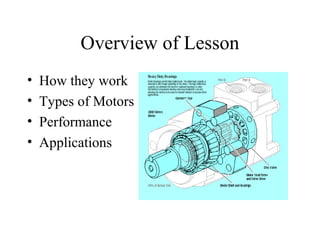
Overview of Lesson
•   How they work
•   Types of Motors
•   Performance
•   Applications
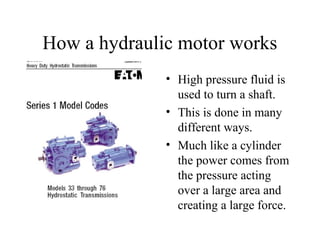
How a hydraulic motor works
              • High pressure fluid is
                used to turn a shaft.
              • This is done in many
                different ways.
              • Much like a cylinder
                the power comes from
                the pressure acting
                over a large area and
                creating a large force.
Types of Hydraulic Motors
•   Gear Motors
•   Vane Motors
•   Piston Motors
•   Limited Rotation Actuator
Gear Motors
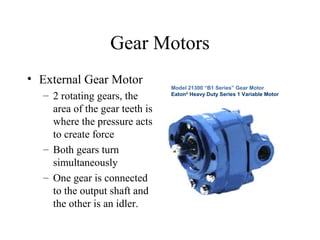
• External Gear Motor
                                Model 21300 “B1 Series” Gear Motor
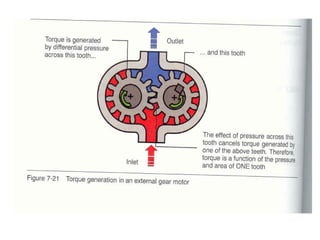
  – 2 rotating gears, the       Eaton® Heavy Duty Series 1 Variable Motor


    area of the gear teeth is
    where the pressure acts
    to create force
  – Both gears turn
    simultaneously
  – One gear is connected
    to the output shaft and
    the other is an idler.
Gear Motors
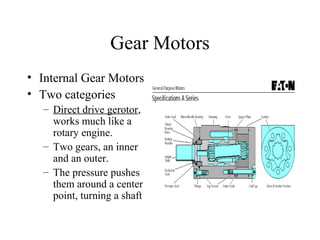
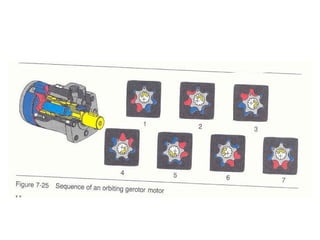
• Internal Gear Motors
• Two categories
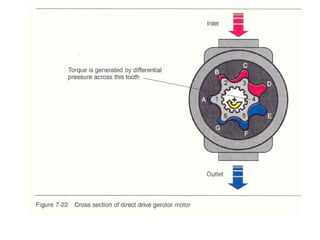
   – Direct drive gerotor,
     works much like a
     rotary engine.
   – Two gears, an inner
     and an outer.
   – The pressure pushes
     them around a center
     point, turning a shaft
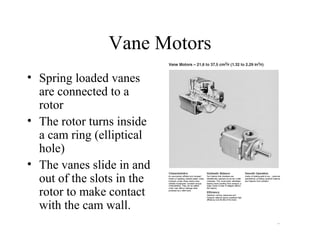
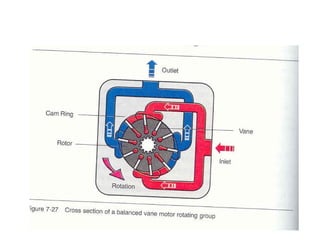
Vane Motors
• Spring loaded vanes
  are connected to a
  rotor
• The rotor turns inside
  a cam ring (elliptical
  hole)
• The vanes slide in and
  out of the slots in the
  rotor to make contact
  with the cam wall.
Piston Motors
• Many different types of piston motors
• All of them use the same basic principles
• Much like a cylinder, only turns a shaft like
  the cylinders in your car engine.
• Generally the most efficient
• High power, high speed, high pressure
Piston Motors
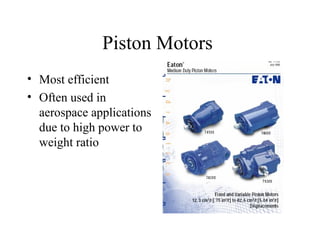
• Most efficient
• Often used in
  aerospace applications
  due to high power to
  weight ratio
In-line Piston Motors
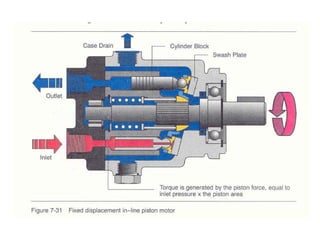
• Simple construction
• Low cost
• Used in low torque
  high speed
  applications, such as
  machine tools
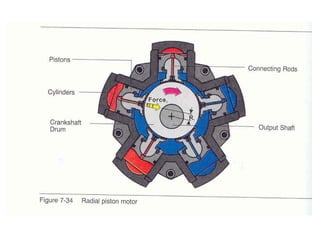
Radial Piston Motors
• High Torque
• Low speed
• Possible application
  could be a roller.
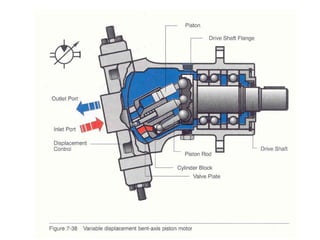
Bent Axis Piston Motor
• Is one example of variable
  displacement motor.
• The angle is altered to
  change the displacement.
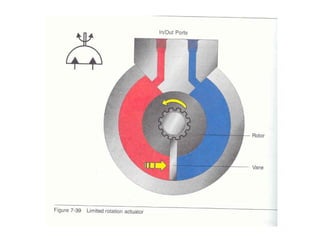
Limited Rotation Actuator
• Also sometimes called
  a oscillator.
• Has limited movement
• High torque
Performance
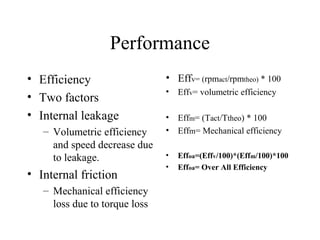
• Efficiency                   • Effv= (rpmact/rpmtheo) * 100
                               •   Effv= volumetric efficiency
• Two factors
• Internal leakage             •   Effm= (Tact/Ttheo) * 100
   – Volumetric efficiency     •   Effm= Mechanical efficiency
     and speed decrease due
     to leakage.               •   Effoa=(Effv/100)*(Effm/100)*100
                               •   Effoa= Over All Efficiency
• Internal friction
   – Mechanical efficiency
     loss due to torque loss
Performance
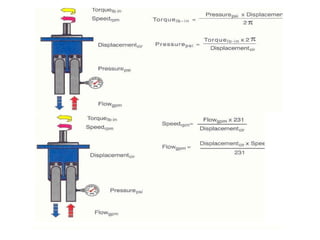
• The mechanical torque   • The rpm desired must
  desired must be           be specified in order to
  specified in order to     find required flow
  find required working     rate.
  pressure.
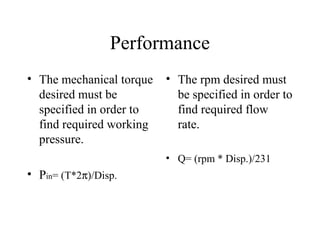
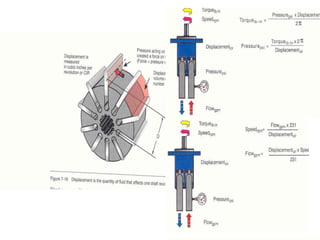
                          • Q= (rpm * Disp.)/231
• Pin= (T*2π)/Disp.
Power
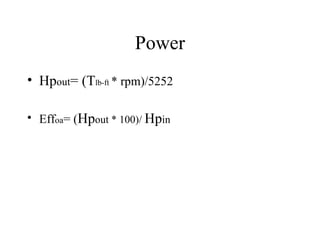
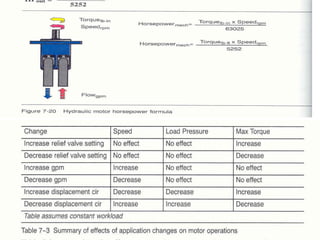
• Hpout= (Tlb-ft * rpm)/5252

• Effoa= (Hpout * 100)/ Hpin
You just learned:
• How a hydraulic motor works
• The basics of the different types of motors
• Some possible applications for hydraulic
  motors
• How to calculate power
• How to find efficiency

Hydraulic motors

  • 1.
    Hydraulic Motors Broughtto you by: Demetri Preonas Greg Unverferth
  • 2.
    Overview of Lesson • How they work • Types of Motors • Performance • Applications
  • 3.
    How a hydraulicmotor works • High pressure fluid is used to turn a shaft. • This is done in many different ways. • Much like a cylinder the power comes from the pressure acting over a large area and creating a large force.
  • 4.
    Types of HydraulicMotors • Gear Motors • Vane Motors • Piston Motors • Limited Rotation Actuator
  • 5.
    Gear Motors • ExternalGear Motor Model 21300 “B1 Series” Gear Motor – 2 rotating gears, the Eaton® Heavy Duty Series 1 Variable Motor area of the gear teeth is where the pressure acts to create force – Both gears turn simultaneously – One gear is connected to the output shaft and the other is an idler.
  • 7.
    Gear Motors • InternalGear Motors • Two categories – Direct drive gerotor, works much like a rotary engine. – Two gears, an inner and an outer. – The pressure pushes them around a center point, turning a shaft
  • 10.
    Vane Motors • Springloaded vanes are connected to a rotor • The rotor turns inside a cam ring (elliptical hole) • The vanes slide in and out of the slots in the rotor to make contact with the cam wall.
  • 12.
    Piston Motors • Manydifferent types of piston motors • All of them use the same basic principles • Much like a cylinder, only turns a shaft like the cylinders in your car engine. • Generally the most efficient • High power, high speed, high pressure
  • 13.
    Piston Motors • Mostefficient • Often used in aerospace applications due to high power to weight ratio
  • 14.
    In-line Piston Motors •Simple construction • Low cost • Used in low torque high speed applications, such as machine tools
  • 16.
    Radial Piston Motors •High Torque • Low speed • Possible application could be a roller.
  • 18.
    Bent Axis PistonMotor • Is one example of variable displacement motor. • The angle is altered to change the displacement.
  • 20.
    Limited Rotation Actuator •Also sometimes called a oscillator. • Has limited movement • High torque
  • 22.
    Performance • Efficiency • Effv= (rpmact/rpmtheo) * 100 • Effv= volumetric efficiency • Two factors • Internal leakage • Effm= (Tact/Ttheo) * 100 – Volumetric efficiency • Effm= Mechanical efficiency and speed decrease due to leakage. • Effoa=(Effv/100)*(Effm/100)*100 • Effoa= Over All Efficiency • Internal friction – Mechanical efficiency loss due to torque loss
  • 25.
    Performance • The mechanicaltorque • The rpm desired must desired must be be specified in order to specified in order to find required flow find required working rate. pressure. • Q= (rpm * Disp.)/231 • Pin= (T*2π)/Disp.
  • 27.
    Power • Hpout= (Tlb-ft* rpm)/5252 • Effoa= (Hpout * 100)/ Hpin
  • 29.
    You just learned: •How a hydraulic motor works • The basics of the different types of motors • Some possible applications for hydraulic motors • How to calculate power • How to find efficiency

Editor's Notes

  • #2 Demetri
  • #3 Demetri
  • #4 Greg
  • #5 Greg
  • #6 The two gears are enclosed in a housing. Close tolerances between the gear teeth and the housing help to prevent fluid leakage and increase volumetric efficiency. FIGURE 7-21 on page 158 Demetri
  • #7 Demitri
  • #8 Figure 7-23 on page 159 and a better stepped progression picture in figure 7-23 on page 160 two cutaway pictures on page 161 Demetri
  • #10 Demetri
  • #11 Figures 7-27 through 7-29 on pages 162 and 163 Greg
  • #12 Greg
  • #13 Greg
  • #14 Greg
  • #15 Figure 7-31 on page 165 Demetri
  • #16 Demetri
  • #17 Figure 7-34 on page 166 Demetri
  • #18 Demetri
  • #19 Figure 7-37,38 pages 168, 169 Greg
  • #20 Greg
  • #21 Figure 7-38 page 170 Greg
  • #22 Greg
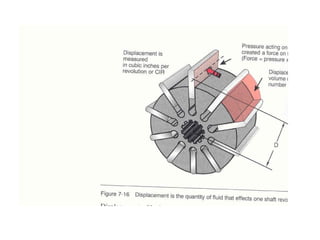
  • #23 Figure 7-16 on page 152 Demetri
  • #24 Demetri
  • #25 Demetri
  • #26 Demetri
  • #27 Demetri
  • #28 Greg
  • #29 Greg
  • #30 Demetri