TERM PAPER ON:
HYDRAULIC SYSTEM
PRESENTED BY:
GOPAL CARPENTER
12-543-008
The term hydraulics is
Hydor+aulos
Hydor –means water
Aulos- pipe
Necessity of hydraulics:
1.To lift or load the implement
2.To set the draft at the time of tillage operations
Pascal’s Law
Pressure exerted at any point on
a confined liquid is transmitted
undiminished in all directions.
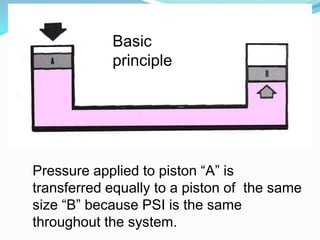
Pressure applied to piston “A” is
transferred equally to a piston of the same
size “B” because PSI is the same
throughout the system.
Basic
principle
Pascal’s Law
 Pressure applied to a
confined fluid is:
 transmitted undiminished in
all directions,
 acts with equal force on equal
areas, and
 acts at a right angle to the
walls of the container.
10 psi
10-lb
1 in2
Area = 10 in2
Force = 100-lbs.
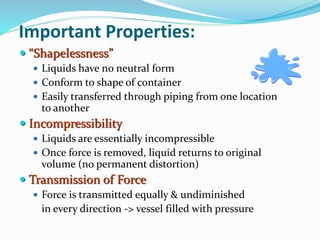
Important Properties:
 “Shapelessness”
 Liquids have no neutral form
 Conform to shape of container
 Easily transferred through piping from one location
to another
 Incompressibility
 Liquids are essentially incompressible
 Once force is removed, liquid returns to original
volume (no permanent distortion)
 Transmission of Force
 Force is transmitted equally & undiminished
in every direction -> vessel filled with pressure
Components of hydraulics:
1.Reservoir
2.Hydraulic
pump
3.Hydraulic
cylinder
4.Hydraulic
piston
5.Control valve
6.Relief valve
Hydraulic circuit:
A hydraulic circuit is a system comprising
an interconnected set of discrete
components that transport liquid.
Pump
Functions in a hydraulic
system by pressurizing
and moving fluid from one
part of the system to
another.
Hydraulic pumps are usually of three
types:
1. GEAR PUMP
2. PISTON PUMP
3. VANE PUMP
Gear Pumps:
 Fixed or constant displacement pump.
 Work well at 1500 psi and below
 Work with a minimum of moving parts
 Less expensive to manufacture than piston
type pumps
Gear
Pump driven gear
idler gear
Piston Pumps
 Work well at 2000 psi or more.
 Require several pistons working together to
generate enough volume for tractor
applications
 Necessarily involve many moving parts
 Two types-1.Axial piston pump
2.Radial piston pump
Vane pump
 Also works at 1500 psi and below
 Three types-1.sliding vane
 2.swinging vane 3.Rolling vane
Hydraulic Cylinders:
 The main function of a cylinder is to convert hydraulic
power into linear mechanical force.
 This force performs work or transmits power.
 Types : 1.Ram cylinder
2.Single Acting
3.Telescopic
4.Spring Return
5.Double Acting
Ram Cylinders:
 The simplest single acting cylinder
 One fluid chamber
 Exerts force in only one direction
 Mounted mostly vertically
 The cylinder retracts by the force of the load
due to gravity
 Ram cylinders are most commonly used in
elevators, jacks, and automobile hoists.
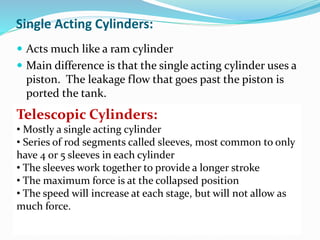
Single Acting Cylinders:
 Acts much like a ram cylinder
 Main difference is that the single acting cylinder uses a
piston. The leakage flow that goes past the piston is
ported the tank.
Telescopic Cylinders:
• Mostly a single acting cylinder
• Series of rod segments called sleeves, most common to only
have 4 or 5 sleeves in each cylinder
• The sleeves work together to provide a longer stroke
• The maximum force is at the collapsed position
• The speed will increase at each stage, but will not allow as
much force.
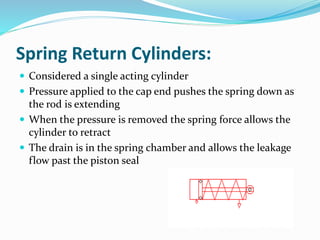
Spring Return Cylinders:
 Considered a single acting cylinder
 Pressure applied to the cap end pushes the spring down as
the rod is extending
 When the pressure is removed the spring force allows the
cylinder to retract
 The drain is in the spring chamber and allows the leakage
flow past the piston seal
Double Acting Cylinders:
 Types:-1.Double acting (differential cylinder)
 2.Double rod cylinder (nondifferential cylinder)
3.Tendom
 Pressure is applied to both rod end and cap end
 Rod extension is slower because has a larger area,
but allows a greater force because of the bigger
area.
 Retract is faster because of the smaller area, but
the force allowed is smaller because of the smaller
area.
Double Acting Cylinders:
Tandem Cylinder-
 Two pistons in line with a common rod
 This allows you to have a greater forces without
increasing the size of the cylinder bore
 Tandem cylinders are used in places where
there is insufficient space to increase the size of
the cylinder bore.
Control valves:
 Functions of a valve:-
1.direct the flow of fluid
2.regulate the pressure
3.control volume
Three types of valves:
 Pressure – adjust psi for some purpose
 Directional -- route the fluid to the desired actuator
 Volume Control or Flow Control -- control the
amount of flow
Accumulators:
 Types:-
 Piston
 Most common
 Bladder
 Gun mounts
 Steering
systems
 Direct contact
 Least common
Hydraulic oil:
 Purposes:-
1.Compressibility
2.Lubrication
3.Sealing
4.Cooling
10/6/2015 25
Fluid Properties:
 These properties include:
 Viscosity and Viscosity Index
 Pour Point
 Specific gravity
 Thermal properties- specific heat & thermal
conductivity
 Lubricating Ability
 Rust and corrosion protection
 Fire resistance
Filters:
Hydraulic lines:
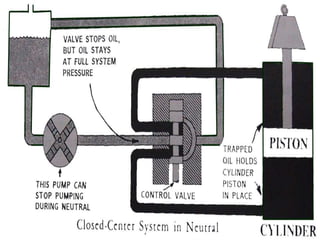
Hydraulic system types:
 Open center system.
 Closed center system.
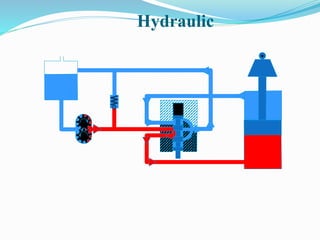
Basic Hydraulic System Operation
Pump
Directional
Control
Valve
Cylinder
Reservoir
Pressure
Relief
Valve
Hydraulic
Hydraulic system

Hydraulic system

  • 1.
    TERM PAPER ON: HYDRAULICSYSTEM PRESENTED BY: GOPAL CARPENTER 12-543-008
  • 2.
    The term hydraulicsis Hydor+aulos Hydor –means water Aulos- pipe
  • 3.
    Necessity of hydraulics: 1.Tolift or load the implement 2.To set the draft at the time of tillage operations
  • 4.
    Pascal’s Law Pressure exertedat any point on a confined liquid is transmitted undiminished in all directions.
  • 5.
    Pressure applied topiston “A” is transferred equally to a piston of the same size “B” because PSI is the same throughout the system. Basic principle
  • 6.
    Pascal’s Law  Pressureapplied to a confined fluid is:  transmitted undiminished in all directions,  acts with equal force on equal areas, and  acts at a right angle to the walls of the container. 10 psi 10-lb 1 in2 Area = 10 in2 Force = 100-lbs.
  • 7.
    Important Properties:  “Shapelessness” Liquids have no neutral form  Conform to shape of container  Easily transferred through piping from one location to another  Incompressibility  Liquids are essentially incompressible  Once force is removed, liquid returns to original volume (no permanent distortion)  Transmission of Force  Force is transmitted equally & undiminished in every direction -> vessel filled with pressure
  • 8.
  • 9.
    Hydraulic circuit: A hydrauliccircuit is a system comprising an interconnected set of discrete components that transport liquid.
  • 10.
    Pump Functions in ahydraulic system by pressurizing and moving fluid from one part of the system to another.
  • 11.
    Hydraulic pumps areusually of three types: 1. GEAR PUMP 2. PISTON PUMP 3. VANE PUMP
  • 12.
    Gear Pumps:  Fixedor constant displacement pump.  Work well at 1500 psi and below  Work with a minimum of moving parts  Less expensive to manufacture than piston type pumps
  • 13.
  • 14.
    Piston Pumps  Workwell at 2000 psi or more.  Require several pistons working together to generate enough volume for tractor applications  Necessarily involve many moving parts  Two types-1.Axial piston pump 2.Radial piston pump
  • 15.
    Vane pump  Alsoworks at 1500 psi and below  Three types-1.sliding vane  2.swinging vane 3.Rolling vane
  • 16.
    Hydraulic Cylinders:  Themain function of a cylinder is to convert hydraulic power into linear mechanical force.  This force performs work or transmits power.  Types : 1.Ram cylinder 2.Single Acting 3.Telescopic 4.Spring Return 5.Double Acting
  • 17.
    Ram Cylinders:  Thesimplest single acting cylinder  One fluid chamber  Exerts force in only one direction  Mounted mostly vertically  The cylinder retracts by the force of the load due to gravity  Ram cylinders are most commonly used in elevators, jacks, and automobile hoists.
  • 18.
    Single Acting Cylinders: Acts much like a ram cylinder  Main difference is that the single acting cylinder uses a piston. The leakage flow that goes past the piston is ported the tank. Telescopic Cylinders: • Mostly a single acting cylinder • Series of rod segments called sleeves, most common to only have 4 or 5 sleeves in each cylinder • The sleeves work together to provide a longer stroke • The maximum force is at the collapsed position • The speed will increase at each stage, but will not allow as much force.
  • 19.
    Spring Return Cylinders: Considered a single acting cylinder  Pressure applied to the cap end pushes the spring down as the rod is extending  When the pressure is removed the spring force allows the cylinder to retract  The drain is in the spring chamber and allows the leakage flow past the piston seal
  • 20.
    Double Acting Cylinders: Types:-1.Double acting (differential cylinder)  2.Double rod cylinder (nondifferential cylinder) 3.Tendom  Pressure is applied to both rod end and cap end  Rod extension is slower because has a larger area, but allows a greater force because of the bigger area.  Retract is faster because of the smaller area, but the force allowed is smaller because of the smaller area.
  • 21.
    Double Acting Cylinders: TandemCylinder-  Two pistons in line with a common rod  This allows you to have a greater forces without increasing the size of the cylinder bore  Tandem cylinders are used in places where there is insufficient space to increase the size of the cylinder bore.
  • 22.
    Control valves:  Functionsof a valve:- 1.direct the flow of fluid 2.regulate the pressure 3.control volume Three types of valves:  Pressure – adjust psi for some purpose  Directional -- route the fluid to the desired actuator  Volume Control or Flow Control -- control the amount of flow
  • 23.
    Accumulators:  Types:-  Piston Most common  Bladder  Gun mounts  Steering systems  Direct contact  Least common
  • 24.
  • 25.
    10/6/2015 25 Fluid Properties: These properties include:  Viscosity and Viscosity Index  Pour Point  Specific gravity  Thermal properties- specific heat & thermal conductivity  Lubricating Ability  Rust and corrosion protection  Fire resistance
  • 26.
  • 27.
    Hydraulic system types: Open center system.  Closed center system.
  • 31.
    Basic Hydraulic SystemOperation Pump Directional Control Valve Cylinder Reservoir Pressure Relief Valve
  • 32.