
WELCOMEWELCOME
CORPORATE STORY
By : Krishna Murari
Why Pharmaceutical
The Pharmaceutical In India is the world third largest in terms of
volume and stands 14th
in terms of values.
Why Lupin
 Lupin is the 4th
largest player in Indian pharmaceuticals industry.
 It has emerged as an out performer in the Pharma sector.
 Its Stock counted among frontline farm stock and considered for
the long term buy.
 The company over the year has grown to be one of the top ten
generic company in the USA, Japan & South African market.
About Lupin
 Lupin Limited is an innovation led transnational pharmaceutical
company producing a wide range of quality, affordable generic and
branded formulations.
 Lupin first gained recognition when it became one of the world's
largest manufacturers of Tuberculosis drugs.
 Lupin has emerged as the 4th largest and the fastest growing Top 5
company in the U.S.A.
 Began Operations : 1968
About Lupin
Board of Directors
• Dr Desh Bandhu Gupta - Chairman
• Dr Kamal K Sharma - Managing Director
• Mrs M. D. Gupta - Executive Director
• Mrs Vinita Gupta - Director
• Mr Nilesh Gupta - Executive Director
• Dr Vijay Kelkar - Director
• Mr Richard Zahn - Director
• Mr R. A. Shah – Director
6
Lupin’s FacilitiesLupin’s Facilities
LOCATION PRODUCTS APPROVALS
Mandideep,
Madhya
Pradesh
Cephalosporins
Prils
WHO, US
FDA, UK
Tarapur,
Maharashtra
Rifampicin
Lovastatin
US FDA,
WHO
Ankleshwar,
Gujarat
Ethambutol
Intermediates
WHO
Aurangabad,
Maharashtra
Anti TB
Lisinopril
WHO, MSF,
Verna,
Goa
Non-
cephalosporin
Oral FD
US FDA,
Jammu,
J&K
Oral FD FDA
Indore,
Madhya
Pradesh
API
FD
-
Baroda,
Gujarat
CRAMS -
Pune,
Maharashtra
R&D
Goa
Pune
arapur
nkleshwar
Mandideep
Aurangabad
Jammu
Mumbai
Indore
Baroda
Head Office:- Mumbai, Maharashtra
Vision Of The Company
An Innovation Led,
Transnational
Pharmaceutical Company.
Mision Of The Company
Our mission is to become a
transnational pharmaceutical company
through the development and
introduction of a wide portfolio of
branded and generic products in key
markets.
Values Of The Company
Superior Performance
Entrepreneurship
Customer Orientation
Working Together
Respect for People
Integrity
History & Milestone Of Lupin
1968: Lupin started business.
1972: Lupin Laboratories Pvt. Ltd was incorporated.
1980: Lupin Started a formulations plant and an R&D center at
Aurangabad (Maharastra).
2001: State-of-the-art R&D Centre at Pune was Started.
History & Milestone Of Lupin
2004 : WHO approval was received for State of the art
formulation Plants at Goa and Aurangabad.
2009 : Lupin acquired majority stake in Multicare
Pharmaceuticals Philippines Inc.
2011: Lupin Acquires I'rom Pharmaceuticals through its Japanese
Subsidiary.
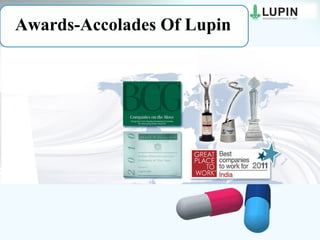
Awards-Accolades Of Lupin
2009 :International Excellence Award by Institute of Economic
Studies.
2010 : Best Drug Development Company, Asia' by The New
Economy Pharmaceutical & Healthcare Awards.
2010: Lupin wins 'The Most Promising Entrant into the Big
League' by CNBC India Business Leader Awards.
2011: Lupin ranked amongst India's Top 3 'Best Companies to
Work For' in Healthcare and Pharma Sector.
2012: Mrs. Vinita Gupta won the Business Today '30 Most
Powerful Women in Business' award.
STP Analysis
STP Analysis
Segmentation
Anti TB segment, Cardiovascular, Oral and injectable, pediatric
products API’s, Anti-Infectives segment .
STP Analysis
Targeting
Healthcare professionals, doctors treating patients suffering from
TB, respiratory & cardiovascular diseases.
STP Analysis
Positioning
It is innovation led pharmaceutical company, which specializes in
generic, API & branded formulations for developed &
developing world.
Marketing Mix
Product
Product on the basis of two types:
Formulation.
API’s.
Product
 Formulation : This is the production of capsules, tablets and
syrup with the help of API’s. A branch which is producing
API’s will send this for formulation.
Product
Product category Segment Product(medicine)
Lupin Pharma Semi acute therapy , Anti-TB R-cinex,Akurit
Lupin Respira Anti-Asthma, respiratory L-cin,Telecast
Endeavour Anti-biotics, pain management Softovac, cefaxone
Maxter Wound management Tazar, Merotrol
Pinnacle Cardiac market Ramistar, Lupenox
Lupin CVN Nephrology Novastat
Lupin Diabetes
Care
Diabetes market Misobit, Telista
Mindvision Neuropsychiatry like stroke,
depression, anxiety
Cognistar, citistar
Lupin Femina Women’s health care segment Faa-20, Luprolide
Product
API’s : This is the active pharmaceutical
ingredient. This is in the form of powder and
this is generally using in the formulation of
medicine. It is the kind of production .
Product
Product category Product(medicine)
Anti-Biotics Cephalexin , Cefadroxil
Anti-TB Rifampicin, Rifabutin
Cardiovascular Lisinnopril, Simvastatin
Central nervous system Lacosamide,Pregabalin
Analgesics Flupirtine
Anti-Gout Febuxostat
Place
 Lupin has created strong foothold in the advanced markets
of USA , Europe, Japan , Australia and emerging markets of
India and some of the other Rest of the world countries.
.
Price
 Initially the company adopted Cost based pricing strategy but after
new Pharma pricing policy, it has changed its pricing policy.
 New Pricing Policy
 New pricing policy is good for the people of India who can buy essential
drugs at cheaper prices and at the same time it is less taxing for the
Pharma companies.
Promotion
 Influencing the physician is key to pharmaceutical sales.
Physicians are the most important players in pharmaceutical
sales.
 Eli Lilly India (Lilly) and Lupin ltd announced that they
have entered into strategic collaboration to promote and
distribute Lilly’s Hum insulin range of products.
PESTAL Analysis
PESTAL Analysis
Political
Governments have a responsibility to take all necessary measures
to ensure that much-needed new medicines are developed,
become available and are accessible.
PESTAL Analysis
Economic
 Global economic crisis.
 Reduction in individual income.
 The economic crisis pressure are seeing an increased growth in
strategic buying groups who are forcing down prices.
PESTAL Analysis
Social/Culture
There is also the problem of the increasing obesity
amongst the population and its associated health risks.
PESTAL Analysis
Technological
The technological advancement creates new business prospects
both in terms of new therapy systems and service provisions. The
online opportunities will see the growth in:
Customized treatment
Social media for health care
Direct to patient advertising
Direct to patient communication
PESTAL Analysis
Legislation
The pharmaceutical industry has many regulatory and legislative
restriction.
Changes to advertising laws.
Increased litigation.
Porter’s five forces Analysis
Power of Buyers
 Generic (low cost versions of the branded drugs) drugs offer
cost-effectives to the innovator drugs and thus offer significant
savings for buyers.
 The bargaining power of buyers is high.
Porter’s five forces Analysis
Power of suppliers
 The barging power is high for API companies with difficult to
manufacture products. These companies command premium
prices. However majority of API suppliers have low barging
power since they produce products which are simple to
manufacture or commoditized.
 Thus bargaining power of suppliers as a whole is Medium.
Porter’s five forces Analysis
Competitive Rivalry
 The growth opportunities for Pharma companies are expected to
grow manifold in the next few years with many drugs going off
patent in the US and emerging countries coming into focus.
 The competitive rivalry is high.
Porter’s five forces Analysis
Availability of substitutes
 The threat of substitution is higher in unbranded markets
where one generic can be substituted by another by the
pharmacists.
 The threat of substitute is high.
Porter’s five forces Analysis
Entry barriers
 Entry barriers in the emerging markets are high due to its branded
nature.
 However the companies require extensive legal knowledge
combined with ability to develop the product earlier than
competition, this is possible for only a few top companies.
Competitor Analysis
Company
Market share of Pharma
company in India
Cipla 5.6
Ranbaxy 4.76
Dr. Reddy's laboratory 4.47
Sun Pharma 4.03
Lupin 2.73
Cadila Healthcare 2.07
Glaxosmithkline Pharmaceuticals 1.79
Matrix Laboratories Ltd. 1.6
Ipca Laboratories Ltd. 1.36
Other 1.29
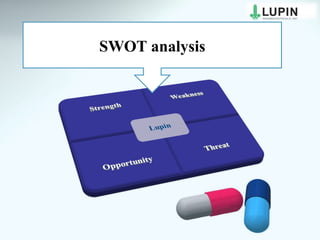
SWOT analysis
SWOT analysis
World wide leader in Anti TB drugs .
In the US and Japanese market it is the largest
generic player.
 Wide global footprint as it is present in over
70 countries
SWOT analysis
 High dependence on global formulation business
with 84% revenue coming from US market.
 It operates in low growth segments such CNS,
respiratory diseases
SWOT analysis
 Increased health awareness.
 Emerging technological trends in
drug delivery.
 Increasing prevalence of TB in
developing countries .
SWOT analysis
 Price regulation by government reduce the pricing
ability of company.
 With around 20000 unorganized and 300 large
organized player makes Indian Pharma industry
highly competitive .
48
Lupin’s Business ModelLupin’s Business Model
Technology
•R&D
•Biotechnology
•Chemical & pharma
engineering
Alliances
•In-Licensing
•Long term partnership with
customers
Sustainable Earnings
Accelerated Growth
Fulfilling Stakeholder
Aspirations
Sustainable Earnings
Accelerated Growth
Fulfilling Stakeholder
Aspirations
Markets
•Advanced Markets –
Exponential Growth
•Geographical
Expansion – Emerging
Markets
• Enhanced Market
Penetration & New
Therapies
Generics Formulation API
Acquisitions
•Markets
•Therapies
•Technology
Financial Statement Analysis
Income Statement
PARTICULARS Mar.12 Mar.11
INCOME Rs. Cr Rs. Cr
Net Sales 7,067.46 5,780.78
Other Income 29.42 44.27
Stock Adjustments 316.91 90.71
Total Income 7,413.79 5,915.76
Expenditure
Raw Materials 3,112.65 2,485.36
Power & Fuel Cost 268.82 205.47
Employee Cost 969.53 767.70
Other Manufacturing Expenses 170.75 137.34
Selling and Admin Expenses 0.00 852.99
Miscellaneous Expenses 1,433.36 232.88
Preoperative Exp Capitalised 0.00 0.00
Total Expenses 5,955.11 4,681.74
PARTICULARS Mar.12 Mar.11
INCOME Rs. Cr Rs. Cr
PBDIT 1,458.68 1,234.02
(-)Interest 35.47 66.84
PBDT 1,423.21 1,167.18
(-)Depreciation 227.52 171.18
Profit Before Tax 1,195.69 996.00
Tax 308.74 116.93
Reported Net Profit 886.95 880.07
PBDIT 1,458.68 1,234.02
(-)Interest 35.47 66.84
PBDT 1,423.21 1,167.18
Book Value (Rs) 89.85 73.53
Balance Sheet Statement
PARTICULARS Mar.12
RS. Cr
Mar.11
Rs . Cr
Sources Of Funds
Equity Share Capital 89.33 89.24
Reserves 3,995.85 3,243.35
Net worth 4,012.89 3,281.08
Secured Loans 764.48 784.13
Unsecured Loans 716.39 378.28
Total Debt 1,480.87 1,162.41
Total Liabilities 5,566.05 4,495.00
Application Of Funds
Gross Block 3,985.52 2,964.34
Less: Accum. Depreciation 1,232.78 907.51
Net Block 2,752.74 2,056.83
Capital Work in Progress 440.64 531.22
PARTICULARS Mar.12 Mar.11
Investments 2.80 3.15
CURRENT ASSETS
Inventories 1,732.67 1,199.96
Sundry Debtors 1,731.81 1,255.82
Cash and Bank Balance 402.47 171.29
Total Current Assets 3,866.95 2,627.07
Loans and Advances 870.89 683.14
Fixed Deposits 0.00 248.83
Total CA, Loans & Advances 4,737.84 3,559.04
Current Liabilities 2,039.29 1,383.43
Provisions 328.68 271.81
Total CL & Provisions 2,367.97 1,655.24
Net Current Assets 2,369.87 1,903.80
Total Assets 5,566.05 4,495.00
RATIO ANALYSIS
0
0.05
0.1
0.15
0.2
0.25
0.3
0.35
0.4
2009-2010 2010-2011 2011-2012
TotalDebt EquityRatio
Total Debt Equity Ratio : Total Debt / Equity
Total Debt To Equity Ratio
2.2
2.25
2.3
2.35
2.4
2.45
2.5
2009-2010 2010-2011 2011-2012
Current Ratio
Current Ratio : Current Assets /Current Liability
Current Ratio
5
5.1
5.2
5.3
5.4
5.5
5.6
5.7
5.8
5.9
6
2009-2010 2010-2011 2011-2012
Inventory Turnover Ratio
Inventory Turnover Ratio : Cost of good sold/ Avg
inventory
Inventory Turnover Ratio
0
0.5
1
1.5
2
2.5
3
2009-2010 2010-2011 2011-2012
Fixed Assets Turnover Ratio
Fixed Assets Turnover Ratio: Cost of good sold/
Avg fixed assets.
Fixed Assets Turnover Ratio
PEERS ANALYSIS
COMPANY
NAME
LAST PRICE NET SALES TOTAL ASSETS
SUN PHARMA 678.50 4015.56 8094.90
CIPLA 378.10 6977.50 7520.84
DR. REDDYS
LAB
1722.40 6686.30 8251.20
LUPIN 561.70 5364.37 4703.07
RANBAXY LABS 511.60 7686.59 6123.38
“Human Resources are something above each
measurement. The capacity of these resources can be
extended indefinitely when each person begin to
think.”
 
To offer differential skill
sets to people for
enhancing competitive
edge.
Philosophy
“To convert employees into leaders in stipulations
of capability to lead self, situation and people.”
Recruitment Process
Lupin is using three different medium for selecting the right talent:
Management Trainee Programme
Young Leaders Programme
Advertisement
Learning and Development
 Lupin has instituted various programs aimed at developing
leadership qualities for first line supervisors, mid-sized team
leaders or large function heads.
 They have developed specific programs in order to groom this
talent pool on individual basis in 3 areas:
• Education
• Training & Development
• Job rotation / exposure
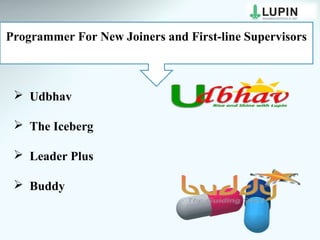
Programmer For New Joiners and First-line Supervisors
 Udbhav
 The Iceberg
 Leader Plus
 Buddy
For Managers:
 AMEX (Accelerating Managerial Excellence)
 Manufacturing Business Leadership Programme
 Executive Coaching For Senior Management
Performance Appraisal
 Employee appraisals are a balancing act between the
expectations of employees and the management's
perception of the employee's contribution to business
goals.
 The Company use Management By Objective Method for
Performance Appraisal.
 It is a developmental aspect as it involves employee
training for right fit.
Need of HR Specialized employees
Issue:
Higher Education Aspirations.
Solution:
Introduction of the PhD Program at the Lupin Research Park.
Whistle Blowing Policy
Whistleblowing encourages and enables employees to raise
serious concerns within the Council rather than overlooking a
problem or 'blowing the whistle' outside.
Transparency helps Companies to redefine processes and
make improvements.
Corporate Social Responsibility
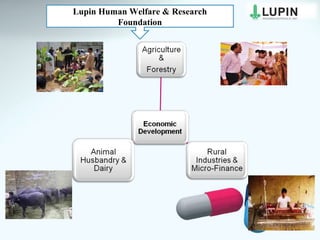
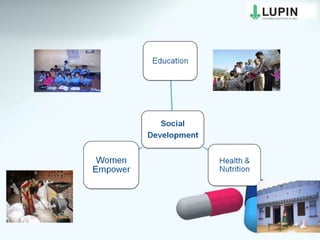
Lupin Human Welfare & Research
Foundation
Milestones of LHWRF
 Won the FICCI Ladies Organization Award for Women
Welfare.
 Third Dalmia Environment Award for best water
management practices.
 Award for outstanding achievement in rural development.
Lupin

Lupin

  • 1.
  • 2.
    Why Pharmaceutical The PharmaceuticalIn India is the world third largest in terms of volume and stands 14th in terms of values.
  • 3.
    Why Lupin  Lupinis the 4th largest player in Indian pharmaceuticals industry.  It has emerged as an out performer in the Pharma sector.  Its Stock counted among frontline farm stock and considered for the long term buy.  The company over the year has grown to be one of the top ten generic company in the USA, Japan & South African market.
  • 4.
    About Lupin  LupinLimited is an innovation led transnational pharmaceutical company producing a wide range of quality, affordable generic and branded formulations.  Lupin first gained recognition when it became one of the world's largest manufacturers of Tuberculosis drugs.  Lupin has emerged as the 4th largest and the fastest growing Top 5 company in the U.S.A.  Began Operations : 1968
  • 5.
    About Lupin Board ofDirectors • Dr Desh Bandhu Gupta - Chairman • Dr Kamal K Sharma - Managing Director • Mrs M. D. Gupta - Executive Director • Mrs Vinita Gupta - Director • Mr Nilesh Gupta - Executive Director • Dr Vijay Kelkar - Director • Mr Richard Zahn - Director • Mr R. A. Shah – Director
  • 6.
    6 Lupin’s FacilitiesLupin’s Facilities LOCATIONPRODUCTS APPROVALS Mandideep, Madhya Pradesh Cephalosporins Prils WHO, US FDA, UK Tarapur, Maharashtra Rifampicin Lovastatin US FDA, WHO Ankleshwar, Gujarat Ethambutol Intermediates WHO Aurangabad, Maharashtra Anti TB Lisinopril WHO, MSF, Verna, Goa Non- cephalosporin Oral FD US FDA, Jammu, J&K Oral FD FDA Indore, Madhya Pradesh API FD - Baroda, Gujarat CRAMS - Pune, Maharashtra R&D Goa Pune arapur nkleshwar Mandideep Aurangabad Jammu Mumbai Indore Baroda Head Office:- Mumbai, Maharashtra
  • 7.
    Vision Of TheCompany An Innovation Led, Transnational Pharmaceutical Company.
  • 8.
    Mision Of TheCompany Our mission is to become a transnational pharmaceutical company through the development and introduction of a wide portfolio of branded and generic products in key markets.
  • 9.
    Values Of TheCompany Superior Performance Entrepreneurship Customer Orientation Working Together Respect for People Integrity
  • 10.
    History & MilestoneOf Lupin 1968: Lupin started business. 1972: Lupin Laboratories Pvt. Ltd was incorporated. 1980: Lupin Started a formulations plant and an R&D center at Aurangabad (Maharastra). 2001: State-of-the-art R&D Centre at Pune was Started.
  • 11.
    History & MilestoneOf Lupin 2004 : WHO approval was received for State of the art formulation Plants at Goa and Aurangabad. 2009 : Lupin acquired majority stake in Multicare Pharmaceuticals Philippines Inc. 2011: Lupin Acquires I'rom Pharmaceuticals through its Japanese Subsidiary.
  • 12.
  • 13.
    Awards-Accolades Of Lupin 2009:International Excellence Award by Institute of Economic Studies. 2010 : Best Drug Development Company, Asia' by The New Economy Pharmaceutical & Healthcare Awards. 2010: Lupin wins 'The Most Promising Entrant into the Big League' by CNBC India Business Leader Awards. 2011: Lupin ranked amongst India's Top 3 'Best Companies to Work For' in Healthcare and Pharma Sector. 2012: Mrs. Vinita Gupta won the Business Today '30 Most Powerful Women in Business' award.
  • 14.
  • 15.
    STP Analysis Segmentation Anti TBsegment, Cardiovascular, Oral and injectable, pediatric products API’s, Anti-Infectives segment .
  • 16.
    STP Analysis Targeting Healthcare professionals,doctors treating patients suffering from TB, respiratory & cardiovascular diseases.
  • 17.
    STP Analysis Positioning It isinnovation led pharmaceutical company, which specializes in generic, API & branded formulations for developed & developing world.
  • 18.
  • 19.
    Product Product on thebasis of two types: Formulation. API’s.
  • 20.
    Product  Formulation :This is the production of capsules, tablets and syrup with the help of API’s. A branch which is producing API’s will send this for formulation.
  • 21.
    Product Product category SegmentProduct(medicine) Lupin Pharma Semi acute therapy , Anti-TB R-cinex,Akurit Lupin Respira Anti-Asthma, respiratory L-cin,Telecast Endeavour Anti-biotics, pain management Softovac, cefaxone Maxter Wound management Tazar, Merotrol Pinnacle Cardiac market Ramistar, Lupenox Lupin CVN Nephrology Novastat Lupin Diabetes Care Diabetes market Misobit, Telista Mindvision Neuropsychiatry like stroke, depression, anxiety Cognistar, citistar Lupin Femina Women’s health care segment Faa-20, Luprolide
  • 22.
    Product API’s : Thisis the active pharmaceutical ingredient. This is in the form of powder and this is generally using in the formulation of medicine. It is the kind of production .
  • 23.
    Product Product category Product(medicine) Anti-BioticsCephalexin , Cefadroxil Anti-TB Rifampicin, Rifabutin Cardiovascular Lisinnopril, Simvastatin Central nervous system Lacosamide,Pregabalin Analgesics Flupirtine Anti-Gout Febuxostat
  • 24.
    Place  Lupin hascreated strong foothold in the advanced markets of USA , Europe, Japan , Australia and emerging markets of India and some of the other Rest of the world countries. .
  • 25.
    Price  Initially thecompany adopted Cost based pricing strategy but after new Pharma pricing policy, it has changed its pricing policy.  New Pricing Policy  New pricing policy is good for the people of India who can buy essential drugs at cheaper prices and at the same time it is less taxing for the Pharma companies.
  • 26.
    Promotion  Influencing thephysician is key to pharmaceutical sales. Physicians are the most important players in pharmaceutical sales.  Eli Lilly India (Lilly) and Lupin ltd announced that they have entered into strategic collaboration to promote and distribute Lilly’s Hum insulin range of products.
  • 29.
  • 30.
    PESTAL Analysis Political Governments havea responsibility to take all necessary measures to ensure that much-needed new medicines are developed, become available and are accessible.
  • 31.
    PESTAL Analysis Economic  Globaleconomic crisis.  Reduction in individual income.  The economic crisis pressure are seeing an increased growth in strategic buying groups who are forcing down prices.
  • 32.
    PESTAL Analysis Social/Culture There isalso the problem of the increasing obesity amongst the population and its associated health risks.
  • 33.
    PESTAL Analysis Technological The technologicaladvancement creates new business prospects both in terms of new therapy systems and service provisions. The online opportunities will see the growth in: Customized treatment Social media for health care Direct to patient advertising Direct to patient communication
  • 34.
    PESTAL Analysis Legislation The pharmaceuticalindustry has many regulatory and legislative restriction. Changes to advertising laws. Increased litigation.
  • 35.
  • 36.
    Porter’s five forcesAnalysis Power of Buyers  Generic (low cost versions of the branded drugs) drugs offer cost-effectives to the innovator drugs and thus offer significant savings for buyers.  The bargaining power of buyers is high.
  • 37.
    Porter’s five forcesAnalysis Power of suppliers  The barging power is high for API companies with difficult to manufacture products. These companies command premium prices. However majority of API suppliers have low barging power since they produce products which are simple to manufacture or commoditized.  Thus bargaining power of suppliers as a whole is Medium.
  • 38.
    Porter’s five forcesAnalysis Competitive Rivalry  The growth opportunities for Pharma companies are expected to grow manifold in the next few years with many drugs going off patent in the US and emerging countries coming into focus.  The competitive rivalry is high.
  • 39.
    Porter’s five forcesAnalysis Availability of substitutes  The threat of substitution is higher in unbranded markets where one generic can be substituted by another by the pharmacists.  The threat of substitute is high.
  • 40.
    Porter’s five forcesAnalysis Entry barriers  Entry barriers in the emerging markets are high due to its branded nature.  However the companies require extensive legal knowledge combined with ability to develop the product earlier than competition, this is possible for only a few top companies.
  • 41.
  • 42.
    Company Market share ofPharma company in India Cipla 5.6 Ranbaxy 4.76 Dr. Reddy's laboratory 4.47 Sun Pharma 4.03 Lupin 2.73 Cadila Healthcare 2.07 Glaxosmithkline Pharmaceuticals 1.79 Matrix Laboratories Ltd. 1.6 Ipca Laboratories Ltd. 1.36 Other 1.29
  • 43.
  • 44.
    SWOT analysis World wideleader in Anti TB drugs . In the US and Japanese market it is the largest generic player.  Wide global footprint as it is present in over 70 countries
  • 45.
    SWOT analysis  Highdependence on global formulation business with 84% revenue coming from US market.  It operates in low growth segments such CNS, respiratory diseases
  • 46.
    SWOT analysis  Increasedhealth awareness.  Emerging technological trends in drug delivery.  Increasing prevalence of TB in developing countries .
  • 47.
    SWOT analysis  Priceregulation by government reduce the pricing ability of company.  With around 20000 unorganized and 300 large organized player makes Indian Pharma industry highly competitive .
  • 48.
    48 Lupin’s Business ModelLupin’sBusiness Model Technology •R&D •Biotechnology •Chemical & pharma engineering Alliances •In-Licensing •Long term partnership with customers Sustainable Earnings Accelerated Growth Fulfilling Stakeholder Aspirations Sustainable Earnings Accelerated Growth Fulfilling Stakeholder Aspirations Markets •Advanced Markets – Exponential Growth •Geographical Expansion – Emerging Markets • Enhanced Market Penetration & New Therapies Generics Formulation API Acquisitions •Markets •Therapies •Technology
  • 49.
  • 50.
  • 51.
    PARTICULARS Mar.12 Mar.11 INCOMERs. Cr Rs. Cr Net Sales 7,067.46 5,780.78 Other Income 29.42 44.27 Stock Adjustments 316.91 90.71 Total Income 7,413.79 5,915.76 Expenditure Raw Materials 3,112.65 2,485.36 Power & Fuel Cost 268.82 205.47 Employee Cost 969.53 767.70 Other Manufacturing Expenses 170.75 137.34 Selling and Admin Expenses 0.00 852.99 Miscellaneous Expenses 1,433.36 232.88 Preoperative Exp Capitalised 0.00 0.00 Total Expenses 5,955.11 4,681.74
  • 52.
    PARTICULARS Mar.12 Mar.11 INCOMERs. Cr Rs. Cr PBDIT 1,458.68 1,234.02 (-)Interest 35.47 66.84 PBDT 1,423.21 1,167.18 (-)Depreciation 227.52 171.18 Profit Before Tax 1,195.69 996.00 Tax 308.74 116.93 Reported Net Profit 886.95 880.07 PBDIT 1,458.68 1,234.02 (-)Interest 35.47 66.84 PBDT 1,423.21 1,167.18 Book Value (Rs) 89.85 73.53
  • 53.
  • 54.
    PARTICULARS Mar.12 RS. Cr Mar.11 Rs. Cr Sources Of Funds Equity Share Capital 89.33 89.24 Reserves 3,995.85 3,243.35 Net worth 4,012.89 3,281.08 Secured Loans 764.48 784.13 Unsecured Loans 716.39 378.28 Total Debt 1,480.87 1,162.41 Total Liabilities 5,566.05 4,495.00 Application Of Funds Gross Block 3,985.52 2,964.34 Less: Accum. Depreciation 1,232.78 907.51 Net Block 2,752.74 2,056.83 Capital Work in Progress 440.64 531.22
  • 55.
    PARTICULARS Mar.12 Mar.11 Investments2.80 3.15 CURRENT ASSETS Inventories 1,732.67 1,199.96 Sundry Debtors 1,731.81 1,255.82 Cash and Bank Balance 402.47 171.29 Total Current Assets 3,866.95 2,627.07 Loans and Advances 870.89 683.14 Fixed Deposits 0.00 248.83 Total CA, Loans & Advances 4,737.84 3,559.04 Current Liabilities 2,039.29 1,383.43 Provisions 328.68 271.81 Total CL & Provisions 2,367.97 1,655.24 Net Current Assets 2,369.87 1,903.80 Total Assets 5,566.05 4,495.00
  • 56.
  • 57.
    0 0.05 0.1 0.15 0.2 0.25 0.3 0.35 0.4 2009-2010 2010-2011 2011-2012 TotalDebtEquityRatio Total Debt Equity Ratio : Total Debt / Equity Total Debt To Equity Ratio
  • 58.
    2.2 2.25 2.3 2.35 2.4 2.45 2.5 2009-2010 2010-2011 2011-2012 CurrentRatio Current Ratio : Current Assets /Current Liability Current Ratio
  • 59.
    5 5.1 5.2 5.3 5.4 5.5 5.6 5.7 5.8 5.9 6 2009-2010 2010-2011 2011-2012 InventoryTurnover Ratio Inventory Turnover Ratio : Cost of good sold/ Avg inventory Inventory Turnover Ratio
  • 60.
    0 0.5 1 1.5 2 2.5 3 2009-2010 2010-2011 2011-2012 FixedAssets Turnover Ratio Fixed Assets Turnover Ratio: Cost of good sold/ Avg fixed assets. Fixed Assets Turnover Ratio
  • 61.
  • 62.
    COMPANY NAME LAST PRICE NETSALES TOTAL ASSETS SUN PHARMA 678.50 4015.56 8094.90 CIPLA 378.10 6977.50 7520.84 DR. REDDYS LAB 1722.40 6686.30 8251.20 LUPIN 561.70 5364.37 4703.07 RANBAXY LABS 511.60 7686.59 6123.38
  • 63.
    “Human Resources aresomething above each measurement. The capacity of these resources can be extended indefinitely when each person begin to think.”
  • 64.
      To offer differentialskill sets to people for enhancing competitive edge.
  • 65.
    Philosophy “To convert employeesinto leaders in stipulations of capability to lead self, situation and people.”
  • 67.
  • 68.
    Lupin is usingthree different medium for selecting the right talent: Management Trainee Programme Young Leaders Programme Advertisement
  • 69.
    Learning and Development Lupin has instituted various programs aimed at developing leadership qualities for first line supervisors, mid-sized team leaders or large function heads.  They have developed specific programs in order to groom this talent pool on individual basis in 3 areas: • Education • Training & Development • Job rotation / exposure
  • 70.
    Programmer For NewJoiners and First-line Supervisors  Udbhav  The Iceberg  Leader Plus  Buddy
  • 71.
    For Managers:  AMEX(Accelerating Managerial Excellence)  Manufacturing Business Leadership Programme  Executive Coaching For Senior Management
  • 72.
  • 73.
     Employee appraisalsare a balancing act between the expectations of employees and the management's perception of the employee's contribution to business goals.  The Company use Management By Objective Method for Performance Appraisal.  It is a developmental aspect as it involves employee training for right fit.
  • 74.
    Need of HRSpecialized employees Issue: Higher Education Aspirations. Solution: Introduction of the PhD Program at the Lupin Research Park.
  • 75.
    Whistle Blowing Policy Whistleblowingencourages and enables employees to raise serious concerns within the Council rather than overlooking a problem or 'blowing the whistle' outside. Transparency helps Companies to redefine processes and make improvements.
  • 76.
  • 77.
    Lupin Human Welfare& Research Foundation
  • 80.
    Milestones of LHWRF Won the FICCI Ladies Organization Award for Women Welfare.  Third Dalmia Environment Award for best water management practices.  Award for outstanding achievement in rural development.