Training on
Industrial
Pneumatics
NFI – Industrial Automation
& CAD Training Academy
nfi
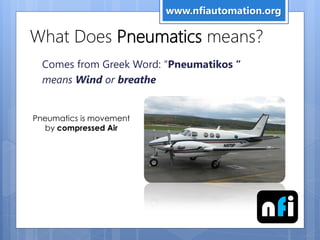
What Does Pneumatics means?
Comes from Greek Word: “Pneumatikos “
means Wind or breathe
Pneumatics is movement
by compressed Air
www.nfiautomation.org
nfi
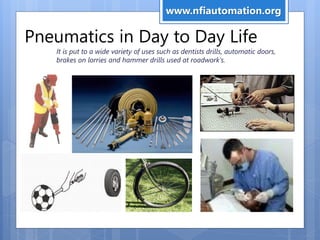
Pneumatics in Day to Day Life
It is put to a wide variety of uses such as dentists drills, automatic doors,
brakes on lorries and hammer drills used at roadwork's.
www.nfiautomation.org
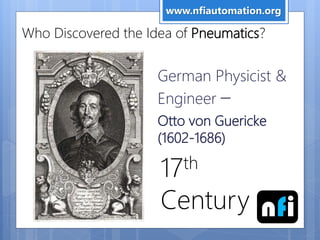
Who Discovered the Idea of Pneumatics?
German Physicist &
Engineer –
Otto von Guericke
(1602-1686)
17th
Century
www.nfiautomation.org
nfi
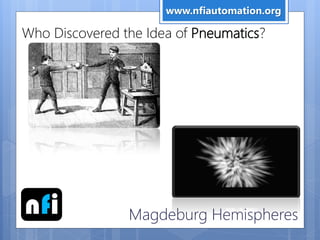
Magdeburg Hemispheres
Who Discovered the Idea of Pneumatics?
www.nfiautomation.org
nfi
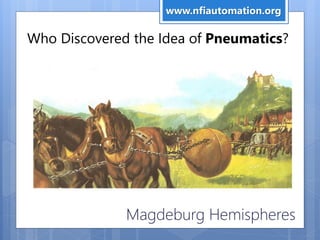
Who Discovered the Idea of Pneumatics?
Magdeburg Hemispheres
www.nfiautomation.org
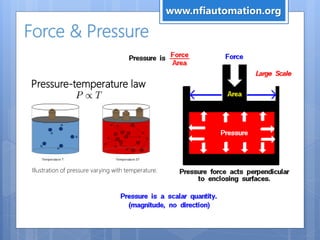
Force & Pressure
Illustration of pressure varying with temperature.
Pressure-temperature law
www.nfiautomation.org
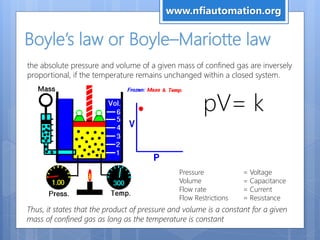
Boyle’s law or Boyle–Mariotte law
the absolute pressure and volume of a given mass of confined gas are inversely
proportional, if the temperature remains unchanged within a closed system.
Thus, it states that the product of pressure and volume is a constant for a given
mass of confined gas as long as the temperature is constant
pV= k
Pressure = Voltage
Volume = Capacitance
Flow rate = Current
Flow Restrictions = Resistance
www.nfiautomation.org
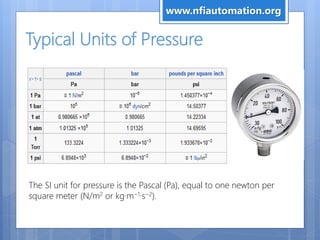
Typical Units of Pressure
The SI unit for pressure is the Pascal (Pa), equal to one newton per
square meter (N/m2 or kg·m−1·s−2).
www.nfiautomation.org
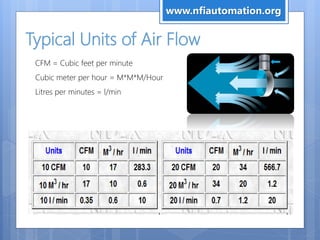
Typical Units of Air Flow
CFM = Cubic feet per minute
Cubic meter per hour = M*M*M/Hour
Litres per minutes = l/min
www.nfiautomation.org
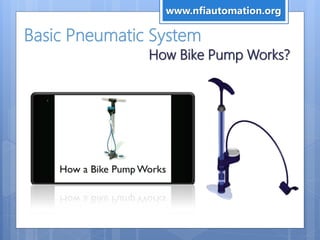
Basic Pneumatic System
How Bike Pump Works?
www.nfiautomation.org
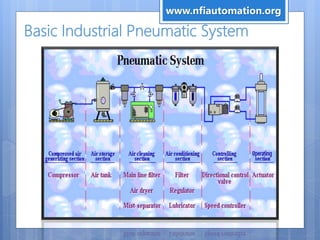
Basic Industrial Pneumatic System
www.nfiautomation.org
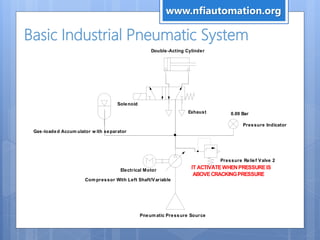
Basic Industrial Pneumatic System
Electrical Motor
IT ACTIVATEWHEN PRESSUREIS
ABOVECRACKINGPRESSURE
Pneumatic Pressure Source
Pressure Relief Valve 2
Double-Acting Cylinder
Gas-loaded Accum ulator w ith separator
0.00 Bar
Pressure Indicator
Exhaust
Compressor With Left Shaft/Variable
Solenoid
www.nfiautomation.org
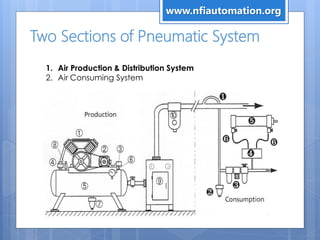
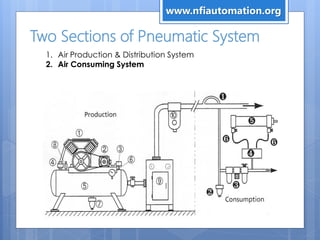
Two Sections of Pneumatic System
1. Air Production & Distribution System
2. Air Consuming System
www.nfiautomation.org
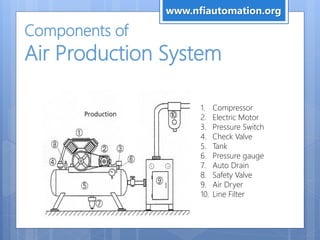
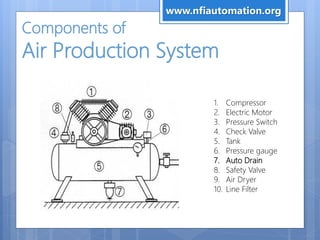
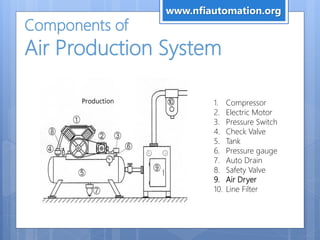
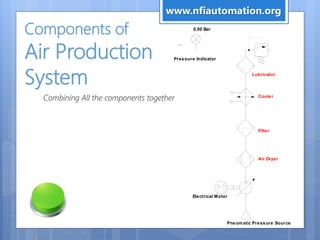
Components of
Air Production System
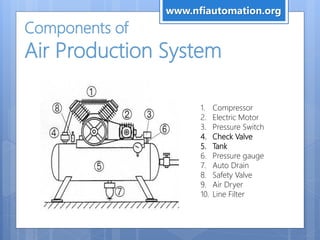
1. Compressor
2. Electric Motor
3. Pressure Switch
4. Check Valve
5. Tank
6. Pressure gauge
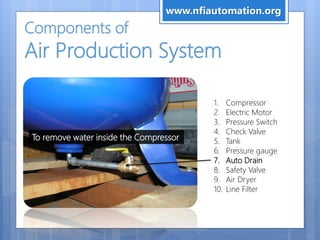
7. Auto Drain
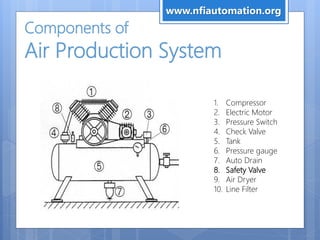
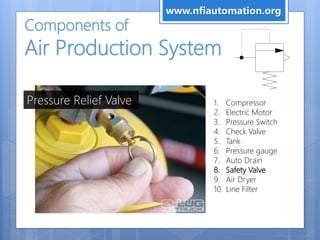
8. Safety Valve
9. Air Dryer
10. Line Filter
www.nfiautomation.org
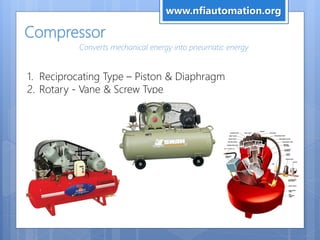
Compressor
1. Reciprocating Type – Piston & Diaphragm
2. Rotary - Vane & Screw Type
Converts mechanical energy into pneumatic energy
www.nfiautomation.org
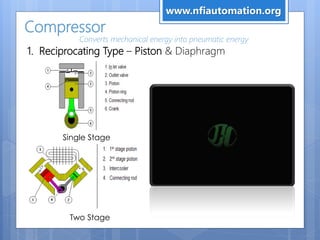
Compressor
1. Reciprocating Type – Piston & Diaphragm
Converts mechanical energy into pneumatic energy
Single Stage
Two Stage
www.nfiautomation.org
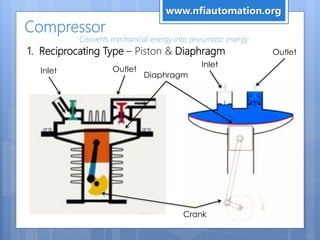
Compressor
1. Reciprocating Type – Piston & Diaphragm
Converts mechanical energy into pneumatic energy
Diaphragm
Inlet Outlet
Inlet
Outlet
Crank
www.nfiautomation.org
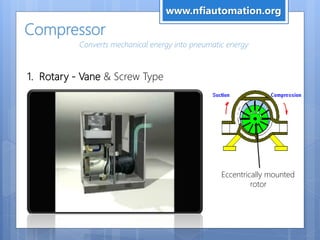
Compressor
1. Rotary - Vane & Screw Type
Converts mechanical energy into pneumatic energy
Eccentrically mounted
rotor
www.nfiautomation.org
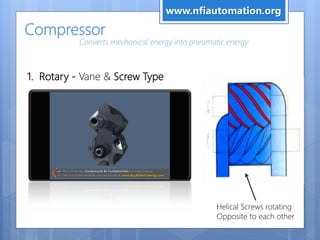
Compressor
1. Rotary - Vane & Screw Type
Converts mechanical energy into pneumatic energy
Helical Screws rotating
Opposite to each other
www.nfiautomation.org
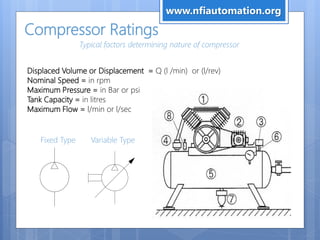
Compressor Ratings
Typical factors determining nature of compressor
Displaced Volume or Displacement = Q (l /min) or (l/rev)
Nominal Speed = in rpm
Maximum Pressure = in Bar or psi
Tank Capacity = in litres
Maximum Flow = l/min or l/sec
Fixed Type Variable Type
www.nfiautomation.org
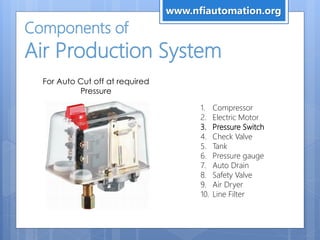
Components of
Air Production System
1. Compressor
2. Electric Motor
3. Pressure Switch
4. Check Valve
5. Tank
6. Pressure gauge
7. Auto Drain
8. Safety Valve
9. Air Dryer
10. Line Filter
For Auto Cut off at required
Pressure
www.nfiautomation.org
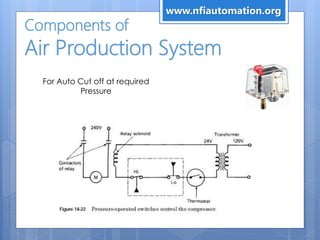
Components of
Air Production System
For Auto Cut off at required
Pressure
www.nfiautomation.org
Components of
Air Production System
1. Compressor
2. Electric Motor
3. Pressure Switch
4. Check Valve
5. Tank
6. Pressure gauge
7. Auto Drain
8. Safety Valve
9. Air Dryer
10. Line Filter
www.nfiautomation.org
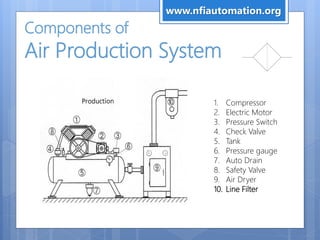
Components of
Air Production System
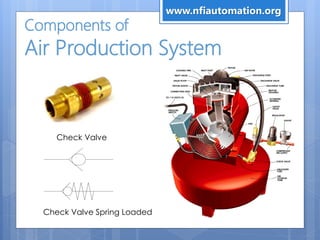
Check Valve
Check Valve Spring Loaded
www.nfiautomation.org
Components of
Air Production System
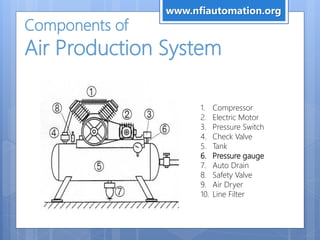
1. Compressor
2. Electric Motor
3. Pressure Switch
4. Check Valve
5. Tank
6. Pressure gauge
7. Auto Drain
8. Safety Valve
9. Air Dryer
10. Line Filter
www.nfiautomation.org
Components of
Air Production System
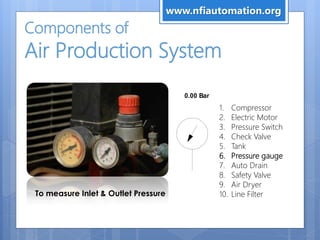
1. Compressor
2. Electric Motor
3. Pressure Switch
4. Check Valve
5. Tank
6. Pressure gauge
7. Auto Drain
8. Safety Valve
9. Air Dryer
10. Line Filter
0.00 Bar
To measure Inlet & Outlet Pressure
www.nfiautomation.org
Components of
Air Production System
1. Compressor
2. Electric Motor
3. Pressure Switch
4. Check Valve
5. Tank
6. Pressure gauge
7. Auto Drain
8. Safety Valve
9. Air Dryer
10. Line Filter
www.nfiautomation.org
Components of
Air Production System
1. Compressor
2. Electric Motor
3. Pressure Switch
4. Check Valve
5. Tank
6. Pressure gauge
7. Auto Drain
8. Safety Valve
9. Air Dryer
10. Line Filter
To remove water inside the Compressor
www.nfiautomation.org
Components of
Air Production System
1. Compressor
2. Electric Motor
3. Pressure Switch
4. Check Valve
5. Tank
6. Pressure gauge
7. Auto Drain
8. Safety Valve
9. Air Dryer
10. Line Filter
www.nfiautomation.org
Components of
Air Production System
1. Compressor
2. Electric Motor
3. Pressure Switch
4. Check Valve
5. Tank
6. Pressure gauge
7. Auto Drain
8. Safety Valve
9. Air Dryer
10. Line Filter
Pressure Relief Valve
www.nfiautomation.org
Components of
Air Production System
1. Compressor
2. Electric Motor
3. Pressure Switch
4. Check Valve
5. Tank
6. Pressure gauge
7. Auto Drain
8. Safety Valve
9. Air Dryer
10. Line Filter
www.nfiautomation.org
Components of
Air Production System
Drying agent such as
Dehydrated chalk
or
Magnesium chloride
It reacts with moisture
(in air) to form solution
which is drained from
the bottom
www.nfiautomation.org
Components of
Air Production System
1. Compressor
2. Electric Motor
3. Pressure Switch
4. Check Valve
5. Tank
6. Pressure gauge
7. Auto Drain
8. Safety Valve
9. Air Dryer
10. Line Filter
www.nfiautomation.org
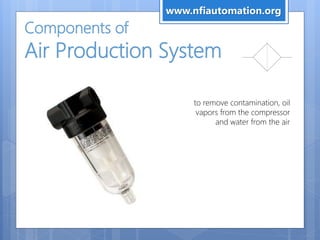
Components of
Air Production System
to remove contamination, oil
vapors from the compressor
and water from the air
www.nfiautomation.org
Components of
Air Production
System
Combining All the components together
0.00 Bar
Pressure Indicator
Electrical Motor
Pneumatic Pressure Source
Air Dryer
Filter
Lubricator
Cooler
www.nfiautomation.org
Two Sections of Pneumatic System
1. Air Production & Distribution System
2. Air Consuming System
www.nfiautomation.org
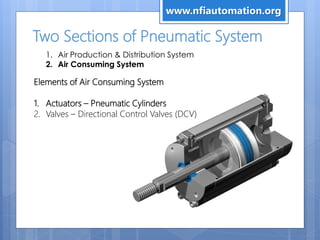
Two Sections of Pneumatic System
1. Air Production & Distribution System
2. Air Consuming System
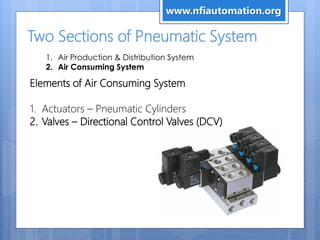
Elements of Air Consuming System
1. Actuators – Pneumatic Cylinders
2. Valves – Directional Control Valves (DCV)
www.nfiautomation.org
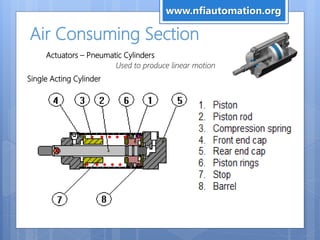
Air Consuming Section
Actuators – Pneumatic Cylinders
Used to produce linear motion
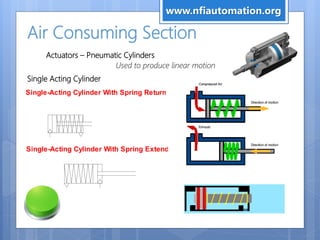
Single Acting Cylinder
www.nfiautomation.org
Air Consuming Section
Actuators – Pneumatic Cylinders
Used to produce linear motion
Single Acting Cylinder
Single-Acting Cylinder With Spring Return
Single-Acting Cylinder With Spring Extend
www.nfiautomation.org
Air Consuming Section
Actuators – Pneumatic Cylinders
Used to produce linear motion
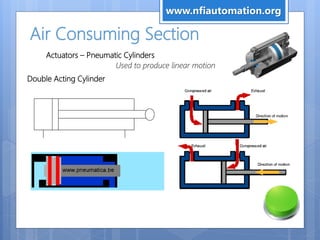
Double Acting Cylinder
www.nfiautomation.org
Air Consuming Section
Actuators – Pneumatic Cylinders
Used to produce linear motion
Double Acting Cylinder
www.nfiautomation.org
Air Consuming Section
Actuators – Pneumatic Cylinders
Used to produce linear motion
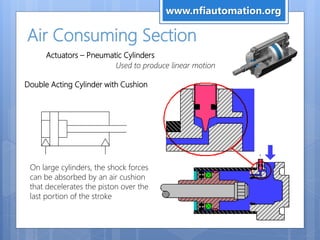
ble-Acting 2-Cushion Cylinder
On large cylinders, the shock forces
can be absorbed by an air cushion
that decelerates the piston over the
last portion of the stroke
Double Acting Cylinder with Cushion
www.nfiautomation.org
Air Consuming Section
Actuators – Pneumatic Cylinders
Used to produce linear motion
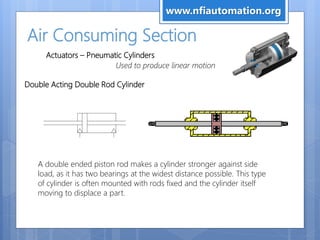
A double ended piston rod makes a cylinder stronger against side
load, as it has two bearings at the widest distance possible. This type
of cylinder is often mounted with rods fixed and the cylinder itself
moving to displace a part.
Double Acting Double Rod Cylinder
Double-Acting Double-Rod Cylinder
www.nfiautomation.org
Air Consuming Section
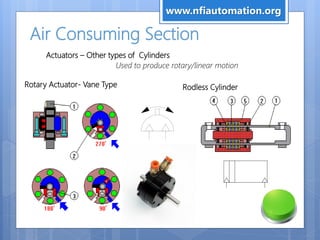
Actuators – Other types of Cylinders
Used to produce rotary/linear motion
Rotary Actuator- Vane Type Rodless Cylinder
www.nfiautomation.org
Piston Force
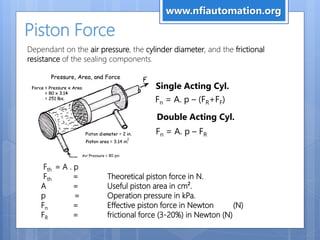
Dependant on the air pressure, the cylinder diameter, and the frictional
resistance of the sealing components.
Fth = A . p
Fth = Theoretical piston force in N.
A = Useful piston area in cm².
p = Operation pressure in kPa.
Fn = Effective piston force in Newton (N)
FR = frictional force (3-20%) in Newton (N)
Fn = A. p – (FR+FF)
Single Acting Cyl.
Fn = A. p – FR
Double Acting Cyl.
www.nfiautomation.org
Two Sections of Pneumatic System
1. Air Production & Distribution System
2. Air Consuming System
Elements of Air Consuming System
1. Actuators – Pneumatic Cylinders
2. Valves – Directional Control Valves (DCV)
www.nfiautomation.org
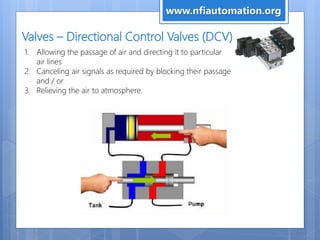
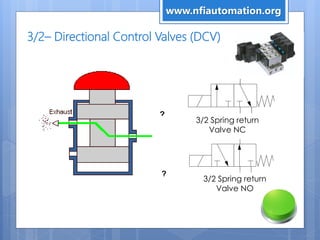
Valves – Directional Control Valves (DCV)
1. Allowing the passage of air and directing it to particular
air lines
2. Canceling air signals as required by blocking their passage
and / or
3. Relieving the air to atmosphere.
www.nfiautomation.org
3/2– Directional Control Valves (DCV)
?
3/2 Spring return
Valve NC
?
3/2 Spring return
Valve NO
www.nfiautomation.org
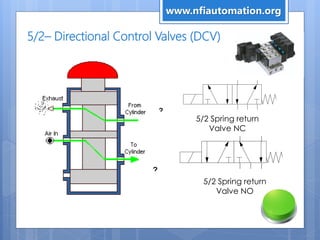
5/2– Directional Control Valves (DCV)
5/2 Spring return
Valve NC
5/2 Spring return
Valve NO
?
?
www.nfiautomation.org
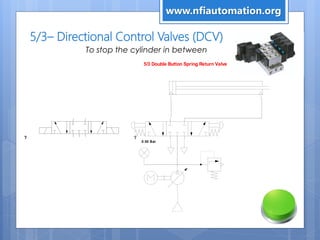
5/3– Directional Control Valves (DCV)
??
To stop the cylinder in between
5/3 Double Button Spring Return Valve
0.00 Bar
www.nfiautomation.org
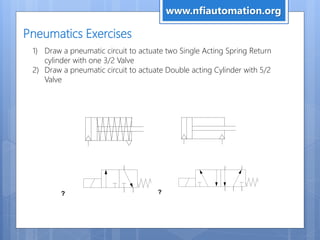
Pneumatics Exercises
www.nfiautomation.org
1) Draw a pneumatic circuit to actuate two Single Acting Spring Return
cylinder with one 3/2 Valve
2) Draw a pneumatic circuit to actuate Double acting Cylinder with 5/2
Valve
? ?
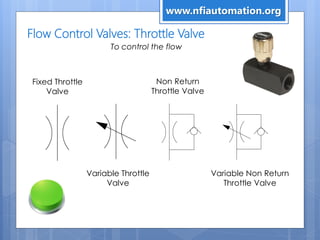
Flow Control Valves: Throttle Valve
To control the flow
Fixed Throttle
Valve
Variable Throttle
Valve
Non Return
Throttle Valve
Variable Non Return
Throttle Valve
www.nfiautomation.org
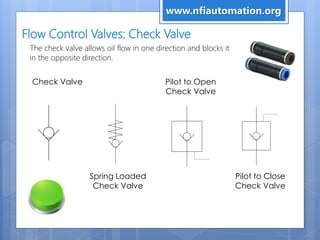
Flow Control Valves: Check Valve
The check valve allows oil flow in one direction and blocks it
in the opposite direction.
Check Valve
Spring Loaded
Check Valve
Pilot to Open
Check Valve
Pilot to Close
Check Valve
www.nfiautomation.org
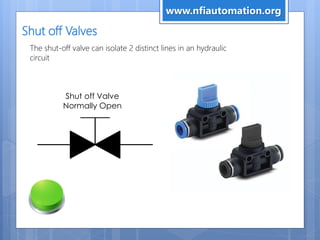
Shut off Valves
The shut-off valve can isolate 2 distinct lines in an hydraulic
circuit
Shut off Valve
Normally Open
www.nfiautomation.org
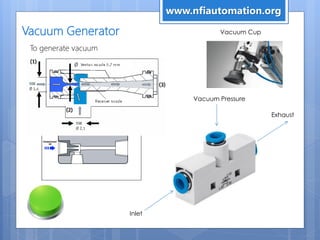
Vacuum Generator
To generate vacuum
Inlet
Exhaust
Vacuum Pressure
Vacuum Cup
www.nfiautomation.org
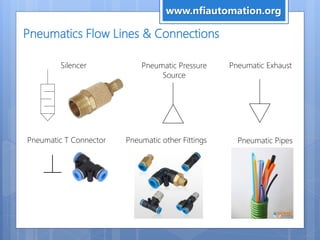
Pneumatics Flow Lines & Connections
Silencer Pneumatic Pressure
Source
Pneumatic Exhaust
Pneumatic T Connector Pneumatic other Fittings Pneumatic Pipes
www.nfiautomation.org
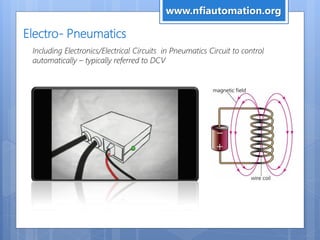
Electro- Pneumatics
www.nfiautomation.org
Including Electronics/Electrical Circuits in Pneumatics Circuit to control
automatically – typically referred to DCV
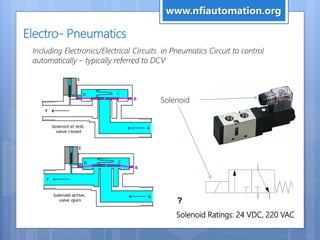
Electro- Pneumatics
www.nfiautomation.org
Including Electronics/Electrical Circuits in Pneumatics Circuit to control
automatically – typically referred to DCV
Solenoid
?
Solenoid Ratings: 24 VDC, 220 VAC
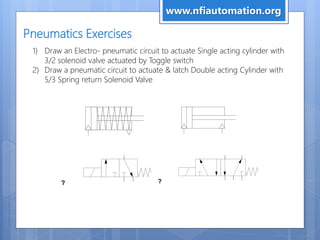
Pneumatics Exercises
www.nfiautomation.org
1) Draw an Electro- pneumatic circuit to actuate Single acting cylinder with
3/2 solenoid valve actuated by Toggle switch
2) Draw a pneumatic circuit to actuate & latch Double acting Cylinder with
5/3 Spring return Solenoid Valve
? ?
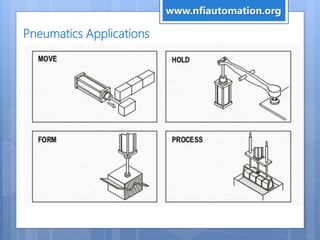
Pneumatics Applications
www.nfiautomation.org
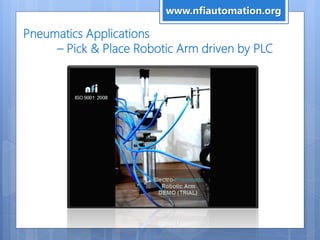
Pneumatics Applications
– Pick & Place Robotic Arm driven by PLC
www.nfiautomation.org
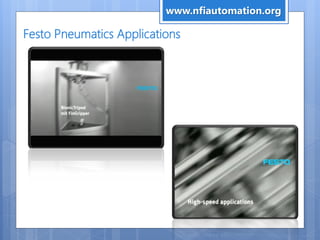
Festo Pneumatics Applications
www.nfiautomation.org
FREE PLC Course: -
“Learn PLC in a DAY”
Automation Knowledge Base
www.nfiautomation.org
rajvir@nfiautomation.org
9988808455
thank you
nfi

NFI - Industrial Pneumatics

  • 1.
    Training on Industrial Pneumatics NFI –Industrial Automation & CAD Training Academy nfi
  • 2.
    What Does Pneumaticsmeans? Comes from Greek Word: “Pneumatikos “ means Wind or breathe Pneumatics is movement by compressed Air www.nfiautomation.org nfi
  • 3.
    Pneumatics in Dayto Day Life It is put to a wide variety of uses such as dentists drills, automatic doors, brakes on lorries and hammer drills used at roadwork's. www.nfiautomation.org
  • 4.
    Who Discovered theIdea of Pneumatics? German Physicist & Engineer – Otto von Guericke (1602-1686) 17th Century www.nfiautomation.org nfi
  • 5.
    Magdeburg Hemispheres Who Discoveredthe Idea of Pneumatics? www.nfiautomation.org nfi
  • 6.
    Who Discovered theIdea of Pneumatics? Magdeburg Hemispheres www.nfiautomation.org
  • 7.
    Force & Pressure Illustrationof pressure varying with temperature. Pressure-temperature law www.nfiautomation.org
  • 8.
    Boyle’s law orBoyle–Mariotte law the absolute pressure and volume of a given mass of confined gas are inversely proportional, if the temperature remains unchanged within a closed system. Thus, it states that the product of pressure and volume is a constant for a given mass of confined gas as long as the temperature is constant pV= k Pressure = Voltage Volume = Capacitance Flow rate = Current Flow Restrictions = Resistance www.nfiautomation.org
  • 9.
    Typical Units ofPressure The SI unit for pressure is the Pascal (Pa), equal to one newton per square meter (N/m2 or kg·m−1·s−2). www.nfiautomation.org
  • 10.
    Typical Units ofAir Flow CFM = Cubic feet per minute Cubic meter per hour = M*M*M/Hour Litres per minutes = l/min www.nfiautomation.org
  • 11.
    Basic Pneumatic System HowBike Pump Works? www.nfiautomation.org
  • 12.
    Basic Industrial PneumaticSystem www.nfiautomation.org
  • 13.
    Basic Industrial PneumaticSystem Electrical Motor IT ACTIVATEWHEN PRESSUREIS ABOVECRACKINGPRESSURE Pneumatic Pressure Source Pressure Relief Valve 2 Double-Acting Cylinder Gas-loaded Accum ulator w ith separator 0.00 Bar Pressure Indicator Exhaust Compressor With Left Shaft/Variable Solenoid www.nfiautomation.org
  • 14.
    Two Sections ofPneumatic System 1. Air Production & Distribution System 2. Air Consuming System www.nfiautomation.org
  • 15.
    Components of Air ProductionSystem 1. Compressor 2. Electric Motor 3. Pressure Switch 4. Check Valve 5. Tank 6. Pressure gauge 7. Auto Drain 8. Safety Valve 9. Air Dryer 10. Line Filter www.nfiautomation.org
  • 16.
    Compressor 1. Reciprocating Type– Piston & Diaphragm 2. Rotary - Vane & Screw Type Converts mechanical energy into pneumatic energy www.nfiautomation.org
  • 17.
    Compressor 1. Reciprocating Type– Piston & Diaphragm Converts mechanical energy into pneumatic energy Single Stage Two Stage www.nfiautomation.org
  • 18.
    Compressor 1. Reciprocating Type– Piston & Diaphragm Converts mechanical energy into pneumatic energy Diaphragm Inlet Outlet Inlet Outlet Crank www.nfiautomation.org
  • 19.
    Compressor 1. Rotary -Vane & Screw Type Converts mechanical energy into pneumatic energy Eccentrically mounted rotor www.nfiautomation.org
  • 20.
    Compressor 1. Rotary -Vane & Screw Type Converts mechanical energy into pneumatic energy Helical Screws rotating Opposite to each other www.nfiautomation.org
  • 21.
    Compressor Ratings Typical factorsdetermining nature of compressor Displaced Volume or Displacement = Q (l /min) or (l/rev) Nominal Speed = in rpm Maximum Pressure = in Bar or psi Tank Capacity = in litres Maximum Flow = l/min or l/sec Fixed Type Variable Type www.nfiautomation.org
  • 22.
    Components of Air ProductionSystem 1. Compressor 2. Electric Motor 3. Pressure Switch 4. Check Valve 5. Tank 6. Pressure gauge 7. Auto Drain 8. Safety Valve 9. Air Dryer 10. Line Filter For Auto Cut off at required Pressure www.nfiautomation.org
  • 23.
    Components of Air ProductionSystem For Auto Cut off at required Pressure www.nfiautomation.org
  • 24.
    Components of Air ProductionSystem 1. Compressor 2. Electric Motor 3. Pressure Switch 4. Check Valve 5. Tank 6. Pressure gauge 7. Auto Drain 8. Safety Valve 9. Air Dryer 10. Line Filter www.nfiautomation.org
  • 25.
    Components of Air ProductionSystem Check Valve Check Valve Spring Loaded www.nfiautomation.org
  • 26.
    Components of Air ProductionSystem 1. Compressor 2. Electric Motor 3. Pressure Switch 4. Check Valve 5. Tank 6. Pressure gauge 7. Auto Drain 8. Safety Valve 9. Air Dryer 10. Line Filter www.nfiautomation.org
  • 27.
    Components of Air ProductionSystem 1. Compressor 2. Electric Motor 3. Pressure Switch 4. Check Valve 5. Tank 6. Pressure gauge 7. Auto Drain 8. Safety Valve 9. Air Dryer 10. Line Filter 0.00 Bar To measure Inlet & Outlet Pressure www.nfiautomation.org
  • 28.
    Components of Air ProductionSystem 1. Compressor 2. Electric Motor 3. Pressure Switch 4. Check Valve 5. Tank 6. Pressure gauge 7. Auto Drain 8. Safety Valve 9. Air Dryer 10. Line Filter www.nfiautomation.org
  • 29.
    Components of Air ProductionSystem 1. Compressor 2. Electric Motor 3. Pressure Switch 4. Check Valve 5. Tank 6. Pressure gauge 7. Auto Drain 8. Safety Valve 9. Air Dryer 10. Line Filter To remove water inside the Compressor www.nfiautomation.org
  • 30.
    Components of Air ProductionSystem 1. Compressor 2. Electric Motor 3. Pressure Switch 4. Check Valve 5. Tank 6. Pressure gauge 7. Auto Drain 8. Safety Valve 9. Air Dryer 10. Line Filter www.nfiautomation.org
  • 31.
    Components of Air ProductionSystem 1. Compressor 2. Electric Motor 3. Pressure Switch 4. Check Valve 5. Tank 6. Pressure gauge 7. Auto Drain 8. Safety Valve 9. Air Dryer 10. Line Filter Pressure Relief Valve www.nfiautomation.org
  • 32.
    Components of Air ProductionSystem 1. Compressor 2. Electric Motor 3. Pressure Switch 4. Check Valve 5. Tank 6. Pressure gauge 7. Auto Drain 8. Safety Valve 9. Air Dryer 10. Line Filter www.nfiautomation.org
  • 33.
    Components of Air ProductionSystem Drying agent such as Dehydrated chalk or Magnesium chloride It reacts with moisture (in air) to form solution which is drained from the bottom www.nfiautomation.org
  • 34.
    Components of Air ProductionSystem 1. Compressor 2. Electric Motor 3. Pressure Switch 4. Check Valve 5. Tank 6. Pressure gauge 7. Auto Drain 8. Safety Valve 9. Air Dryer 10. Line Filter www.nfiautomation.org
  • 35.
    Components of Air ProductionSystem to remove contamination, oil vapors from the compressor and water from the air www.nfiautomation.org
  • 36.
    Components of Air Production System CombiningAll the components together 0.00 Bar Pressure Indicator Electrical Motor Pneumatic Pressure Source Air Dryer Filter Lubricator Cooler www.nfiautomation.org
  • 37.
    Two Sections ofPneumatic System 1. Air Production & Distribution System 2. Air Consuming System www.nfiautomation.org
  • 38.
    Two Sections ofPneumatic System 1. Air Production & Distribution System 2. Air Consuming System Elements of Air Consuming System 1. Actuators – Pneumatic Cylinders 2. Valves – Directional Control Valves (DCV) www.nfiautomation.org
  • 39.
    Air Consuming Section Actuators– Pneumatic Cylinders Used to produce linear motion Single Acting Cylinder www.nfiautomation.org
  • 40.
    Air Consuming Section Actuators– Pneumatic Cylinders Used to produce linear motion Single Acting Cylinder Single-Acting Cylinder With Spring Return Single-Acting Cylinder With Spring Extend www.nfiautomation.org
  • 41.
    Air Consuming Section Actuators– Pneumatic Cylinders Used to produce linear motion Double Acting Cylinder www.nfiautomation.org
  • 42.
    Air Consuming Section Actuators– Pneumatic Cylinders Used to produce linear motion Double Acting Cylinder www.nfiautomation.org
  • 43.
    Air Consuming Section Actuators– Pneumatic Cylinders Used to produce linear motion ble-Acting 2-Cushion Cylinder On large cylinders, the shock forces can be absorbed by an air cushion that decelerates the piston over the last portion of the stroke Double Acting Cylinder with Cushion www.nfiautomation.org
  • 44.
    Air Consuming Section Actuators– Pneumatic Cylinders Used to produce linear motion A double ended piston rod makes a cylinder stronger against side load, as it has two bearings at the widest distance possible. This type of cylinder is often mounted with rods fixed and the cylinder itself moving to displace a part. Double Acting Double Rod Cylinder Double-Acting Double-Rod Cylinder www.nfiautomation.org
  • 45.
    Air Consuming Section Actuators– Other types of Cylinders Used to produce rotary/linear motion Rotary Actuator- Vane Type Rodless Cylinder www.nfiautomation.org
  • 46.
    Piston Force Dependant onthe air pressure, the cylinder diameter, and the frictional resistance of the sealing components. Fth = A . p Fth = Theoretical piston force in N. A = Useful piston area in cm². p = Operation pressure in kPa. Fn = Effective piston force in Newton (N) FR = frictional force (3-20%) in Newton (N) Fn = A. p – (FR+FF) Single Acting Cyl. Fn = A. p – FR Double Acting Cyl. www.nfiautomation.org
  • 47.
    Two Sections ofPneumatic System 1. Air Production & Distribution System 2. Air Consuming System Elements of Air Consuming System 1. Actuators – Pneumatic Cylinders 2. Valves – Directional Control Valves (DCV) www.nfiautomation.org
  • 48.
    Valves – DirectionalControl Valves (DCV) 1. Allowing the passage of air and directing it to particular air lines 2. Canceling air signals as required by blocking their passage and / or 3. Relieving the air to atmosphere. www.nfiautomation.org
  • 49.
    3/2– Directional ControlValves (DCV) ? 3/2 Spring return Valve NC ? 3/2 Spring return Valve NO www.nfiautomation.org
  • 50.
    5/2– Directional ControlValves (DCV) 5/2 Spring return Valve NC 5/2 Spring return Valve NO ? ? www.nfiautomation.org
  • 51.
    5/3– Directional ControlValves (DCV) ?? To stop the cylinder in between 5/3 Double Button Spring Return Valve 0.00 Bar www.nfiautomation.org
  • 52.
    Pneumatics Exercises www.nfiautomation.org 1) Drawa pneumatic circuit to actuate two Single Acting Spring Return cylinder with one 3/2 Valve 2) Draw a pneumatic circuit to actuate Double acting Cylinder with 5/2 Valve ? ?
  • 53.
    Flow Control Valves:Throttle Valve To control the flow Fixed Throttle Valve Variable Throttle Valve Non Return Throttle Valve Variable Non Return Throttle Valve www.nfiautomation.org
  • 54.
    Flow Control Valves:Check Valve The check valve allows oil flow in one direction and blocks it in the opposite direction. Check Valve Spring Loaded Check Valve Pilot to Open Check Valve Pilot to Close Check Valve www.nfiautomation.org
  • 55.
    Shut off Valves Theshut-off valve can isolate 2 distinct lines in an hydraulic circuit Shut off Valve Normally Open www.nfiautomation.org
  • 56.
    Vacuum Generator To generatevacuum Inlet Exhaust Vacuum Pressure Vacuum Cup www.nfiautomation.org
  • 57.
    Pneumatics Flow Lines& Connections Silencer Pneumatic Pressure Source Pneumatic Exhaust Pneumatic T Connector Pneumatic other Fittings Pneumatic Pipes www.nfiautomation.org
  • 58.
    Electro- Pneumatics www.nfiautomation.org Including Electronics/ElectricalCircuits in Pneumatics Circuit to control automatically – typically referred to DCV
  • 59.
    Electro- Pneumatics www.nfiautomation.org Including Electronics/ElectricalCircuits in Pneumatics Circuit to control automatically – typically referred to DCV Solenoid ? Solenoid Ratings: 24 VDC, 220 VAC
  • 60.
    Pneumatics Exercises www.nfiautomation.org 1) Drawan Electro- pneumatic circuit to actuate Single acting cylinder with 3/2 solenoid valve actuated by Toggle switch 2) Draw a pneumatic circuit to actuate & latch Double acting Cylinder with 5/3 Spring return Solenoid Valve ? ?
  • 61.
  • 62.
    Pneumatics Applications – Pick& Place Robotic Arm driven by PLC www.nfiautomation.org
  • 63.
  • 64.
    FREE PLC Course:- “Learn PLC in a DAY” Automation Knowledge Base www.nfiautomation.org
  • 65.