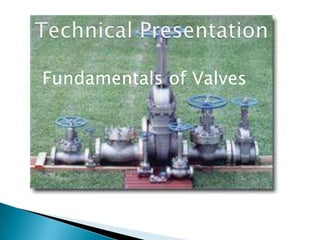
Fundamentals of Valves
   What is valve?
   Classification of valves
   Valve types.
   Methods of controlling flow through a valve.
   Basic Parts of the valve.
   Valve types
What is valve?
  A valve is a device that regulates, directs or controls the flow of a fluid by
  opening, closing, or partially obstructing various passageways.


Valve Functions
       Stopping and starting fluid flow.
       Varying (throttling) the amount of fluid flow.
       Controlling the direction of fluid flow.
       Regulating downstream system or process pressure.
       Relieving component or piping over pressure.
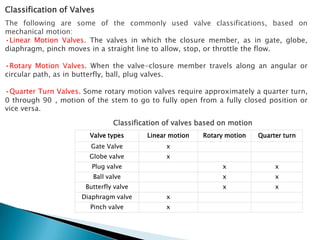
Classification of Valves
The following are some of the commonly used valve classifications, based on
mechanical motion:
•Linear Motion Valves. The valves in which the closure member, as in gate, globe,
diaphragm, pinch moves in a straight line to allow, stop, or throttle the flow.

•Rotary Motion Valves. When the valve-closure member travels along an angular or
circular path, as in butterfly, ball, plug valves.

•Quarter Turn Valves. Some rotary motion valves require approximately a quarter turn,
0 through 90 , motion of the stem to go to fully open from a fully closed position or
vice versa.

                               Classification of valves based on motion
                       Valve types      Linear motion   Rotary motion     Quarter turn
                        Gate Valve            x
                       Globe valve            x
                        Plug valve                            x                x
                        Ball valve                            x                x
                      Butterfly valve                         x                x
                     Diaphragm valve          x
                       Pinch valve            x
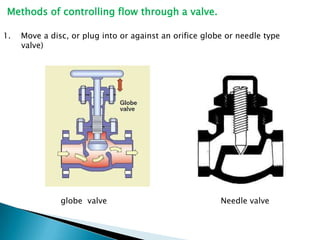
Methods of controlling flow through a valve.

1.   Move a disc, or plug into or against an orifice globe or needle type
     valve)


               globe valve                               Needle valve
Methods of controlling flow through a valve.

2.   Slide a flat, cylindrical, or spherical surface across the orifice.


                 plug valve                                       gate valve
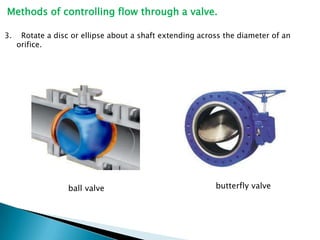
Methods of controlling flow through a valve.

3.    Rotate a disc or ellipse about a shaft extending across the diameter of an
     orifice.


                   ball valve                              butterfly valve
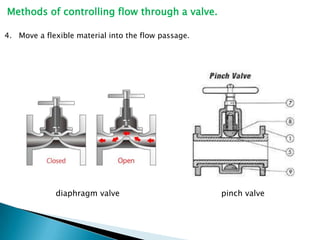
Methods of controlling flow through a valve.

4. Move a flexible material into the flow passage.


             diaphragm valve                         pinch valve
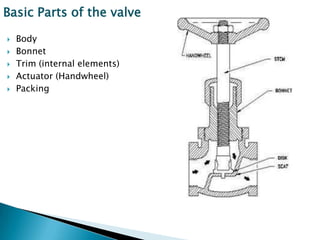
Basic Parts of the valve

   Body
   Bonnet
   Trim (internal elements)
   Actuator (Handwheel)
   Packing
Basic Parts of the valve
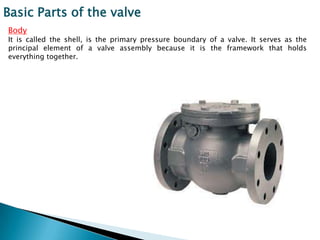
Body
It is called the shell, is the primary pressure boundary of a valve. It serves as the
principal element of a valve assembly because it is the framework that holds
everything together.
Basic Parts of the valve
Bonnet
The cover for the opening in the valve body.
Bonnets Features
• bonnet is the second principal pressure boundary of a
  valve.
• It is cast or forged of the same material as the body and
  is connected to the body by a threaded, bolted, or
  welded joint.
• the attachment of the bonnet to the body is considered
  a pressure boundary. This means that the weld joint or
  bolts that connect the bonnet to the body are pressure-
  retaining parts.
• Valve bonnets, although a necessity for most valves,
                                                                 Welded Bonnet
 represent a cause for concern,
         • Bonnets can complicate the manufacture.
         • Increase valve size.
         • Represent a significant cost portion of valve cost.
         • Bonnets are a source for potential leakage.


                                                                   Bolted Bonnet
Basic Parts of the valve
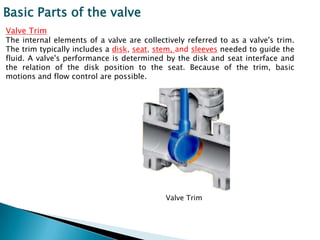
Valve Trim
The internal elements of a valve are collectively referred to as a valve's trim.
The trim typically includes a disk, seat, stem, and sleeves needed to guide the
fluid. A valve's performance is determined by the disk and seat interface and
the relation of the disk position to the seat. Because of the trim, basic
motions and flow control are possible.


                                            Valve Trim
Basic Parts of the valve
Internal parts of the valve

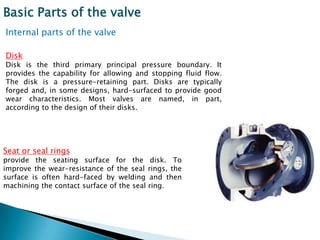
Disk
Disk is the third primary principal pressure boundary. It
provides the capability for allowing and stopping fluid flow.
The disk is a pressure-retaining part. Disks are typically
forged and, in some designs, hard-surfaced to provide good
wear characteristics. Most valves are named, in part,
according to the design of their disks.


Seat or seal rings
provide the seating surface for the disk. To
improve the wear-resistance of the seal rings, the
surface is often hard-faced by welding and then
machining the contact surface of the seal ring.
Basic Parts of the valve
Internal parts of the valve

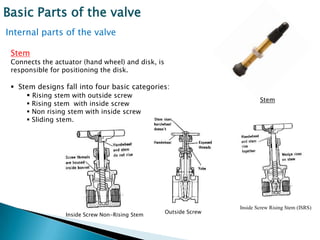
 Stem
 Connects the actuator (hand wheel) and disk, is
 responsible for positioning the disk.

  Stem designs fall into four basic categories:
      Rising stem with outside screw
                                                                           Stem
      Rising stem with inside screw
      Non rising stem with inside screw
      Sliding stem.


                                                                   Inside Screw Rising Stem (ISRS)
                                                   Outside Screw
                 Inside Screw Non-Rising Stem
Basic Parts of the valve
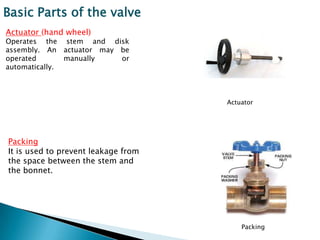
Actuator (hand wheel)
Operates the stem and disk
assembly. An actuator may be
operated       manually   or
automatically.


                                     Actuator


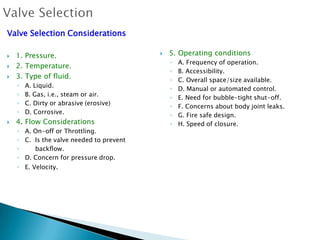
Packing
It is used to prevent leakage from
the space between the stem and
the bonnet.


                                         Packing
Valve Selection Considerations

   1. Pressure.                             5. Operating conditions
                                              ◦   A. Frequency of operation.
   2. Temperature.
                                              ◦   B. Accessibility.
   3. Type of fluid.                         ◦   C. Overall space/size available.
    ◦   A. Liquid.
                                              ◦   D. Manual or automated control.
    ◦   B. Gas, i.e., steam or air.
                                              ◦   E. Need for bubble-tight shut-off.
    ◦   C. Dirty or abrasive (erosive)
                                              ◦   F. Concerns about body joint leaks.
    ◦   D. Corrosive.
                                              ◦   G. Fire safe design.
   4. Flow Considerations                    ◦   H. Speed of closure.
    ◦ A. On-off or Throttling.
    ◦ C. Is the valve needed to prevent
    ◦    backflow.
    ◦ D. Concern for pressure drop.
    ◦ E. Velocity.
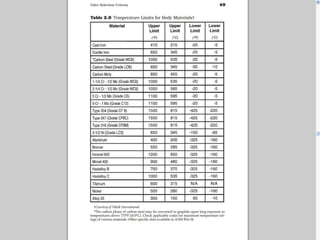
   There are factors govern the basic materials selection
      Corrosion-resistance requirements.
      Thermal shock.
      Piping stress.
      Fire hazard.

   Types of materials typically available include,
      Ductile iron.
      Carbon steel.
      Cast iron.
      Stainless steels.
      Brass.
      Bronze.
      Polyvinyl chloride (PVC) plastic.

   Body Materials
      For small valves are usually brass, bronze, or forged steel
      For larger valves, cast iron, cast ductile iron or cast steel as required for the
      pressure and service.
   Seat and Valve Disk Materials
   The valve seat and valve disk are sometimes referred to as the valve trim
    and are usually constructed of the same material selected to meet the
    service requirements.

   Valve stem material should be selected to meet service conditions.
    Stainless steel is commonly used for most HVAC applications, and bronze
    is commonly used in ball valve construction.
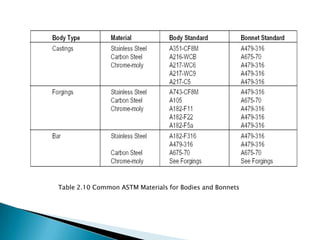
Table 2.10 Common ASTM Materials for Bodies and Bonnets
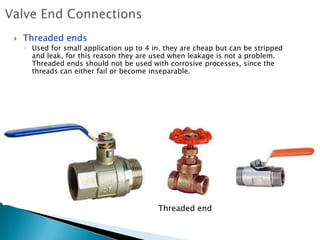
   Threaded ends
    ◦ Used for small application up to 4 in. they are cheap but can be stripped
      and leak, for this reason they are used when leakage is not a problem.
      Threaded ends should not be used with corrosive processes, since the
      threads can either fail or become inseparable.


                                          Threaded end
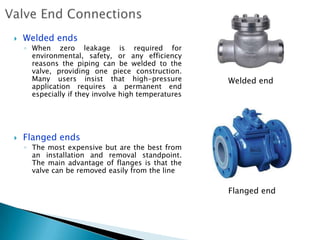
   Welded ends
    ◦ When zero leakage is required for
      environmental, safety, or any efficiency
      reasons the piping can be welded to the
      valve, providing one piece construction.
      Many users insist that high-pressure           Welded end
      application requires a permanent end
      especially if they involve high temperatures


   Flanged ends
    ◦ The most expensive but are the best from
      an installation and removal standpoint.
      The main advantage of flanges is that the
      valve can be removed easily from the line

                                                     Flanged end
Valve types

 ◦   Globe valve       ◦   Diaphragm valve
 ◦   Gate valve        ◦   Pinch valve
 ◦   Plug valve        ◦   Check valve
 ◦   Ball valve        ◦   Safety/relief valve
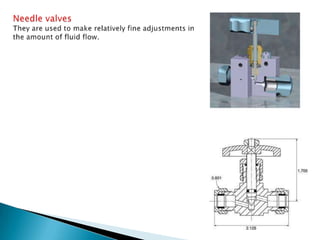
 ◦   Needle valve      ◦   Reducing valve
 ◦   Butterfly valve
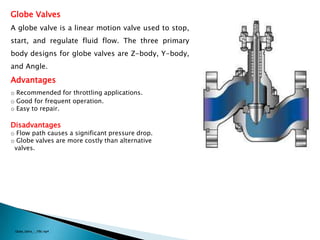
Globe Valves
A globe valve is a linear motion valve used to stop,
start, and regulate fluid flow. The three primary
body designs for globe valves are Z-body, Y-body,
and Angle.
Advantages
o Recommended for throttling applications.
o Good for frequent operation.
o Easy to repair.

Disadvantages
o Flow path causes a significant pressure drop.
o Globe valves are more costly than alternative
 valves.


 Globe_Valve_-_FBV. mp4
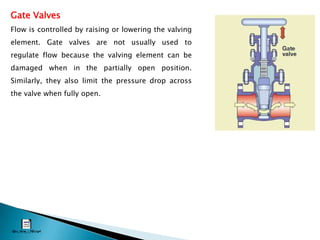
Gate Valves
Flow is controlled by raising or lowering the valving
element. Gate valves are not usually used to
regulate flow because the valving element can be
damaged when in the partially open position.
Similarly, they also limit the pressure drop across
the valve when fully open.
Advantages
• Gate valves opens or closes slowly, which prevents fluid hammer and
    subsequent damage to the piping system.
• They need long operation time since setting the valve to the fully open or
    closed position requires the handle to be turned many times.
• Good choice for on-off service.
• Full flow, low pressure drop.
• Bidirectional.

Disadvantages
•   It is not suitable for throttling applications.
•   It is prone to vibration in the partially open state.
•   It is more subject to seat and disk wear.
•   Repairs, such as lapping and grinding, are generally more difficult to
    accomplish.
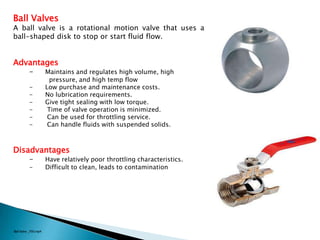
Ball Valves
A ball valve is a rotational motion valve that uses a
ball-shaped disk to stop or start fluid flow.


Advantages
           -           Maintains and regulates high volume, high
                         pressure, and high temp flow
           -           Low purchase and maintenance costs.
           -           No lubrication requirements.
           -           Give tight sealing with low torque.
           -            Time of valve operation is minimized.
           -            Can be used for throttling service.
           -            Can handle fluids with suspended solids.


Disadvantages
           -           Have relatively poor throttling characteristics.
           -           Difficult to clean, leads to contamination


Ball Va lve _FBV.mp4
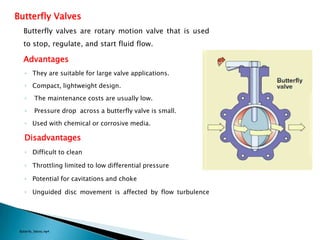
Butterfly Valves
   Butterfly valves are rotary motion valve that is used
   to stop, regulate, and start fluid flow.

   Advantages
    ◦ They are suitable for large valve applications.

    ◦ Compact, lightweight design.

    ◦      The maintenance costs are usually low.

    ◦      Pressure drop across a butterfly valve is small.

    ◦ Used with chemical or corrosive media.

    Disadvantages
    ◦ Difficult to clean

    ◦ Throttling limited to low differential pressure

    ◦ Potential for cavitations and choke

    ◦ Unguided disc movement is affected by flow turbulence


 Butterfly_Valves. mp4
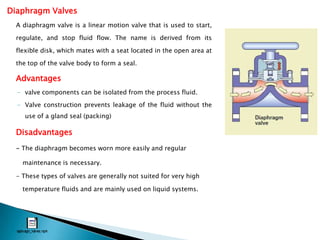
Diaphragm Valves
  A diaphragm valve is a linear motion valve that is used to start,

  regulate, and stop fluid flow. The name is derived from its

  flexible disk, which mates with a seat located in the open area at

  the top of the valve body to form a seal.

  Advantages
  - valve components can be isolated from the process fluid.

  - Valve construction prevents leakage of the fluid without the
     use of a gland seal (packing)

  Disadvantages
  - The diaphragm becomes worn more easily and regular

    maintenance is necessary.

  - These types of valves are generally not suited for very high

    temperature fluids and are mainly used on liquid systems.
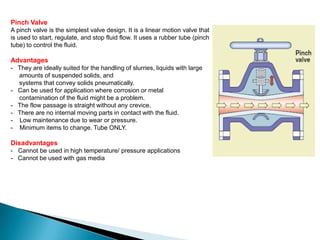
Pinch Valve
A pinch valve is the simplest valve design. It is a linear motion valve that
is used to start, regulate, and stop fluid flow. It uses a rubber tube (pinch
tube) to control the fluid.

Advantages
- They are ideally suited for the handling of slurries, liquids with large
  amounts of suspended solids, and
  systems that convey solids pneumatically.
- Can be used for application where corrosion or metal
  contamination of the fluid might be a problem.
- The flow passage is straight without any crevice.
- There are no internal moving parts in contact with the fluid.
- Low maintenance due to wear or pressure.
- Minimum items to change. Tube ONLY.

Disadvantages
- Cannot be used in high temperature/ pressure applications
- Cannot be used with gas media
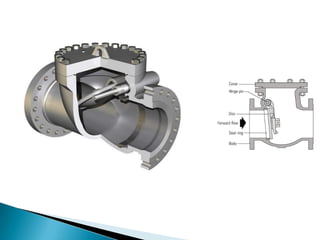
Check Valves
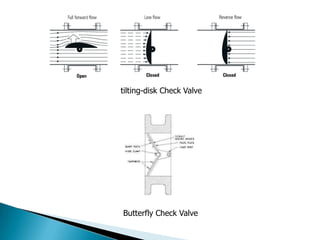
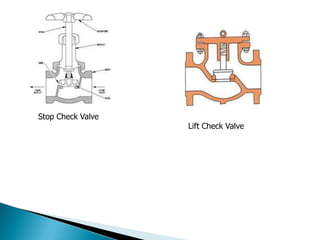
 Check valves are designed to prevent the reversal of flow in a piping system. These
  valves are activated by the flowing material in the pipeline. The pressure of the fluid
  passing through the system opens the valve, while any reversal of flow will close the
  valve. Closure is accomplished by the weight of the check mechanism, by back
  pressure, by a spring, or by a combination of these means. The general types of check
  valves are swing, tilting-disk, piston, , and stop.
tilting-disk Check Valve


Butterfly Check Valve
Stop Check Valve
                   Lift Check Valve
References
http://www.iklimnet.com/expert_hvac/valve_selection.html

Valves presentation

  • 1.
  • 2.
    What is valve?  Classification of valves  Valve types.  Methods of controlling flow through a valve.  Basic Parts of the valve.  Valve types
  • 3.
    What is valve? A valve is a device that regulates, directs or controls the flow of a fluid by opening, closing, or partially obstructing various passageways. Valve Functions  Stopping and starting fluid flow.  Varying (throttling) the amount of fluid flow.  Controlling the direction of fluid flow.  Regulating downstream system or process pressure.  Relieving component or piping over pressure.
  • 4.
    Classification of Valves Thefollowing are some of the commonly used valve classifications, based on mechanical motion: •Linear Motion Valves. The valves in which the closure member, as in gate, globe, diaphragm, pinch moves in a straight line to allow, stop, or throttle the flow. •Rotary Motion Valves. When the valve-closure member travels along an angular or circular path, as in butterfly, ball, plug valves. •Quarter Turn Valves. Some rotary motion valves require approximately a quarter turn, 0 through 90 , motion of the stem to go to fully open from a fully closed position or vice versa. Classification of valves based on motion Valve types Linear motion Rotary motion Quarter turn Gate Valve x Globe valve x Plug valve x x Ball valve x x Butterfly valve x x Diaphragm valve x Pinch valve x
  • 5.
    Methods of controllingflow through a valve. 1. Move a disc, or plug into or against an orifice globe or needle type valve) globe valve Needle valve
  • 6.
    Methods of controllingflow through a valve. 2. Slide a flat, cylindrical, or spherical surface across the orifice. plug valve gate valve
  • 7.
    Methods of controllingflow through a valve. 3. Rotate a disc or ellipse about a shaft extending across the diameter of an orifice. ball valve butterfly valve
  • 8.
    Methods of controllingflow through a valve. 4. Move a flexible material into the flow passage. diaphragm valve pinch valve
  • 9.
    Basic Parts ofthe valve  Body  Bonnet  Trim (internal elements)  Actuator (Handwheel)  Packing
  • 10.
    Basic Parts ofthe valve Body It is called the shell, is the primary pressure boundary of a valve. It serves as the principal element of a valve assembly because it is the framework that holds everything together.
  • 11.
    Basic Parts ofthe valve Bonnet The cover for the opening in the valve body. Bonnets Features • bonnet is the second principal pressure boundary of a valve. • It is cast or forged of the same material as the body and is connected to the body by a threaded, bolted, or welded joint. • the attachment of the bonnet to the body is considered a pressure boundary. This means that the weld joint or bolts that connect the bonnet to the body are pressure- retaining parts. • Valve bonnets, although a necessity for most valves, Welded Bonnet represent a cause for concern, • Bonnets can complicate the manufacture. • Increase valve size. • Represent a significant cost portion of valve cost. • Bonnets are a source for potential leakage. Bolted Bonnet
  • 12.
    Basic Parts ofthe valve Valve Trim The internal elements of a valve are collectively referred to as a valve's trim. The trim typically includes a disk, seat, stem, and sleeves needed to guide the fluid. A valve's performance is determined by the disk and seat interface and the relation of the disk position to the seat. Because of the trim, basic motions and flow control are possible. Valve Trim
  • 13.
    Basic Parts ofthe valve Internal parts of the valve Disk Disk is the third primary principal pressure boundary. It provides the capability for allowing and stopping fluid flow. The disk is a pressure-retaining part. Disks are typically forged and, in some designs, hard-surfaced to provide good wear characteristics. Most valves are named, in part, according to the design of their disks. Seat or seal rings provide the seating surface for the disk. To improve the wear-resistance of the seal rings, the surface is often hard-faced by welding and then machining the contact surface of the seal ring.
  • 14.
    Basic Parts ofthe valve Internal parts of the valve Stem Connects the actuator (hand wheel) and disk, is responsible for positioning the disk.  Stem designs fall into four basic categories:  Rising stem with outside screw Stem  Rising stem with inside screw  Non rising stem with inside screw  Sliding stem. Inside Screw Rising Stem (ISRS) Outside Screw Inside Screw Non-Rising Stem
  • 15.
    Basic Parts ofthe valve Actuator (hand wheel) Operates the stem and disk assembly. An actuator may be operated manually or automatically. Actuator Packing It is used to prevent leakage from the space between the stem and the bonnet. Packing
  • 16.
    Valve Selection Considerations  1. Pressure.  5. Operating conditions ◦ A. Frequency of operation.  2. Temperature. ◦ B. Accessibility.  3. Type of fluid. ◦ C. Overall space/size available. ◦ A. Liquid. ◦ D. Manual or automated control. ◦ B. Gas, i.e., steam or air. ◦ E. Need for bubble-tight shut-off. ◦ C. Dirty or abrasive (erosive) ◦ F. Concerns about body joint leaks. ◦ D. Corrosive. ◦ G. Fire safe design.  4. Flow Considerations ◦ H. Speed of closure. ◦ A. On-off or Throttling. ◦ C. Is the valve needed to prevent ◦ backflow. ◦ D. Concern for pressure drop. ◦ E. Velocity.
  • 17.
    There are factors govern the basic materials selection Corrosion-resistance requirements. Thermal shock. Piping stress. Fire hazard.  Types of materials typically available include, Ductile iron. Carbon steel. Cast iron. Stainless steels. Brass. Bronze. Polyvinyl chloride (PVC) plastic.  Body Materials For small valves are usually brass, bronze, or forged steel For larger valves, cast iron, cast ductile iron or cast steel as required for the pressure and service.
  • 18.
    Seat and Valve Disk Materials  The valve seat and valve disk are sometimes referred to as the valve trim and are usually constructed of the same material selected to meet the service requirements.  Valve stem material should be selected to meet service conditions. Stainless steel is commonly used for most HVAC applications, and bronze is commonly used in ball valve construction.
  • 20.
    Table 2.10 CommonASTM Materials for Bodies and Bonnets
  • 21.
    Threaded ends ◦ Used for small application up to 4 in. they are cheap but can be stripped and leak, for this reason they are used when leakage is not a problem. Threaded ends should not be used with corrosive processes, since the threads can either fail or become inseparable. Threaded end
  • 22.
    Welded ends ◦ When zero leakage is required for environmental, safety, or any efficiency reasons the piping can be welded to the valve, providing one piece construction. Many users insist that high-pressure Welded end application requires a permanent end especially if they involve high temperatures  Flanged ends ◦ The most expensive but are the best from an installation and removal standpoint. The main advantage of flanges is that the valve can be removed easily from the line Flanged end
  • 23.
    Valve types ◦ Globe valve ◦ Diaphragm valve ◦ Gate valve ◦ Pinch valve ◦ Plug valve ◦ Check valve ◦ Ball valve ◦ Safety/relief valve ◦ Needle valve ◦ Reducing valve ◦ Butterfly valve
  • 24.
    Globe Valves A globevalve is a linear motion valve used to stop, start, and regulate fluid flow. The three primary body designs for globe valves are Z-body, Y-body, and Angle. Advantages o Recommended for throttling applications. o Good for frequent operation. o Easy to repair. Disadvantages o Flow path causes a significant pressure drop. o Globe valves are more costly than alternative valves. Globe_Valve_-_FBV. mp4
  • 25.
    Gate Valves Flow iscontrolled by raising or lowering the valving element. Gate valves are not usually used to regulate flow because the valving element can be damaged when in the partially open position. Similarly, they also limit the pressure drop across the valve when fully open.
  • 26.
    Advantages • Gate valvesopens or closes slowly, which prevents fluid hammer and subsequent damage to the piping system. • They need long operation time since setting the valve to the fully open or closed position requires the handle to be turned many times. • Good choice for on-off service. • Full flow, low pressure drop. • Bidirectional. Disadvantages • It is not suitable for throttling applications. • It is prone to vibration in the partially open state. • It is more subject to seat and disk wear. • Repairs, such as lapping and grinding, are generally more difficult to accomplish.
  • 27.
    Ball Valves A ballvalve is a rotational motion valve that uses a ball-shaped disk to stop or start fluid flow. Advantages - Maintains and regulates high volume, high pressure, and high temp flow - Low purchase and maintenance costs. - No lubrication requirements. - Give tight sealing with low torque. - Time of valve operation is minimized. - Can be used for throttling service. - Can handle fluids with suspended solids. Disadvantages - Have relatively poor throttling characteristics. - Difficult to clean, leads to contamination Ball Va lve _FBV.mp4
  • 28.
    Butterfly Valves Butterfly valves are rotary motion valve that is used to stop, regulate, and start fluid flow. Advantages ◦ They are suitable for large valve applications. ◦ Compact, lightweight design. ◦ The maintenance costs are usually low. ◦ Pressure drop across a butterfly valve is small. ◦ Used with chemical or corrosive media. Disadvantages ◦ Difficult to clean ◦ Throttling limited to low differential pressure ◦ Potential for cavitations and choke ◦ Unguided disc movement is affected by flow turbulence Butterfly_Valves. mp4
  • 29.
    Diaphragm Valves A diaphragm valve is a linear motion valve that is used to start, regulate, and stop fluid flow. The name is derived from its flexible disk, which mates with a seat located in the open area at the top of the valve body to form a seal. Advantages - valve components can be isolated from the process fluid. - Valve construction prevents leakage of the fluid without the use of a gland seal (packing) Disadvantages - The diaphragm becomes worn more easily and regular maintenance is necessary. - These types of valves are generally not suited for very high temperature fluids and are mainly used on liquid systems.
  • 30.
    Pinch Valve A pinchvalve is the simplest valve design. It is a linear motion valve that is used to start, regulate, and stop fluid flow. It uses a rubber tube (pinch tube) to control the fluid. Advantages - They are ideally suited for the handling of slurries, liquids with large amounts of suspended solids, and systems that convey solids pneumatically. - Can be used for application where corrosion or metal contamination of the fluid might be a problem. - The flow passage is straight without any crevice. - There are no internal moving parts in contact with the fluid. - Low maintenance due to wear or pressure. - Minimum items to change. Tube ONLY. Disadvantages - Cannot be used in high temperature/ pressure applications - Cannot be used with gas media
  • 32.
    Check Valves Checkvalves are designed to prevent the reversal of flow in a piping system. These valves are activated by the flowing material in the pipeline. The pressure of the fluid passing through the system opens the valve, while any reversal of flow will close the valve. Closure is accomplished by the weight of the check mechanism, by back pressure, by a spring, or by a combination of these means. The general types of check valves are swing, tilting-disk, piston, , and stop.
  • 33.
  • 34.
    Stop Check Valve Lift Check Valve
  • 36.