OVERVIEW OF
IMMUNE SYSTEM
BY: DR SADAF MOEEZ
LECTURE 1
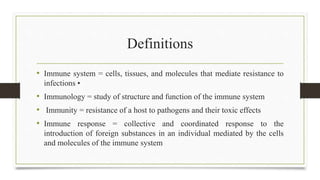
Definitions
• Immune system = cells, tissues, and molecules that mediate resistance to
infections •
• Immunology = study of structure and function of the immune system
• Immunity = resistance of a host to pathogens and their toxic effects
• Immune response = collective and coordinated response to the
introduction of foreign substances in an individual mediated by the cells
and molecules of the immune system
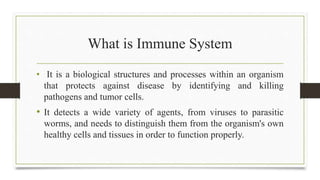
What is Immune System
• It is a biological structures and processes within an organism
that protects against disease by identifying and killing
pathogens and tumor cells.
• It detects a wide variety of agents, from viruses to parasitic
worms, and needs to distinguish them from the organism's own
healthy cells and tissues in order to function properly.
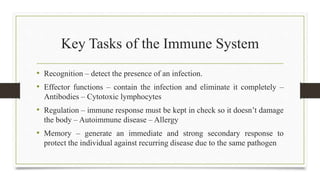
Key Tasks of the Immune System
• Recognition – detect the presence of an infection.
• Effector functions – contain the infection and eliminate it completely –
Antibodies – Cytotoxic lymphocytes
• Regulation – immune response must be kept in check so it doesn’t damage
the body – Autoimmune disease – Allergy
• Memory – generate an immediate and strong secondary response to
protect the individual against recurring disease due to the same pathogen
Immunity
• The Latin term “IMMUNIS” means EXEMPT, referring to protection against
foreign agents.
• DEFINITION: - The integrated body system of organs, tissues, cells & cell
products that differentiates self from non – self & neutralizes potentially
pathogenic organisms.
• Immunology is the study of our protection from foreign macromolecules or
invading organisms and our responses to them. • Host – e.g. me!!!! •
• Foreign macromolecule, antigen – e.g. virus protein, worm, parasite (Everything
that should not be in my body)
Role of the Immune System
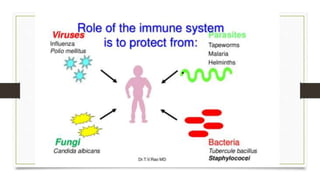
• Defense against microbes
• Defense against the growth of tumor cells – kills the growth of tumor cells
Homeostasis – destruction of abnormal or dead cells (e.g. dead red or
white blood cells, antigen-antibody complex)
Immunology
• The study of the body’s defense against infection.
• How does the body eliminate invaders and cure itself?
Immunity
• Resistance acquired by a host towards injury caused by microorganisms
and their products. •
• Protection against the infectious diseases is only one of the consequences
of the immune response, which entirely is concerned with the reaction of
the body against any foreign antigen.
What causes Disease?
• At the time vaccinations started in the late 1700’s, nothing was known
about what caused disease.
• In the late 1800’s, Robert Koch proved that microorganisms are
responsible for particular diseases.
• Pathogen: disease causing organism. – Four main types today: viruses,
bacteria, fungi, and unicellular and multicellular parasites.
The search for an answer
• Scientists asked, “how are vaccines offering protection? What is the
mechanism?”
• 1890’s: serum of animals immune to tetanus contains antitoxic activity that offers
short-lived protection against tetanus toxins in people –
• Discovery of antibodies! Antibodies bound specifically to the toxins and
neutralized their activity. –
• The toxins are antigens.
• Antigen = substance that stimulates antibody generation.
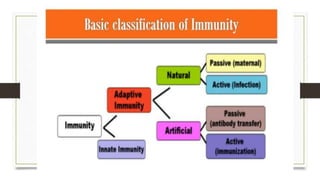
Types of Immunity
• Its classified as
• Innate immunity (Native)
• Non specific: species, racial, individual
• Specific: Species, racial, individual
• Acquired Immunity (Adaptive)
• Active: Natural or Artificial
• Passive: Natural or Artificial
Types of Immunity
• Two types of immunity
• 1. Innate (non-adaptive) – first line of immune response
• relies on mechanisms that exist before infection
• 2. Acquired (adaptive) – Second line of response (if innate fails)
• relies on mechanisms that adapt after infection
• handled by T- and B- lymphocytes
• one cell determines one antigenic determinant
Antigen
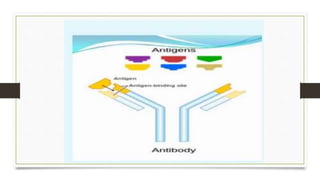
• ANTIGEN: An antigen is a molecule that induces an immune response in
the body.
• Origin of antigen
• Exogenous antigens • Antigens that have entered the body from the
outside. E.g. By inhalation, ingestion, or injection.
• Endogenous antigens • Antigens that have been generated within
previously normal cells as a result of normal cell metabolism, or because
of viral or intracellular bacterial infection
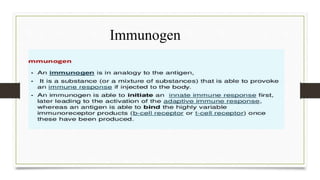
Immunogen
immunology .pptx
immunology .pptx
immunology .pptx

immunology .pptx

  • 1.
    OVERVIEW OF IMMUNE SYSTEM BY:DR SADAF MOEEZ LECTURE 1
  • 2.
    Definitions • Immune system= cells, tissues, and molecules that mediate resistance to infections • • Immunology = study of structure and function of the immune system • Immunity = resistance of a host to pathogens and their toxic effects • Immune response = collective and coordinated response to the introduction of foreign substances in an individual mediated by the cells and molecules of the immune system
  • 3.
    What is ImmuneSystem • It is a biological structures and processes within an organism that protects against disease by identifying and killing pathogens and tumor cells. • It detects a wide variety of agents, from viruses to parasitic worms, and needs to distinguish them from the organism's own healthy cells and tissues in order to function properly.
  • 4.
    Key Tasks ofthe Immune System • Recognition – detect the presence of an infection. • Effector functions – contain the infection and eliminate it completely – Antibodies – Cytotoxic lymphocytes • Regulation – immune response must be kept in check so it doesn’t damage the body – Autoimmune disease – Allergy • Memory – generate an immediate and strong secondary response to protect the individual against recurring disease due to the same pathogen
  • 5.
    Immunity • The Latinterm “IMMUNIS” means EXEMPT, referring to protection against foreign agents. • DEFINITION: - The integrated body system of organs, tissues, cells & cell products that differentiates self from non – self & neutralizes potentially pathogenic organisms. • Immunology is the study of our protection from foreign macromolecules or invading organisms and our responses to them. • Host – e.g. me!!!! • • Foreign macromolecule, antigen – e.g. virus protein, worm, parasite (Everything that should not be in my body)
  • 6.
    Role of theImmune System • Defense against microbes • Defense against the growth of tumor cells – kills the growth of tumor cells Homeostasis – destruction of abnormal or dead cells (e.g. dead red or white blood cells, antigen-antibody complex)
  • 8.
    Immunology • The studyof the body’s defense against infection. • How does the body eliminate invaders and cure itself?
  • 9.
    Immunity • Resistance acquiredby a host towards injury caused by microorganisms and their products. • • Protection against the infectious diseases is only one of the consequences of the immune response, which entirely is concerned with the reaction of the body against any foreign antigen.
  • 10.
    What causes Disease? •At the time vaccinations started in the late 1700’s, nothing was known about what caused disease. • In the late 1800’s, Robert Koch proved that microorganisms are responsible for particular diseases. • Pathogen: disease causing organism. – Four main types today: viruses, bacteria, fungi, and unicellular and multicellular parasites.
  • 11.
    The search foran answer • Scientists asked, “how are vaccines offering protection? What is the mechanism?” • 1890’s: serum of animals immune to tetanus contains antitoxic activity that offers short-lived protection against tetanus toxins in people – • Discovery of antibodies! Antibodies bound specifically to the toxins and neutralized their activity. – • The toxins are antigens. • Antigen = substance that stimulates antibody generation.
  • 12.
    Types of Immunity •Its classified as • Innate immunity (Native) • Non specific: species, racial, individual • Specific: Species, racial, individual • Acquired Immunity (Adaptive) • Active: Natural or Artificial • Passive: Natural or Artificial
  • 13.
    Types of Immunity •Two types of immunity • 1. Innate (non-adaptive) – first line of immune response • relies on mechanisms that exist before infection • 2. Acquired (adaptive) – Second line of response (if innate fails) • relies on mechanisms that adapt after infection • handled by T- and B- lymphocytes • one cell determines one antigenic determinant
  • 15.
    Antigen • ANTIGEN: Anantigen is a molecule that induces an immune response in the body. • Origin of antigen • Exogenous antigens • Antigens that have entered the body from the outside. E.g. By inhalation, ingestion, or injection. • Endogenous antigens • Antigens that have been generated within previously normal cells as a result of normal cell metabolism, or because of viral or intracellular bacterial infection
  • 18.