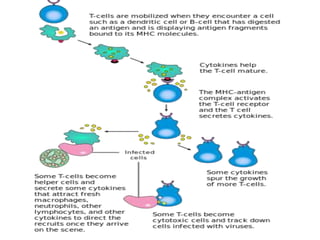
T CELL ACTIVATION
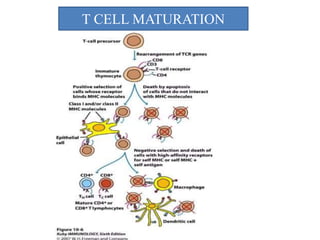
T CELL MATURATION
‱ Negative selection: The process by which T
cells are screened so that those with a high
affinity for binding to self antigens (and
potentially causing autoimmunity) are
destroyed.
‱ Positive selection: The process by which T
cells are screened so that only those capable of
binding to MHC are kept alive.
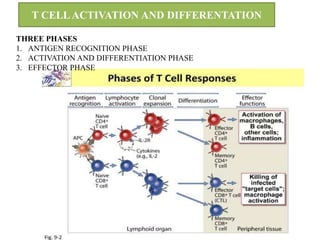
THREE PHASES
1. ANTIGEN RECOGNITION PHASE
2. ACTIVATION AND DIFFERENTIATION PHASE
3. EFFECTOR PHASE
T CELLACTIVATION AND DIFFERENTATION
T CELLACTIVATION
‱ Activation of T cells occurs through the simultaneous
engagement of the T-cell receptor and a co-stimulatory
molecule (like CD4 or CD28) on the T cell by the major
histocompatibility complex (MHCII) peptide and co-
stimulatory molecules on the APC.
‱ Both are required for production of an effective immune
response; in the absence of co-stimulation, T cell receptor
signalling alone results in anergy.
– Anergy is a term in immunobiology that describes a
lack of reaction by the body's defense mechanisms to
foreign substances
FIRST SIGNAL
‱ The first signal is provided by binding of the
T cell receptor to its peptide presented on
MHCII on an APC.
‱ Peptides presented to CD8+ T cells by MHC
class I molecules are 8–13 amino acids in
length.
‱ Peptides presented to CD4+ cells by MHC
class II molecules are longer, usually 12–25
amino acids in length.
SECOND SIGNAL
‱ The second signal comes from co-stimulation.
in which surface receptors on the APC are
induced by a relatively small number of
stimuli, usually
– products of pathogens,
– sometimes breakdown products of cells, such
as necrotic-bodies or heat shock proteins.
The second signal licenses the T cell to respond to an
antigen. Without it, the T cell becomes anergic, and
it becomes more difficult for it to activate in future.
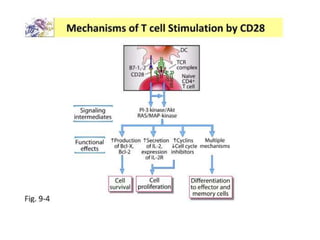
CD28
T CELL ACTIVATION.pptx

T CELL ACTIVATION.pptx

  • 1.
  • 2.
  • 3.
    ‱ Negative selection:The process by which T cells are screened so that those with a high affinity for binding to self antigens (and potentially causing autoimmunity) are destroyed. ‱ Positive selection: The process by which T cells are screened so that only those capable of binding to MHC are kept alive.
  • 4.
    THREE PHASES 1. ANTIGENRECOGNITION PHASE 2. ACTIVATION AND DIFFERENTIATION PHASE 3. EFFECTOR PHASE T CELLACTIVATION AND DIFFERENTATION
  • 5.
    T CELLACTIVATION ‱ Activationof T cells occurs through the simultaneous engagement of the T-cell receptor and a co-stimulatory molecule (like CD4 or CD28) on the T cell by the major histocompatibility complex (MHCII) peptide and co- stimulatory molecules on the APC. ‱ Both are required for production of an effective immune response; in the absence of co-stimulation, T cell receptor signalling alone results in anergy. – Anergy is a term in immunobiology that describes a lack of reaction by the body's defense mechanisms to foreign substances
  • 6.
    FIRST SIGNAL ‱ Thefirst signal is provided by binding of the T cell receptor to its peptide presented on MHCII on an APC. ‱ Peptides presented to CD8+ T cells by MHC class I molecules are 8–13 amino acids in length. ‱ Peptides presented to CD4+ cells by MHC class II molecules are longer, usually 12–25 amino acids in length.
  • 7.
    SECOND SIGNAL ‱ Thesecond signal comes from co-stimulation. in which surface receptors on the APC are induced by a relatively small number of stimuli, usually – products of pathogens, – sometimes breakdown products of cells, such as necrotic-bodies or heat shock proteins. The second signal licenses the T cell to respond to an antigen. Without it, the T cell becomes anergic, and it becomes more difficult for it to activate in future.
  • 8.