Carbohydrates
Carbohydrates
Carbohydrates (also called saccharides) are molecular compounds
made from just three elements: carbon, hydrogen and oxygen.
Carbohydrates are aldehyde and ketone compounds with multiple
hydroxyl groups.
Carbohydrates are polyhydroxyalcohols with an aldehyde or keto group.
They are represented with general formulae Cn(H2O)n and hence
called hydrates of carbons.
Functions of Carbohydrates
• Carbohydrates are components of other molecules e.g. DNA, RNA,
glycolipids, glycoproteins, ATP
• They serve as energy stores, fuels and metabolic intermediates.
• They are constituent of RNA and DNA backbones as ribose and
deoxyribose sugars.
• Polysaccharides are constituents of cell walls of bacteria and plants.
• Carbohydrates are linked to surfaces of proteins and lipids where they
play role as informational materials e.g. in cell-cell interaction and
interaction between cells with other elements in the cellular
environment.
Classification of Carbohydrates
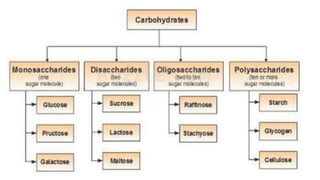
Carbohydrates are classified according to the hydrolysis products into
four main groups as follows:
1. Monosaccharides: contain one monosaccharide unit.
2. Disaccharides: contain 2 monosaccharide units per molecule.
3. Oligosaccharides: contain from 3 to 10 monosaccharide units per
molecule.
4. Polysaccharides: contain more than 10 monosaccharide units per
molecule.
Monosaccharide
Monosaccharide are the simplest carbohydrates which contain free
aldehyde (-CHO) and ketone (>C=O) groups that have two or more
hydroxyl (-OH) groups. The general formula of monosaccharide
Cn(H2O)n. With 4 or more C's, they are usually cyclic molecules with
5-membered (furanose) or 6-membered (pyranose) rings
Monosaccharides are sugars that can not be further hydrolysed into
simple carbohydrates. They consist of one sugar containing 3,4,5,6
and 7 carbon atoms and are usually colorless, water-soluble,
crystalline solids. Examples of monosaccharides include glucose
(dextrose), fructose (levulose), galactose, xylose and ribose. Every
monosaccharide is a reducing sugar. All of the monosaccharides—
glucose, fructose, and galactose—are reducing sugars.
Classification of Monosaccharide
They are classified on the basis of:-
A) The number of carbon atoms in the molecule into trioses (3 carbons), tetroses (4
carbons), pentoses (5 carbons), hexoses (6 carbons) and heptoses (7 carbons).
n = 3 trioses, e.g. glyceraldehyde
n = 5 pentoses, e.g. ribose and deoxyribose ('pent' indicates 5)
n = 6 hexoses, e.g. fructose, glucose and galactose ('hex' indicates 6)
B) and on the basis of functional group they possess: the presence of aldehyde or ketone
group into aldoses and ketoses.
Both the classifications i.e. number of carbon atoms and nature of functional groups may
be combined to classify the sugar. For example glycerose (=glyceraldehyde) is an aldotriose,
ribose is an aldopentose and fructose is a ketohexose.
Examples of Monosaccharide
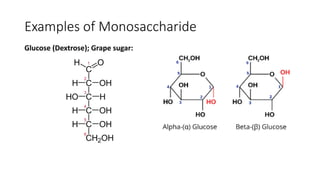
Glucose (Dextrose); Grape sugar:
Cont…
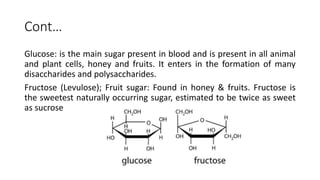
Glucose: is the main sugar present in blood and is present in all animal
and plant cells, honey and fruits. It enters in the formation of many
disaccharides and polysaccharides.
Fructose (Levulose); Fruit sugar: Found in honey & fruits. Fructose is
the sweetest naturally occurring sugar, estimated to be twice as sweet
as sucrose
Disaccharides
Two monosaccharides can join to form a disaccharide. The bond
formed between the monosaccharide is called glycosidic bond.
Disaccharides are produced from the condensation of 2
monosaccharide molecules. Examples:
• Lactose [milk sugar]: It is composed of galactose and glucose.
• Maltose (Malt sugar): is composed of 2 molecules of glucose.
• Sucrose (Table sugar, Cane sugar, Beet sugar): is composed of glucose
and fructose
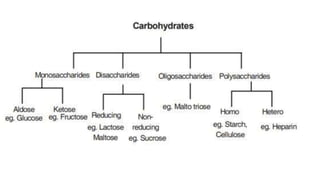
Disaccharides can be classified as reducing and non reducing sugars.
• Reducing sugars contain free aldehyde or ketone groups. They can transfer
hydrogen electrons to other compounds and can cause the reduction of
other compounds. To elaborate, the anomeric carbon of a sugar can be
used to identify it. The first stereocenter of the molecule is an anomeric
carbon. If the anomeric carbon has an OH group, it is a reducing sugar.
When the sugar is in an open configuration, an alcohol molecule converts it
to a ketone or aldehyde, which can reduce other compounds.
• Non-reducing sugars do not contain any free aldehyde or ketone groups
and are not capable of reducing other compounds because the anomeric
carbon does not have an OH group attached to it. Sucrose is the most
common non-reducing sugar. It is also known as table sugar. Sucrose is a
glucose carbon connected at the anomeric carbon to a fructose carbon.
Because the bond involves both anomeric carbons, neither carbon has an
OH group. Therefore, sucrose cannot reduce other compounds and is not a
reducing sugar.
Polysaccharides
Monosaccharides can undergo a series of condensation reactions, adding one unit after another to the chain
until very large molecules (polysaccharides) are formed. This is called condensation polymerisation, and the
building blocks are called monomers. The properties of a polysaccharide molecule depend on:
• its length (though they are usually very long)
• the extent of any branching (addition of units to the side of the chain rather than one of its ends)
• any folding which results in a more compact molecule
• whether the chain is 'straight' or 'coiled
Polysaccharides are polymers composed of ten or more monosaccharide units. These monosaccharide units
are joined together by glycosidic linkages. They have two categories:
1. Homopolysaccharides: Polysaccharides made up of a single type of monosaccharide units are called as
homopolysaccharides.
2. Heteropolysaccharides: whereas polysaccharides composed of two or more types of monosaccharides
are called heteropolysaccharides.
Polysaccharides differ from each other in the type of repeating monosaccharide unit, in the number of
repeating units, in the degree of branching, and in the type of glycosidic linkage between the monomeric units.
Examples of Polysaccharides
1. Starch: Starch is often produced in plants as a way of storing energy.
It exists in two forms: amylose and amylopectin. Both are made
from Îą-glucose. Amylose is an unbranched polymer of Îą-glucose.
The molecules coil into a helical structure. It forms a colloidal
suspension in hot water. Amylopectin is a branched polymer of Îą-
glucose. It is completely insoluble in water.
2. Glycogen: Glycogen is amylopectin with very short distances
between the branching side-chains. Starch from plants is hydrolysed
in the body to produce glucose. Glucose passes into the cell and is
used in metabolism. Inside the cell, glucose can be polymerised to
make glycogen which acts as a carbohydrate energy store.
3. Cellulose: Cellulose is a third polymer made from glucose. But this
time it's made from β-glucose molecules and the polymer molecules
are 'straight'. Cellulose serves a very different purpose in nature to
starch and glycogen. It makes up the cell walls in plant cells. These are
much tougher than cell membranes. This toughness is due to the
arrangement of glucose units in the polymer chain and the hydrogen-
bonding between neighbouring chains.
Cellulose is not hydrolysed easily and, therefore, cannot be digested so
it is not a source of energy for humans. The stomachs of Herbivores
contain a specific enzyme called cellulase which enables them to digest
cellulose.

Carbohydrates.pptx

  • 1.
  • 2.
    Carbohydrates Carbohydrates (also calledsaccharides) are molecular compounds made from just three elements: carbon, hydrogen and oxygen. Carbohydrates are aldehyde and ketone compounds with multiple hydroxyl groups. Carbohydrates are polyhydroxyalcohols with an aldehyde or keto group. They are represented with general formulae Cn(H2O)n and hence called hydrates of carbons.
  • 3.
    Functions of Carbohydrates •Carbohydrates are components of other molecules e.g. DNA, RNA, glycolipids, glycoproteins, ATP • They serve as energy stores, fuels and metabolic intermediates. • They are constituent of RNA and DNA backbones as ribose and deoxyribose sugars. • Polysaccharides are constituents of cell walls of bacteria and plants. • Carbohydrates are linked to surfaces of proteins and lipids where they play role as informational materials e.g. in cell-cell interaction and interaction between cells with other elements in the cellular environment.
  • 4.
    Classification of Carbohydrates Carbohydratesare classified according to the hydrolysis products into four main groups as follows: 1. Monosaccharides: contain one monosaccharide unit. 2. Disaccharides: contain 2 monosaccharide units per molecule. 3. Oligosaccharides: contain from 3 to 10 monosaccharide units per molecule. 4. Polysaccharides: contain more than 10 monosaccharide units per molecule.
  • 7.
    Monosaccharide Monosaccharide are thesimplest carbohydrates which contain free aldehyde (-CHO) and ketone (>C=O) groups that have two or more hydroxyl (-OH) groups. The general formula of monosaccharide Cn(H2O)n. With 4 or more C's, they are usually cyclic molecules with 5-membered (furanose) or 6-membered (pyranose) rings Monosaccharides are sugars that can not be further hydrolysed into simple carbohydrates. They consist of one sugar containing 3,4,5,6 and 7 carbon atoms and are usually colorless, water-soluble, crystalline solids. Examples of monosaccharides include glucose (dextrose), fructose (levulose), galactose, xylose and ribose. Every monosaccharide is a reducing sugar. All of the monosaccharides— glucose, fructose, and galactose—are reducing sugars.
  • 8.
    Classification of Monosaccharide Theyare classified on the basis of:- A) The number of carbon atoms in the molecule into trioses (3 carbons), tetroses (4 carbons), pentoses (5 carbons), hexoses (6 carbons) and heptoses (7 carbons). n = 3 trioses, e.g. glyceraldehyde n = 5 pentoses, e.g. ribose and deoxyribose ('pent' indicates 5) n = 6 hexoses, e.g. fructose, glucose and galactose ('hex' indicates 6) B) and on the basis of functional group they possess: the presence of aldehyde or ketone group into aldoses and ketoses. Both the classifications i.e. number of carbon atoms and nature of functional groups may be combined to classify the sugar. For example glycerose (=glyceraldehyde) is an aldotriose, ribose is an aldopentose and fructose is a ketohexose.
  • 9.
    Examples of Monosaccharide Glucose(Dextrose); Grape sugar:
  • 10.
    Cont… Glucose: is themain sugar present in blood and is present in all animal and plant cells, honey and fruits. It enters in the formation of many disaccharides and polysaccharides. Fructose (Levulose); Fruit sugar: Found in honey & fruits. Fructose is the sweetest naturally occurring sugar, estimated to be twice as sweet as sucrose
  • 11.
    Disaccharides Two monosaccharides canjoin to form a disaccharide. The bond formed between the monosaccharide is called glycosidic bond. Disaccharides are produced from the condensation of 2 monosaccharide molecules. Examples: • Lactose [milk sugar]: It is composed of galactose and glucose. • Maltose (Malt sugar): is composed of 2 molecules of glucose. • Sucrose (Table sugar, Cane sugar, Beet sugar): is composed of glucose and fructose Disaccharides can be classified as reducing and non reducing sugars.
  • 12.
    • Reducing sugarscontain free aldehyde or ketone groups. They can transfer hydrogen electrons to other compounds and can cause the reduction of other compounds. To elaborate, the anomeric carbon of a sugar can be used to identify it. The first stereocenter of the molecule is an anomeric carbon. If the anomeric carbon has an OH group, it is a reducing sugar. When the sugar is in an open configuration, an alcohol molecule converts it to a ketone or aldehyde, which can reduce other compounds. • Non-reducing sugars do not contain any free aldehyde or ketone groups and are not capable of reducing other compounds because the anomeric carbon does not have an OH group attached to it. Sucrose is the most common non-reducing sugar. It is also known as table sugar. Sucrose is a glucose carbon connected at the anomeric carbon to a fructose carbon. Because the bond involves both anomeric carbons, neither carbon has an OH group. Therefore, sucrose cannot reduce other compounds and is not a reducing sugar.
  • 13.
    Polysaccharides Monosaccharides can undergoa series of condensation reactions, adding one unit after another to the chain until very large molecules (polysaccharides) are formed. This is called condensation polymerisation, and the building blocks are called monomers. The properties of a polysaccharide molecule depend on: • its length (though they are usually very long) • the extent of any branching (addition of units to the side of the chain rather than one of its ends) • any folding which results in a more compact molecule • whether the chain is 'straight' or 'coiled Polysaccharides are polymers composed of ten or more monosaccharide units. These monosaccharide units are joined together by glycosidic linkages. They have two categories: 1. Homopolysaccharides: Polysaccharides made up of a single type of monosaccharide units are called as homopolysaccharides. 2. Heteropolysaccharides: whereas polysaccharides composed of two or more types of monosaccharides are called heteropolysaccharides. Polysaccharides differ from each other in the type of repeating monosaccharide unit, in the number of repeating units, in the degree of branching, and in the type of glycosidic linkage between the monomeric units.
  • 14.
    Examples of Polysaccharides 1.Starch: Starch is often produced in plants as a way of storing energy. It exists in two forms: amylose and amylopectin. Both are made from Îą-glucose. Amylose is an unbranched polymer of Îą-glucose. The molecules coil into a helical structure. It forms a colloidal suspension in hot water. Amylopectin is a branched polymer of Îą- glucose. It is completely insoluble in water. 2. Glycogen: Glycogen is amylopectin with very short distances between the branching side-chains. Starch from plants is hydrolysed in the body to produce glucose. Glucose passes into the cell and is used in metabolism. Inside the cell, glucose can be polymerised to make glycogen which acts as a carbohydrate energy store.
  • 15.
    3. Cellulose: Celluloseis a third polymer made from glucose. But this time it's made from β-glucose molecules and the polymer molecules are 'straight'. Cellulose serves a very different purpose in nature to starch and glycogen. It makes up the cell walls in plant cells. These are much tougher than cell membranes. This toughness is due to the arrangement of glucose units in the polymer chain and the hydrogen- bonding between neighbouring chains. Cellulose is not hydrolysed easily and, therefore, cannot be digested so it is not a source of energy for humans. The stomachs of Herbivores contain a specific enzyme called cellulase which enables them to digest cellulose.