INTRODUCTION TO IMMUNE SYSTEMINTRODUCTION TO IMMUNE SYSTEM
PRESENTER
Shakira
Ghazanfar
PhDScholar
Shakira_sulehri@yahoo.com
‫الرحيم‬ ‫الرحمن‬ ‫اللة‬ ‫بسم‬‫الرحيم‬ ‫الرحمن‬ ‫اللة‬ ‫بسم‬
INTRODUCTION
Immunity : Defence capacity of the body to
combat diseases  counter infection.
Immune System: Molecules, cells, tissues and
organs which provide non-specific and specific
protection against, Microorganisms, Microbial
toxins, Tumor cells.
INTRODUCTION
Their collective and coordinative response to
introduction of foreign substance represent the
immune response.
Specific definition :
Immunity is a reaction to foreign substances
including microbes, as well as macromolecules
(proteins, polysacharides). The reactions
include cellular and molecular types (events).
Immunology lingo
* Antigen
* Any molecule that binds to immunoglobulin or T
cell receptor
* Pathogen
* Microorganism that can cause disease
* Antibody (Ab)
* Secreted immunoglobulin
* Immunoglobulin (Ig)
* Antigen binding molecules of B cells
NATURALLY ACQUIRED
IMMUNITY
* Active
* Antigens enter body naturally with response of
* Innate and adaptive immune systems
* Provides long term protection
* Passive
* Antibodies pass from mother to
* Fetus across placenta
* Infant in breast milk
* Provides immediate short term protection
ARTIFICIALLY ACQUIRED
IMMUNITY
* Active
* Antigens enter body through vaccination with response of
* Innate and adaptive immune systems
* Provides long term protection
* Passive
* Antibodies from immune individuals injected into body
* Referred to as
* Immune serum globulins (ISG)
* Immune globulins (IG)
* Gamma globulins
* Provides immediate short term protection
PRINCIPAL FUNCTION OF THE
IMMUNE SYSTEM
* To protect humans from pathogenic microorganisms
* Pathogenic microorganisms (Pathogens)
* Microorganisms capable of causing infection and/or disease
* Infection
* Ability of pathogen to enter host, multiply and stimulate an
immune response
* Disease
* Clinical manifestations associated with infection
BACTERIA, VIRUSES, FUNGI,
PARASITES—OH MY!
* Streptococcus pyogenes (Group A Streptococcus)
* Klebsiella pneumoniae
* Mycobacterium tuberculosis
* Ebola virus
* Human Immunodeficiency Virus (HIV)
* Aspergillus fumigatus
* Candida albicans
* Cryptococcus neoformans
* Cryptosporidium parvum
* Stronglyoides stercoralis
* Ascaris lumbricoides
* Plasmodium falciparum
DEFENSE MECHANISMS OF THE
HUMAN HOST
* Innate Mechanisms (Innate immunity)
* First line of defense
* Non-specific
* Adaptive Mechanisms (Adaptive immunity)
* Second line of defense
* Highly specific with memory
* Cooperation between mechanisms
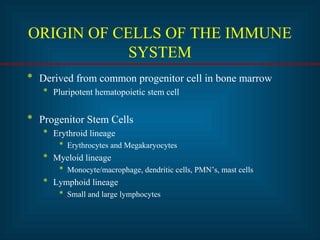
ORIGIN OF CELLS OF THE IMMUNE
SYSTEM
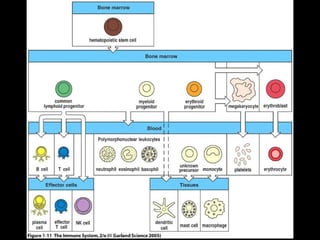
* Derived from common progenitor cell in bone marrow
* Pluripotent hematopoietic stem cell
* Progenitor Stem Cells
* Erythroid lineage
* Erythrocytes and Megakaryocytes
* Myeloid lineage
* Monocyte/macrophage, dendritic cells, PMN’s, mast cells
* Lymphoid lineage
* Small and large lymphocytes
CELLS OF INNATE AND ADAPTIVE
IMMUNITY
* Myeloid Lineage
* Neutrophil
* Principal phagocytic cell of innate immunity
* Eosinophil
* Principal defender against parasites
* Basophil
* Functions similar to eosinophils and mast cells
* Referred to as
* Polymorphonuclear leukocytes (PMN’s)
* Nuclei are multilobed (2 to 5)
* Granulocytes
* Cytoplasmic granules
CELLS OF INNATE AND ADAPTIVE
IMMUNITY
* Myeloid lineage
* Monocytes
* Leukocytes with bean shaped or brain-like convoluted nuclei
* Circulate in blood with half life of 8 hours
* Precursors of tissue macrophages
* Macrophages
* Mononuclear phagocytic cells in tissue
* Derive from blood monocytes
* Participate in innate and adaptive immunity

Introduction to immune system

  • 1.
    INTRODUCTION TO IMMUNESYSTEMINTRODUCTION TO IMMUNE SYSTEM PRESENTER Shakira Ghazanfar PhDScholar Shakira_sulehri@yahoo.com ‫الرحيم‬ ‫الرحمن‬ ‫اللة‬ ‫بسم‬‫الرحيم‬ ‫الرحمن‬ ‫اللة‬ ‫بسم‬
  • 2.
    INTRODUCTION Immunity : Defencecapacity of the body to combat diseases  counter infection. Immune System: Molecules, cells, tissues and organs which provide non-specific and specific protection against, Microorganisms, Microbial toxins, Tumor cells.
  • 3.
    INTRODUCTION Their collective andcoordinative response to introduction of foreign substance represent the immune response. Specific definition : Immunity is a reaction to foreign substances including microbes, as well as macromolecules (proteins, polysacharides). The reactions include cellular and molecular types (events).
  • 4.
    Immunology lingo * Antigen *Any molecule that binds to immunoglobulin or T cell receptor * Pathogen * Microorganism that can cause disease * Antibody (Ab) * Secreted immunoglobulin * Immunoglobulin (Ig) * Antigen binding molecules of B cells
  • 5.
    NATURALLY ACQUIRED IMMUNITY * Active *Antigens enter body naturally with response of * Innate and adaptive immune systems * Provides long term protection * Passive * Antibodies pass from mother to * Fetus across placenta * Infant in breast milk * Provides immediate short term protection
  • 6.
    ARTIFICIALLY ACQUIRED IMMUNITY * Active *Antigens enter body through vaccination with response of * Innate and adaptive immune systems * Provides long term protection * Passive * Antibodies from immune individuals injected into body * Referred to as * Immune serum globulins (ISG) * Immune globulins (IG) * Gamma globulins * Provides immediate short term protection
  • 7.
    PRINCIPAL FUNCTION OFTHE IMMUNE SYSTEM * To protect humans from pathogenic microorganisms * Pathogenic microorganisms (Pathogens) * Microorganisms capable of causing infection and/or disease * Infection * Ability of pathogen to enter host, multiply and stimulate an immune response * Disease * Clinical manifestations associated with infection
  • 8.
    BACTERIA, VIRUSES, FUNGI, PARASITES—OHMY! * Streptococcus pyogenes (Group A Streptococcus) * Klebsiella pneumoniae * Mycobacterium tuberculosis * Ebola virus * Human Immunodeficiency Virus (HIV) * Aspergillus fumigatus * Candida albicans * Cryptococcus neoformans * Cryptosporidium parvum * Stronglyoides stercoralis * Ascaris lumbricoides * Plasmodium falciparum
  • 9.
    DEFENSE MECHANISMS OFTHE HUMAN HOST * Innate Mechanisms (Innate immunity) * First line of defense * Non-specific * Adaptive Mechanisms (Adaptive immunity) * Second line of defense * Highly specific with memory * Cooperation between mechanisms
  • 10.
    ORIGIN OF CELLSOF THE IMMUNE SYSTEM * Derived from common progenitor cell in bone marrow * Pluripotent hematopoietic stem cell * Progenitor Stem Cells * Erythroid lineage * Erythrocytes and Megakaryocytes * Myeloid lineage * Monocyte/macrophage, dendritic cells, PMN’s, mast cells * Lymphoid lineage * Small and large lymphocytes
  • 12.
    CELLS OF INNATEAND ADAPTIVE IMMUNITY * Myeloid Lineage * Neutrophil * Principal phagocytic cell of innate immunity * Eosinophil * Principal defender against parasites * Basophil * Functions similar to eosinophils and mast cells * Referred to as * Polymorphonuclear leukocytes (PMN’s) * Nuclei are multilobed (2 to 5) * Granulocytes * Cytoplasmic granules
  • 13.
    CELLS OF INNATEAND ADAPTIVE IMMUNITY * Myeloid lineage * Monocytes * Leukocytes with bean shaped or brain-like convoluted nuclei * Circulate in blood with half life of 8 hours * Precursors of tissue macrophages * Macrophages * Mononuclear phagocytic cells in tissue * Derive from blood monocytes * Participate in innate and adaptive immunity