ADAPTIVE IMMUNITY
BY: DR SADAF MOEEZ
Acquired immunity
 Acquired immunity is immunity you develop over your
lifetime. It can come from:
1. a vaccine
2. exposure to an infection or disease
3. another person’s antibodies (infection-fighting
immune cells)
What are the 4 phases of the immune response?
• The adaptive immune response in B cells, Helper T
cells and Cytotoxic T cells involved four
phases: encounter, activation, attack, and memory.
FACTORS REQUIRED FOR ACQUIRED IMMUNITY
Major Characteristics of the Adaptive
Immune Response
 Specificity: is the ability to discriminate among different molecular entities
and to respond only to those uniquely required.
 Adaptiveness: is the ability to respond to previously unseen molecules that
may in fact never have naturally existed before on earth.
 Discrimination between self and non-self: This distinction, and the
recognition of antigen, is conferred by specialized cells (lymphocytes) that
bear on their surface antigen-specific receptors.
 Memory: a property shared with the nervous system, is the ability to recall
previous contact with a foreign molecule and respond to it in a learned
manner, that is with a more rapid and larger response(secondary response).
– Another term often used to describe immunologic memory
is anamnestic response.
• rapid production of an antibody on the second (or subsequent)
encounter with the same antigen.
Types of T Cells
EFFECTOR T CELLS TYPES
1. T HELPER CELLS OR TH CELLS has CD4 surface co-receptor
2. CYTOTOXIC T CELLS has CD8 surface co-receptor
The T cells differentiates in to 2 types of cells
 TH /T helper cells (CD4+): have a co-receptor called CD4 on their cell
surface.
 Interacts with MHC class II molecules, This allows helper T cells to
recognize pathogen peptides that have been displayed by antigen presenting
cells.
 When helper T cells recognize a peptide on an antigen presenting cell,
they become activated and begin to produce molecules called cytokines that
signal to other immune cells.
 These cells secrete cytokines which stimulate cell division of B cells and
its maturation into plasma and memory cells that eventually release
antibodies.
 Activation of macrophages to bring the process of phagocytosis.
 They also help activate cytotoxic T cells to kill infected target cells.
T-HELPER CELLS
TYPES OF T-HELPER CELLS
T follicular helper cells (Tfh) are a specialized subset of CD4+ T cells that were first
identified in the human tonsil.
They play a critical role in protective immunity helping B cells produce antibody
against foreign pathogens.
Tfh are located in secondary lymphoid organs (SLOs), including the tonsil, spleen
and lymph nodes.
 T helper cell lineage development and function. The cytokines
produced by dendritic cells regulate the T helper cell lineage (Th1,
Th2, Th17, T regulatory [Treg], and follicular helper T cells
[Tfh]).
 Each of them exhibits a unique phenotype, cytokine, and
transcriptional profile and exerts different functions in immune
response.
 BCL-6, B cell lymphoma 6 protein;
 CCR, C-C chemokine receptor;
 CXCR, CXC chemokine receptor;
 Foxp3, forkhead box P3;
 RORs, retinoid-acid receptor related orphan receptors;
 STAT, signal transducer and activator of transcription;
 TGF-b, transforming growth factor-beta;
 TNF, tumor necrosis factor
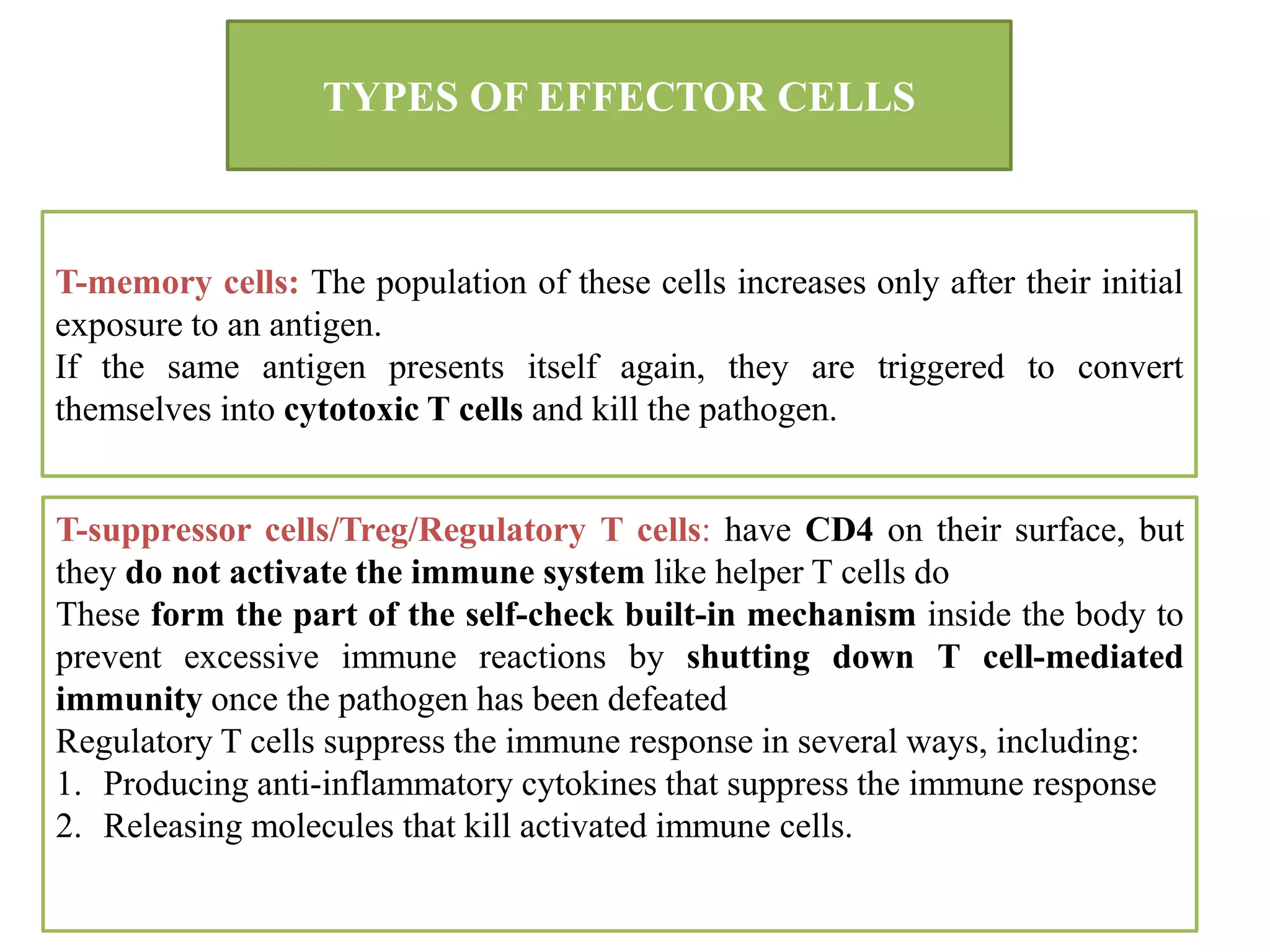
T-memory cells: The population of these cells increases only after their initial
exposure to an antigen.
If the same antigen presents itself again, they are triggered to convert
themselves into cytotoxic T cells and kill the pathogen.
TYPES OF EFFECTOR CELLS
T-suppressor cells/Treg/Regulatory T cells: have CD4 on their surface, but
they do not activate the immune system like helper T cells do
These form the part of the self-check built-in mechanism inside the body to
prevent excessive immune reactions by shutting down T cell-mediated
immunity once the pathogen has been defeated
Regulatory T cells suppress the immune response in several ways, including:
1. Producing anti-inflammatory cytokines that suppress the immune response
2. Releasing molecules that kill activated immune cells.
Tc (T- killer/cytotoxic) cells (CD8+):These cells interact MHC
class I molecules.
 These cells trigger the destruction of the pathogen‟s DNA by
secreting cytotoxin or creating holes in the pathogen‟s cell
membrane by perforin and granzyme.
This results in cell lysis or apoptosis.
 Cytotoxins are the chemical weapons that Killer T-cells use to
destroy infected cells.
TYPES OF EFFECTOR CELLS
Tc (T- killer/cytotoxic) cells (CD8+):
• Naïve CD8+ cells are also called cytotoxic lymphocyte
precursor, or CTL-P cells.
• After a CTL-P binds an antigen, it will be activated.
This will cause it to express IL-2 receptor.
• Parallelly to this activation, a Th1 cell has been
activated by an APC, which will cause the Th1 to start
secreting IL-2.
• The binding of these IL-2 to the IL-2 receptor on the
activated CTL-P cell will cause it to differentiate into
the mature cytotoxic lymphocyte, or CTL cell.
Effector mechanisms of CTL cells
• After a CD8+ has been activated to become a CTL
cell, it can start killing target cells.
• When the CTL binds to an infected cell or a tumor
cell it will form tight adhesions with the target
cell with the use of adhesion molecules like
integrins, creating a so-called conjugate.
• This causes the granules in the CTL to rearrange
to the side of the CTL that faces the target cell.
• The CTL will then degranulate, releasing their
granules onto the target cell by exocytosis.
Effector mechanisms of CTL cells
• The granules contain molecules like perforin and granzymes.
1. Perforin is an enzyme that creates a pore in the membrane of
the target cell.
2. Granzymes will then enter the target cell and kill it in two
different ways.
 Granzyme A will cause DNA-damage by a different pathway, which
will also induce the death of the cell.
 Granzyme B will activate a protein cascade called the caspase
cascade (which begins with a protein called caspase 8). Caspase 8
will activate an enzyme called CAD (caspase activated
deoxyribonuclease), which cleaves DNA eventually kills the cell.
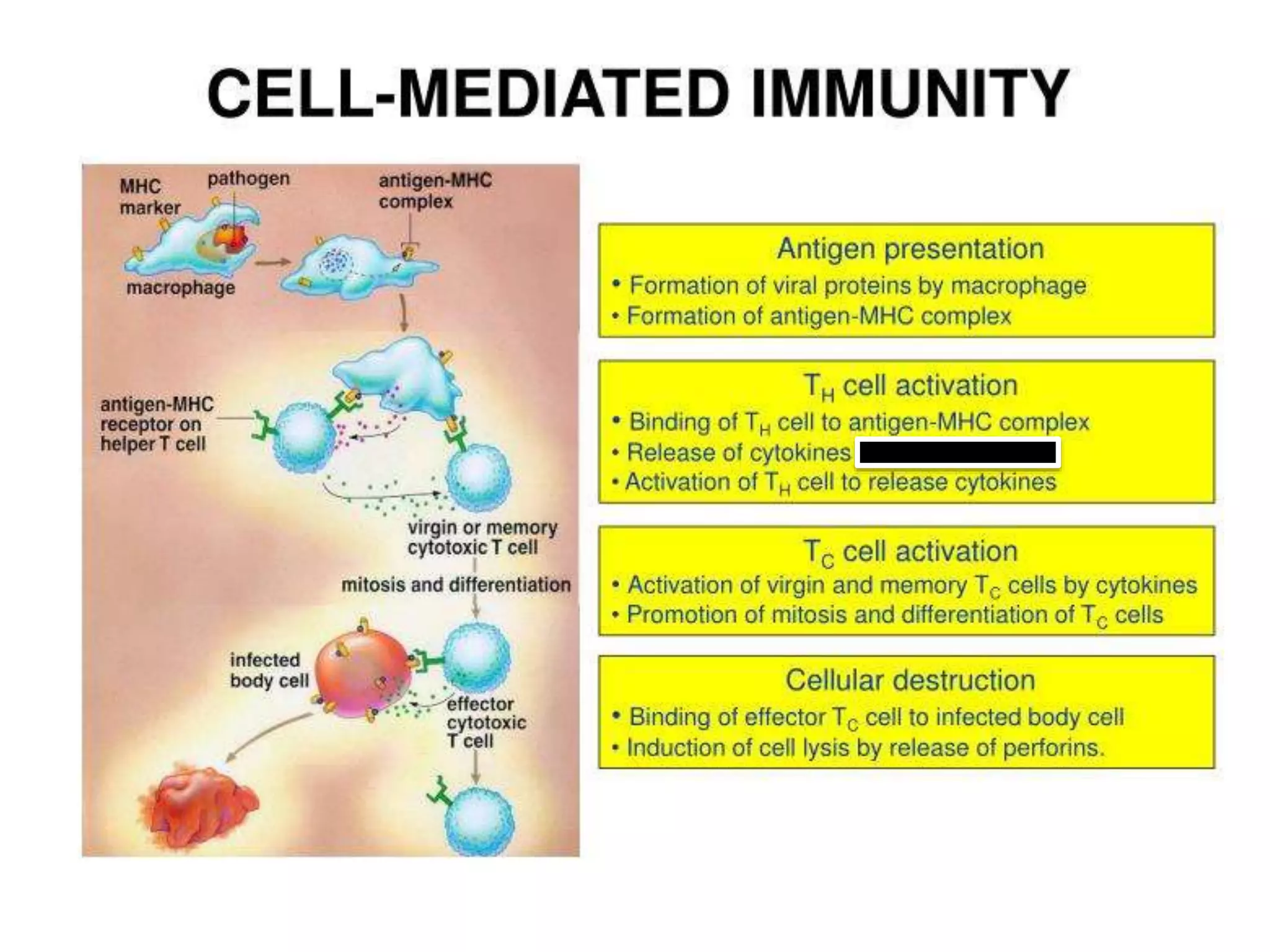
Cell-mediated immune response
• This immune response is driven by T lymphocytes, Antigen
Presenting Cells such as macrophages, B cells, and dendritic
cells, and various cytokines.
• It does not use antibodies.
• Cell-mediated immunity describes a pathway that
targets endogenous antigens.
• Involve the destruction of infected cells by cytotoxic T cells,
or the destruction of intracellular pathogens by macrophages
• It mostly kills viruses and cancerous cells
Cancerous and virus-infected cells involve the body’s own cells and thus are not
recognized as foreign, evading normal detection
These cells may instead present antigenic fragments as a complex with their own self
markers (MHC class I)
When helper T cells identify these cells, they stimulate a second type of T lymphocyte
– cytotoxic T cells (TC cells)
Cytotoxic T cells show specificity to particular antigens and will bind to the presented
antigen and release perforating enzymes. enzymes cause the infected / cancerous cell to
by lysed, preventing the further spread of infection
Virus infected cells can also be destroyed non-specifically by NK cells, which respond
to interferon released by the infected cell
ADAPTIVE IMMUNITY T CELLS.pptx

ADAPTIVE IMMUNITY T CELLS.pptx

  • 1.
  • 2.
    Acquired immunity  Acquiredimmunity is immunity you develop over your lifetime. It can come from: 1. a vaccine 2. exposure to an infection or disease 3. another person’s antibodies (infection-fighting immune cells) What are the 4 phases of the immune response? • The adaptive immune response in B cells, Helper T cells and Cytotoxic T cells involved four phases: encounter, activation, attack, and memory.
  • 4.
    FACTORS REQUIRED FORACQUIRED IMMUNITY
  • 5.
    Major Characteristics ofthe Adaptive Immune Response  Specificity: is the ability to discriminate among different molecular entities and to respond only to those uniquely required.  Adaptiveness: is the ability to respond to previously unseen molecules that may in fact never have naturally existed before on earth.  Discrimination between self and non-self: This distinction, and the recognition of antigen, is conferred by specialized cells (lymphocytes) that bear on their surface antigen-specific receptors.  Memory: a property shared with the nervous system, is the ability to recall previous contact with a foreign molecule and respond to it in a learned manner, that is with a more rapid and larger response(secondary response). – Another term often used to describe immunologic memory is anamnestic response. • rapid production of an antibody on the second (or subsequent) encounter with the same antigen.
  • 10.
    Types of TCells EFFECTOR T CELLS TYPES 1. T HELPER CELLS OR TH CELLS has CD4 surface co-receptor 2. CYTOTOXIC T CELLS has CD8 surface co-receptor The T cells differentiates in to 2 types of cells
  • 11.
     TH /Thelper cells (CD4+): have a co-receptor called CD4 on their cell surface.  Interacts with MHC class II molecules, This allows helper T cells to recognize pathogen peptides that have been displayed by antigen presenting cells.  When helper T cells recognize a peptide on an antigen presenting cell, they become activated and begin to produce molecules called cytokines that signal to other immune cells.  These cells secrete cytokines which stimulate cell division of B cells and its maturation into plasma and memory cells that eventually release antibodies.  Activation of macrophages to bring the process of phagocytosis.  They also help activate cytotoxic T cells to kill infected target cells. T-HELPER CELLS
  • 13.
  • 14.
    T follicular helpercells (Tfh) are a specialized subset of CD4+ T cells that were first identified in the human tonsil. They play a critical role in protective immunity helping B cells produce antibody against foreign pathogens. Tfh are located in secondary lymphoid organs (SLOs), including the tonsil, spleen and lymph nodes.
  • 15.
     T helpercell lineage development and function. The cytokines produced by dendritic cells regulate the T helper cell lineage (Th1, Th2, Th17, T regulatory [Treg], and follicular helper T cells [Tfh]).  Each of them exhibits a unique phenotype, cytokine, and transcriptional profile and exerts different functions in immune response.  BCL-6, B cell lymphoma 6 protein;  CCR, C-C chemokine receptor;  CXCR, CXC chemokine receptor;  Foxp3, forkhead box P3;  RORs, retinoid-acid receptor related orphan receptors;  STAT, signal transducer and activator of transcription;  TGF-b, transforming growth factor-beta;  TNF, tumor necrosis factor
  • 17.
    T-memory cells: Thepopulation of these cells increases only after their initial exposure to an antigen. If the same antigen presents itself again, they are triggered to convert themselves into cytotoxic T cells and kill the pathogen. TYPES OF EFFECTOR CELLS T-suppressor cells/Treg/Regulatory T cells: have CD4 on their surface, but they do not activate the immune system like helper T cells do These form the part of the self-check built-in mechanism inside the body to prevent excessive immune reactions by shutting down T cell-mediated immunity once the pathogen has been defeated Regulatory T cells suppress the immune response in several ways, including: 1. Producing anti-inflammatory cytokines that suppress the immune response 2. Releasing molecules that kill activated immune cells.
  • 18.
    Tc (T- killer/cytotoxic)cells (CD8+):These cells interact MHC class I molecules.  These cells trigger the destruction of the pathogen‟s DNA by secreting cytotoxin or creating holes in the pathogen‟s cell membrane by perforin and granzyme. This results in cell lysis or apoptosis.  Cytotoxins are the chemical weapons that Killer T-cells use to destroy infected cells. TYPES OF EFFECTOR CELLS
  • 20.
    Tc (T- killer/cytotoxic)cells (CD8+): • Naïve CD8+ cells are also called cytotoxic lymphocyte precursor, or CTL-P cells. • After a CTL-P binds an antigen, it will be activated. This will cause it to express IL-2 receptor. • Parallelly to this activation, a Th1 cell has been activated by an APC, which will cause the Th1 to start secreting IL-2. • The binding of these IL-2 to the IL-2 receptor on the activated CTL-P cell will cause it to differentiate into the mature cytotoxic lymphocyte, or CTL cell.
  • 22.
    Effector mechanisms ofCTL cells • After a CD8+ has been activated to become a CTL cell, it can start killing target cells. • When the CTL binds to an infected cell or a tumor cell it will form tight adhesions with the target cell with the use of adhesion molecules like integrins, creating a so-called conjugate. • This causes the granules in the CTL to rearrange to the side of the CTL that faces the target cell. • The CTL will then degranulate, releasing their granules onto the target cell by exocytosis.
  • 23.
    Effector mechanisms ofCTL cells • The granules contain molecules like perforin and granzymes. 1. Perforin is an enzyme that creates a pore in the membrane of the target cell. 2. Granzymes will then enter the target cell and kill it in two different ways.  Granzyme A will cause DNA-damage by a different pathway, which will also induce the death of the cell.  Granzyme B will activate a protein cascade called the caspase cascade (which begins with a protein called caspase 8). Caspase 8 will activate an enzyme called CAD (caspase activated deoxyribonuclease), which cleaves DNA eventually kills the cell.
  • 25.
    Cell-mediated immune response •This immune response is driven by T lymphocytes, Antigen Presenting Cells such as macrophages, B cells, and dendritic cells, and various cytokines. • It does not use antibodies. • Cell-mediated immunity describes a pathway that targets endogenous antigens. • Involve the destruction of infected cells by cytotoxic T cells, or the destruction of intracellular pathogens by macrophages • It mostly kills viruses and cancerous cells
  • 26.
    Cancerous and virus-infectedcells involve the body’s own cells and thus are not recognized as foreign, evading normal detection These cells may instead present antigenic fragments as a complex with their own self markers (MHC class I) When helper T cells identify these cells, they stimulate a second type of T lymphocyte – cytotoxic T cells (TC cells) Cytotoxic T cells show specificity to particular antigens and will bind to the presented antigen and release perforating enzymes. enzymes cause the infected / cancerous cell to by lysed, preventing the further spread of infection Virus infected cells can also be destroyed non-specifically by NK cells, which respond to interferon released by the infected cell