Uzma Bibi 1372
Laiba Suleman 1402
Hamnah Zubair 1365
Tasbiha Mukhtar 1360
SUBMITTED TO: Dr.Sadaf Moeez
BSBT-13 (B)
IMMUNOLOGY
IMMUNE
ORGANS
Of the Human Body
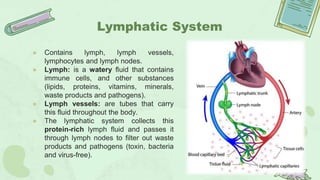
Lymphatic System
● Contains lymph, lymph vessels,
lymphocytes and lymph nodes.
● Lymph: is a watery fluid that contains
immune cells, and other substances
(lipids, proteins, vitamins, minerals,
waste products and pathogens).
● Lymph vessels: are tubes that carry
this fluid throughout the body.
● The lymphatic system collects this
protein-rich lymph fluid and passes it
through lymph nodes to filter out waste
products and pathogens (toxin, bacteria
and virus-free).
Organs
01
Primary lymphoid organs
• Create lymphocytes (B cells and T cells),
the immune system needs to fight against
illness.
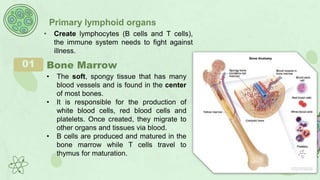
Bone Marrow
• The soft, spongy tissue that has many
blood vessels and is found in the center
of most bones.
• It is responsible for the production of
white blood cells, red blood cells and
platelets. Once created, they migrate to
other organs and tissues via blood.
• B cells are produced and matured in the
bone marrow while T cells travel to
thymus for maturation.
• B-lymphocytes make proteins called antibodies which
attach onto the surface of infection-causing
microbes to fight against future infection.
• Selection process within the bone marrow
eliminates B cells with self-reactive antibody
receptors.
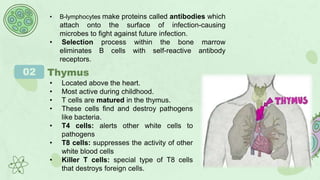
02 Thymus
• Located above the heart.
• Most active during childhood.
• T cells are matured in the thymus.
• These cells find and destroy pathogens
like bacteria.
• T4 cells: alerts other white cells to
pathogens
• T8 cells: suppresses the activity of other
white blood cells
• Killer T cells: special type of T8 cells
that destroys foreign cells.
03
Secondary lymphoid organs
• Where the Lymphocytes are activated to
defend against pathogens.
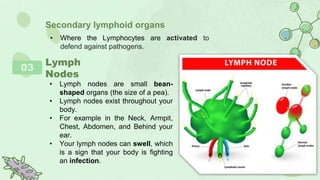
Lymph
Nodes
• Lymph nodes are small bean-
shaped organs (the size of a pea).
• Lymph nodes exist throughout your
body.
• For example in the Neck, Armpit,
Chest, Abdomen, and Behind your
ear.
• Your lymph nodes can swell, which
is a sign that your body is fighting
an infection.
• A lymph node’s job is to filter substances in your lymph
fluid.
• Destruction and elimination of bacteria and toxins,
carried out by the macrophages in lymph nodes.
• The nodes filter out the damaged cells and cancer cells.
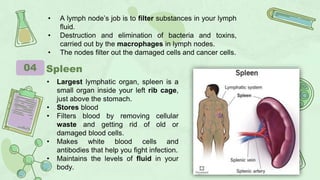
04 Spleen
• Largest lymphatic organ, spleen is a
small organ inside your left rib cage,
just above the stomach.
• Stores blood
• Filters blood by removing cellular
waste and getting rid of old or
damaged blood cells.
• Makes white blood cells and
antibodies that help you fight infection.
• Maintains the levels of fluid in your
body.
05
• are two round, fleshy masses in the
back of your throat (pharynx).
• Protect against foreign substances that
you inhale or ingest through the nose or
mouth.
• Once trapped in the tonsils, bacteria or
viruses are then transported to lymph
nodes, where specialized immune cells
cluster to fight infection.
• Your body’s first protective barrier.
Tonsils
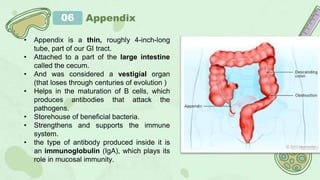
06 Appendix
• Appendix is a thin, roughly 4-inch-long
tube, part of our GI tract.
• Attached to a part of the large intestine
called the cecum.
• And was considered a vestigial organ
(that loses through centuries of evolution )
• Helps in the maturation of B cells, which
produces antibodies that attack the
pathogens.
• Storehouse of beneficial bacteria.
• Strengthens and supports the immune
system.
• the type of antibody produced inside it is
an immunoglobulin (IgA), which plays its
role in mucosal immunity.
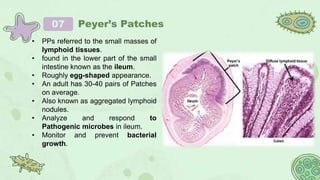
07 Peyer’s Patches
• PPs referred to the small masses of
lymphoid tissues.
• found in the lower part of the small
intestine known as the ileum.
• Roughly egg-shaped appearance.
• An adult has 30-40 pairs of Patches
on average.
• Also known as aggregated lymphoid
nodules.
• Analyze and respond to
Pathogenic microbes in ileum.
• Monitor and prevent bacterial
growth.
Step 2
Microfold cells
(lining the surface
of Peyer’s patches)
Step 4
B & T
Lymphocytes
Step 5
Immune Response
Step 3
Macrophages
Step 1
Antigen or
microbes
from the gut
Trigger
Endocytosis Absorbed
Transfer
Transfer to lymph
node- alert other
cells
Thank
You!

immune organs final-1.pptx

  • 1.
    Uzma Bibi 1372 LaibaSuleman 1402 Hamnah Zubair 1365 Tasbiha Mukhtar 1360 SUBMITTED TO: Dr.Sadaf Moeez BSBT-13 (B) IMMUNOLOGY
  • 2.
  • 3.
    Lymphatic System ● Containslymph, lymph vessels, lymphocytes and lymph nodes. ● Lymph: is a watery fluid that contains immune cells, and other substances (lipids, proteins, vitamins, minerals, waste products and pathogens). ● Lymph vessels: are tubes that carry this fluid throughout the body. ● The lymphatic system collects this protein-rich lymph fluid and passes it through lymph nodes to filter out waste products and pathogens (toxin, bacteria and virus-free).
  • 4.
  • 5.
    01 Primary lymphoid organs •Create lymphocytes (B cells and T cells), the immune system needs to fight against illness. Bone Marrow • The soft, spongy tissue that has many blood vessels and is found in the center of most bones. • It is responsible for the production of white blood cells, red blood cells and platelets. Once created, they migrate to other organs and tissues via blood. • B cells are produced and matured in the bone marrow while T cells travel to thymus for maturation.
  • 6.
    • B-lymphocytes makeproteins called antibodies which attach onto the surface of infection-causing microbes to fight against future infection. • Selection process within the bone marrow eliminates B cells with self-reactive antibody receptors. 02 Thymus • Located above the heart. • Most active during childhood. • T cells are matured in the thymus. • These cells find and destroy pathogens like bacteria. • T4 cells: alerts other white cells to pathogens • T8 cells: suppresses the activity of other white blood cells • Killer T cells: special type of T8 cells that destroys foreign cells.
  • 7.
    03 Secondary lymphoid organs •Where the Lymphocytes are activated to defend against pathogens. Lymph Nodes • Lymph nodes are small bean- shaped organs (the size of a pea). • Lymph nodes exist throughout your body. • For example in the Neck, Armpit, Chest, Abdomen, and Behind your ear. • Your lymph nodes can swell, which is a sign that your body is fighting an infection.
  • 8.
    • A lymphnode’s job is to filter substances in your lymph fluid. • Destruction and elimination of bacteria and toxins, carried out by the macrophages in lymph nodes. • The nodes filter out the damaged cells and cancer cells. 04 Spleen • Largest lymphatic organ, spleen is a small organ inside your left rib cage, just above the stomach. • Stores blood • Filters blood by removing cellular waste and getting rid of old or damaged blood cells. • Makes white blood cells and antibodies that help you fight infection. • Maintains the levels of fluid in your body.
  • 9.
    05 • are tworound, fleshy masses in the back of your throat (pharynx). • Protect against foreign substances that you inhale or ingest through the nose or mouth. • Once trapped in the tonsils, bacteria or viruses are then transported to lymph nodes, where specialized immune cells cluster to fight infection. • Your body’s first protective barrier. Tonsils
  • 10.
    06 Appendix • Appendixis a thin, roughly 4-inch-long tube, part of our GI tract. • Attached to a part of the large intestine called the cecum. • And was considered a vestigial organ (that loses through centuries of evolution ) • Helps in the maturation of B cells, which produces antibodies that attack the pathogens. • Storehouse of beneficial bacteria. • Strengthens and supports the immune system. • the type of antibody produced inside it is an immunoglobulin (IgA), which plays its role in mucosal immunity.
  • 11.
    07 Peyer’s Patches •PPs referred to the small masses of lymphoid tissues. • found in the lower part of the small intestine known as the ileum. • Roughly egg-shaped appearance. • An adult has 30-40 pairs of Patches on average. • Also known as aggregated lymphoid nodules. • Analyze and respond to Pathogenic microbes in ileum. • Monitor and prevent bacterial growth.
  • 12.
    Step 2 Microfold cells (liningthe surface of Peyer’s patches) Step 4 B & T Lymphocytes Step 5 Immune Response Step 3 Macrophages Step 1 Antigen or microbes from the gut Trigger Endocytosis Absorbed Transfer Transfer to lymph node- alert other cells
  • 13.