Zika Virus
Disease
Group D BT 13B
Table of contents
01 Morphology
02 Outbreak
03 Transmission
04 Life Cycle
05 Symptoms
06 Treatment
Introduction
Zika virus is a member
of the virus family
Flaviviridae. It is spread
by daytime-active Aedes
mosquitoes.
Morphology
01.
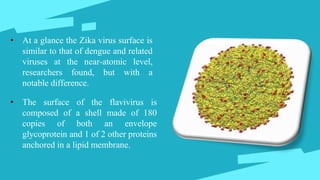
• At a glance the Zika virus surface is
similar to that of dengue and related
viruses at the near-atomic level,
researchers found, but with a
notable difference.
• The surface of the flavivirus is
composed of a shell made of 180
copies of both an envelope
glycoprotein and 1 of 2 other proteins
anchored in a lipid membrane.
• Zika virus structure is
similar to that of other
known flaviviruses, except
for one region of the
envelope glycoprotein.
• Flaviviruses may use this
glycoprotein region to
attach to and enter human
cells.
The virion is approximately
40 nm in diameter with
surface projections that
measure roughly 5-10 nm.
Nucleocapsid is 25-30 nm in
diameter surrounded by a
host-membrane derived lipid
bilayer.
Outbreak
02.
Outbreak
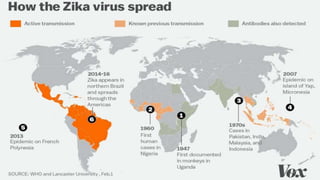
Zika virus was initially
isolated in 1947 from a
captive rhesus monkey
in Zika forest near
Entebbe (Uganda).
One year later the virus
was also found in the
mosquito species Aedes
africanus which was
caught on a tree platform
in the same forest.
The first human cases
were noted by
detecting neutralizing
antibodies to Zika
virus in sera of
individuals from
Uganda and Tanzania.
01 02 03
Still, the first proof that the
Zika virus actually causes
human disease came in 1964,
when a researcher in Uganda
fell ill during his experiment
with Zika strains from
mosquitoes.
From 1969 to 1983 the
geographical distribution
of the Zika virus expanded
to equatorial Asia –
including Pakistan,
Malaysia, India and
Indonesia.
04 05
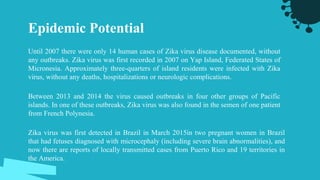
Epidemic Potential
Until 2007 there were only 14 human cases of Zika virus disease documented, without
any outbreaks. Zika virus was first recorded in 2007 on Yap Island, Federated States of
Micronesia. Approximately three-quarters of island residents were infected with Zika
virus, without any deaths, hospitalizations or neurologic complications.
Between 2013 and 2014 the virus caused outbreaks in four other groups of Pacific
islands. In one of these outbreaks, Zika virus was also found in the semen of one patient
from French Polynesia.
Zika virus was first detected in Brazil in March 2015in two pregnant women in Brazil
that had fetuses diagnosed with microcephaly (including severe brain abnormalities), and
now there are reports of locally transmitted cases from Puerto Rico and 19 territories in
the America.
Transmission
03.
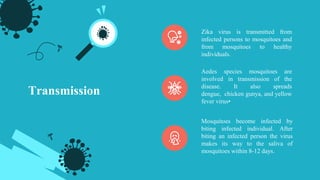
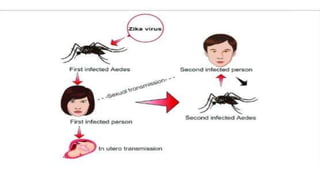
Zika virus is transmitted from
infected persons to mosquitoes and
from mosquitoes to healthy
individuals.
Aedes species mosquitoes are
involved in transmission of the
disease. It also spreads
dengue, chicken gunya, and yellow
fever virus•
Transmission
Mosquitoes become infected by
biting infected individual. After
biting an infected person the virus
makes its way to the saliva of
mosquitoes within 8-12 days.
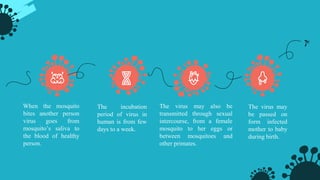
The incubation
period of virus in
human is from few
days to a week.
The virus may also be
transmitted through sexual
intercourse, from a female
mosquito to her eggs or
between mosquitoes and
other primates.
The virus may
be passed on
form infected
mother to baby
during birth.
When the mosquito
bites another person
virus goes from
mosquito’s saliva to
the blood of healthy
person.
Life Cycle
04.
Life Cycle
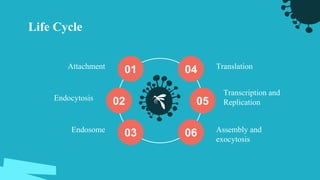
01
02
03
04
05
06
Attachment Translation
Transcription and
Replication
Endocytosis
Endosome Assembly and
exocytosis
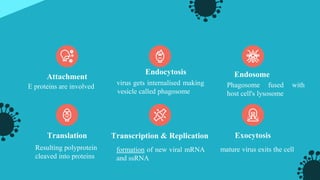
Attachment
E proteins are involved
Endocytosis Endosome
mature virus exits the cell
Translation
Resulting polyprotein
cleaved into proteins
formation of new viral mRNA
and ssRNA
Exocytosis
Phagosome fused with
host cell's lysosome
virus gets internalised making
vesicle called phagosome
Transcription & Replication
Symptoms
05.
Signs
• Signs usually last for 2–7 days.
• The incubation period (the time from exposure to
symptoms) of Zika virus disease is estimated to be
3–14 days.
• The majority of people infected with Zika virus
do not develop symptoms.
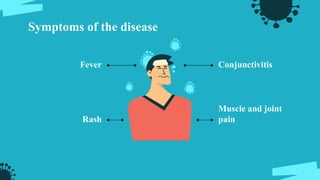
Symptoms of the disease
Fever
Rash
Conjunctivitis
Muscle and joint
pain
Complications
• Zika virus infection during pregnancy is a cause
of microcephaly and other congenital
abnormalities in the developing fetus and
newborn.
• Zika infection in pregnancy also results in
pregnancy complications such as fetal loss,
stillbirth, and preterm birth.
• Zika virus infection is also a trigger of Guillain-
Barré syndrome, neuropathy and myelitis,
particularly in adults and older children.
Issues
01 02
Better public health strategies
to control arboviral spread,
including vaccine platforms
for flaviviruses, alphaviruses,
and other arbovirus groups.
• No vaccines
• Dengue and chikungunya, which
result in similar clinical pictures,
confounds clinical diagnoses.
03 04
ZVD is usually relatively
mild and requires no specific
treatment. If symptoms

worsen, they should seek
medical care and advice.
• Zika-specific tests are
not yet widely available.
• Broad-spectrum antiviral
drugs effective against
whole classes of
viruses are urgently
needed.
Treatment
06.
Treatment
ZVD is usually relatively
mild and requires no specific
treatment. If symptoms
worsen, they should seek
medical care and advice.
People sick with Zika virus
should: Get plenty of rest, Drink
plenty of fluids, and Receive
symptomatic treatment with
acetaminophen (paracetamol) for
pain and fever and antihistaminic
for pruritic rash.
01 02
Prevention
Mosquito bites
This can be done by wearing
clothes (preferably light- coloured)
that cover as much of the body as
possible; using physical barriers
such as window screens or closing
doors and windows; sleeping
under mosquito nets; and using
insect repellent containing DEET,
IR3535 or icaridin according to
the product label instruction.
Our team
AYESHA NAZIR
1381-FBAS/BSBT/F20
IRSA TAHIR
1377-FBAS/BSBT/F20
ZANINB SIDDIQUE
1385-FBAS/BSBT/F20
MARIA HUSSAIN
1393-FBAS/BSBT/F20
DANIA MUQADAS
1394-FBAS/BSBT/F20
MAHIRA BIBI
1396-FBAS/BSBT/F20
DUR-E-SHEWAR
1407-FBAS/BSBT/F20
CREDITS: This presentation
template was created by Slidesgo,
including icons by Flaticon, and
infographics & images by Freepik.

zika-virus-disease.pptx

  • 1.
  • 2.
    Table of contents 01Morphology 02 Outbreak 03 Transmission 04 Life Cycle 05 Symptoms 06 Treatment
  • 3.
    Introduction Zika virus isa member of the virus family Flaviviridae. It is spread by daytime-active Aedes mosquitoes.
  • 4.
  • 5.
    • At aglance the Zika virus surface is similar to that of dengue and related viruses at the near-atomic level, researchers found, but with a notable difference. • The surface of the flavivirus is composed of a shell made of 180 copies of both an envelope glycoprotein and 1 of 2 other proteins anchored in a lipid membrane.
  • 6.
    • Zika virusstructure is similar to that of other known flaviviruses, except for one region of the envelope glycoprotein. • Flaviviruses may use this glycoprotein region to attach to and enter human cells. The virion is approximately 40 nm in diameter with surface projections that measure roughly 5-10 nm. Nucleocapsid is 25-30 nm in diameter surrounded by a host-membrane derived lipid bilayer.
  • 7.
  • 8.
    Outbreak Zika virus wasinitially isolated in 1947 from a captive rhesus monkey in Zika forest near Entebbe (Uganda). One year later the virus was also found in the mosquito species Aedes africanus which was caught on a tree platform in the same forest. The first human cases were noted by detecting neutralizing antibodies to Zika virus in sera of individuals from Uganda and Tanzania. 01 02 03
  • 9.
    Still, the firstproof that the Zika virus actually causes human disease came in 1964, when a researcher in Uganda fell ill during his experiment with Zika strains from mosquitoes. From 1969 to 1983 the geographical distribution of the Zika virus expanded to equatorial Asia – including Pakistan, Malaysia, India and Indonesia. 04 05
  • 10.
    Epidemic Potential Until 2007there were only 14 human cases of Zika virus disease documented, without any outbreaks. Zika virus was first recorded in 2007 on Yap Island, Federated States of Micronesia. Approximately three-quarters of island residents were infected with Zika virus, without any deaths, hospitalizations or neurologic complications. Between 2013 and 2014 the virus caused outbreaks in four other groups of Pacific islands. In one of these outbreaks, Zika virus was also found in the semen of one patient from French Polynesia. Zika virus was first detected in Brazil in March 2015in two pregnant women in Brazil that had fetuses diagnosed with microcephaly (including severe brain abnormalities), and now there are reports of locally transmitted cases from Puerto Rico and 19 territories in the America.
  • 12.
  • 13.
    Zika virus istransmitted from infected persons to mosquitoes and from mosquitoes to healthy individuals. Aedes species mosquitoes are involved in transmission of the disease. It also spreads dengue, chicken gunya, and yellow fever virus• Transmission Mosquitoes become infected by biting infected individual. After biting an infected person the virus makes its way to the saliva of mosquitoes within 8-12 days.
  • 14.
    The incubation period ofvirus in human is from few days to a week. The virus may also be transmitted through sexual intercourse, from a female mosquito to her eggs or between mosquitoes and other primates. The virus may be passed on form infected mother to baby during birth. When the mosquito bites another person virus goes from mosquito’s saliva to the blood of healthy person.
  • 16.
  • 17.
    Life Cycle 01 02 03 04 05 06 Attachment Translation Transcriptionand Replication Endocytosis Endosome Assembly and exocytosis
  • 18.
    Attachment E proteins areinvolved Endocytosis Endosome mature virus exits the cell Translation Resulting polyprotein cleaved into proteins formation of new viral mRNA and ssRNA Exocytosis Phagosome fused with host cell's lysosome virus gets internalised making vesicle called phagosome Transcription & Replication
  • 19.
  • 20.
    Signs • Signs usuallylast for 2–7 days. • The incubation period (the time from exposure to symptoms) of Zika virus disease is estimated to be 3–14 days. • The majority of people infected with Zika virus do not develop symptoms.
  • 21.
    Symptoms of thedisease Fever Rash Conjunctivitis Muscle and joint pain
  • 22.
    Complications • Zika virusinfection during pregnancy is a cause of microcephaly and other congenital abnormalities in the developing fetus and newborn. • Zika infection in pregnancy also results in pregnancy complications such as fetal loss, stillbirth, and preterm birth. • Zika virus infection is also a trigger of Guillain- Barré syndrome, neuropathy and myelitis, particularly in adults and older children.
  • 23.
    Issues 01 02 Better publichealth strategies to control arboviral spread, including vaccine platforms for flaviviruses, alphaviruses, and other arbovirus groups. • No vaccines • Dengue and chikungunya, which result in similar clinical pictures, confounds clinical diagnoses.
  • 24.
    03 04 ZVD isusually relatively mild and requires no specific treatment. If symptoms worsen, they should seek medical care and advice. • Zika-specific tests are not yet widely available. • Broad-spectrum antiviral drugs effective against whole classes of viruses are urgently needed.
  • 25.
  • 26.
    Treatment ZVD is usuallyrelatively mild and requires no specific treatment. If symptoms worsen, they should seek medical care and advice. People sick with Zika virus should: Get plenty of rest, Drink plenty of fluids, and Receive symptomatic treatment with acetaminophen (paracetamol) for pain and fever and antihistaminic for pruritic rash. 01 02
  • 27.
    Prevention Mosquito bites This canbe done by wearing clothes (preferably light- coloured) that cover as much of the body as possible; using physical barriers such as window screens or closing doors and windows; sleeping under mosquito nets; and using insect repellent containing DEET, IR3535 or icaridin according to the product label instruction.
  • 28.
    Our team AYESHA NAZIR 1381-FBAS/BSBT/F20 IRSATAHIR 1377-FBAS/BSBT/F20 ZANINB SIDDIQUE 1385-FBAS/BSBT/F20 MARIA HUSSAIN 1393-FBAS/BSBT/F20 DANIA MUQADAS 1394-FBAS/BSBT/F20 MAHIRA BIBI 1396-FBAS/BSBT/F20 DUR-E-SHEWAR 1407-FBAS/BSBT/F20
  • 29.
    CREDITS: This presentation templatewas created by Slidesgo, including icons by Flaticon, and infographics & images by Freepik.