Adaptive Immunity
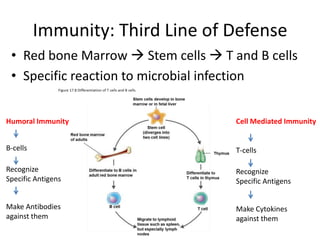
Immunity: Third Line of Defense
• Red bone Marrow  Stem cells  T and B cells
• Specific reaction to microbial infection
Humoral Immunity Cell Mediated Immunity
B-cells
Recognize
Specific Antigens
Make Antibodies
against them
T-cells
Recognize
Specific Antigens
Make Cytokines
against them
Antigens & Antibodies
• Antigens (Antibody generators)
• proteins or large polysaccharides
• Components of invading microbes
• Non-microbial antigens:
• pollen, egg white, serum proteins, blood cells etc
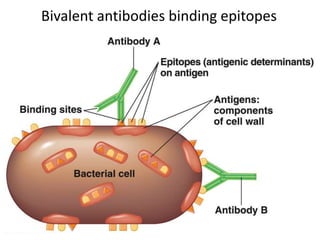
• Epitopes = specific region that interacts with Ab.
• Antibodies
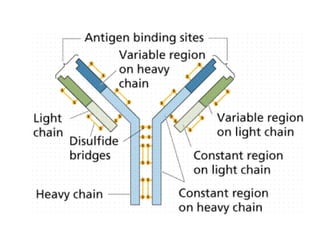
• globulin proteins (immunoglobulins) Y-shaped
• Made in response to antigen; bind specifically to Ag
• At least two identical sites that bind to epitopes
• Bivalent molecule
Bivalent antibodies binding epitopes
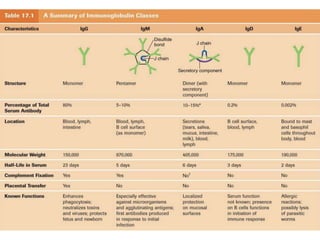
Classes of Immunoglobulin
IgG:
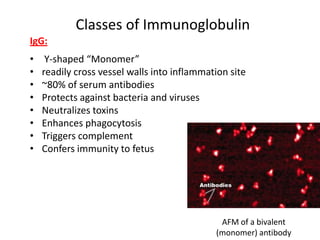
• Y-shaped “Monomer”
• readily cross vessel walls into inflammation site
• ~80% of serum antibodies
• Protects against bacteria and viruses
• Neutralizes toxins
• Enhances phagocytosis
• Triggers complement
• Confers immunity to fetus
AFM of a bivalent
(monomer) antibody
Classes of Immunoglobulin
IgM:
• Pentamer (can be monomer too)
– Too big to cross into tissue from blood
• First Antibody response to 1 response
• Dominates ABO blood group response
• Effective in Complement Activation
• Highly effective at Agglutination
– Cross-links several Antigens
Classes of Immunoglobulin
IgA:
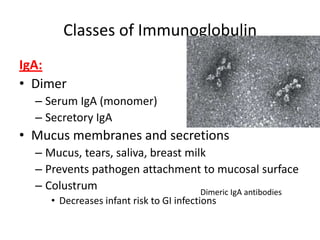
• Dimer
– Serum IgA (monomer)
– Secretory IgA
• Mucus membranes and secretions
– Mucus, tears, saliva, breast milk
– Prevents pathogen attachment to mucosal surface
– Colustrum
• Decreases infant risk to GI infections
Dimeric IgA antibodies
Classes of Immunoglobulin
IgD:
• Monomer
• Blood, lymph, B-cell surface
• No defined function
– 0.002% serum antibodies
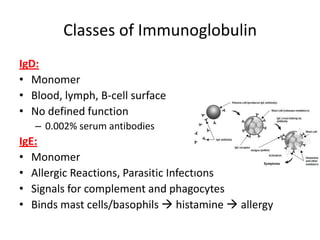
IgE:
• Monomer
• Allergic Reactions, Parasitic Infections
• Signals for complement and phagocytes
• Binds mast cells/basophils  histamine  allergy
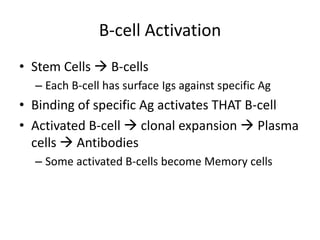
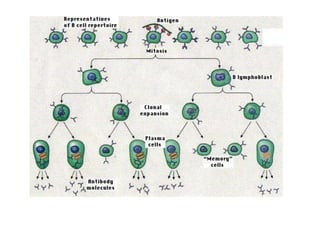
B-cell Activation
• Stem Cells  B-cells
– Each B-cell has surface Igs against specific Ag
• Binding of specific Ag activates THAT B-cell
• Activated B-cell  clonal expansion  Plasma
cells  Antibodies
– Some activated B-cells become Memory cells
Antigen-antibody binding
• Antigen-Antibody Complex
– Specific interaction
• Affinity: strength of bond
• Specificity: ability to distinguish minor differences in AA
– Binds at epitope
– Complex formation tags foreign cells
• Destruction by phagocytes and complement
Outcomes of Ab-Ag binding
• Agglutination
– Clumping of Antigens
• Opsonization
– Ab coats microbe
– Enhances phagocytosis
• Neutralization
– prevents Ag binding host cell
• Antibody-dependent cell-mediated cytotoxicity
– Ab coats microbe
– Ab binds T-cells/NK cells/other immune cells
– Cytokines released  lyse microbe
• Complement Activation
– IgG, IgM
– Binds C1
– C1 C2, C4  C3  complementation cascade
T-cells and cellular immunity
• T-lymphocytes
• Combat pathogens within host cells
– Not exposed to circulating Antibodies
• Two Types
– T-helper Cells (TH: TH1 and TH2)
– Cytotoxic T-cells (Tc)
– Surface Receptors
• Glycoproteins
• CD (clusters of differentiation)
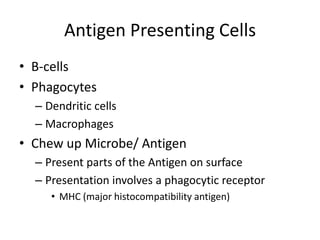
Antigen Presenting Cells
• B-cells
• Phagocytes
– Dendritic cells
– Macrophages
• Chew up Microbe/ Antigen
– Present parts of the Antigen on surface
– Presentation involves a phagocytic receptor
• MHC (major histocompatibility antigen)
The MHC-antigen complex
MHC = major histocompatibility complex
• Collection of genes that encode proteins found on all
nucleated mammalian cell membranes
• Presence of MHC identifies the host
- Keeps immune system from making antibodies
against host cells
Class II – found on APCs like B-cells
Class I – found on almost any cell of the host
• Makes it possible for cytotoxic T-cells to attack
host cells that have been altered
T-Helper Cells (CD4+)
- bind to MHC class II molecules
Activation of TH cells:
1. TH cell recognizes an antigen in complex with MHC class II
presented on the surface of an APC
2. TH cell proliferates and differentiates into TH1 and TH2
cells – secrete cytokines
TH1 = cytokines activate macrophages, enhance complement
TH2 = cytokines stimulate production of antibodies
important for allergic reactions, and eosinophils that protect
against extracellular parasites
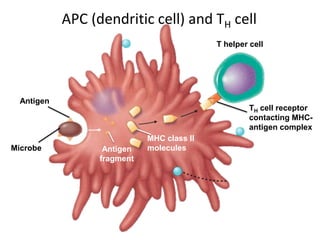
APC (dendritic cell) and TH cell
Antigen
fragment
Antigen
MHC class II
moleculesMicrobe
T helper cell
TH cell receptor
contacting MHC-
antigen complex
Cytotoxic T-cells (CD8+)
• Recognize and kill altered or foreign cells
• bind to MHC class I molecules
- found on all nucleated cells
• Presented in complex with viral/parasitic antigens on
surface of infection-altered cells
Steps in destruction of target cells:
1. Recognize foreign antigen/MHC class I protein
complex on cell
2. Attaches and released perforin  pore
• Allows proteases to enter
3. Apoptosis = programmed cell death
Cytotoxic T-cells (CD8+)
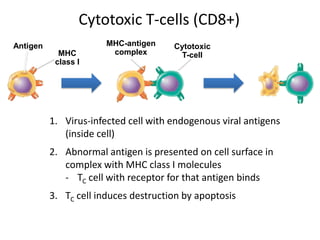
1. Virus-infected cell with endogenous viral antigens
(inside cell)
2. Abnormal antigen is presented on cell surface in
complex with MHC class I molecules
- TC cell with receptor for that antigen binds
3. TC cell induces destruction by apoptosis
Antigen
MHC
class I
MHC-antigen
complex
Cytotoxic
T-cell
Apoptosis
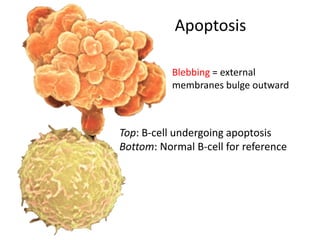
Blebbing = external
membranes bulge outward
Top: B-cell undergoing apoptosis
Bottom: Normal B-cell for reference
Antigen-presenting cells
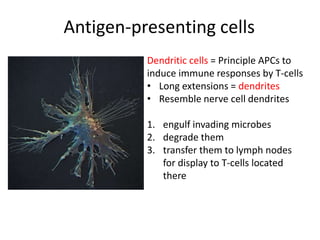
Dendritic cells = Principle APCs to
induce immune responses by T-cells
• Long extensions = dendrites
• Resemble nerve cell dendrites
1. engulf invading microbes
2. degrade them
3. transfer them to lymph nodes
for display to T-cells located
there
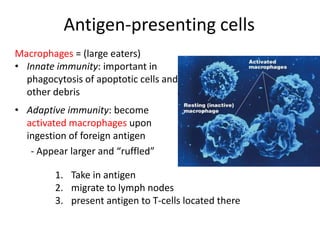
Macrophages = (large eaters)
• Innate immunity: important in
phagocytosis of apoptotic cells and
other debris
• Adaptive immunity: become
activated macrophages upon
ingestion of foreign antigen
- Appear larger and “ruffled”
1. Take in antigen
2. migrate to lymph nodes
3. present antigen to T-cells located there
Antigen-presenting cells
Extracellular killing
Natural killer cells = granular leukocytes that destroy virus-
infected cells, tumor cells, and parasites
• Part of innate immunity (non-specific)
- Not triggered by antigen
• Remains external to target cell
Mechanism:
1. Contact a target cell
2. Determine if it expresses MHC class I self-antigen
(*tumor cells, viral-infected cells don’t)
3. No expression  induces lysis/apoptosis (similar to
that of cytotoxic T-cell)
Antibody-dependent-cell-mediated
cytotoxicity
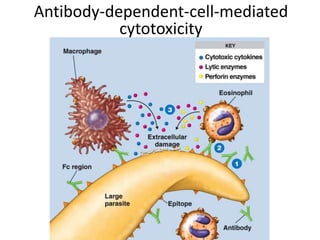
• Invaders too large to be phagocytized (euks) can
be attacked by immune cells
• Uses antibodies of humoral system
• NK cells, macrophages, neutrophils, and
eosinophils respond and kill targeted cells
Mechanism:
• Target cell coated with antibodies
• Immune cells bind to antibodies
• Target cell is lysed by secretions
Antibody-dependent-cell-mediated
cytotoxicity
Antibody-dependent-cell-mediated
cytotoxicity
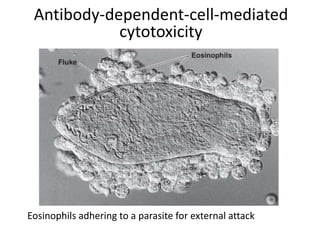
Eosinophils adhering to a parasite for external attack
Cytokines
Cytokines = chemical messengers of immune cells
• Soluble proteins/glycoproteins
• Produced by immune cells after a stimulus
• Act only on a cell that has receptors for it
- Interleukins = cytokines that serve as communicators
between leukocytes (WBCs)
- Chemokines = induce migration of leukocytes into
areas of infection/tissue damage
- Interferons = protect cells from viral infection
Cytokines
- Tumor necrosis factor (TNF) = cytokines that act in
inflammatory reactions; also target tumor cells
- Hematopoietic cytokines = control development of
stem cells into red or white blood cells
Ex) Granulocyte-colony stimulating factor
• Granulocyte precursors  neutrophils
Cytokine storm = overproduction of cytokines
- Damage to host tissues
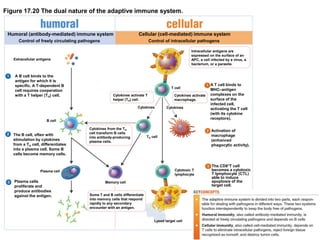
Extracellular antigens
A B cell binds to the
antigen for which it is
specific. A T-dependent B
cell requires cooperation
with a T helper (TH) cell.
The B cell, often with
stimulation by cytokines
from a TH cell, differentiates
into a plasma cell. Some B
cells become memory cells.
Plasma cells
proliferate and
produce antibodies
against the antigen.
Intracellular antigens are
expressed on the surface of an
APC, a cell infected by a virus, a
bacterium, or a parasite.
A T cell binds to
MHC–antigen
complexes on the
surface of the
infected cell,
activating the T cell
(with its cytokine
receptors).
Activation of
macrophage
(enhanced
phagocytic activity).
The CD8+T cell
becomes a cytotoxic
T lymphocyte (CTL)
able to induce
apoptosis of the
target cell.
B cell
Plasma cell
T cell
TH cell
Cytotoxic T
lymphocyte
CytokinesCytokines
Lysed target cell
Cytokines activate
macrophage.
Cytokines from the TH
cell transform B cells
into antibody-producing
plasma cells.
Cytokines activate T
helper (TH) cell.
Memory cell
Some T and B cells differentiate
into memory cells that respond
rapidly to any secondary
encounter with an antigen.
Humoral (antibody-mediated) immune system Cellular (cell-mediated) immune system
Control of freely circulating pathogens Control of intracellular pathogens
Figure 17.20 The dual nature of the adaptive immune system.
Vaccines
• suspension of organisms/ parts of organism
used to INDUCE immunity
• Artificial Active Immunity
Vaccine: Types
• Live attenuated whole-agent
• Inactivated whole-agent
• Toxoids
• Subunit Vaccines
– Recombinant subunit vaccines
• Nucleic acid Vaccines
Live attentuated Whole agent
• living but attenuated (weakened) microbes
– Mutated virus
– Related virus
• Attenuated viruses replicate in the body
– Cell and humoral immunity
• Lifelong immunity
• Counterindicated
– immune compromised
– Attenuated microbes: from mutated strains  can back-mutate to virulent
form
• Viral vaccines: MMR, Sabin polio, Smallpox, Flumist (influenza)
• Bacterial vaccines: tuberculosis
Inactivated “Dead” Whole-agent
• Killed by formalin or phenol
• Immunity not life-long
– Boosters may be required
– Primarily humoral response
• Examples:
– Viral: Salk (polio, IPV), Rabies, Flu
– Bacterial: Pneumococcal, Cholera
Subunit Vaccines
• Highly immunogenic fragments
– Cannot replicate in host
– Less side-effects/ dangers
• Recombinant vaccines
– Desired Ag fragment expressed by unrelated, non-pathogenic microbe
– Ex. HepB virion protein in GM yeast
– Rabies glycoprotein in Vaccinia virus (V-RG)
• Toxoids
– Tetanus, diphtheria
– Several injections required for full immunity
– Boosters every 10 years
• Conjugated Vaccines
– Capsular polysaccharides: poor immunogens; T-independent Ags
– Conjugate with Toxoid for maximal immunity
– Ex. Hib
Nucleic Acid Vaccines (DNA vaccines)
• Newest “promising” vaccines
• Plasmid DNA
– Containing gene for immunogen of interest
– Injected intramuscularly
• Gene gun
• Conventional needle
– Expressed Protein Ag  Red Bone Marrow humoral
and cellular immunity
• Long lasting immunity
• West Nile vaccine (horses)
• Human trials underway
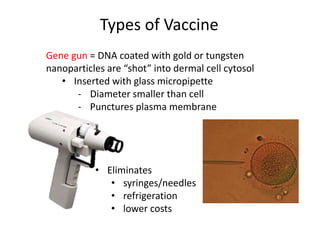
Types of Vaccine
Gene gun = DNA coated with gold or tungsten
nanoparticles are “shot” into dermal cell cytosol
• Inserted with glass micropipette
- Diameter smaller than cell
- Punctures plasma membrane
• Eliminates
• syringes/needles
• refrigeration
• lower costs
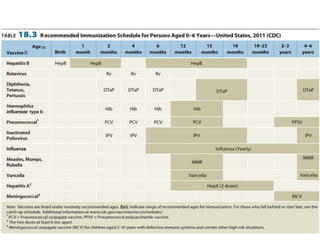
Recommended Immunization Schedule
Vaccine Development
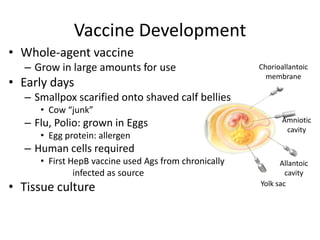
• Whole-agent vaccine
– Grow in large amounts for use
• Early days
– Smallpox scarified onto shaved calf bellies
• Cow “junk”
– Flu, Polio: grown in Eggs
• Egg protein: allergen
– Human cells required
• First HepB vaccine used Ags from chronically
infected as source
• Tissue culture Yolk sac
Allantoic
cavity
Amniotic
cavity
Chorioallantoic
membrane
Current Vaccine Development
• Tissue Culture
– Tissue slice
– Digest with enzymes (trypsin)
• Breaks down tissue into single cells
– Nutritive growth media
• Cells adhere and divide to from a “monolayer”
– Infect with virus
• CPE (cytopathic effect) caused by virus infection
Vaccine Development
Advancement in cultivation: cell culture
Viruses may be grown in:
Primary cell lines = derived from tissue slices; die out
after a few generations
Diploid cell lines = develop from human embryos;
maintained for ~100 generations
Continuous cell lines = (aka immortal cell lines)
Cancerous cells; can be maintained indefinitely
Ex) HeLa cell line
• tend to have:
- Less round shape
- Chromosomal abnormalities
Vaccine Safety: Risks v/s benefits
• Disease caused by vaccine
– Smallpox
• Variolation
– Incidence of disease decreased from 25% to 1%
– OPV (Sabin)
• Poliovirus mutated
• Reversion to wt
– Poliomyelitis
• Risk v/s Benefits
– Public reaction
• Low perceived risk of contracting disease
– Polio, measles
• Reports/ rumors of harmful effects
– MMR  autism
– Flu  Guillain Barre syndrome
• Herd immunity
Immune Disorders
Hypersensitivity
• Abnormal reaction to Antigen
– Allergy
– Sensitization to previous exposure to Allergen
– Higher exposure to Antigen
• Sensitized
• Immune response to low levels of Ag
– Genetic predisposition
Hypersensitivity
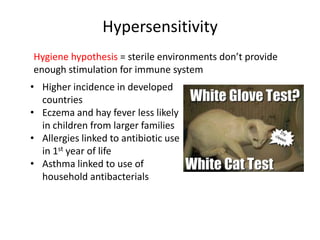
Hygiene hypothesis = sterile environments don’t provide
enough stimulation for immune system
• Higher incidence in developed
countries
• Eczema and hay fever less likely
in children from larger families
• Allergies linked to antibiotic use
in 1st year of life
• Asthma linked to use of
household antibacterials
Hypersensitivity Reactions
• Type I: Anaphylaxis
– Sytemic anaphylaxis (Anaphylactic shock)
– IgE response
• Type II: Cytotoxic Reactions
– IgM, IgG, complement response
• Type III: Immune complex reactions
– IgG response against soluble Antigen
• Type IV: Delayed Hypersensitivity Reaction
– Cell mediated response (CTL or ADCC)
Type I: Anaphylactic Reactions
• Rapid
– 2-30 mins after exposure
– Systemic
• Shock, breathlessness, can be fatal
– Localized
• Hives
• IgE response
– Binds basophils/ mast cells
– Degranulation: release mediators
• Histamine
• Leukotrienes
• Prostaglandins
– Swelling, inflammation, runny nose, contraction of smooth
muscles
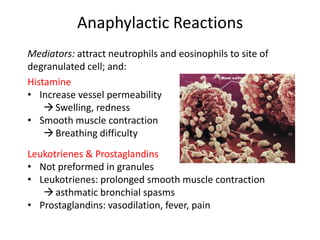
Anaphylactic Reactions
Mediators: attract neutrophils and eosinophils to site of
degranulated cell; and:
Histamine
• Increase vessel permeability
Swelling, redness
• Smooth muscle contraction
Breathing difficulty
Leukotrienes & Prostaglandins
• Not preformed in granules
• Leukotrienes: prolonged smooth muscle contraction
asthmatic bronchial spasms
• Prostaglandins: vasodilation, fever, pain
Systemic & Localized Anaphylaxis
• Systemic
– Shock
– Second or subsequent exposure to allergen
• Mediators  vasodilation  BP drop (shock)
• Injected antigens (insect bites)
– Epinephrine
• Constricts blood vessels
• Localized
– Ingested or inhaled allergen
• Pollen
– Inhalation
• Itchy eyes, runny nose, congestion, coughing, sneezing
– Antihistamine (blocks histamine receptors)
– Ingestion
• Food allergies
• Hives, systemic anaphylaxis
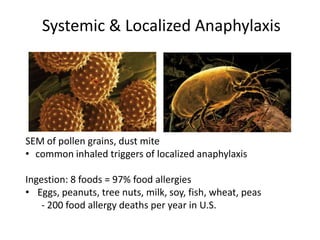
Systemic & Localized Anaphylaxis
SEM of pollen grains, dust mite
• common inhaled triggers of localized anaphylaxis
Ingestion: 8 foods = 97% food allergies
• Eggs, peanuts, tree nuts, milk, soy, fish, wheat, peas
- 200 food allergy deaths per year in U.S.
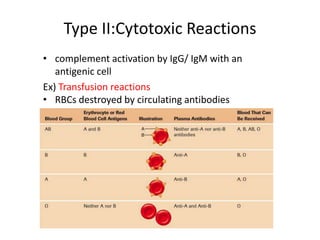
Type II:Cytotoxic Reactions
• complement activation by IgG/ IgM with an
antigenic cell
Ex) Transfusion reactions
• RBCs destroyed by circulating antibodies
Type III: Immune Complex Reactions
• IgG/ IgM against soluble antigens circulating in serum
Immune complexes:
• [Ag] > [Ab]
• Complexes evade phagocytes
• Soluble, circulating
• “stuck” on capillaries, joints, organ tissues
• Activate complement:
 Transient Inflammation
 Attract neutrophils  enzymes
- tissue destruction
Glumerulonephritis = inflammatory
damage to kidney glomeruli
Type IV: Delayed Cell-Mediated
Reactions
• T-cell activation
• Development time: longer
– Days
– T-cell and macrophage migration/ accumulation
• Sensitization
– Macrophage phagocytoses Ag
– Presents to T-cells
– T-memory cells formed
• Subsequent exposure
– Memory cells activated
– Cytokines releases
• Attract and activate macrophages
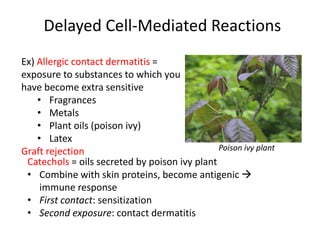
Delayed Cell-Mediated Reactions
Ex) Allergic contact dermatitis =
exposure to substances to which you
have become extra sensitive
• Fragrances
• Metals
• Plant oils (poison ivy)
• Latex
Graft rejection Poison ivy plant
Catechols = oils secreted by poison ivy plant
• Combine with skin proteins, become antigenic 
immune response
• First contact: sensitization
• Second exposure: contact dermatitis
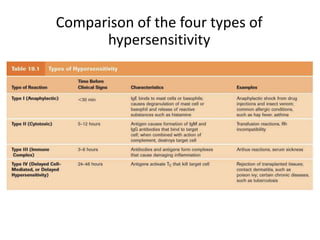
Comparison of the four types of
hypersensitivity
Autoimmune Diseases
• Hosts immune response against self
– Loss of discrimination between self v/s non-self
– Thymic selection
– >40 known ds., 75% women
• Autoimmune hepatitis
– Hepatocytes display MHC-II to APCs
• Viral infections (HepC, EBV)
• Medications
• Genetic predisposition
Autoimmune Diseases
• Immune complex reactions
– Rheumatoid arthritis
• Immune complexes (IgG/ IgM) deposits in joint
• Chronic inflammation
• Damage to bone/ joint cartilage
– SLE (systemic lupus erythematosus)
• Abs against cell components
– DNA
– Tissue breakdown
• Cytotoxic autoimmune reactions
– Graves Disease
• Abs that mimic TSH bind TSH-receptors
• Increased production of thyroid hormones
– Hyperthyroidism
– Goiter, bulging eyes
Immunodeficiencies
• Absence/ deficient immune response
• Congenital
– DiGeorge’s syndrome (22q11.2)
• Chromosome 22
• Defective/ missing thymus
– No CMI
– Frequent/ severe infections
• Acquired: drugs, cancer, infectious agents
– AIDS
• Final stage of HIV
• Destruction of T-helper (CD4+) cells
– cancer, bacterial, viral, fungal, and protozoan diseases
» Pneumocystis pneumonia, Kaposi’s sarcoma
• Diagnosis: CD4+ T-cell count below 200 cells/μl
• Chemotherapy: inhibit viral enzymes
reverse transcriptase inhibitors
Types of Acquired Immunity:
Active & Passive Immunity
Active immunity = acquired from an immune response to
exposure of foreign antigens
• Naturally acquired = exposure to antigens leads to
illness, recovery
• Artificially acquired = vaccination
Passive immunity = acquired from transfer of antibodies
from one person to another
• Naturally acquired = mother to infant
- Transplacental, breast milk
• Artificially acquired = injection of antibodies

11 - Adaptive Immunity

  • 1.
  • 2.
    Immunity: Third Lineof Defense • Red bone Marrow  Stem cells  T and B cells • Specific reaction to microbial infection Humoral Immunity Cell Mediated Immunity B-cells Recognize Specific Antigens Make Antibodies against them T-cells Recognize Specific Antigens Make Cytokines against them
  • 3.
    Antigens & Antibodies •Antigens (Antibody generators) • proteins or large polysaccharides • Components of invading microbes • Non-microbial antigens: • pollen, egg white, serum proteins, blood cells etc • Epitopes = specific region that interacts with Ab. • Antibodies • globulin proteins (immunoglobulins) Y-shaped • Made in response to antigen; bind specifically to Ag • At least two identical sites that bind to epitopes • Bivalent molecule
  • 5.
  • 6.
    Classes of Immunoglobulin IgG: •Y-shaped “Monomer” • readily cross vessel walls into inflammation site • ~80% of serum antibodies • Protects against bacteria and viruses • Neutralizes toxins • Enhances phagocytosis • Triggers complement • Confers immunity to fetus AFM of a bivalent (monomer) antibody
  • 7.
    Classes of Immunoglobulin IgM: •Pentamer (can be monomer too) – Too big to cross into tissue from blood • First Antibody response to 1 response • Dominates ABO blood group response • Effective in Complement Activation • Highly effective at Agglutination – Cross-links several Antigens
  • 8.
    Classes of Immunoglobulin IgA: •Dimer – Serum IgA (monomer) – Secretory IgA • Mucus membranes and secretions – Mucus, tears, saliva, breast milk – Prevents pathogen attachment to mucosal surface – Colustrum • Decreases infant risk to GI infections Dimeric IgA antibodies
  • 9.
    Classes of Immunoglobulin IgD: •Monomer • Blood, lymph, B-cell surface • No defined function – 0.002% serum antibodies IgE: • Monomer • Allergic Reactions, Parasitic Infections • Signals for complement and phagocytes • Binds mast cells/basophils  histamine  allergy
  • 11.
    B-cell Activation • StemCells  B-cells – Each B-cell has surface Igs against specific Ag • Binding of specific Ag activates THAT B-cell • Activated B-cell  clonal expansion  Plasma cells  Antibodies – Some activated B-cells become Memory cells
  • 13.
    Antigen-antibody binding • Antigen-AntibodyComplex – Specific interaction • Affinity: strength of bond • Specificity: ability to distinguish minor differences in AA – Binds at epitope – Complex formation tags foreign cells • Destruction by phagocytes and complement
  • 14.
    Outcomes of Ab-Agbinding • Agglutination – Clumping of Antigens • Opsonization – Ab coats microbe – Enhances phagocytosis • Neutralization – prevents Ag binding host cell • Antibody-dependent cell-mediated cytotoxicity – Ab coats microbe – Ab binds T-cells/NK cells/other immune cells – Cytokines released  lyse microbe • Complement Activation – IgG, IgM – Binds C1 – C1 C2, C4  C3  complementation cascade
  • 15.
    T-cells and cellularimmunity • T-lymphocytes • Combat pathogens within host cells – Not exposed to circulating Antibodies • Two Types – T-helper Cells (TH: TH1 and TH2) – Cytotoxic T-cells (Tc) – Surface Receptors • Glycoproteins • CD (clusters of differentiation)
  • 16.
    Antigen Presenting Cells •B-cells • Phagocytes – Dendritic cells – Macrophages • Chew up Microbe/ Antigen – Present parts of the Antigen on surface – Presentation involves a phagocytic receptor • MHC (major histocompatibility antigen)
  • 17.
    The MHC-antigen complex MHC= major histocompatibility complex • Collection of genes that encode proteins found on all nucleated mammalian cell membranes • Presence of MHC identifies the host - Keeps immune system from making antibodies against host cells Class II – found on APCs like B-cells Class I – found on almost any cell of the host • Makes it possible for cytotoxic T-cells to attack host cells that have been altered
  • 18.
    T-Helper Cells (CD4+) -bind to MHC class II molecules Activation of TH cells: 1. TH cell recognizes an antigen in complex with MHC class II presented on the surface of an APC 2. TH cell proliferates and differentiates into TH1 and TH2 cells – secrete cytokines TH1 = cytokines activate macrophages, enhance complement TH2 = cytokines stimulate production of antibodies important for allergic reactions, and eosinophils that protect against extracellular parasites
  • 19.
    APC (dendritic cell)and TH cell Antigen fragment Antigen MHC class II moleculesMicrobe T helper cell TH cell receptor contacting MHC- antigen complex
  • 20.
    Cytotoxic T-cells (CD8+) •Recognize and kill altered or foreign cells • bind to MHC class I molecules - found on all nucleated cells • Presented in complex with viral/parasitic antigens on surface of infection-altered cells Steps in destruction of target cells: 1. Recognize foreign antigen/MHC class I protein complex on cell 2. Attaches and released perforin  pore • Allows proteases to enter 3. Apoptosis = programmed cell death
  • 21.
    Cytotoxic T-cells (CD8+) 1.Virus-infected cell with endogenous viral antigens (inside cell) 2. Abnormal antigen is presented on cell surface in complex with MHC class I molecules - TC cell with receptor for that antigen binds 3. TC cell induces destruction by apoptosis Antigen MHC class I MHC-antigen complex Cytotoxic T-cell
  • 22.
    Apoptosis Blebbing = external membranesbulge outward Top: B-cell undergoing apoptosis Bottom: Normal B-cell for reference
  • 23.
    Antigen-presenting cells Dendritic cells= Principle APCs to induce immune responses by T-cells • Long extensions = dendrites • Resemble nerve cell dendrites 1. engulf invading microbes 2. degrade them 3. transfer them to lymph nodes for display to T-cells located there
  • 24.
    Macrophages = (largeeaters) • Innate immunity: important in phagocytosis of apoptotic cells and other debris • Adaptive immunity: become activated macrophages upon ingestion of foreign antigen - Appear larger and “ruffled” 1. Take in antigen 2. migrate to lymph nodes 3. present antigen to T-cells located there Antigen-presenting cells
  • 25.
    Extracellular killing Natural killercells = granular leukocytes that destroy virus- infected cells, tumor cells, and parasites • Part of innate immunity (non-specific) - Not triggered by antigen • Remains external to target cell Mechanism: 1. Contact a target cell 2. Determine if it expresses MHC class I self-antigen (*tumor cells, viral-infected cells don’t) 3. No expression  induces lysis/apoptosis (similar to that of cytotoxic T-cell)
  • 26.
    Antibody-dependent-cell-mediated cytotoxicity • Invaders toolarge to be phagocytized (euks) can be attacked by immune cells • Uses antibodies of humoral system • NK cells, macrophages, neutrophils, and eosinophils respond and kill targeted cells Mechanism: • Target cell coated with antibodies • Immune cells bind to antibodies • Target cell is lysed by secretions
  • 27.
  • 28.
  • 29.
    Cytokines Cytokines = chemicalmessengers of immune cells • Soluble proteins/glycoproteins • Produced by immune cells after a stimulus • Act only on a cell that has receptors for it - Interleukins = cytokines that serve as communicators between leukocytes (WBCs) - Chemokines = induce migration of leukocytes into areas of infection/tissue damage - Interferons = protect cells from viral infection
  • 30.
    Cytokines - Tumor necrosisfactor (TNF) = cytokines that act in inflammatory reactions; also target tumor cells - Hematopoietic cytokines = control development of stem cells into red or white blood cells Ex) Granulocyte-colony stimulating factor • Granulocyte precursors  neutrophils Cytokine storm = overproduction of cytokines - Damage to host tissues
  • 31.
    Extracellular antigens A Bcell binds to the antigen for which it is specific. A T-dependent B cell requires cooperation with a T helper (TH) cell. The B cell, often with stimulation by cytokines from a TH cell, differentiates into a plasma cell. Some B cells become memory cells. Plasma cells proliferate and produce antibodies against the antigen. Intracellular antigens are expressed on the surface of an APC, a cell infected by a virus, a bacterium, or a parasite. A T cell binds to MHC–antigen complexes on the surface of the infected cell, activating the T cell (with its cytokine receptors). Activation of macrophage (enhanced phagocytic activity). The CD8+T cell becomes a cytotoxic T lymphocyte (CTL) able to induce apoptosis of the target cell. B cell Plasma cell T cell TH cell Cytotoxic T lymphocyte CytokinesCytokines Lysed target cell Cytokines activate macrophage. Cytokines from the TH cell transform B cells into antibody-producing plasma cells. Cytokines activate T helper (TH) cell. Memory cell Some T and B cells differentiate into memory cells that respond rapidly to any secondary encounter with an antigen. Humoral (antibody-mediated) immune system Cellular (cell-mediated) immune system Control of freely circulating pathogens Control of intracellular pathogens Figure 17.20 The dual nature of the adaptive immune system.
  • 32.
    Vaccines • suspension oforganisms/ parts of organism used to INDUCE immunity • Artificial Active Immunity
  • 33.
    Vaccine: Types • Liveattenuated whole-agent • Inactivated whole-agent • Toxoids • Subunit Vaccines – Recombinant subunit vaccines • Nucleic acid Vaccines
  • 34.
    Live attentuated Wholeagent • living but attenuated (weakened) microbes – Mutated virus – Related virus • Attenuated viruses replicate in the body – Cell and humoral immunity • Lifelong immunity • Counterindicated – immune compromised – Attenuated microbes: from mutated strains  can back-mutate to virulent form • Viral vaccines: MMR, Sabin polio, Smallpox, Flumist (influenza) • Bacterial vaccines: tuberculosis
  • 35.
    Inactivated “Dead” Whole-agent •Killed by formalin or phenol • Immunity not life-long – Boosters may be required – Primarily humoral response • Examples: – Viral: Salk (polio, IPV), Rabies, Flu – Bacterial: Pneumococcal, Cholera
  • 36.
    Subunit Vaccines • Highlyimmunogenic fragments – Cannot replicate in host – Less side-effects/ dangers • Recombinant vaccines – Desired Ag fragment expressed by unrelated, non-pathogenic microbe – Ex. HepB virion protein in GM yeast – Rabies glycoprotein in Vaccinia virus (V-RG) • Toxoids – Tetanus, diphtheria – Several injections required for full immunity – Boosters every 10 years • Conjugated Vaccines – Capsular polysaccharides: poor immunogens; T-independent Ags – Conjugate with Toxoid for maximal immunity – Ex. Hib
  • 37.
    Nucleic Acid Vaccines(DNA vaccines) • Newest “promising” vaccines • Plasmid DNA – Containing gene for immunogen of interest – Injected intramuscularly • Gene gun • Conventional needle – Expressed Protein Ag  Red Bone Marrow humoral and cellular immunity • Long lasting immunity • West Nile vaccine (horses) • Human trials underway
  • 38.
    Types of Vaccine Genegun = DNA coated with gold or tungsten nanoparticles are “shot” into dermal cell cytosol • Inserted with glass micropipette - Diameter smaller than cell - Punctures plasma membrane • Eliminates • syringes/needles • refrigeration • lower costs
  • 39.
  • 40.
    Vaccine Development • Whole-agentvaccine – Grow in large amounts for use • Early days – Smallpox scarified onto shaved calf bellies • Cow “junk” – Flu, Polio: grown in Eggs • Egg protein: allergen – Human cells required • First HepB vaccine used Ags from chronically infected as source • Tissue culture Yolk sac Allantoic cavity Amniotic cavity Chorioallantoic membrane
  • 41.
    Current Vaccine Development •Tissue Culture – Tissue slice – Digest with enzymes (trypsin) • Breaks down tissue into single cells – Nutritive growth media • Cells adhere and divide to from a “monolayer” – Infect with virus • CPE (cytopathic effect) caused by virus infection
  • 42.
    Vaccine Development Advancement incultivation: cell culture Viruses may be grown in: Primary cell lines = derived from tissue slices; die out after a few generations Diploid cell lines = develop from human embryos; maintained for ~100 generations Continuous cell lines = (aka immortal cell lines) Cancerous cells; can be maintained indefinitely Ex) HeLa cell line • tend to have: - Less round shape - Chromosomal abnormalities
  • 43.
    Vaccine Safety: Risksv/s benefits • Disease caused by vaccine – Smallpox • Variolation – Incidence of disease decreased from 25% to 1% – OPV (Sabin) • Poliovirus mutated • Reversion to wt – Poliomyelitis • Risk v/s Benefits – Public reaction • Low perceived risk of contracting disease – Polio, measles • Reports/ rumors of harmful effects – MMR  autism – Flu  Guillain Barre syndrome • Herd immunity
  • 44.
  • 45.
    Hypersensitivity • Abnormal reactionto Antigen – Allergy – Sensitization to previous exposure to Allergen – Higher exposure to Antigen • Sensitized • Immune response to low levels of Ag – Genetic predisposition
  • 46.
    Hypersensitivity Hygiene hypothesis =sterile environments don’t provide enough stimulation for immune system • Higher incidence in developed countries • Eczema and hay fever less likely in children from larger families • Allergies linked to antibiotic use in 1st year of life • Asthma linked to use of household antibacterials
  • 47.
    Hypersensitivity Reactions • TypeI: Anaphylaxis – Sytemic anaphylaxis (Anaphylactic shock) – IgE response • Type II: Cytotoxic Reactions – IgM, IgG, complement response • Type III: Immune complex reactions – IgG response against soluble Antigen • Type IV: Delayed Hypersensitivity Reaction – Cell mediated response (CTL or ADCC)
  • 48.
    Type I: AnaphylacticReactions • Rapid – 2-30 mins after exposure – Systemic • Shock, breathlessness, can be fatal – Localized • Hives • IgE response – Binds basophils/ mast cells – Degranulation: release mediators • Histamine • Leukotrienes • Prostaglandins – Swelling, inflammation, runny nose, contraction of smooth muscles
  • 49.
    Anaphylactic Reactions Mediators: attractneutrophils and eosinophils to site of degranulated cell; and: Histamine • Increase vessel permeability Swelling, redness • Smooth muscle contraction Breathing difficulty Leukotrienes & Prostaglandins • Not preformed in granules • Leukotrienes: prolonged smooth muscle contraction asthmatic bronchial spasms • Prostaglandins: vasodilation, fever, pain
  • 50.
    Systemic & LocalizedAnaphylaxis • Systemic – Shock – Second or subsequent exposure to allergen • Mediators  vasodilation  BP drop (shock) • Injected antigens (insect bites) – Epinephrine • Constricts blood vessels • Localized – Ingested or inhaled allergen • Pollen – Inhalation • Itchy eyes, runny nose, congestion, coughing, sneezing – Antihistamine (blocks histamine receptors) – Ingestion • Food allergies • Hives, systemic anaphylaxis
  • 51.
    Systemic & LocalizedAnaphylaxis SEM of pollen grains, dust mite • common inhaled triggers of localized anaphylaxis Ingestion: 8 foods = 97% food allergies • Eggs, peanuts, tree nuts, milk, soy, fish, wheat, peas - 200 food allergy deaths per year in U.S.
  • 52.
    Type II:Cytotoxic Reactions •complement activation by IgG/ IgM with an antigenic cell Ex) Transfusion reactions • RBCs destroyed by circulating antibodies
  • 53.
    Type III: ImmuneComplex Reactions • IgG/ IgM against soluble antigens circulating in serum Immune complexes: • [Ag] > [Ab] • Complexes evade phagocytes • Soluble, circulating • “stuck” on capillaries, joints, organ tissues • Activate complement:  Transient Inflammation  Attract neutrophils  enzymes - tissue destruction Glumerulonephritis = inflammatory damage to kidney glomeruli
  • 54.
    Type IV: DelayedCell-Mediated Reactions • T-cell activation • Development time: longer – Days – T-cell and macrophage migration/ accumulation • Sensitization – Macrophage phagocytoses Ag – Presents to T-cells – T-memory cells formed • Subsequent exposure – Memory cells activated – Cytokines releases • Attract and activate macrophages
  • 55.
    Delayed Cell-Mediated Reactions Ex)Allergic contact dermatitis = exposure to substances to which you have become extra sensitive • Fragrances • Metals • Plant oils (poison ivy) • Latex Graft rejection Poison ivy plant Catechols = oils secreted by poison ivy plant • Combine with skin proteins, become antigenic  immune response • First contact: sensitization • Second exposure: contact dermatitis
  • 56.
    Comparison of thefour types of hypersensitivity
  • 57.
    Autoimmune Diseases • Hostsimmune response against self – Loss of discrimination between self v/s non-self – Thymic selection – >40 known ds., 75% women • Autoimmune hepatitis – Hepatocytes display MHC-II to APCs • Viral infections (HepC, EBV) • Medications • Genetic predisposition
  • 58.
    Autoimmune Diseases • Immunecomplex reactions – Rheumatoid arthritis • Immune complexes (IgG/ IgM) deposits in joint • Chronic inflammation • Damage to bone/ joint cartilage – SLE (systemic lupus erythematosus) • Abs against cell components – DNA – Tissue breakdown • Cytotoxic autoimmune reactions – Graves Disease • Abs that mimic TSH bind TSH-receptors • Increased production of thyroid hormones – Hyperthyroidism – Goiter, bulging eyes
  • 59.
    Immunodeficiencies • Absence/ deficientimmune response • Congenital – DiGeorge’s syndrome (22q11.2) • Chromosome 22 • Defective/ missing thymus – No CMI – Frequent/ severe infections • Acquired: drugs, cancer, infectious agents – AIDS • Final stage of HIV • Destruction of T-helper (CD4+) cells – cancer, bacterial, viral, fungal, and protozoan diseases » Pneumocystis pneumonia, Kaposi’s sarcoma • Diagnosis: CD4+ T-cell count below 200 cells/μl • Chemotherapy: inhibit viral enzymes reverse transcriptase inhibitors
  • 60.
    Types of AcquiredImmunity: Active & Passive Immunity Active immunity = acquired from an immune response to exposure of foreign antigens • Naturally acquired = exposure to antigens leads to illness, recovery • Artificially acquired = vaccination Passive immunity = acquired from transfer of antibodies from one person to another • Naturally acquired = mother to infant - Transplacental, breast milk • Artificially acquired = injection of antibodies