Immunoglobulins:
Structure and Function
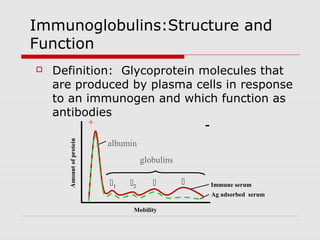
Immunoglobulins:Structure and
Function
   Definition: Glycoprotein molecules that
    are produced by plasma cells in response
    to an immunogen and which function as
    antibodies
                          +                             -
      Amount of protein


                              albumin
                                        globulins

                              1   2                     Immune serum
                                                            Ag adsorbed serum

                                    Mobility
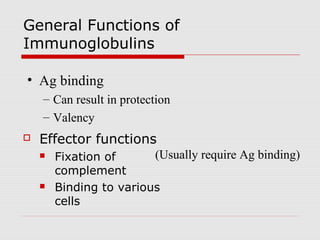
General Functions of
Immunoglobulins

• Ag binding
    – Can result in protection
    – Valency
   Effector functions
       Fixation of      (Usually require Ag binding)
        complement
       Binding to various
        cells
Basic Immunoglobulin Structure

   Immunoglobulins - heterogeneous

   Myeloma proteins - homogeneous
    immunoglobulins
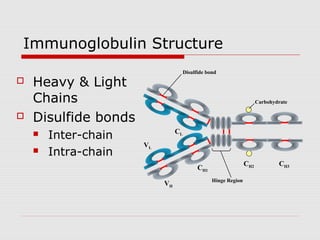
Immunoglobulin Structure
                                     Disulfide bond
   Heavy & Light
    Chains                                                            Carbohydrate

   Disulfide bonds
       Inter-chain             CL
                      VL
       Intra-chain
                                                                CH2           CH3
                                           CH1
                                                 Hinge Region
                           VH
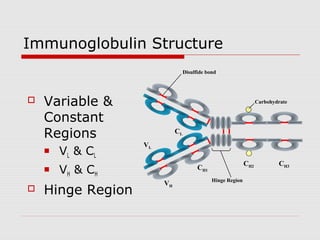
Immunoglobulin Structure
                                  Disulfide bond


   Variable &                                                     Carbohydrate


    Constant
    Regions                  CL
                   VL
       VL & CL
                                                             CH2           CH3
       VH & CH                         CH1
                                              Hinge Region
                        VH
   Hinge Region
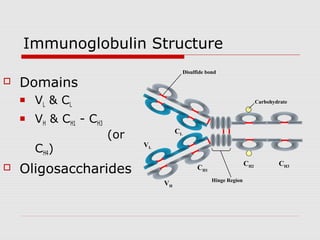
Immunoglobulin Structure
                                              Disulfide bond
   Domains
       VL & C L                                                               Carbohydrate


       VH & CH1 - CH3
                         (or             CL

        CH4)                   VL

                                                                         CH2           CH3
   Oligosaccharides                                CH1
                                                          Hinge Region
                                    VH
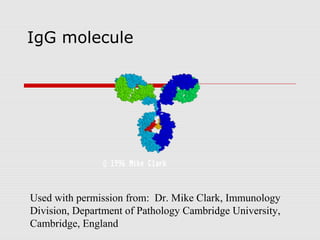
IgG molecule


Used with permission from: Dr. Mike Clark, Immunology
Division, Department of Pathology Cambridge University,
Cambridge, England
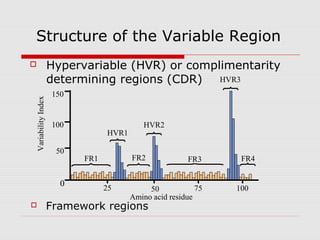
Structure of the Variable Region
                   Hypervariable (HVR) or complimentarity
                    determining regions (CDR)   HVR3
                    150
Variability Index


                    100                    HVR2
                                HVR1

                     50
                          FR1          FR2             FR3      FR4


                      0         25          50            75   100
                                       Amino acid residue
                   Framework regions
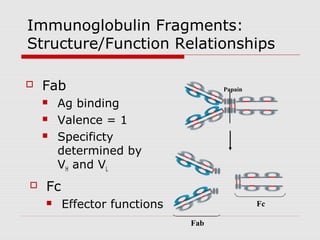
Immunoglobulin Fragments:
Structure/Function Relationships

   Fab                             Papain

       Ag binding
       Valence = 1
       Specificty
        determined by
        VH and VL
   Fc
        Effector functions                  Fc

                              Fab
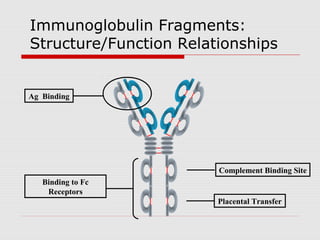
Immunoglobulin Fragments:
Structure/Function Relationships


Ag Binding


                        Complement Binding Site
   Binding to Fc
    Receptors
                        Placental Transfer
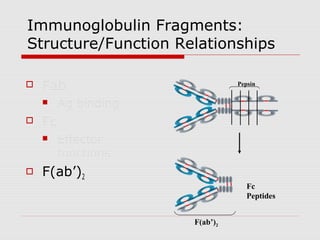
Immunoglobulin Fragments:
Structure/Function Relationships

   Fab                         Pepsin


        Ag binding
   Fc
        Effector
         functions
   F(ab’)2
                                   Fc
                                   Peptides


                      F(ab’)2
Human Immunoglobulin
Classes

   IgG - Gamma heavy chains
   IgM - Mu heavy chains
   IgA - Alpha heavy chains
   IgD - Delta heavy chains
   IgE - Epsilon heavy chains
Human Immunoglobulin
Subclasses
   IgG Subclasses
       IgG1   -   Gamma   1   heavy   chains
       IgG2   -   Gamma   2   heavy   chains
       IgG3   -   Gamma   3   heavy   chains
       IgG4   -   Gamma   4   heavy   chains
   IgA subclasses
       IgA1 - Alpha 1 heavy chains
       IgA2 - Alpha 2 heavy chains
Human Immunoglobulin
Light Chain Types

   Kappa ()
   Lambda ()
Human Immunoglobulin
Light Chain Subtypes

   Lambda light chains
       Lambda   1
       Lambda   2
       Lambda   3
       Lambda   4
Immunoglobulins
   Nomenclature
       IgM (kappa)
       IgA1(lambda 2)
       IgG
   Heterogeneity
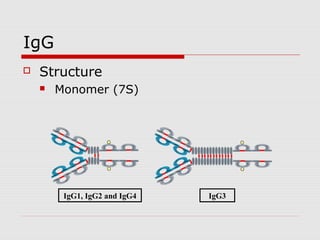
IgG
   Structure
       Monomer (7S)


         IgG1, IgG2 and IgG4   IgG3
IgG
   Structure
   Properties
       Major serum Ig
       Major Ig in extravascular spaces
       Placental transfer – Does not require Ag binding
        (IgG2)
       Fixes complement (IgG4)
       Binds to Fc receptors (IgG2, IgG4)
          Phagocytes - opsonization
          K cells - ADCC
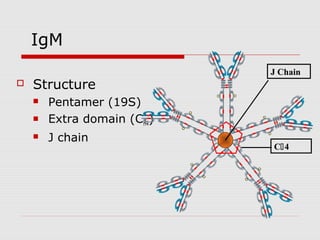
IgM
                             J Chain
   Structure
       Pentamer (19S)
       Extra domain (CH4)
       J chain
                             C4
IgM
     Structure
     Properties
         3rd highest serum Ig
         First Ig made by
          fetus and B cells
         Fixes complement
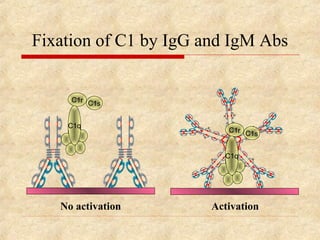
Fixation of C1 by IgG and IgM Abs


     C1r C1
            s


    C1q
                          C1r C1
                                 s


                         C1q


   No activation       Activation
IgM
    Structure
    Properties
        3rd highest serum Ig
        First Ig made by fetus
         and B cells
        Fixes complement

     Agglutinating Ig
     Binds to Fc receptors       Tail
                                  Piece
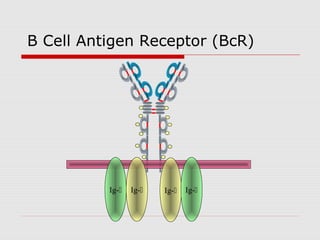
     B cell surface Ig
B Cell Antigen Receptor (BcR)


          Ig-   Ig-   Ig-   Ig-
IgA

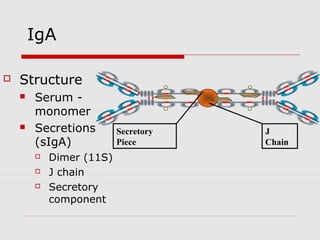
   Structure
       Serum -
        monomer
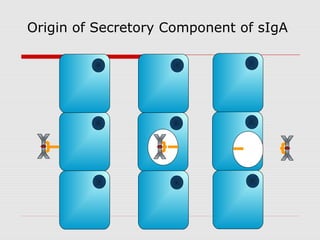
       Secretions        Secretory   J
        (sIgA)            Piece       Chain
           Dimer (11S)
           J chain
           Secretory
            component
Origin of Secretory Component of sIgA
IgA
   Structure
   Properties
       2nd highest serum Ig
       Major secretory Ig (Mucosal or Local
        Immunity)
           Tears, saliva, gastric and pulmonary
            secretions
       Does not fix complement (unless
        aggregated)
       Binds to Fc receptors on some cells
IgD

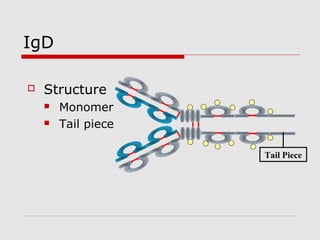
   Structure
       Monomer
       Tail piece

                     Tail Piece
IgD
   Structure
   Properties
       4th highest serum Ig
       B cell surface Ig
       Does not bind complement
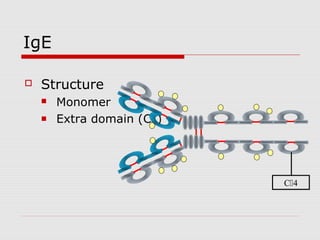
IgE

   Structure
       Monomer
       Extra domain (CH4)


                             C4
IgE
   Structure
   Properties
       Least common serum Ig
           Binds to basophils and mast cells (Does not
            require Ag binding)
       Allergic reactions
       Parasitic infections (Helminths)
           Binds to Fc receptor on eosinophils
       Does not fix complement

Immunoglobulins 2001

  • 1.
  • 2.
    Immunoglobulins:Structure and Function  Definition: Glycoprotein molecules that are produced by plasma cells in response to an immunogen and which function as antibodies + - Amount of protein albumin globulins 1 2   Immune serum Ag adsorbed serum Mobility
  • 3.
    General Functions of Immunoglobulins •Ag binding – Can result in protection – Valency  Effector functions  Fixation of (Usually require Ag binding) complement  Binding to various cells
  • 4.
    Basic Immunoglobulin Structure  Immunoglobulins - heterogeneous  Myeloma proteins - homogeneous immunoglobulins
  • 5.
    Immunoglobulin Structure Disulfide bond  Heavy & Light Chains Carbohydrate  Disulfide bonds  Inter-chain CL VL  Intra-chain CH2 CH3 CH1 Hinge Region VH
  • 6.
    Immunoglobulin Structure Disulfide bond  Variable & Carbohydrate Constant Regions CL VL  VL & CL CH2 CH3  VH & CH CH1 Hinge Region VH  Hinge Region
  • 7.
    Immunoglobulin Structure Disulfide bond  Domains  VL & C L Carbohydrate  VH & CH1 - CH3 (or CL CH4) VL CH2 CH3  Oligosaccharides CH1 Hinge Region VH
  • 8.
    IgG molecule Used withpermission from: Dr. Mike Clark, Immunology Division, Department of Pathology Cambridge University, Cambridge, England
  • 9.
    Structure of theVariable Region  Hypervariable (HVR) or complimentarity determining regions (CDR) HVR3 150 Variability Index 100 HVR2 HVR1 50 FR1 FR2 FR3 FR4 0 25 50 75 100 Amino acid residue  Framework regions
  • 10.
    Immunoglobulin Fragments: Structure/Function Relationships  Fab Papain  Ag binding  Valence = 1  Specificty determined by VH and VL  Fc  Effector functions Fc Fab
  • 11.
    Immunoglobulin Fragments: Structure/Function Relationships AgBinding Complement Binding Site Binding to Fc Receptors Placental Transfer
  • 12.
    Immunoglobulin Fragments: Structure/Function Relationships  Fab Pepsin  Ag binding  Fc  Effector functions  F(ab’)2 Fc Peptides F(ab’)2
  • 13.
    Human Immunoglobulin Classes  IgG - Gamma heavy chains  IgM - Mu heavy chains  IgA - Alpha heavy chains  IgD - Delta heavy chains  IgE - Epsilon heavy chains
  • 14.
    Human Immunoglobulin Subclasses  IgG Subclasses  IgG1 - Gamma 1 heavy chains  IgG2 - Gamma 2 heavy chains  IgG3 - Gamma 3 heavy chains  IgG4 - Gamma 4 heavy chains  IgA subclasses  IgA1 - Alpha 1 heavy chains  IgA2 - Alpha 2 heavy chains
  • 15.
    Human Immunoglobulin Light ChainTypes  Kappa ()  Lambda ()
  • 16.
    Human Immunoglobulin Light ChainSubtypes  Lambda light chains  Lambda 1  Lambda 2  Lambda 3  Lambda 4
  • 17.
    Immunoglobulins  Nomenclature  IgM (kappa)  IgA1(lambda 2)  IgG  Heterogeneity
  • 18.
    IgG  Structure  Monomer (7S) IgG1, IgG2 and IgG4 IgG3
  • 19.
    IgG  Structure  Properties  Major serum Ig  Major Ig in extravascular spaces  Placental transfer – Does not require Ag binding (IgG2)  Fixes complement (IgG4)  Binds to Fc receptors (IgG2, IgG4)  Phagocytes - opsonization  K cells - ADCC
  • 20.
    IgM J Chain  Structure  Pentamer (19S)  Extra domain (CH4)  J chain C4
  • 21.
    IgM  Structure  Properties  3rd highest serum Ig  First Ig made by fetus and B cells  Fixes complement
  • 22.
    Fixation of C1by IgG and IgM Abs C1r C1 s C1q C1r C1 s C1q No activation Activation
  • 23.
    IgM  Structure  Properties  3rd highest serum Ig  First Ig made by fetus and B cells  Fixes complement  Agglutinating Ig  Binds to Fc receptors Tail Piece  B cell surface Ig
  • 24.
    B Cell AntigenReceptor (BcR) Ig- Ig- Ig- Ig-
  • 25.
    IgA  Structure  Serum - monomer  Secretions Secretory J (sIgA) Piece Chain  Dimer (11S)  J chain  Secretory component
  • 26.
    Origin of SecretoryComponent of sIgA
  • 27.
    IgA  Structure  Properties  2nd highest serum Ig  Major secretory Ig (Mucosal or Local Immunity)  Tears, saliva, gastric and pulmonary secretions  Does not fix complement (unless aggregated)  Binds to Fc receptors on some cells
  • 28.
    IgD  Structure  Monomer  Tail piece Tail Piece
  • 29.
    IgD  Structure  Properties  4th highest serum Ig  B cell surface Ig  Does not bind complement
  • 30.
    IgE  Structure  Monomer  Extra domain (CH4) C4
  • 31.
    IgE  Structure  Properties  Least common serum Ig  Binds to basophils and mast cells (Does not require Ag binding)  Allergic reactions  Parasitic infections (Helminths)  Binds to Fc receptor on eosinophils  Does not fix complement