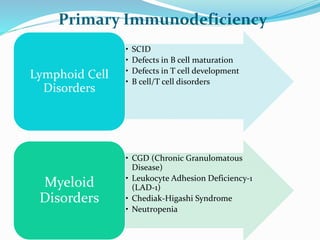
Primary Immunodeficiency
• SCID
• Defects in B cell maturation
• Defects in T cell development
• B cell/T cell disorders
Lymphoid Cell
Disorders
• CGD (Chronic Granulomatous
Disease)
• Leukocyte Adhesion Deficiency-1
(LAD-1)
• Chediak-Higashi Syndrome
• Neutropenia
Myeloid
Disorders
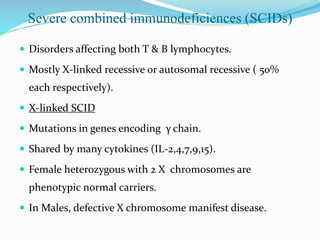
Severe combined immunodeficiences (SCIDs)
 Disorders affecting both T & B lymphocytes.
 Mostly X-linked recessive or autosomal recessive ( 50%
each respectively).
 X-linked SCID
 Mutations in genes encoding γ chain.
 Shared by many cytokines (IL-2,4,7,9,15).
 Female heterozygous with 2 X chromosomes are
phenotypic normal carriers.
 In Males, defective X chromosome manifest disease.
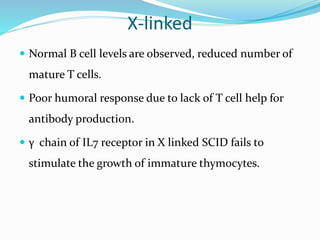
X-linked
 Normal B cell levels are observed, reduced number of
mature T cells.
 Poor humoral response due to lack of T cell help for
antibody production.
 γ chain of IL7 receptor in X linked SCID fails to
stimulate the growth of immature thymocytes.
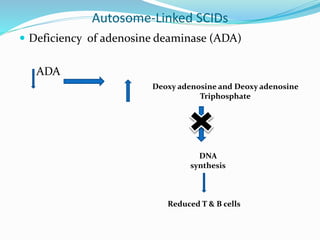
Autosome-Linked SCIDs
 Deficiency of adenosine deaminase (ADA)
ADA
Deoxy adenosine and Deoxy adenosine
Triphosphate
DNA
synthesis
Reduced T & B cells
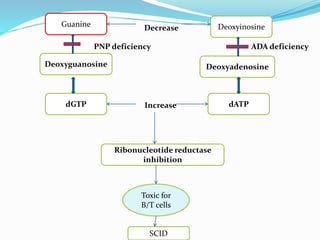
Guanine
Deoxyguanosine
dGTP
Deoxyinosine
Deoxyadenosine
dATP
Ribonucleotide reductase
inhibition
Toxic for
B/T cells
SCID
PNP deficiency ADA deficiency
Increase
Decrease
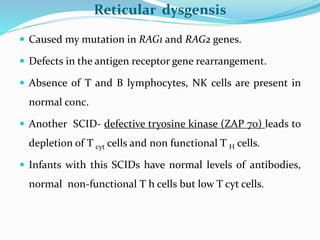
Reticular dysgensis
 Caused my mutation in RAG1 and RAG2 genes.
 Defects in the antigen receptor gene rearrangement.
 Absence of T and B lymphocytes, NK cells are present in
normal conc.
 Another SCID- defective tryosine kinase (ZAP 70) leads to
depletion of T cyt cells and non functional T H cells.
 Infants with this SCIDs have normal levels of antibodies,
normal non-functional T h cells but low T cyt cells.
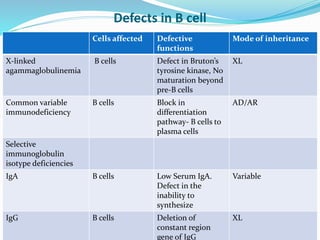
Defects in B cell
Cells affected Defective
functions
Mode of inheritance
X-linked
agammaglobulinemia
B cells Defect in Bruton’s
tyrosine kinase, No
maturation beyond
pre-B cells
XL
Common variable
immunodeficiency
B cells Block in
differentiation
pathway- B cells to
plasma cells
AD/AR
Selective
immunoglobulin
isotype deficiencies
IgA B cells Low Serum IgA.
Defect in the
inability to
synthesize
Variable
IgG B cells Deletion of
constant region
gene of IgG
XL
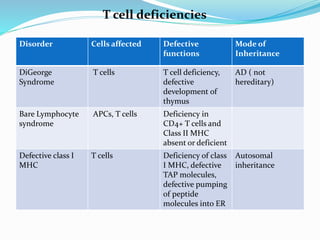
Disorder Cells affected Defective
functions
Mode of
Inheritance
DiGeorge
Syndrome
T cells T cell deficiency,
defective
development of
thymus
AD ( not
hereditary)
Bare Lymphocyte
syndrome
APCs, T cells Deficiency in
CD4+ T cells and
Class II MHC
absent or deficient
Defective class I
MHC
T cells Deficiency of class
I MHC, defective
TAP molecules,
defective pumping
of peptide
molecules into ER
Autosomal
inheritance
T cell deficiencies
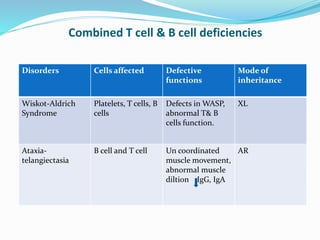
Combined T cell & B cell deficiencies
Disorders Cells affected Defective
functions
Mode of
inheritance
Wiskot-Aldrich
Syndrome
Platelets, T cells, B
cells
Defects in WASP,
abnormal T& B
cells function.
XL
Ataxia-
telangiectasia
B cell and T cell Un coordinated
muscle movement,
abnormal muscle
diltion IgG, IgA
AR
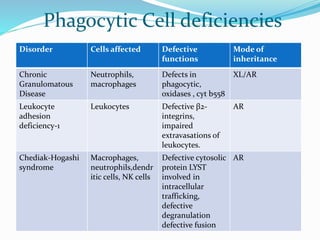
Phagocytic Cell deficiencies
Disorder Cells affected Defective
functions
Mode of
inheritance
Chronic
Granulomatous
Disease
Neutrophils,
macrophages
Defects in
phagocytic,
oxidases , cyt b558
XL/AR
Leukocyte
adhesion
deficiency-1
Leukocytes Defective β2-
integrins,
impaired
extravasations of
leukocytes.
AR
Chediak-Hogashi
syndrome
Macrophages,
neutrophils,dendr
itic cells, NK cells
Defective cytosolic
protein LYST
involved in
intracellular
trafficking,
defective
degranulation
defective fusion
AR

Immunodeficiency 1

  • 2.
    Primary Immunodeficiency • SCID •Defects in B cell maturation • Defects in T cell development • B cell/T cell disorders Lymphoid Cell Disorders • CGD (Chronic Granulomatous Disease) • Leukocyte Adhesion Deficiency-1 (LAD-1) • Chediak-Higashi Syndrome • Neutropenia Myeloid Disorders
  • 3.
    Severe combined immunodeficiences(SCIDs)  Disorders affecting both T & B lymphocytes.  Mostly X-linked recessive or autosomal recessive ( 50% each respectively).  X-linked SCID  Mutations in genes encoding γ chain.  Shared by many cytokines (IL-2,4,7,9,15).  Female heterozygous with 2 X chromosomes are phenotypic normal carriers.  In Males, defective X chromosome manifest disease.
  • 4.
    X-linked  Normal Bcell levels are observed, reduced number of mature T cells.  Poor humoral response due to lack of T cell help for antibody production.  γ chain of IL7 receptor in X linked SCID fails to stimulate the growth of immature thymocytes.
  • 5.
    Autosome-Linked SCIDs  Deficiencyof adenosine deaminase (ADA) ADA Deoxy adenosine and Deoxy adenosine Triphosphate DNA synthesis Reduced T & B cells
  • 6.
  • 7.
    Reticular dysgensis  Causedmy mutation in RAG1 and RAG2 genes.  Defects in the antigen receptor gene rearrangement.  Absence of T and B lymphocytes, NK cells are present in normal conc.  Another SCID- defective tryosine kinase (ZAP 70) leads to depletion of T cyt cells and non functional T H cells.  Infants with this SCIDs have normal levels of antibodies, normal non-functional T h cells but low T cyt cells.
  • 8.
    Defects in Bcell Cells affected Defective functions Mode of inheritance X-linked agammaglobulinemia B cells Defect in Bruton’s tyrosine kinase, No maturation beyond pre-B cells XL Common variable immunodeficiency B cells Block in differentiation pathway- B cells to plasma cells AD/AR Selective immunoglobulin isotype deficiencies IgA B cells Low Serum IgA. Defect in the inability to synthesize Variable IgG B cells Deletion of constant region gene of IgG XL
  • 9.
    Disorder Cells affectedDefective functions Mode of Inheritance DiGeorge Syndrome T cells T cell deficiency, defective development of thymus AD ( not hereditary) Bare Lymphocyte syndrome APCs, T cells Deficiency in CD4+ T cells and Class II MHC absent or deficient Defective class I MHC T cells Deficiency of class I MHC, defective TAP molecules, defective pumping of peptide molecules into ER Autosomal inheritance T cell deficiencies
  • 10.
    Combined T cell& B cell deficiencies Disorders Cells affected Defective functions Mode of inheritance Wiskot-Aldrich Syndrome Platelets, T cells, B cells Defects in WASP, abnormal T& B cells function. XL Ataxia- telangiectasia B cell and T cell Un coordinated muscle movement, abnormal muscle diltion IgG, IgA AR
  • 11.
    Phagocytic Cell deficiencies DisorderCells affected Defective functions Mode of inheritance Chronic Granulomatous Disease Neutrophils, macrophages Defects in phagocytic, oxidases , cyt b558 XL/AR Leukocyte adhesion deficiency-1 Leukocytes Defective β2- integrins, impaired extravasations of leukocytes. AR Chediak-Hogashi syndrome Macrophages, neutrophils,dendr itic cells, NK cells Defective cytosolic protein LYST involved in intracellular trafficking, defective degranulation defective fusion AR