1.   Definition of Antigen-Antibody Reactions
2.    Antibodies
3.   Antigens
4.   Nature of Antigen- Antibody reactions
5.   Characteristics of antigen-antibody
     reactions
6.   Types of antigen-antibody reactions
7.   Consequences of antigen-antibody
     reactions
 It is the reaction between an antigen and
  an antibody when they come in contact.
 This occurs when antigens enter the body.
 When antigens enter the body, signals are
  sent out and in response to that antibodies
  are made specifically to destroy the
  antigens.
 It is part of the Adaptive(Specific) immune
  system.
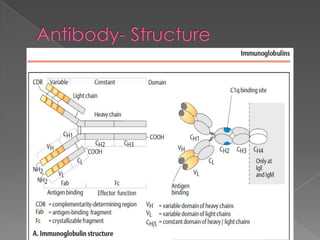
   Antibodies are also known as Immunoglobulin (Ig)
   These are globulin proteins that are found in the
    blood or other bodily fluids of vertebrates.
   Antibodies are used by the immune system to identify
    and neutralize foreign objects such as bacteria and
    viruses.
   Antibodies are produced by the Plasma Cells and
    are the receptors of the B- cells.
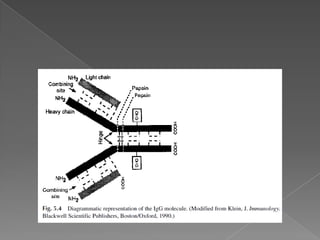
   An Antibody is typically a Y-shaped structure
    consisting of four polypeptide chains- two Heavy
    chains and two Light chains. Each arm of the „Y‟
    bears an antigen binding site.
 An antigen is any substance that triggers
  your immune system to produce
  antibodies against it.
 It may be a foreign substance from the
  environment such as chemicals,
  bacteria, viruses, or pollen.
 It may also be formed within the body,
  as with bacterial toxins or tissue cells.
 Antigens have different structures and
  types.
 Antigen is a substance that reacts with
  the products of a specific immune
  response( specific antibodies)
 Immunogen is a substance that induces
  a specific immune response
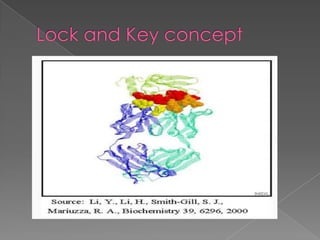
1. Lock and key concept
    - Fab ( antigen- binding fragment) is the
   combining site which is constructed by
   Hypervariable regions( H1-H4) of the heavy
   and light chains that interacts with an
   antigenic determinant(epitope) which forms a
   lock and key concept where lock= antibody
   and key= antigen
   - X-ray crystallographers studies of Ag-Ab
   interactions shows that antigenic determinant
   is nestled in a cleft formed by the combining
   sites of the antibody as illustrated…
2. Non- Covalent Bonds
 There are Four invisible forces that enables the binding of
   the antigen and the antibody and these are:
   a. Hydrogen Bond
        - When the antigen and antibody are in very close
   proximity, relatively weak hydrogen bonds can be formed
   between hydrophilic groups (e.g., OH and C=O, NH and
   C=O, and NH and OH groups).
   b. Electrostatic Bond
       - Electrostatic bonds result from the attraction between
   oppositely charged ionic groups of two protein side
   chains, for example, an ionized amino group (NH4) on a
   lysine in the antibody and an ionized carboxyl
   group(COO) on an aspartate residue in the antigen.
c. Hydrophobic Bond
     - the attractive force between molecules due to the close
    positioning of non- hydrophilic portions of the two molecules ( ie
    antigen and antibody)
d. Van der Waal’s forces
    - These forces depend upon interactions between the “electron
    clouds” that surround the antigen and antibody molecules. The
    interaction has been compared to that which might exist
    between alternating dipoles in two molecules, alternating in
    such a way that at any given moment oppositely oriented
    dipoles will be present in closely apposed areas of the antigen
    and antibody molecules.

3. Reversibility
    - it is reversible since the Ag- Ab rxns are via non- covalent
    bonds.
   ANTIBODY AFFINITY
    Strength or force of attraction of a rxn
    btwn a single antigenic determinant
    (epitope) at a single combining site on
    the Ab.
   ↑ the affinity of Ab for Ag, the more
    stable the interaction will be.
   ANTIBODY AVIDITY
    Overall strength of binding of several
    antibodies produced in response to an
    immunogen, which presents several
    different epitopes to the immune system.
   ↑ the avidity, the more stable the Ag-Ab
    reaction
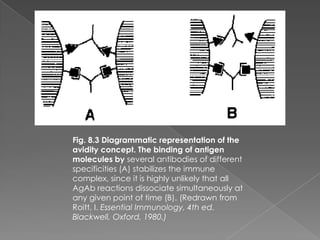
Fig. 8.3 Diagrammatic representation of the
avidity concept. The binding of antigen
molecules by several antibodies of different
specificities (A) stabilizes the immune
complex, since it is highly unlikely that all
AgAb reactions dissociate simultaneously at
any given point of time (B). (Redrawn from
Roitt, I. Essential Immunology, 4th ed.
Blackwell, Oxford, 1980.)
   ANTIBODY SPECIFICITY
    refers to the ability of an individual
    antibody combining site to react with
    only one epitope or the ability of a
    population of Ab molecules to react with
    only one antigen.
   In general, there is a high degree of
    specificity in Ag-Ab rxns.
   CROSS REACTIVITY
    refers to the ability of an individual
    antibody combining site to react with
    more than one epitopes.
   It arises because the cross reacting
    antigen shares an epitope in common
    with the immunizing antigen or becoz it
    has an epitope which is structurally
    similar to one of the immunizing antigen.
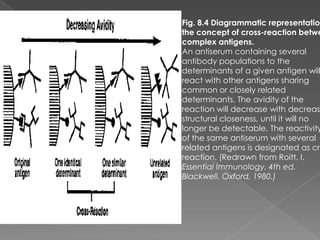
Fig. 8.4 Diagrammatic representation
the concept of cross-reaction betwe
complex antigens.
An antiserum containing several
antibody populations to the
determinants of a given antigen will
react with other antigens sharing
common or closely related
determinants. The avidity of the
reaction will decrease with decreasi
structural closeness, until it will no
longer be detectable. The reactivity
of the same antiserum with several
related antigens is designated as cro
reaction. (Redrawn from Roitt, I.
Essential Immunology, 4th ed.
Blackwell, Oxford, 1980.)
 AGGLUTINATION REACTIONS
- the aggregation by antibody of already
 insoluble particles or cells, e.g., bacteria
 or red cells, into larger clumps.
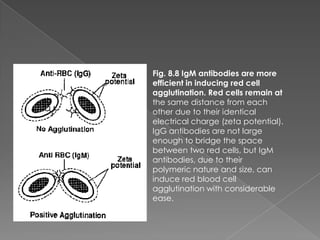
Fig. 8.8 IgM antibodies are more
efficient in inducing red cell
agglutination. Red cells remain at
the same distance from each
other due to their identical
electrical charge (zeta potential).
IgG antibodies are not large
enough to bridge the space
between two red cells, but IgM
antibodies, due to their
polymeric nature and size, can
induce red blood cell
agglutination with considerable
ease.
   PRECIPITATION REACTIONS
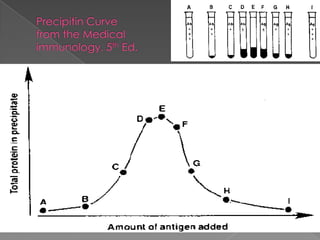
    A. Quantitative Reaction:
        - adding increasing amount of antigen
    to a known amount of antibodies results in
    a progressive increase in the amount of
    specific precipitate, which reaches a
    maximum level and then declines.
       - precipitation occurs when there is more
    binding and cross linking take place and it‟s
    at its highest peak when there are no free-
    antibodies and free- antigens in the
    solution.
B. Qualitative Reactions
    - various procedures are used to
   determine the presence, identity, and
   specificity of soluble antigens and
   antibodies.
     - Procedures include:
        - Ring precipitin tests, agar diffusion
   tests, and immunoelectrophoresis are
   commonly done in the laboratory.
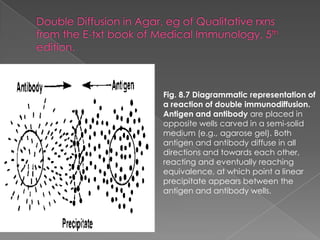
Fig. 8.7 Diagrammatic representation of
a reaction of double immunodiffusion.
Antigen and antibody are placed in
opposite wells carved in a semi-solid
medium (e.g., agarose gel). Both
antigen and antibody diffuse in all
directions and towards each other,
reacting and eventually reaching
equivalence, at which point a linear
precipitate appears between the
antigen and antibody wells.
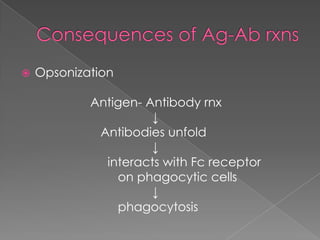
   Opsonization

            Antigen- Antibody rnx
                      ↓
             Antibodies unfold
                      ↓
              interаcts with Fc receptor
                on phаgocytic cells
                      ↓
                phаgocytosis
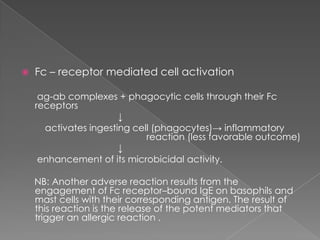
   Fc – receptor mediated cell activation

     ag-ab complexes + phagocytic cells through their Fc
    receptors
                       ↓
      activates ingesting cell (phagocytes)→ inflammatory
                             reaction (less favorable outcome)
                       ↓
     enhancement of its microbicidal activity.

    NB: Another adverse reaction results from the
    engagement of Fc receptor–bound IgE on basophils and
    mast cells with their corresponding antigen. The result of
    this reaction is the release of the potent mediators that
    trigger an allergic reaction .
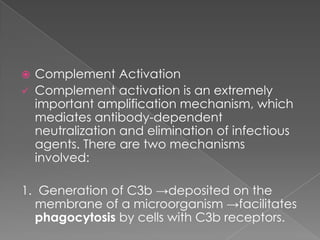
 Complement Activation
 Complement activation is an extremely
  important amplification mechanism, which
  mediates antibody-dependent
  neutralization and elimination of infectious
  agents. There аre two mechаnisms
  involved:

1. Generation of C3b →deposited on the
  membrane of a microorganism →facilitates
  phagocytosis by cells with C3b receptors.
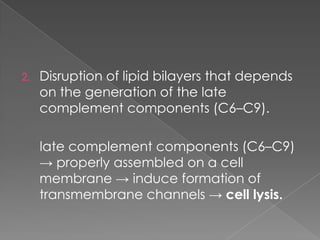
2.   Disruption of lipid bilayers that depends
     on the generation of the late
     complement components (C6–C9).

     late complement components (C6–C9)
     → properly assembled on a cell
     membrane → induce formation of
     transmembrane channels → cell lysis.
   Neutrаlisаtion
   аntibodies bind to bаcteriа, viruses, or
    toxin (Ag- Ab rnx) → prevents the
    interaction of the microbial agents or
    their products with the receptors that
    mediate their infectiveness or toxic
    effects → infectious agent or the toxin
    become harmless( neutralized.)
   Antigen- Antibody reactions are interactions
    between antigens and antibodies when they come
    into contact.
   Nature of the Ag-Ab reactions are as follows: Lock
    and Key Concept; Non- covalent bonds (Hydrogen,
    Electrostatic, and Hydrophobic bonds, and Van der
    Waal‟s Forces; and Reversibility.
   Characteristics of Ag- Ab reactions are: Affinity;
    Avidity; Specificity; and Cross- reactivity.
   The Specific Types of Ag- Ab reactions include:
    Agglutination and Precipitation Reactions
   Consequences of the Ag-Ab reactions are:
    Opsonization; Fc- receptor mediator Cell activation;
    Complement Activation; and Neutralization.
CAI, Color Atlas of Immunology[PDF]. Burmester G,
Pezzutto A[MD]. Thieme Stuttgart, New York;2003

Google Browser[ database on the Internet]. Mayer. G
[MD]: Southern Carolina University School of Medicine
(US); 2010. Available from:
http://pathmicro.med.sc.edu/mayer/ab-agrx.html

Hildamann W.H. Essentials of Immunology. New York,
Elsevier Science Publishers; 1984

MI, Medical Immunology[PDF]. Virella G, ed. 5th Ed.
New York, Marcel Dekker, Inc. 2001
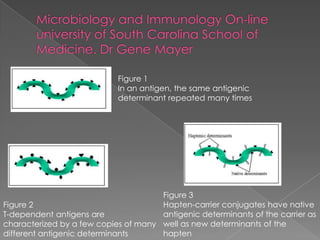
Figure 1
                            In an antigen, the same antigenic
                            determinant repeated many times


                                      Figure 3
Figure 2                              Hapten-carrier conjugates have native
T-dependent antigens are              antigenic determinants of the carrier as
characterized by a few copies of many well as new determinants of the
different antigenic determinants      hapten
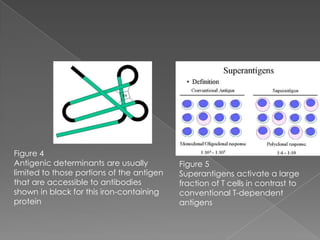
Figure 4
Antigenic determinants are usually         Figure 5
limited to those portions of the antigen   Superantigens activate a large
that are accessible to antibodies          fraction of T cells in contrast to
shown in black for this iron-containing    conventional T-dependent
protein                                    antigens

Immunoglobulins

  • 2.
    1. Definition of Antigen-Antibody Reactions 2. Antibodies 3. Antigens 4. Nature of Antigen- Antibody reactions 5. Characteristics of antigen-antibody reactions 6. Types of antigen-antibody reactions 7. Consequences of antigen-antibody reactions
  • 3.
     It isthe reaction between an antigen and an antibody when they come in contact.  This occurs when antigens enter the body.  When antigens enter the body, signals are sent out and in response to that antibodies are made specifically to destroy the antigens.  It is part of the Adaptive(Specific) immune system.
  • 4.
    Antibodies are also known as Immunoglobulin (Ig)  These are globulin proteins that are found in the blood or other bodily fluids of vertebrates.  Antibodies are used by the immune system to identify and neutralize foreign objects such as bacteria and viruses.  Antibodies are produced by the Plasma Cells and are the receptors of the B- cells.  An Antibody is typically a Y-shaped structure consisting of four polypeptide chains- two Heavy chains and two Light chains. Each arm of the „Y‟ bears an antigen binding site.
  • 7.
     An antigenis any substance that triggers your immune system to produce antibodies against it.  It may be a foreign substance from the environment such as chemicals, bacteria, viruses, or pollen.  It may also be formed within the body, as with bacterial toxins or tissue cells.  Antigens have different structures and types.
  • 8.
     Antigen isa substance that reacts with the products of a specific immune response( specific antibodies)  Immunogen is a substance that induces a specific immune response
  • 9.
    1. Lock andkey concept - Fab ( antigen- binding fragment) is the combining site which is constructed by Hypervariable regions( H1-H4) of the heavy and light chains that interacts with an antigenic determinant(epitope) which forms a lock and key concept where lock= antibody and key= antigen - X-ray crystallographers studies of Ag-Ab interactions shows that antigenic determinant is nestled in a cleft formed by the combining sites of the antibody as illustrated…
  • 11.
    2. Non- CovalentBonds  There are Four invisible forces that enables the binding of the antigen and the antibody and these are: a. Hydrogen Bond - When the antigen and antibody are in very close proximity, relatively weak hydrogen bonds can be formed between hydrophilic groups (e.g., OH and C=O, NH and C=O, and NH and OH groups). b. Electrostatic Bond - Electrostatic bonds result from the attraction between oppositely charged ionic groups of two protein side chains, for example, an ionized amino group (NH4) on a lysine in the antibody and an ionized carboxyl group(COO) on an aspartate residue in the antigen.
  • 12.
    c. Hydrophobic Bond - the attractive force between molecules due to the close positioning of non- hydrophilic portions of the two molecules ( ie antigen and antibody) d. Van der Waal’s forces - These forces depend upon interactions between the “electron clouds” that surround the antigen and antibody molecules. The interaction has been compared to that which might exist between alternating dipoles in two molecules, alternating in such a way that at any given moment oppositely oriented dipoles will be present in closely apposed areas of the antigen and antibody molecules. 3. Reversibility - it is reversible since the Ag- Ab rxns are via non- covalent bonds.
  • 13.
    ANTIBODY AFFINITY  Strength or force of attraction of a rxn btwn a single antigenic determinant (epitope) at a single combining site on the Ab.  ↑ the affinity of Ab for Ag, the more stable the interaction will be.
  • 14.
    ANTIBODY AVIDITY  Overall strength of binding of several antibodies produced in response to an immunogen, which presents several different epitopes to the immune system.  ↑ the avidity, the more stable the Ag-Ab reaction
  • 15.
    Fig. 8.3 Diagrammaticrepresentation of the avidity concept. The binding of antigen molecules by several antibodies of different specificities (A) stabilizes the immune complex, since it is highly unlikely that all AgAb reactions dissociate simultaneously at any given point of time (B). (Redrawn from Roitt, I. Essential Immunology, 4th ed. Blackwell, Oxford, 1980.)
  • 16.
    ANTIBODY SPECIFICITY  refers to the ability of an individual antibody combining site to react with only one epitope or the ability of a population of Ab molecules to react with only one antigen.  In general, there is a high degree of specificity in Ag-Ab rxns.
  • 17.
    CROSS REACTIVITY  refers to the ability of an individual antibody combining site to react with more than one epitopes.  It arises because the cross reacting antigen shares an epitope in common with the immunizing antigen or becoz it has an epitope which is structurally similar to one of the immunizing antigen.
  • 18.
    Fig. 8.4 Diagrammaticrepresentation the concept of cross-reaction betwe complex antigens. An antiserum containing several antibody populations to the determinants of a given antigen will react with other antigens sharing common or closely related determinants. The avidity of the reaction will decrease with decreasi structural closeness, until it will no longer be detectable. The reactivity of the same antiserum with several related antigens is designated as cro reaction. (Redrawn from Roitt, I. Essential Immunology, 4th ed. Blackwell, Oxford, 1980.)
  • 19.
     AGGLUTINATION REACTIONS -the aggregation by antibody of already insoluble particles or cells, e.g., bacteria or red cells, into larger clumps.
  • 20.
    Fig. 8.8 IgMantibodies are more efficient in inducing red cell agglutination. Red cells remain at the same distance from each other due to their identical electrical charge (zeta potential). IgG antibodies are not large enough to bridge the space between two red cells, but IgM antibodies, due to their polymeric nature and size, can induce red blood cell agglutination with considerable ease.
  • 21.
    PRECIPITATION REACTIONS A. Quantitative Reaction: - adding increasing amount of antigen to a known amount of antibodies results in a progressive increase in the amount of specific precipitate, which reaches a maximum level and then declines. - precipitation occurs when there is more binding and cross linking take place and it‟s at its highest peak when there are no free- antibodies and free- antigens in the solution.
  • 23.
    B. Qualitative Reactions - various procedures are used to determine the presence, identity, and specificity of soluble antigens and antibodies. - Procedures include: - Ring precipitin tests, agar diffusion tests, and immunoelectrophoresis are commonly done in the laboratory.
  • 24.
    Fig. 8.7 Diagrammaticrepresentation of a reaction of double immunodiffusion. Antigen and antibody are placed in opposite wells carved in a semi-solid medium (e.g., agarose gel). Both antigen and antibody diffuse in all directions and towards each other, reacting and eventually reaching equivalence, at which point a linear precipitate appears between the antigen and antibody wells.
  • 25.
    Opsonization Antigen- Antibody rnx ↓ Antibodies unfold ↓ interаcts with Fc receptor on phаgocytic cells ↓ phаgocytosis
  • 26.
    Fc – receptor mediated cell activation ag-ab complexes + phagocytic cells through their Fc receptors ↓ activates ingesting cell (phagocytes)→ inflammatory reaction (less favorable outcome) ↓ enhancement of its microbicidal activity. NB: Another adverse reaction results from the engagement of Fc receptor–bound IgE on basophils and mast cells with their corresponding antigen. The result of this reaction is the release of the potent mediators that trigger an allergic reaction .
  • 27.
     Complement Activation Complement activation is an extremely important amplification mechanism, which mediates antibody-dependent neutralization and elimination of infectious agents. There аre two mechаnisms involved: 1. Generation of C3b →deposited on the membrane of a microorganism →facilitates phagocytosis by cells with C3b receptors.
  • 28.
    2. Disruption of lipid bilayers that depends on the generation of the late complement components (C6–C9). late complement components (C6–C9) → properly assembled on a cell membrane → induce formation of transmembrane channels → cell lysis.
  • 29.
    Neutrаlisаtion  аntibodies bind to bаcteriа, viruses, or toxin (Ag- Ab rnx) → prevents the interaction of the microbial agents or their products with the receptors that mediate their infectiveness or toxic effects → infectious agent or the toxin become harmless( neutralized.)
  • 30.
    Antigen- Antibody reactions are interactions between antigens and antibodies when they come into contact.  Nature of the Ag-Ab reactions are as follows: Lock and Key Concept; Non- covalent bonds (Hydrogen, Electrostatic, and Hydrophobic bonds, and Van der Waal‟s Forces; and Reversibility.  Characteristics of Ag- Ab reactions are: Affinity; Avidity; Specificity; and Cross- reactivity.  The Specific Types of Ag- Ab reactions include: Agglutination and Precipitation Reactions  Consequences of the Ag-Ab reactions are: Opsonization; Fc- receptor mediator Cell activation; Complement Activation; and Neutralization.
  • 31.
    CAI, Color Atlasof Immunology[PDF]. Burmester G, Pezzutto A[MD]. Thieme Stuttgart, New York;2003 Google Browser[ database on the Internet]. Mayer. G [MD]: Southern Carolina University School of Medicine (US); 2010. Available from: http://pathmicro.med.sc.edu/mayer/ab-agrx.html Hildamann W.H. Essentials of Immunology. New York, Elsevier Science Publishers; 1984 MI, Medical Immunology[PDF]. Virella G, ed. 5th Ed. New York, Marcel Dekker, Inc. 2001
  • 32.
    Figure 1 In an antigen, the same antigenic determinant repeated many times Figure 3 Figure 2 Hapten-carrier conjugates have native T-dependent antigens are antigenic determinants of the carrier as characterized by a few copies of many well as new determinants of the different antigenic determinants hapten
  • 33.
    Figure 4 Antigenic determinantsare usually Figure 5 limited to those portions of the antigen Superantigens activate a large that are accessible to antibodies fraction of T cells in contrast to shown in black for this iron-containing conventional T-dependent protein antigens