DAVANGERE UNIVERSITY
SEMINAR ON THE TOPIC:
COMPLEMENT PATHWAYS
SUBMITTED BY :
Ponnanna. M.B
M.Sc. Microbiology.
CONTENTS
1. Introduction
2. History
3. Components of complement
4. Complement activation
5. Functions of complements
6. Complement regulation
7. Complement related diseases
8. Summary
9. Conclusion
10. References
INTRODUCTION
The complement system is a part of the immune system,
consists of a series of proteins that interact with one another
in a highly regulated manner in order to eliminate pathogens
and fight infections. It helps antibodies and phagocytic cells
to clear pathogens and damaged cells, promote inflammation
and attack pathogen’s plasma membrane.
Proteins that take part in the complement system are called
complements. They collectively work as a biological cascade
and sequence of reactions, each being the catalyst for the
next. Complement activation is triggered by an antibody
when it is bound to the antigen. It can also be triggered by
some components of innate immunity. Thus the complement
system works in both innate and adaptive immunity.
HISTORY
• Research on complement began in the 1890s , when Jules
Bordet showed that ,sheep antiserum to the bacterium
Vibrio cholerae caused lysis of the bacteria. And on
heating the antiserum, it destroyed its bacteriolytic
activity. But the ability to lyse the bacteria was restored to
the heated serum by adding fresh serum that contained no
antibodies.
• Paul Ehrlich in Berlin independently carried out similar
experiments and coined the term complement, defining it
as “the activity of blood serum that completes the action
of antibody”. In further years, researchers discovered that
action of complement was the result of interactions of a
large and complex group of proteins.
Components of Complement
The soluble proteins and glycoproteins that constitute complement
system are synthesized mainly by liver hepatocytes ,however
significant amount are produced by blood monocytes ,tissue
macrophages and epithelial cells of GI tract.
More than 20 types of complements are present in serum, found
circulating normally in human body in inactive forms (called as
zymogens or proenzymes).
Complements are mainly denoted by the capital letter C with numbers
like: C1,C2,C3 and so on. Some have only alphabets like B, D. Some
are simply represented by names like homologous restriction factor.
C1 has three sub-units C1q, C1r ,C1s and C2,C3,C4,C5 have two
components a and b. Larger subunits are denoted by ‘b’ which binds to
target near site of activation. Whereas the smaller subunits are denoted
by ‘a’ (except C2a which is larger than C2b) which initiate localized
inflammatory response by binding to specific receptors.
Complement Activation
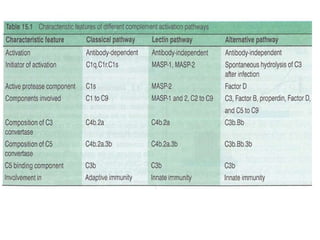
The complement activation occurs via three pathways:
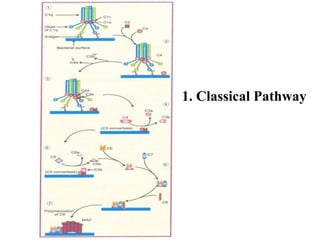
1.Classical pathway
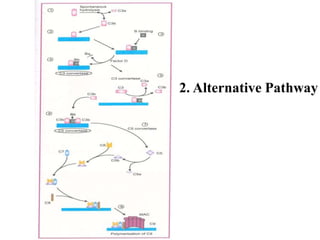
2.Alternative pathway
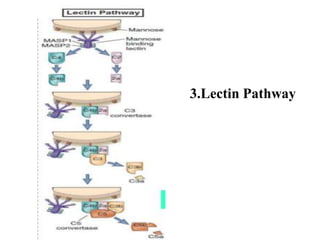
3.Lectin pathway (or mannose binding lectin pathway)
1. Classical Pathway
2. Alternative Pathway
3.Lectin Pathway
Functions of Complements
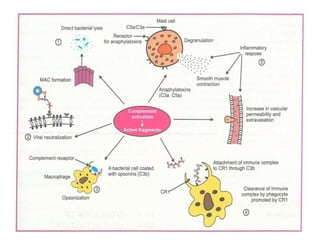
1.Opsonization and phagocytosis
C3b, bound to immune complex or coated on the surface of pathogen,
activate phagocytic cells. These proteins bind to specific receptors on the
phagocytic cells to get engulfed.
2.Cell lysis
Membrane attack complex formed by C5b6789 components ruptures the
microbial cell surface which kills the cell.
3.Chemotaxis
Complement fragments attract neutrophils and macrophages to the area
where the antigen is present. These cell surfaces have receptors for
complements like C5a, C3a .Thus, run towards the site of inflammation,
i.e. chemotaxis.
4.Production of antibodies
B cells have receptor for C3b. When C3b binds to B-cell, it secretes more
antibodies. Thus C3b is also an antibody producing amplifiers which
converts it into an effective defense mechanism to destroy invading
microorganism.
5.Immune clearance
The complement system removes immune complexes from circulating and
deposits them in the spleen and liver. Thus it acts as anti-inflammatory
function. Complement proteins promote the solubilization of these
complexes and their clearance by phagocytes.
6.Activation of mast cells and basophils and enhancement
of inflammation
The proteolytic complement fragments C5a, C4a, and C3a induce acute
inflammation by activating mast cells and neutrophils. All three peptides
bind to mast cells and induce degranulation, with the release of vasoactive
mediators such as histamine. These peptides are also called anaphylatoxins
because the mast cell reactions they trigger are characteristic of anaphylaxis.
Binding to specific complement receptors on cells of the immune system,
they trigger specific cell functions, inflammation, and secretion of
immunoregulatory molecules.
Complement regulation
The complement system has the potential to be extremely
damaging to host tissues, hence regulatory mechanisms
are required to restrict the complement pathway. Various
plasma and cell membrane proteins regulate complement
activation by inhibiting different steps in the cascade.
Several mechanisms exist to prevent uncontrolled
activation of complement system.
1. Passive mechanism of regulation
2. Active mechanism of regulation.
Complement related Diseases
Diseases associated with complements can be due to the deficiencies
in any of the protein components or in regulatory components.
Some examples of complement protein deficiencies are:
• Deficiency of C2 and C4 can cause systemic lupus erythematosus;
deficiency of C3 and factor D can cause pyogenic bacterial
infection; and deficiency of C5-C9 (or MAC deficiency) may lead
to the Neisserial infections like, gonorrhea and meningitis.
• Deficiencies of regulatory proteins lead to too much activation of
complements in wrong time and place which leads to unwanted
inflammation and cell lysis. Pyogenic bacterial infection and
glomerulonephritis are the results of such deficiencies.
• Mutations in the complement regulators factors may lead to
atypical hemolytic uremic syndrome, age-related macular
degeneration, hereditary angioedema etc.
• Complement system can also be stimulated by abnormal stimuli
like persistent microbes, antibody against self antigens or immune
complexes deposited in tissues. Even when the system is properly
regulated and activated, it can cause significant tissue damage.
SUMMARY
Complement system comprises of group of serum
proteins that complement the action of antibody leading
to a cascade of reactions that occurs on the surface of
pathogen and generate active components with various
effector functions.
Complement system is activated by three pathways
namely classical , alternative and lectin pathway.
Complement system participate in both innate and
adaptive immunity.
CONCLUSION
The complement system plays a vital role in enhancing
the ability of antibodies and phagocytic cells to clear
pathogens and damaged cells from the host body.
Deficiency of complement factors may lead to
complement associated diseases, on the contrary
regulation of complement activation is also necessary to
avoid damage to host tissues and normal functioning of
the immune system.
REFERENCES
• Owen.J.A , Punt.J , Strandford.S.A and Jones.P.P,[2013],
Kuby-Immunology, 7th Edn , W.H.Freeman and company.
New York,Pp-692
• Male.D and Brostoff.J, Immunology, 8th Edn, published
by Dianne zark International Pvt Ltd,Pp-455
• Rabson.A , Ivan.M.R , Delves.P.J. Medical Immunology,
2nd Edn, Blackwell publishers. USA,Pp-213
• Javetz , Melnick and Adelberg’s [2013] Medical
Microbiology,26th Edn, McGrawHill publications.Pp-823
• Murphy.K and Weaver.C, Immunology 9th Edn,
Published by Garland science Taylor .New York, Pp-855

Complement system

  • 1.
    DAVANGERE UNIVERSITY SEMINAR ONTHE TOPIC: COMPLEMENT PATHWAYS SUBMITTED BY : Ponnanna. M.B M.Sc. Microbiology.
  • 2.
    CONTENTS 1. Introduction 2. History 3.Components of complement 4. Complement activation 5. Functions of complements 6. Complement regulation 7. Complement related diseases 8. Summary 9. Conclusion 10. References
  • 3.
    INTRODUCTION The complement systemis a part of the immune system, consists of a series of proteins that interact with one another in a highly regulated manner in order to eliminate pathogens and fight infections. It helps antibodies and phagocytic cells to clear pathogens and damaged cells, promote inflammation and attack pathogen’s plasma membrane. Proteins that take part in the complement system are called complements. They collectively work as a biological cascade and sequence of reactions, each being the catalyst for the next. Complement activation is triggered by an antibody when it is bound to the antigen. It can also be triggered by some components of innate immunity. Thus the complement system works in both innate and adaptive immunity.
  • 4.
    HISTORY • Research oncomplement began in the 1890s , when Jules Bordet showed that ,sheep antiserum to the bacterium Vibrio cholerae caused lysis of the bacteria. And on heating the antiserum, it destroyed its bacteriolytic activity. But the ability to lyse the bacteria was restored to the heated serum by adding fresh serum that contained no antibodies. • Paul Ehrlich in Berlin independently carried out similar experiments and coined the term complement, defining it as “the activity of blood serum that completes the action of antibody”. In further years, researchers discovered that action of complement was the result of interactions of a large and complex group of proteins.
  • 5.
    Components of Complement Thesoluble proteins and glycoproteins that constitute complement system are synthesized mainly by liver hepatocytes ,however significant amount are produced by blood monocytes ,tissue macrophages and epithelial cells of GI tract. More than 20 types of complements are present in serum, found circulating normally in human body in inactive forms (called as zymogens or proenzymes). Complements are mainly denoted by the capital letter C with numbers like: C1,C2,C3 and so on. Some have only alphabets like B, D. Some are simply represented by names like homologous restriction factor. C1 has three sub-units C1q, C1r ,C1s and C2,C3,C4,C5 have two components a and b. Larger subunits are denoted by ‘b’ which binds to target near site of activation. Whereas the smaller subunits are denoted by ‘a’ (except C2a which is larger than C2b) which initiate localized inflammatory response by binding to specific receptors.
  • 6.
    Complement Activation The complementactivation occurs via three pathways: 1.Classical pathway 2.Alternative pathway 3.Lectin pathway (or mannose binding lectin pathway)
  • 7.
  • 8.
  • 9.
  • 11.
    Functions of Complements 1.Opsonizationand phagocytosis C3b, bound to immune complex or coated on the surface of pathogen, activate phagocytic cells. These proteins bind to specific receptors on the phagocytic cells to get engulfed. 2.Cell lysis Membrane attack complex formed by C5b6789 components ruptures the microbial cell surface which kills the cell. 3.Chemotaxis Complement fragments attract neutrophils and macrophages to the area where the antigen is present. These cell surfaces have receptors for complements like C5a, C3a .Thus, run towards the site of inflammation, i.e. chemotaxis. 4.Production of antibodies B cells have receptor for C3b. When C3b binds to B-cell, it secretes more antibodies. Thus C3b is also an antibody producing amplifiers which converts it into an effective defense mechanism to destroy invading microorganism.
  • 12.
    5.Immune clearance The complementsystem removes immune complexes from circulating and deposits them in the spleen and liver. Thus it acts as anti-inflammatory function. Complement proteins promote the solubilization of these complexes and their clearance by phagocytes. 6.Activation of mast cells and basophils and enhancement of inflammation The proteolytic complement fragments C5a, C4a, and C3a induce acute inflammation by activating mast cells and neutrophils. All three peptides bind to mast cells and induce degranulation, with the release of vasoactive mediators such as histamine. These peptides are also called anaphylatoxins because the mast cell reactions they trigger are characteristic of anaphylaxis. Binding to specific complement receptors on cells of the immune system, they trigger specific cell functions, inflammation, and secretion of immunoregulatory molecules.
  • 14.
    Complement regulation The complementsystem has the potential to be extremely damaging to host tissues, hence regulatory mechanisms are required to restrict the complement pathway. Various plasma and cell membrane proteins regulate complement activation by inhibiting different steps in the cascade. Several mechanisms exist to prevent uncontrolled activation of complement system. 1. Passive mechanism of regulation 2. Active mechanism of regulation.
  • 15.
    Complement related Diseases Diseasesassociated with complements can be due to the deficiencies in any of the protein components or in regulatory components. Some examples of complement protein deficiencies are: • Deficiency of C2 and C4 can cause systemic lupus erythematosus; deficiency of C3 and factor D can cause pyogenic bacterial infection; and deficiency of C5-C9 (or MAC deficiency) may lead to the Neisserial infections like, gonorrhea and meningitis. • Deficiencies of regulatory proteins lead to too much activation of complements in wrong time and place which leads to unwanted inflammation and cell lysis. Pyogenic bacterial infection and glomerulonephritis are the results of such deficiencies. • Mutations in the complement regulators factors may lead to atypical hemolytic uremic syndrome, age-related macular degeneration, hereditary angioedema etc. • Complement system can also be stimulated by abnormal stimuli like persistent microbes, antibody against self antigens or immune complexes deposited in tissues. Even when the system is properly regulated and activated, it can cause significant tissue damage.
  • 16.
    SUMMARY Complement system comprisesof group of serum proteins that complement the action of antibody leading to a cascade of reactions that occurs on the surface of pathogen and generate active components with various effector functions. Complement system is activated by three pathways namely classical , alternative and lectin pathway. Complement system participate in both innate and adaptive immunity.
  • 17.
    CONCLUSION The complement systemplays a vital role in enhancing the ability of antibodies and phagocytic cells to clear pathogens and damaged cells from the host body. Deficiency of complement factors may lead to complement associated diseases, on the contrary regulation of complement activation is also necessary to avoid damage to host tissues and normal functioning of the immune system.
  • 18.
    REFERENCES • Owen.J.A ,Punt.J , Strandford.S.A and Jones.P.P,[2013], Kuby-Immunology, 7th Edn , W.H.Freeman and company. New York,Pp-692 • Male.D and Brostoff.J, Immunology, 8th Edn, published by Dianne zark International Pvt Ltd,Pp-455 • Rabson.A , Ivan.M.R , Delves.P.J. Medical Immunology, 2nd Edn, Blackwell publishers. USA,Pp-213 • Javetz , Melnick and Adelberg’s [2013] Medical Microbiology,26th Edn, McGrawHill publications.Pp-823 • Murphy.K and Weaver.C, Immunology 9th Edn, Published by Garland science Taylor .New York, Pp-855