THE COMPLEMENT SYSTEM
(INNATE IMMUNITY)
PRESENTED BY
DR.VAMSHIKRISHNA, MD (H)
What is complement system?
• Complement system consists of series of
proteins which complement or augment the
function of Antibodies and other cells of
innate immunity like Macrophages.
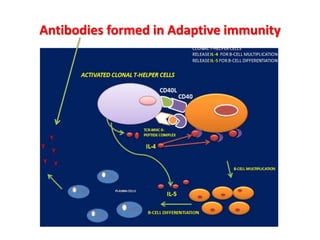
• The complement system can be brought into
action by antibodies generated by
the adaptive immune system.
Antibodies formed in Adaptive immunity
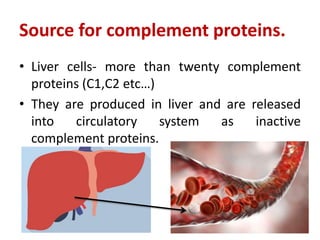
Source for complement proteins.
• Liver cells- more than twenty complement
proteins (C1,C2 etc…)
• They are produced in liver and are released
into circulatory system as inactive
complement proteins.
Other sources for complement proteins
productions:
- Macrophages,
- Complement Protein 1 – C1- produced by GIT
mucosa.
Function of Complement Proteins.
• It is part of the innate immune system
(Humoral Immunity).
• They Complement the immune system and
the inflammatory function.
Complement Pathways
1- THE CLASSICAL PATHWAY
2- THE ALTERNATIVE PATHWAY
THE CLASSICAL PATHWAY
The classical pathway is initiated by:
- Antibodies (IgM or IgG) binding to the
Pathogen.
- C1 binding to the Fc portion of Antibody
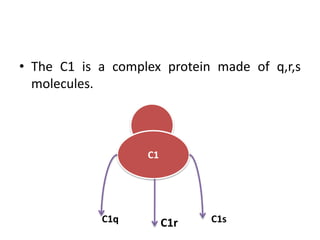
• The C1 is a complex protein made of q,r,s
molecules.
C1
C1q C1r C1s
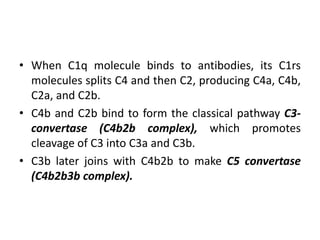
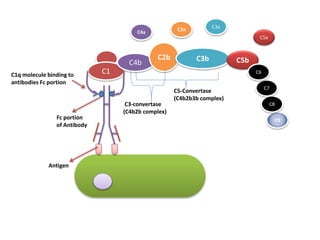
• When C1q molecule binds to antibodies, its C1rs
molecules splits C4 and then C2, producing C4a, C4b,
C2a, and C2b.
• C4b and C2b bind to form the classical pathway C3-
convertase (C4b2b complex), which promotes
cleavage of C3 into C3a and C3b.
• C3b later joins with C4b2b to make C5 convertase
(C4b2b3b complex).
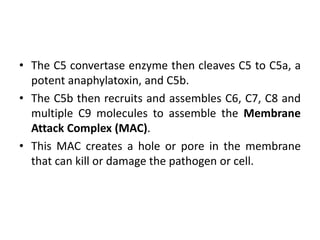
• The C5 convertase enzyme then cleaves C5 to C5a, a
potent anaphylatoxin, and C5b.
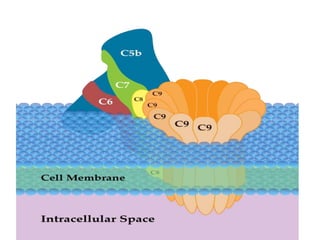
• The C5b then recruits and assembles C6, C7, C8 and
multiple C9 molecules to assemble the Membrane
Attack Complex (MAC).
• This MAC creates a hole or pore in the membrane
that can kill or damage the pathogen or cell.
C1
C4b
C4a
C2b
C2a
C3b
C3a
C3-convertase
(C4b2b complex)
C5-Convertase
(C4b2b3b complex)
C5b
C5a
C9
C8
C7
C6
Fc portion
of Antibody
Antigen
C1q molecule binding to
antibodies Fc portion
C5b
C9C8
C7
C6
C9
c
C9
C
9 C
9
C9
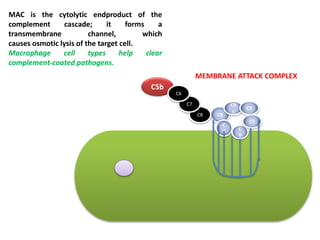
MEMBRANE ATTACK COMPLEX
MAC is the cytolytic endproduct of the
complement cascade; it forms a
transmembrane channel, which
causes osmotic lysis of the target cell.
Macrophage cell types help clear
complement-coated pathogens.
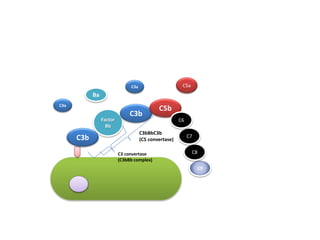
THE ALTERNATIVE PATHWAY
• The alternative pathway does not rely on pathogen-
binding antibodies like the classical pathway.
• In alternative pathway the C3 molecule directly binds
to the antigen of the pathogen and it cleaves to C3b
and C3a.
• The surface-bound C3b may now bind factor B to form
C3bB.
• This complex will be cleaved into Ba and Bb.
• Bb will remain associated with C3b to form C3bBb,
which is the alternative pathway C3 convertase
• Once the alternative C3 convertase enzyme is formed
on a pathogen or cell surface, it may bind covalently
another C3b, to form C3bBbC3b, the C5 convertase.
• This enzyme then cleaves C5 to C5a, a
potent anaphylatoxin, and C5b.
• The C5b then recruits and assembles C6, C7, C8 and
multiple C9 molecules to assemble the Membrane
attack complex (MAC).
• This creates a hole or pore in the membrane that can
kill or damage the pathogen or cell.
C3b
C3a
Factor
Bb
Ba
C3 convertase
(C3bBb complex)
C3b
C3a
C3bBbC3b
(C5 convertase)
C5b
C5a
C9
C8
C7
C6
C5b
C9C8
C7
C6
C9
c
C9
C
9 C
9
C9
MEMBRANE ATTACK COMPLEX
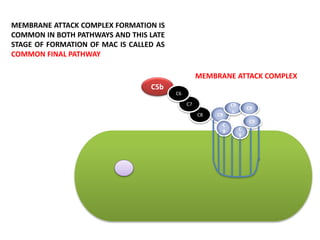
MEMBRANE ATTACK COMPLEX FORMATION IS
COMMON IN BOTH PATHWAYS AND THIS LATE
STAGE OF FORMATION OF MAC IS CALLED AS
COMMON FINAL PATHWAY
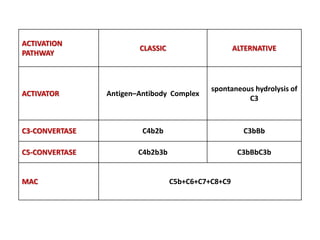
ACTIVATION
PATHWAY
CLASSIC ALTERNATIVE
ACTIVATOR Antigen–Antibody Complex
spontaneous hydrolysis of
C3
C3-CONVERTASE C4b2b C3bBb
C5-CONVERTASE C4b2b3b C3bBbC3b
MAC C5b+C6+C7+C8+C9
• The complement system has the potential to be
extremely damaging to host tissues, meaning its
activation must be tightly regulated.
• The complement system is regulated by complement
control proteins, which are present at a higher
concentration in the blood plasma than the
complement proteins themselves.
REGULATION
• Some complement control proteins are present on
the membranes of self-cells preventing them from
being targeted by complement.
• One example is CD59, also known as protectin, which
inhibits C9 polymerisation during the formation of
the membrane attack complex.
• The classical pathway is inhibited by C1-inhibitor,
which binds to C1 to prevent its activation.
• C3-convertase can be inhibited by Decay accelerating
factor (DAF).
PATHOLOGY OF COMPLEMENT SYSTEM
Complement deficiency:
• Asthma
• Systemic lupus erythematosus
• Glomerulonephritis
• Inflammatory bowel disease
• Rejection of transplanted organs.
• Autoimmune disorders.
• Deficiencies of the terminal pathway predispose to:
• Autoimmune and infections (particularly Neisseria
meningitidis, due to the role that the membrane
attack complex ("MAC") plays in attacking Gram-
negative bacteria).
• Infections with N. meningitidis and N. gonorrhoeae are
the only conditions known to be associated with
deficiencies in the MAC components of complement.
• People with MAC deficiencies experience recurrent
infections with N. meningitidis.
Complement system
Complement system
Complement system
Complement system
Complement system
Complement system
Complement system

Complement system

  • 1.
    THE COMPLEMENT SYSTEM (INNATEIMMUNITY) PRESENTED BY DR.VAMSHIKRISHNA, MD (H)
  • 2.
    What is complementsystem? • Complement system consists of series of proteins which complement or augment the function of Antibodies and other cells of innate immunity like Macrophages. • The complement system can be brought into action by antibodies generated by the adaptive immune system.
  • 3.
    Antibodies formed inAdaptive immunity
  • 4.
    Source for complementproteins. • Liver cells- more than twenty complement proteins (C1,C2 etc…) • They are produced in liver and are released into circulatory system as inactive complement proteins.
  • 5.
    Other sources forcomplement proteins productions: - Macrophages, - Complement Protein 1 – C1- produced by GIT mucosa.
  • 6.
    Function of ComplementProteins. • It is part of the innate immune system (Humoral Immunity). • They Complement the immune system and the inflammatory function.
  • 7.
    Complement Pathways 1- THECLASSICAL PATHWAY 2- THE ALTERNATIVE PATHWAY
  • 8.
    THE CLASSICAL PATHWAY Theclassical pathway is initiated by: - Antibodies (IgM or IgG) binding to the Pathogen. - C1 binding to the Fc portion of Antibody
  • 9.
    • The C1is a complex protein made of q,r,s molecules. C1 C1q C1r C1s
  • 10.
    • When C1qmolecule binds to antibodies, its C1rs molecules splits C4 and then C2, producing C4a, C4b, C2a, and C2b. • C4b and C2b bind to form the classical pathway C3- convertase (C4b2b complex), which promotes cleavage of C3 into C3a and C3b. • C3b later joins with C4b2b to make C5 convertase (C4b2b3b complex).
  • 11.
    • The C5convertase enzyme then cleaves C5 to C5a, a potent anaphylatoxin, and C5b. • The C5b then recruits and assembles C6, C7, C8 and multiple C9 molecules to assemble the Membrane Attack Complex (MAC). • This MAC creates a hole or pore in the membrane that can kill or damage the pathogen or cell.
  • 12.
    C1 C4b C4a C2b C2a C3b C3a C3-convertase (C4b2b complex) C5-Convertase (C4b2b3b complex) C5b C5a C9 C8 C7 C6 Fcportion of Antibody Antigen C1q molecule binding to antibodies Fc portion
  • 13.
    C5b C9C8 C7 C6 C9 c C9 C 9 C 9 C9 MEMBRANE ATTACKCOMPLEX MAC is the cytolytic endproduct of the complement cascade; it forms a transmembrane channel, which causes osmotic lysis of the target cell. Macrophage cell types help clear complement-coated pathogens.
  • 15.
    THE ALTERNATIVE PATHWAY •The alternative pathway does not rely on pathogen- binding antibodies like the classical pathway. • In alternative pathway the C3 molecule directly binds to the antigen of the pathogen and it cleaves to C3b and C3a. • The surface-bound C3b may now bind factor B to form C3bB. • This complex will be cleaved into Ba and Bb. • Bb will remain associated with C3b to form C3bBb, which is the alternative pathway C3 convertase
  • 16.
    • Once thealternative C3 convertase enzyme is formed on a pathogen or cell surface, it may bind covalently another C3b, to form C3bBbC3b, the C5 convertase. • This enzyme then cleaves C5 to C5a, a potent anaphylatoxin, and C5b. • The C5b then recruits and assembles C6, C7, C8 and multiple C9 molecules to assemble the Membrane attack complex (MAC). • This creates a hole or pore in the membrane that can kill or damage the pathogen or cell.
  • 17.
  • 18.
    C5b C9C8 C7 C6 C9 c C9 C 9 C 9 C9 MEMBRANE ATTACKCOMPLEX MEMBRANE ATTACK COMPLEX FORMATION IS COMMON IN BOTH PATHWAYS AND THIS LATE STAGE OF FORMATION OF MAC IS CALLED AS COMMON FINAL PATHWAY
  • 19.
    ACTIVATION PATHWAY CLASSIC ALTERNATIVE ACTIVATOR Antigen–AntibodyComplex spontaneous hydrolysis of C3 C3-CONVERTASE C4b2b C3bBb C5-CONVERTASE C4b2b3b C3bBbC3b MAC C5b+C6+C7+C8+C9
  • 20.
    • The complementsystem has the potential to be extremely damaging to host tissues, meaning its activation must be tightly regulated. • The complement system is regulated by complement control proteins, which are present at a higher concentration in the blood plasma than the complement proteins themselves. REGULATION
  • 21.
    • Some complementcontrol proteins are present on the membranes of self-cells preventing them from being targeted by complement. • One example is CD59, also known as protectin, which inhibits C9 polymerisation during the formation of the membrane attack complex. • The classical pathway is inhibited by C1-inhibitor, which binds to C1 to prevent its activation. • C3-convertase can be inhibited by Decay accelerating factor (DAF).
  • 22.
    PATHOLOGY OF COMPLEMENTSYSTEM Complement deficiency: • Asthma • Systemic lupus erythematosus • Glomerulonephritis • Inflammatory bowel disease • Rejection of transplanted organs. • Autoimmune disorders.
  • 23.
    • Deficiencies ofthe terminal pathway predispose to: • Autoimmune and infections (particularly Neisseria meningitidis, due to the role that the membrane attack complex ("MAC") plays in attacking Gram- negative bacteria). • Infections with N. meningitidis and N. gonorrhoeae are the only conditions known to be associated with deficiencies in the MAC components of complement. • People with MAC deficiencies experience recurrent infections with N. meningitidis.