{let’s get defensive}
Presented by;
Shruti
sharma,
Pharmacology,
2nd sem.
Ⅰ. Definition A
group of low molecular weight polypeptides or proteins which
are secreted by activated immunocytes or some matrix cells and
possess high activity and various functions.
Their major functions are to mediate and regulate immune
response and inflammatory reactions.
Cytokines are produced by lymphocytes known as lymphokines.
where as produced by monocytes or macrophages are called as
monokines.
Peripherally
Mast cell
Glial cell
Monocytes
Macrophages
Lymphocytes
Centrally
Non neurnal cell
Microglia
Astrocytes
Schwan Cells
Release of Cytokines
 Cell growth
 Cell differentiation
 Cell death
 Induce non-
responsiveness to other
cytokines/cells
 Induce responsiveness
to other cytokines/cells
 Induce secretion of
other cytokines
1. Most cytokines are low molecular weight polypeptides or
glycoprotein(8~80 KD), and most of them are monomer.
2. Natural cytokines are secreted
by activated cells
Such as activated immune cells, matrix cells and some
tumor cells.
IL-3,GM-CSF,TNF-
IL-2
IFN-γ,TNF-β
IL-4,6
IL-5
TH1 TH2
 Autocrine
Cytokine binds to receptor on cell that secreted it.
 Paracrine
Cytokine binds to receptors on near by cells.
 Endocrine
Cytokine binds cells in distant parts of the body.
Distance
Autocrine
Endocrine
Blood circulation
Paracrine Nearby
self
Cytokines take effect in
three ways
5.Cytokines initiate their actions by
binding to specific membrane receptors
on target cells.
 Receptors for cytokines
often bind their ligands
with high affinities.
6. The effects of cytokines are often
pleiotropism, redundant, synergy,
antagonism, that form a cytokine network.
Pleiotropism refers to the ability of one cytokine having
multiple effects on diverse cell types.
Redundancy refers to the property of multiple
cytokines having the same or overlapping
functional effects.
Synergy refers to the property of two or more cytokines
having greater than additive effects.
 Antagonism refers to the ability of one
cytokine inhibiting the action of another.
 Interleukin, IL
 Interferon , IFN
 Tumor necrosis factor, TNF
 Colony stimulating factor
 Transforming growth factor
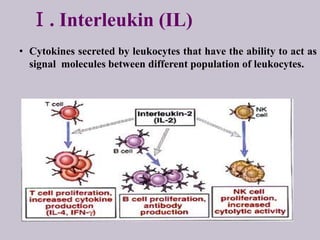
Ⅰ. Interleukin (IL)
• Cytokines secreted by leukocytes that have the ability to act as
signal molecules between different population of leukocytes.
T cell
IL-2
IL-2 gene
B cell
IL-2 Receptor
IL-4
IL-4 Re
IL-4 gene
A group of glycoproteins that produced by human or
animal cells following the infection of virus and
exposure to various inducing agents
_____________________________________
Types Produced cells Main functions
____________________________________
IFN- leukocyte anti-virus,immune regulation
IFN- fibroblast anti-tumor
IFN- Th1,NK weaker anti-virus effect
stronger immune regulation effect
anti-tumor
_____________________________________
 TNFs were originally thought of as selective
antitumour agents, but are now known to
have a multiplicity of actions.
 TNF- is produced mainly by activated
monocytes and macrophages.
 TNF- (lymphotoxin, LT) is produced mainly
by activated Th0 and Th1.
 Cytokines that stimulate proliferation andor
differentiation of pluripotent hematopoietic stem cell
and different progenitors.
 Granulocyte macrophage-CSF(GM-CSF)
 Monocyte-CSF(M-CSF)
 Granulocyte-CSF(G-CSF)
 Stem cell factor(SCF)
 Erythropoietin(EPO)
 Growth-factor are cytokines which stimulate the growth of their
target cells.
 Transforming growth factor- (TGF- )
 Epithelia growth factor(EGF)
 Vascular endothelia cell growth factor(VEGF)
 Fibroblastic growth factor(FGF)
How does overexpression of growth factor
receptor participate in the formation of cancers ?
1. When the receptor molecules are overexpressed, their
high numbers cause them to collide frequently, and these
encounters, like the dimerization events triggered by
ligand binding, can result in trans-phosphorylation,
receptor activation, and signal emission.
2. Alternatively, excessive receptor expression may make
some cancer cells hyper-responsive to the low levels of
growth factors that may be present in their surroundings.
The stepwise progression of cancer and
roles for growth factors
1. Membrane Binding Cytokine Receptors
 Ig- superfamily receptor
 Class 1- hematopoeitin receptor
 Class 2- Interferon receptor
2 . TNF receptor
3. Chemokine receptor
Cytokines
1) Interleuki
a) IL-1
IL-1 alpha
IL-1 beta
b) IL-2
c)IL-4
Receptor
IL-1RI
IL-1R2
IL-2R alpha
IL-2R beta
IL-2R gamma
Agonist
Recombinant
-
IL-1NK^beta
Antagonist
Corticosteroid
FR-167653
Cyclosporine
Tacrolimus
P’cology
Action
1)Inflammation
and fever
2)Phagocyte
activation
3)Hematopoeisis
1)Proliferation
of activated
Tcell
2)Promote NK
and Tc cell
functions
3)Promote Bcell
proliferation
1)Promote Bcell
& Tcell
proliferation
d) IL-7
e) IL-9
2) Tumour
necrosis factor
(TNF)
a) TNF alpha
b) TNF beta
3)Interferon(INF
)
a) INF alpha
b) INF beta
4)TGF beta
TNFR1
TNFR2
TNFR-Rp
INFR-1
TGF beta-1,2,3,4
& 5
Infliximab
RO-452081
CC1069
CC1104
CC1115
1)T & B cell
lymphopoiesis
1)T & B cell
lymphopoiesis
1)Cytotoxicity
2)Apoptosis
3)Septic shock
1)Inhibit viral
replication
2) Anti viral
activity
1)Anti-inflamatory
2)Promote Bcell
expression
3)Prmote fibroblast
proliferation
 Cytokines represent a diverse number of molecules.
 The super family of cytokine receptors more specifically refers
to those cytokines that signal via the Jak-STAT pathway.
 These include Interleukins 2, 3, 4, 5, 6, 7, 9, 11, 12, 13, & 15, and
G-CSF, TNF and the interferons.
 Many growth factor signal pathways cross-communicate with
the STAT pathway.
Initiated by cytokine binding
Activates JAK (Janus kinase)
Phosphorylation of tyrosine
Binding of STAT(Signal transducers and activators of transcription)
Translocation of STAT to cell’s DNA
Transcription of specific target genes
Signal Transduction
Signaling through cytokine receptor
1.Take part in
nonspecific
immunity
2. Take part in
specific
immunity
3. Stimulate
hematopoiesis
4. Take part in
inflammatory
reaction
Role Of Cytokines In various Diseases
1) Neuroinflamatory
a) Neurodegenerative disease – AD, PD, Multiple sclerosis
a) Asthma,COPD (Chronic Obstructive Pulmonary Disease)
2) Respiratory
3) CVS
a) Hypertrophy
b) Ischemia reperfusion Injury
a) Glomerulonephritis
b) Diabetic nephropathy
4) GIT
a) IBD,IBS,ulceritivecolitis
5) Renal
8) Rheumatoid arthritis
6) Liver
a) Viral hepatitis
b) Alcohol hepatitis
7) Fever
IL-1B ;TNF
Therapeutic Uses of Cytokines
1) Interferon in treatment of viral diseases, cancer.
2) Several cytokines are used to enhance T-cell activation in
immunofideficency diseases, e.g. IL-2, IFN- ,TNF- .
3) IL-2 and lymphokine activating killer cells (LAK) in treatment
4) Anti-cytokines in management of autoimmune diseases :
a)- Anti-TNF in treatment rheumatoid arthritis
b)- Anti-IL2R to reduce graft rejection.
5) Anti-TNF antibodies in treating septic shock.
6) Anti-IL-2R in treating adult T-cell leukemia.
7) Anti-IL-4 is under trial for treatment of allergies.
Cytokines

Cytokines

  • 1.
    {let’s get defensive} Presentedby; Shruti sharma, Pharmacology, 2nd sem.
  • 2.
    Ⅰ. Definition A groupof low molecular weight polypeptides or proteins which are secreted by activated immunocytes or some matrix cells and possess high activity and various functions. Their major functions are to mediate and regulate immune response and inflammatory reactions. Cytokines are produced by lymphocytes known as lymphokines. where as produced by monocytes or macrophages are called as monokines.
  • 3.
    Peripherally Mast cell Glial cell Monocytes Macrophages Lymphocytes Centrally Nonneurnal cell Microglia Astrocytes Schwan Cells Release of Cytokines
  • 4.
     Cell growth Cell differentiation  Cell death  Induce non- responsiveness to other cytokines/cells  Induce responsiveness to other cytokines/cells  Induce secretion of other cytokines
  • 6.
    1. Most cytokinesare low molecular weight polypeptides or glycoprotein(8~80 KD), and most of them are monomer.
  • 7.
    2. Natural cytokinesare secreted by activated cells Such as activated immune cells, matrix cells and some tumor cells.
  • 8.
  • 9.
     Autocrine Cytokine bindsto receptor on cell that secreted it.  Paracrine Cytokine binds to receptors on near by cells.  Endocrine Cytokine binds cells in distant parts of the body.
  • 10.
  • 11.
    5.Cytokines initiate theiractions by binding to specific membrane receptors on target cells.  Receptors for cytokines often bind their ligands with high affinities.
  • 12.
    6. The effectsof cytokines are often pleiotropism, redundant, synergy, antagonism, that form a cytokine network. Pleiotropism refers to the ability of one cytokine having multiple effects on diverse cell types.
  • 13.
    Redundancy refers tothe property of multiple cytokines having the same or overlapping functional effects.
  • 14.
    Synergy refers tothe property of two or more cytokines having greater than additive effects.
  • 15.
     Antagonism refersto the ability of one cytokine inhibiting the action of another.
  • 16.
     Interleukin, IL Interferon , IFN  Tumor necrosis factor, TNF  Colony stimulating factor  Transforming growth factor
  • 17.
    Ⅰ. Interleukin (IL) •Cytokines secreted by leukocytes that have the ability to act as signal molecules between different population of leukocytes.
  • 19.
    T cell IL-2 IL-2 gene Bcell IL-2 Receptor IL-4 IL-4 Re IL-4 gene
  • 20.
    A group ofglycoproteins that produced by human or animal cells following the infection of virus and exposure to various inducing agents
  • 21.
    _____________________________________ Types Produced cellsMain functions ____________________________________ IFN- leukocyte anti-virus,immune regulation IFN- fibroblast anti-tumor IFN- Th1,NK weaker anti-virus effect stronger immune regulation effect anti-tumor _____________________________________
  • 23.
     TNFs wereoriginally thought of as selective antitumour agents, but are now known to have a multiplicity of actions.  TNF- is produced mainly by activated monocytes and macrophages.  TNF- (lymphotoxin, LT) is produced mainly by activated Th0 and Th1.
  • 25.
     Cytokines thatstimulate proliferation andor differentiation of pluripotent hematopoietic stem cell and different progenitors.  Granulocyte macrophage-CSF(GM-CSF)  Monocyte-CSF(M-CSF)  Granulocyte-CSF(G-CSF)  Stem cell factor(SCF)  Erythropoietin(EPO)
  • 27.
     Growth-factor arecytokines which stimulate the growth of their target cells.  Transforming growth factor- (TGF- )  Epithelia growth factor(EGF)  Vascular endothelia cell growth factor(VEGF)  Fibroblastic growth factor(FGF)
  • 28.
    How does overexpressionof growth factor receptor participate in the formation of cancers ? 1. When the receptor molecules are overexpressed, their high numbers cause them to collide frequently, and these encounters, like the dimerization events triggered by ligand binding, can result in trans-phosphorylation, receptor activation, and signal emission. 2. Alternatively, excessive receptor expression may make some cancer cells hyper-responsive to the low levels of growth factors that may be present in their surroundings.
  • 29.
    The stepwise progressionof cancer and roles for growth factors
  • 30.
    1. Membrane BindingCytokine Receptors  Ig- superfamily receptor  Class 1- hematopoeitin receptor  Class 2- Interferon receptor 2 . TNF receptor 3. Chemokine receptor
  • 36.
    Cytokines 1) Interleuki a) IL-1 IL-1alpha IL-1 beta b) IL-2 c)IL-4 Receptor IL-1RI IL-1R2 IL-2R alpha IL-2R beta IL-2R gamma Agonist Recombinant - IL-1NK^beta Antagonist Corticosteroid FR-167653 Cyclosporine Tacrolimus P’cology Action 1)Inflammation and fever 2)Phagocyte activation 3)Hematopoeisis 1)Proliferation of activated Tcell 2)Promote NK and Tc cell functions 3)Promote Bcell proliferation 1)Promote Bcell & Tcell proliferation
  • 37.
    d) IL-7 e) IL-9 2)Tumour necrosis factor (TNF) a) TNF alpha b) TNF beta 3)Interferon(INF ) a) INF alpha b) INF beta 4)TGF beta TNFR1 TNFR2 TNFR-Rp INFR-1 TGF beta-1,2,3,4 & 5 Infliximab RO-452081 CC1069 CC1104 CC1115 1)T & B cell lymphopoiesis 1)T & B cell lymphopoiesis 1)Cytotoxicity 2)Apoptosis 3)Septic shock 1)Inhibit viral replication 2) Anti viral activity 1)Anti-inflamatory 2)Promote Bcell expression 3)Prmote fibroblast proliferation
  • 38.
     Cytokines representa diverse number of molecules.  The super family of cytokine receptors more specifically refers to those cytokines that signal via the Jak-STAT pathway.  These include Interleukins 2, 3, 4, 5, 6, 7, 9, 11, 12, 13, & 15, and G-CSF, TNF and the interferons.  Many growth factor signal pathways cross-communicate with the STAT pathway.
  • 39.
    Initiated by cytokinebinding Activates JAK (Janus kinase) Phosphorylation of tyrosine Binding of STAT(Signal transducers and activators of transcription) Translocation of STAT to cell’s DNA Transcription of specific target genes Signal Transduction
  • 40.
  • 42.
    1.Take part in nonspecific immunity 2.Take part in specific immunity 3. Stimulate hematopoiesis 4. Take part in inflammatory reaction
  • 43.
    Role Of CytokinesIn various Diseases 1) Neuroinflamatory a) Neurodegenerative disease – AD, PD, Multiple sclerosis a) Asthma,COPD (Chronic Obstructive Pulmonary Disease) 2) Respiratory 3) CVS a) Hypertrophy b) Ischemia reperfusion Injury a) Glomerulonephritis b) Diabetic nephropathy 4) GIT a) IBD,IBS,ulceritivecolitis 5) Renal 8) Rheumatoid arthritis 6) Liver a) Viral hepatitis b) Alcohol hepatitis 7) Fever IL-1B ;TNF
  • 45.
    Therapeutic Uses ofCytokines 1) Interferon in treatment of viral diseases, cancer. 2) Several cytokines are used to enhance T-cell activation in immunofideficency diseases, e.g. IL-2, IFN- ,TNF- . 3) IL-2 and lymphokine activating killer cells (LAK) in treatment 4) Anti-cytokines in management of autoimmune diseases : a)- Anti-TNF in treatment rheumatoid arthritis b)- Anti-IL2R to reduce graft rejection. 5) Anti-TNF antibodies in treating septic shock. 6) Anti-IL-2R in treating adult T-cell leukemia. 7) Anti-IL-4 is under trial for treatment of allergies.