Nucleus and its components
-SYED MASOOD
NUCLEUS:
 It is a specialized double membrane
bounded protoplasmic body which
contains all the genetic information for
controlling cellular metabolism.
 Nucleus was first observed by a Dutch
scientist, Anton van Leeuwenhoek, in
RBCs of fish.
NUCLEUS:
 But it was first described by a Scotch
botanist, Robert Brown(1831), in Orchid
cells.
 J. Hammerling (1934) shows in
Acetabularia (a green alga) that shape and
other characters are controlled by the
nucleus of the cell, so nucleus is
storehouse of genetic informations.
OCCURANCE:
 A true nucleus is present in all the
eukaryotes except the mammalian
RBCs, sieve-tube cells of phloem,
vessels of xylem.
 There is incipient nucleus, called
nucleoid or genophore, in the
prokaryotes like bacteria, blue-green
algae and mycoplasmas.
POSITION:
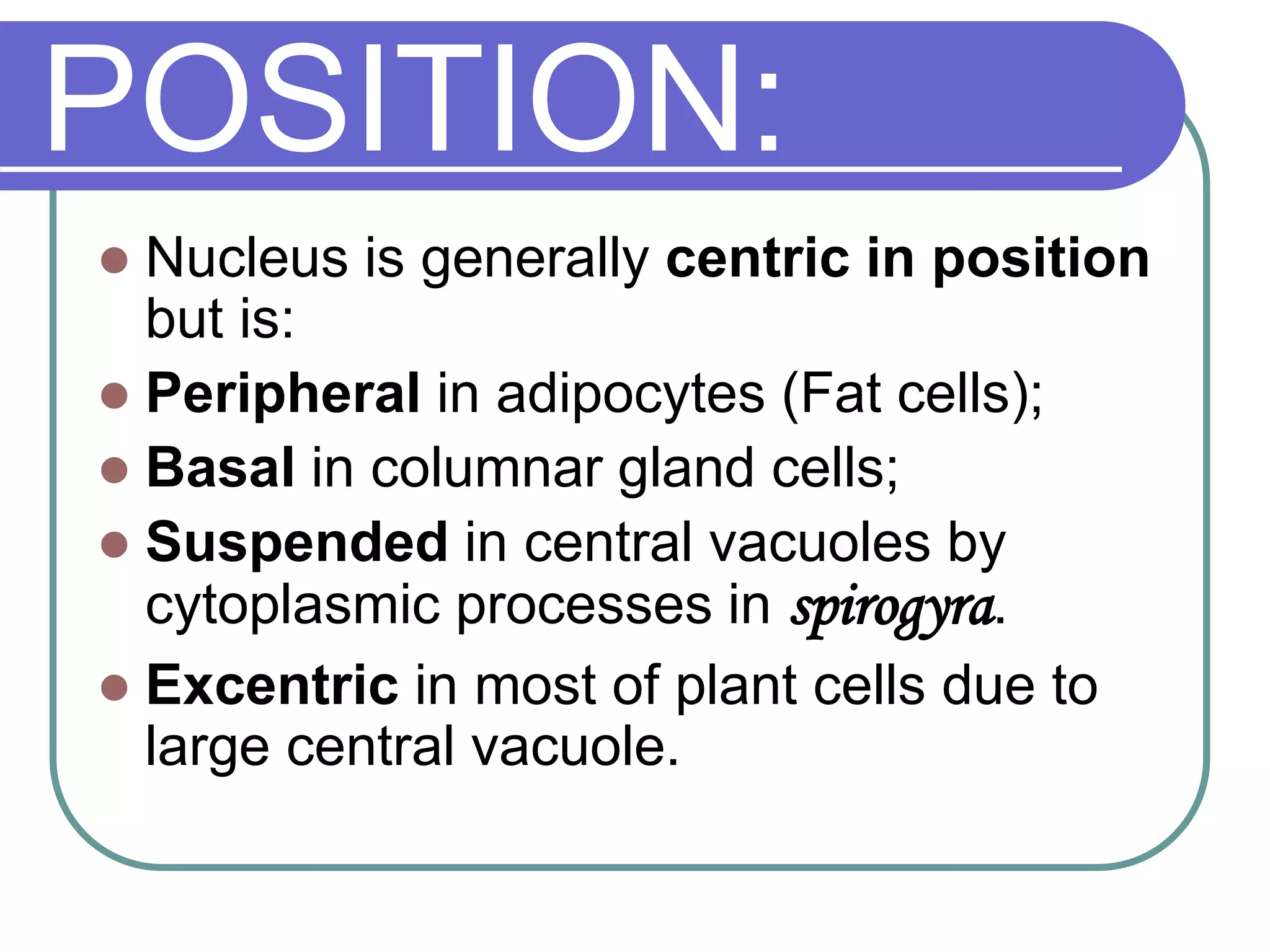
 Nucleus is generally centric in position
but is:
 Peripheral in adipocytes (Fat cells);
 Basal in columnar gland cells;
 Suspended in central vacuoles by
cytoplasmic processes in spirogyra.
 Excentric in most of plant cells due to
large central vacuole.
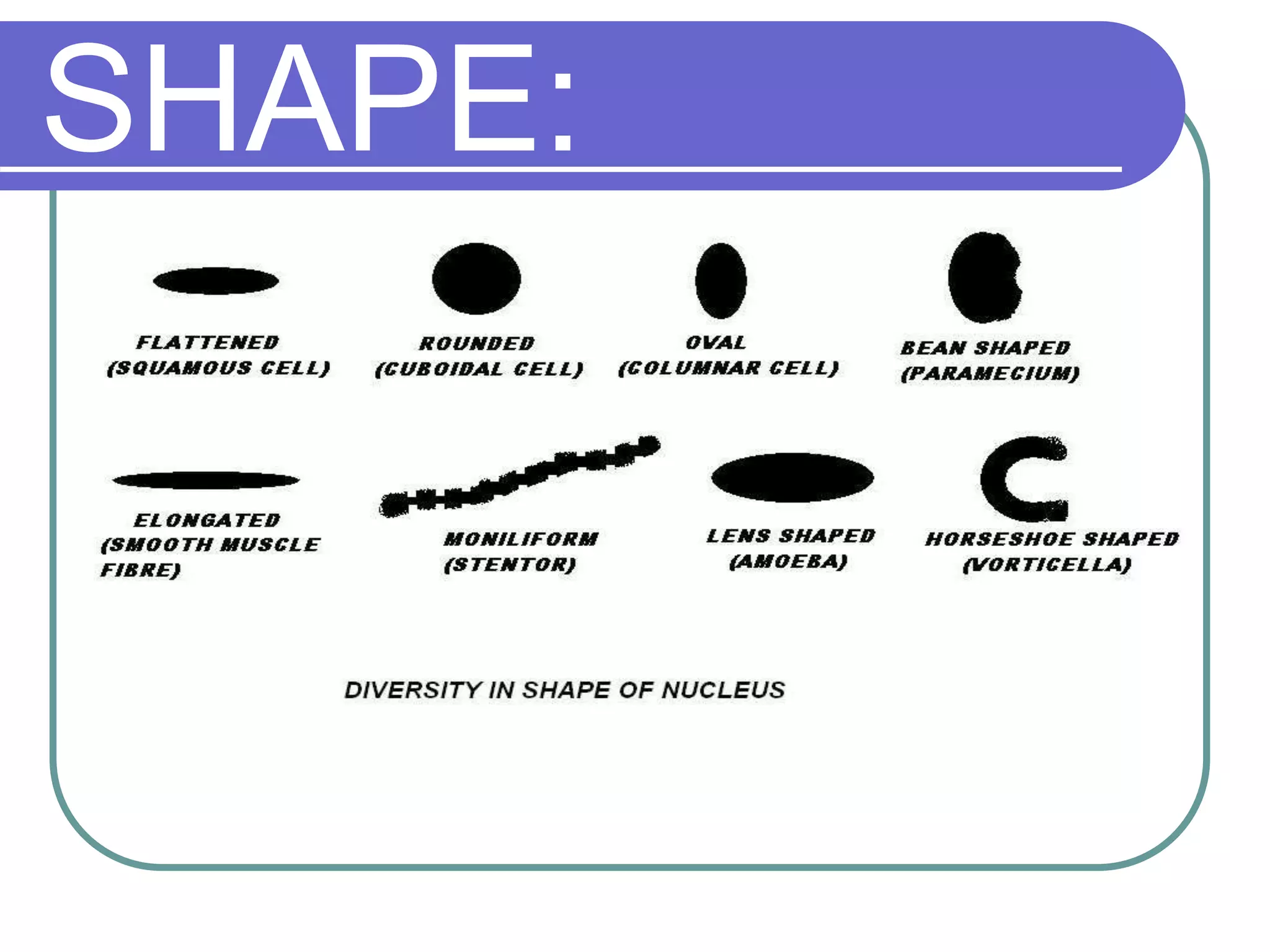
SHAPE:
SIZE:
 Size of a nucleus depends on:
I. Nucleo-cytoplasmic Index (NP): ratio
b/w the size of the nucleus and
amount of cytoplasm.
II. Number of Chromosomes.
BIOCHEMICAL ANALYSIS:
 DNA------------------------------9-12%
 RNA------------------------------5%
 Lipids-----------------------------3%
 Basic Proteins-----------------15%
 Acid Proteins,
neutral Proteins and
enzymes---------------------------65%
ULTRASTRUCTURE:
 The nucleus is formed of 4
components:
A. Nuclear envelop
B. Nucleolus
C. Nuclear sap
D. Nuclear Chromatin
ULTRASTRUCTURE:
NUCLEOLUS:
 Under a microscope, the nucleus looks
like a dark blob, with a darker region,
called the nucleolus, centered within it.
 The nucleolus is the site where the
subunits of ribosomes are manufactured.
 First observed by Fontana (1781).
NUCLEOLUS:
 Term Nucleolus was coined by
Bowmann (1840).
 While its light microscope structure was
given by Wanger (1840).
 Its ultrastructure was given by De
Robertis et. al. (1971).
NUCLEOLUS:
 In some cells, it is found attached to
nuclear membrane. It is absent in certain
types. e.g. sperm cells and muscle
fibres.
NUCLEAR ENVELOP:
 Surrounding the nucleus is a double
membrane called the nuclear envelope.
The nuclear envelope is studded all over
with tiny openings called nuclear pores.
 The nuclear envelop separates the
nucleoplasm and cytoplasm.
NUCLEAR ENVELOP:
 The nuclear envelop is a bilayered
envelop formed of following parts:
Nuclear membranes.
Perinuclear space. (Cohn, 1970)
Nuclear pores. (Callan & Tomlin 1950)
CHROMATIN:
 It is a darkly stained network of long and
fine threads, called chromatin fibres,
suspended in most of the nucleoplasm of
the interphase nucleus. It was first
reported by W. Flemming (1879).
CHROMATIN:
 Chromatins are of two types:
Heterochromatin.
Euchromatin.
CHROMATIN:
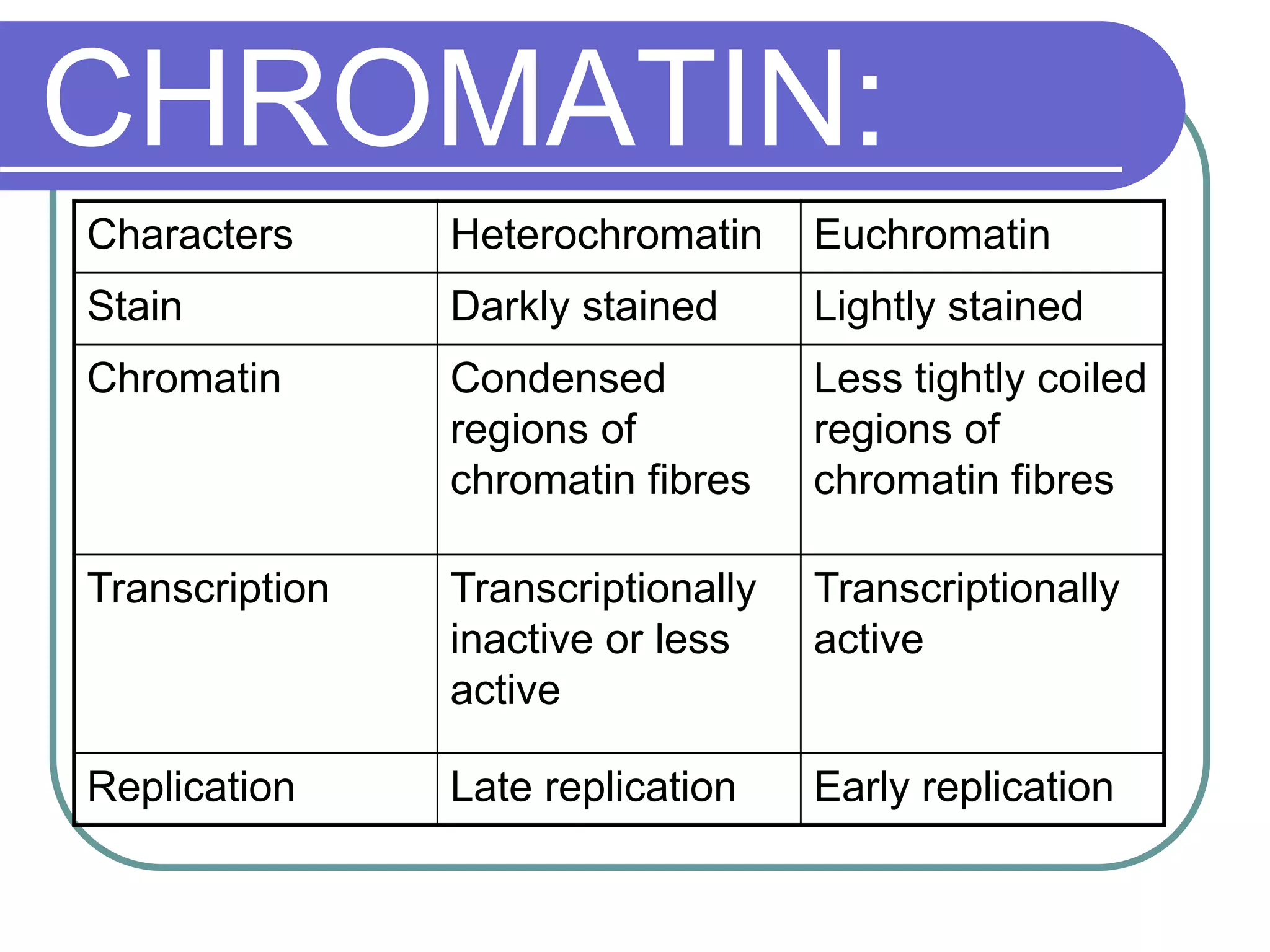
Characters Heterochromatin Euchromatin
Stain Darkly stained Lightly stained
Chromatin Condensed
regions of
chromatin fibres
Less tightly coiled
regions of
chromatin fibres
Transcription Transcriptionally
inactive or less
active
Transcriptionally
active
Replication Late replication Early replication

Nucleus and Chromatin.ppt

  • 1.
    Nucleus and itscomponents -SYED MASOOD
  • 2.
    NUCLEUS:  It isa specialized double membrane bounded protoplasmic body which contains all the genetic information for controlling cellular metabolism.  Nucleus was first observed by a Dutch scientist, Anton van Leeuwenhoek, in RBCs of fish.
  • 3.
    NUCLEUS:  But itwas first described by a Scotch botanist, Robert Brown(1831), in Orchid cells.  J. Hammerling (1934) shows in Acetabularia (a green alga) that shape and other characters are controlled by the nucleus of the cell, so nucleus is storehouse of genetic informations.
  • 4.
    OCCURANCE:  A truenucleus is present in all the eukaryotes except the mammalian RBCs, sieve-tube cells of phloem, vessels of xylem.  There is incipient nucleus, called nucleoid or genophore, in the prokaryotes like bacteria, blue-green algae and mycoplasmas.
  • 5.
    POSITION:  Nucleus isgenerally centric in position but is:  Peripheral in adipocytes (Fat cells);  Basal in columnar gland cells;  Suspended in central vacuoles by cytoplasmic processes in spirogyra.  Excentric in most of plant cells due to large central vacuole.
  • 6.
  • 7.
    SIZE:  Size ofa nucleus depends on: I. Nucleo-cytoplasmic Index (NP): ratio b/w the size of the nucleus and amount of cytoplasm. II. Number of Chromosomes.
  • 8.
    BIOCHEMICAL ANALYSIS:  DNA------------------------------9-12% RNA------------------------------5%  Lipids-----------------------------3%  Basic Proteins-----------------15%  Acid Proteins, neutral Proteins and enzymes---------------------------65%
  • 9.
    ULTRASTRUCTURE:  The nucleusis formed of 4 components: A. Nuclear envelop B. Nucleolus C. Nuclear sap D. Nuclear Chromatin
  • 10.
  • 11.
    NUCLEOLUS:  Under amicroscope, the nucleus looks like a dark blob, with a darker region, called the nucleolus, centered within it.  The nucleolus is the site where the subunits of ribosomes are manufactured.  First observed by Fontana (1781).
  • 12.
    NUCLEOLUS:  Term Nucleoluswas coined by Bowmann (1840).  While its light microscope structure was given by Wanger (1840).  Its ultrastructure was given by De Robertis et. al. (1971).
  • 13.
    NUCLEOLUS:  In somecells, it is found attached to nuclear membrane. It is absent in certain types. e.g. sperm cells and muscle fibres.
  • 14.
    NUCLEAR ENVELOP:  Surroundingthe nucleus is a double membrane called the nuclear envelope. The nuclear envelope is studded all over with tiny openings called nuclear pores.  The nuclear envelop separates the nucleoplasm and cytoplasm.
  • 15.
    NUCLEAR ENVELOP:  Thenuclear envelop is a bilayered envelop formed of following parts: Nuclear membranes. Perinuclear space. (Cohn, 1970) Nuclear pores. (Callan & Tomlin 1950)
  • 16.
    CHROMATIN:  It isa darkly stained network of long and fine threads, called chromatin fibres, suspended in most of the nucleoplasm of the interphase nucleus. It was first reported by W. Flemming (1879).
  • 17.
    CHROMATIN:  Chromatins areof two types: Heterochromatin. Euchromatin.
  • 18.
    CHROMATIN: Characters Heterochromatin Euchromatin StainDarkly stained Lightly stained Chromatin Condensed regions of chromatin fibres Less tightly coiled regions of chromatin fibres Transcription Transcriptionally inactive or less active Transcriptionally active Replication Late replication Early replication