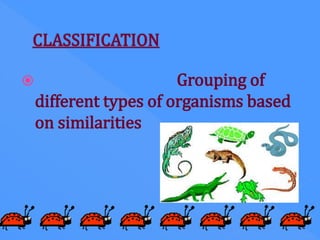
 Grouping of
different types of organisms based
on similarities
Branch of biology
that deals with
classification of
living things
 Carl Linnaeus classified the living world as plant
kingdom and animal kingdom
 Carl Linnaeus suggested different levels of
classification on the basis of similarities and
differences and devised the system of naming each
organism scientifically .
 Hence he is considered the father of scientific
classification
 PLANT KINGDOM  ANIMAL KINGDOM
 All plants are included in the Kingdom Plantae
 Plants vary greatly in form and size. The body is
usually asymmetrical. In higher forms of plants
structures like leaves and plants have a definite
form and shape
 Multicellular organisms which do not have the
power the locomotion
 Nutrition in plants is usually autotrophic.
 The body of the plant is composed of cells. All the
cells of the plant body have a distinct cell wall and
nucleus
 Plants have reserve food as starch
 Plants grow throughout their life span
 All animals are included in this kingdom
 Body of animals exhibits a definite symmetry ,
form and shape.
 Animals can move from one place to another.
 Animal body is also made up of cells, the cells, the
cells do not have the cell wall.
 Animals cannot prepare food by themselves hence
they are heterotrophic
 Carl Linnaeus[1700’s]
 All organisms are
divided into seven
levels of classification
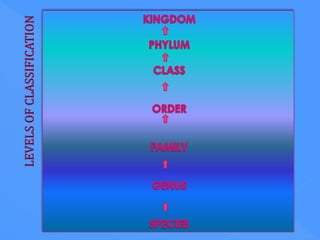
 These are the seven levels in the classification of
plants and animals
 Each kingdom is classified in to many phylum's
and each phylum is classified in to many classes
 In Animal kingdom each class is divided in to many
series
 But in plant kingdom each class is divided in to
many series
 The order of each animal kingdom series of each
plant kingdom is divided in to many families
 Each family is divided in to many Genus and each
genus is divided in to many species
 The basic unit of classification is species.
 One kind of organisms that can mate with each
other and produce fertile offspring.
 The members of organisms of two different species
cannot interbreed.
 The off spring produced in interspecific breeding
may be fertile.
 Eg; tiger-a species named tigris
 Closely related species are united to
form genus
 EG:- Panthera [ lion , tiger , cheetah ]
 Group of similar genera constitute a family
 EG:- Felidae [ cheetah ,lion , tiger ]
 Similar families are grouped into order
Eg:- Carnivore [ flesh eating animals in mammalian]
 Similar orders are grouped in to
class
Eg:-Mammalia [ those who give birth to young ones
and feed them with milk ]
 Similar classes are grouped under next category
called phylum
 Eg:- chordata [ animals having vertebral column ]
 Kingdom represents the highest category in which
all similar phyla are grouped in to order
 EG : - Animalia , plantae
 Living organism are numerous and highly
diversified in their character.
 These organisms are classified into different
groups for better approach and understanding
 Carolus Linnaeus classified the living organism in
systematic manner.
 This kingdom of classification laid the base for
modern classification and was quite a reasonable
at that period of time ,plants and animals could be
quite easily distinguished.
 Dr.B.B.Arora and A.K Sabharwal [2010]: a text book
of biology std : XII , Modem publication
 Dr.E.Valsala kumar [2004] : A text book of botany
and zoology , Trivandrum publications
 Kumar Pushkar and Dr. A.P Singh[2011]: A
textbook of CSIR –UGC Life science , Upakar
publications.
Powepoint presentation on classification

Powepoint presentation on classification

  • 3.
     Grouping of differenttypes of organisms based on similarities
  • 4.
    Branch of biology thatdeals with classification of living things
  • 5.
     Carl Linnaeusclassified the living world as plant kingdom and animal kingdom  Carl Linnaeus suggested different levels of classification on the basis of similarities and differences and devised the system of naming each organism scientifically .  Hence he is considered the father of scientific classification
  • 6.
     PLANT KINGDOM ANIMAL KINGDOM
  • 7.
     All plantsare included in the Kingdom Plantae  Plants vary greatly in form and size. The body is usually asymmetrical. In higher forms of plants structures like leaves and plants have a definite form and shape  Multicellular organisms which do not have the power the locomotion
  • 8.
     Nutrition inplants is usually autotrophic.  The body of the plant is composed of cells. All the cells of the plant body have a distinct cell wall and nucleus  Plants have reserve food as starch  Plants grow throughout their life span
  • 9.
     All animalsare included in this kingdom  Body of animals exhibits a definite symmetry , form and shape.  Animals can move from one place to another.  Animal body is also made up of cells, the cells, the cells do not have the cell wall.  Animals cannot prepare food by themselves hence they are heterotrophic
  • 10.
     Carl Linnaeus[1700’s] All organisms are divided into seven levels of classification
  • 12.
     These arethe seven levels in the classification of plants and animals  Each kingdom is classified in to many phylum's and each phylum is classified in to many classes  In Animal kingdom each class is divided in to many series  But in plant kingdom each class is divided in to many series
  • 13.
     The orderof each animal kingdom series of each plant kingdom is divided in to many families  Each family is divided in to many Genus and each genus is divided in to many species
  • 14.
     The basicunit of classification is species.  One kind of organisms that can mate with each other and produce fertile offspring.  The members of organisms of two different species cannot interbreed.  The off spring produced in interspecific breeding may be fertile.  Eg; tiger-a species named tigris
  • 15.
     Closely relatedspecies are united to form genus  EG:- Panthera [ lion , tiger , cheetah ]
  • 17.
     Group ofsimilar genera constitute a family  EG:- Felidae [ cheetah ,lion , tiger ]
  • 19.
     Similar familiesare grouped into order Eg:- Carnivore [ flesh eating animals in mammalian]
  • 21.
     Similar ordersare grouped in to class Eg:-Mammalia [ those who give birth to young ones and feed them with milk ]
  • 23.
     Similar classesare grouped under next category called phylum  Eg:- chordata [ animals having vertebral column ]
  • 25.
     Kingdom representsthe highest category in which all similar phyla are grouped in to order  EG : - Animalia , plantae
  • 26.
     Living organismare numerous and highly diversified in their character.  These organisms are classified into different groups for better approach and understanding  Carolus Linnaeus classified the living organism in systematic manner.  This kingdom of classification laid the base for modern classification and was quite a reasonable at that period of time ,plants and animals could be quite easily distinguished.
  • 27.
     Dr.B.B.Arora andA.K Sabharwal [2010]: a text book of biology std : XII , Modem publication  Dr.E.Valsala kumar [2004] : A text book of botany and zoology , Trivandrum publications  Kumar Pushkar and Dr. A.P Singh[2011]: A textbook of CSIR –UGC Life science , Upakar publications.