Antigens & Haptens
Name - Kajal Sharma
Course – B. Pharm (8th sem)
College – K.R. Mangalam University
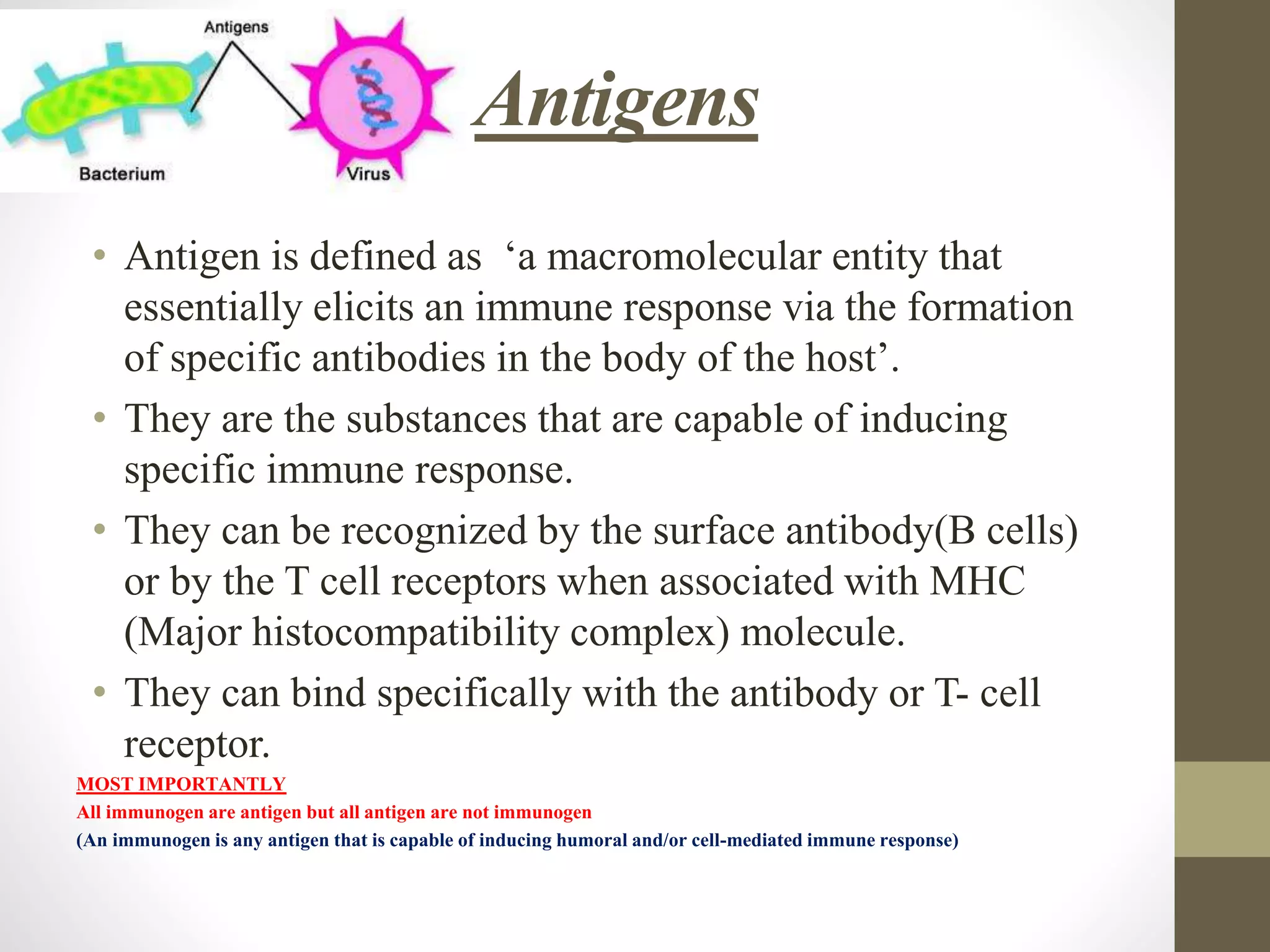
Antigens
• Antigen is defined as ‘a macromolecular entity that
essentially elicits an immune response via the formation
of specific antibodies in the body of the host’.
• They are the substances that are capable of inducing
specific immune response.
• They can be recognized by the surface antibody(B cells)
or by the T cell receptors when associated with MHC
(Major histocompatibility complex) molecule.
• They can bind specifically with the antibody or T- cell
receptor.
MOST IMPORTANTLY
All immunogen are antigen but all antigen are not immunogen
(An immunogen is any antigen that is capable of inducing humoral and/or cell-mediated immune response)
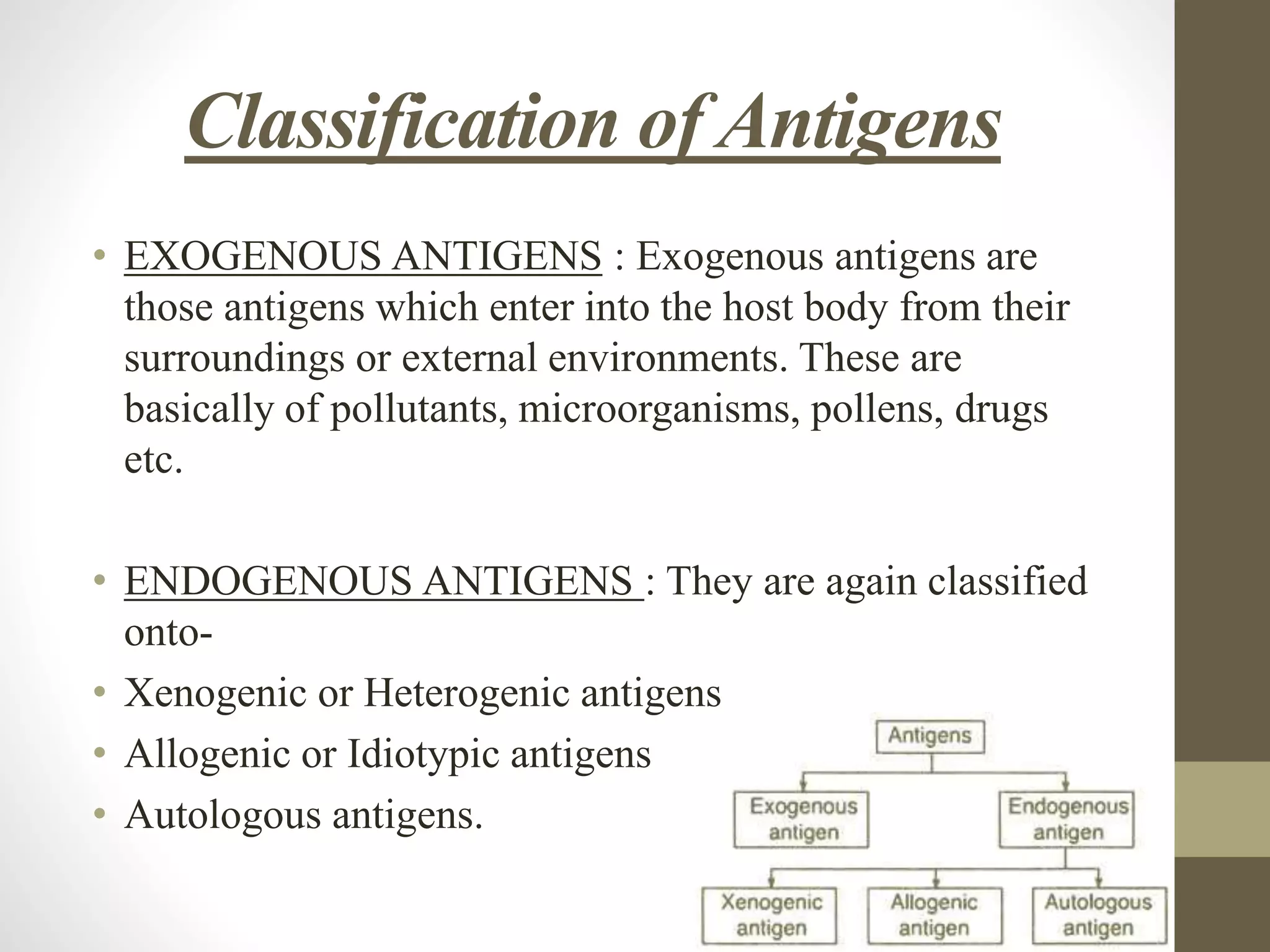
Classification of Antigens
• EXOGENOUS ANTIGENS : Exogenous antigens are
those antigens which enter into the host body from their
surroundings or external environments. These are
basically of pollutants, microorganisms, pollens, drugs
etc.
• ENDOGENOUS ANTIGENS : They are again classified
onto-
• Xenogenic or Heterogenic antigens
• Allogenic or Idiotypic antigens
• Autologous antigens.
• XENOGENIC ANTIGENS : Foreign items which are related
with tissue transplantation and serology.
• ALLOGENIC ANTIGENS : Foreign items which enter when
an individual receives a blood transfusion or undergoes
transplantation operation.
• AUTOLOGOUS ANTIGENS : This group of antigens is very
rare and unnatural. In normal condition, self-components are
non-immunogenic in nature, but in an abnormal condition self-
body components are started to be considered as non-self or
antigenic component.
Immunogenicity v/s Antigenicity
• IMMUNOGENICITY : Ability to induce a humoral or
cell mediated immune response.
• ANTIGENICITY : Ability to combine specifically with
the final products of humoral or cell mediated immune
response.
• All molecules possessing the property of immunogenicity
also possess the property of antigenicity.
• Some molecules that possess the property of antigenicity
but lack immunogenicity is known as haptens.
Factors that influence
Immunogenicity
1. Contribution of the Immunogen
• Foreignness
• Molecular size
• Chemical Composition
• Physical Form
• Degradability
2. Contribution of the biological system
• Genetic factors
• Age
3. Method of administration
• Dose
• Route
• Adjuvants
Haptens
• Haptens are low molecular weight compound or molecules.
• Small organic molecules that are antigenic but not
immunogenic.
• They can bind to antibodies by themselves but they are not
recognised by the immune cells.
• And hence they fail to induce immune response, as a result no
antibodies to act against hapten.
• WHY HAPTENS ARE NOT IMMUNOGEN ?
• Haptens cannot bind to MHC/MHC-II (Major
histocompatibility complex). Hence cannot bind to TCR (T-
cell receptor).
• Results in no immune response
• Haptens can be immunogenic if they are covalently coupled
with a carrier protein.
• The carrier protein must be a larger protein having a molecular
weight of above 10,000 Da.
• This hapten-carrier conjugate is recognized by immune cells
and processed and presented to T-cell by MHC-II.
• Hence antibodies are generated. When hapten carrier conjugate
is introduced in body antibodies are generated against hapten,
carrier protein or conjugate.
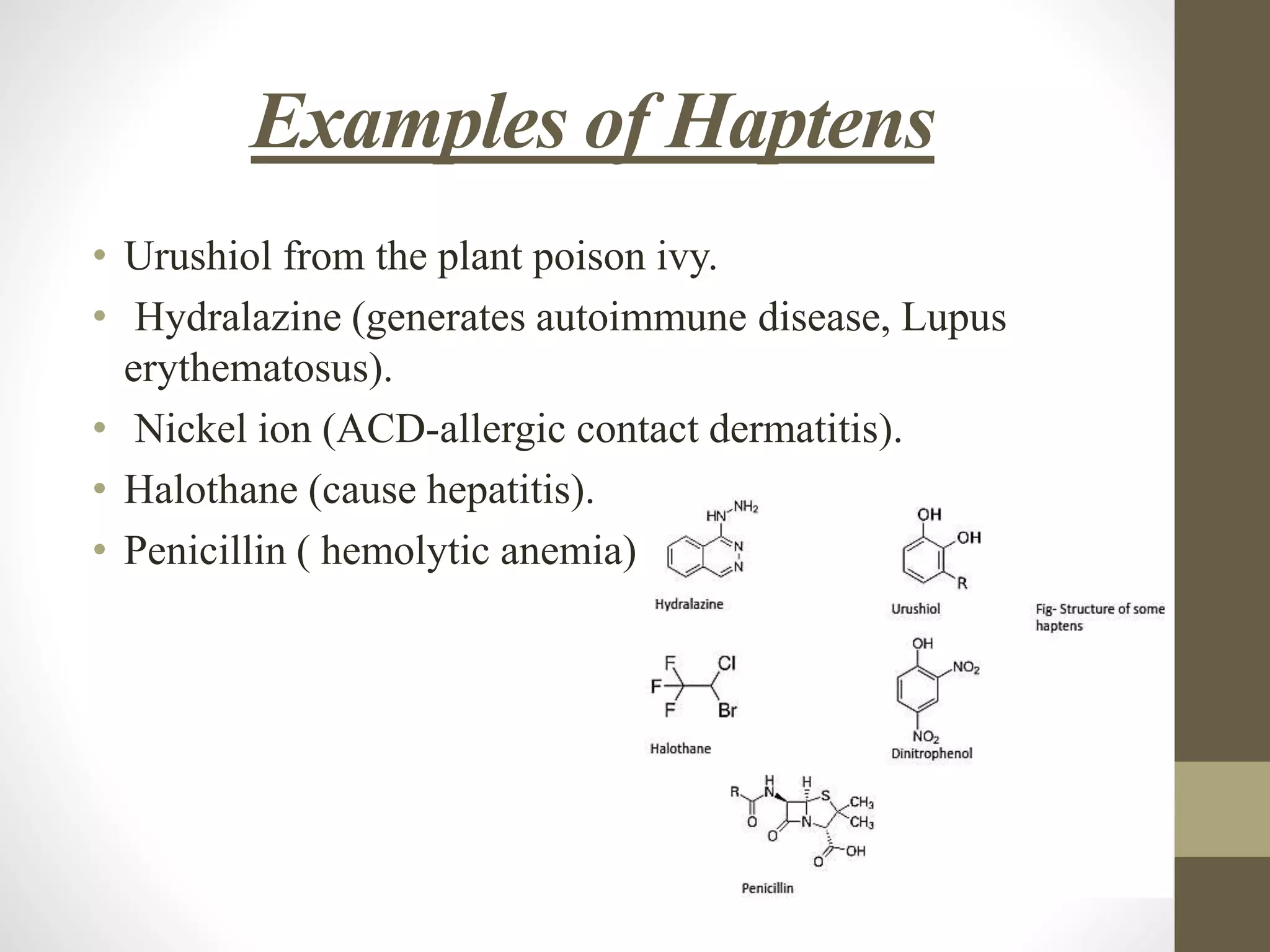
Examples of Haptens
• Urushiol from the plant poison ivy.
• Hydralazine (generates autoimmune disease, Lupus
erythematosus).
• Nickel ion (ACD-allergic contact dermatitis).
• Halothane (cause hepatitis).
• Penicillin ( hemolytic anemia).
Tests
Test for Antigen :
i. Direct ELISA
ii. Direct Immunofluorescence
iii. RIA ( Radioimmunoassay technique)
iv. Neutralization test
v. CFT (Complement fixation test)
vi. Immunohistochemistry
vii. rapid antigen test (RAT)
Test for Hapten :
i. Patch Test procedure
References
1. Sambamurthy K, Kar Ashutosh. Pharmaceutical
Biotechnology. New Delhi: New Age International
Publishers; 1st edition 2006. p 25-27.
2. Punt J, Stanford S, Jones P, Owen A. Judith. Kuby
Immunology. United States: W.H Freeman & Company;
8th edition 2018. p 23-35.

Antigens & haptens

  • 1.
    Antigens & Haptens Name- Kajal Sharma Course – B. Pharm (8th sem) College – K.R. Mangalam University
  • 2.
    Antigens • Antigen isdefined as ‘a macromolecular entity that essentially elicits an immune response via the formation of specific antibodies in the body of the host’. • They are the substances that are capable of inducing specific immune response. • They can be recognized by the surface antibody(B cells) or by the T cell receptors when associated with MHC (Major histocompatibility complex) molecule. • They can bind specifically with the antibody or T- cell receptor. MOST IMPORTANTLY All immunogen are antigen but all antigen are not immunogen (An immunogen is any antigen that is capable of inducing humoral and/or cell-mediated immune response)
  • 3.
    Classification of Antigens •EXOGENOUS ANTIGENS : Exogenous antigens are those antigens which enter into the host body from their surroundings or external environments. These are basically of pollutants, microorganisms, pollens, drugs etc. • ENDOGENOUS ANTIGENS : They are again classified onto- • Xenogenic or Heterogenic antigens • Allogenic or Idiotypic antigens • Autologous antigens.
  • 4.
    • XENOGENIC ANTIGENS: Foreign items which are related with tissue transplantation and serology. • ALLOGENIC ANTIGENS : Foreign items which enter when an individual receives a blood transfusion or undergoes transplantation operation. • AUTOLOGOUS ANTIGENS : This group of antigens is very rare and unnatural. In normal condition, self-components are non-immunogenic in nature, but in an abnormal condition self- body components are started to be considered as non-self or antigenic component.
  • 5.
    Immunogenicity v/s Antigenicity •IMMUNOGENICITY : Ability to induce a humoral or cell mediated immune response. • ANTIGENICITY : Ability to combine specifically with the final products of humoral or cell mediated immune response. • All molecules possessing the property of immunogenicity also possess the property of antigenicity. • Some molecules that possess the property of antigenicity but lack immunogenicity is known as haptens.
  • 6.
    Factors that influence Immunogenicity 1.Contribution of the Immunogen • Foreignness • Molecular size • Chemical Composition • Physical Form • Degradability 2. Contribution of the biological system • Genetic factors • Age 3. Method of administration • Dose • Route • Adjuvants
  • 7.
    Haptens • Haptens arelow molecular weight compound or molecules. • Small organic molecules that are antigenic but not immunogenic. • They can bind to antibodies by themselves but they are not recognised by the immune cells. • And hence they fail to induce immune response, as a result no antibodies to act against hapten. • WHY HAPTENS ARE NOT IMMUNOGEN ? • Haptens cannot bind to MHC/MHC-II (Major histocompatibility complex). Hence cannot bind to TCR (T- cell receptor). • Results in no immune response
  • 8.
    • Haptens canbe immunogenic if they are covalently coupled with a carrier protein. • The carrier protein must be a larger protein having a molecular weight of above 10,000 Da. • This hapten-carrier conjugate is recognized by immune cells and processed and presented to T-cell by MHC-II. • Hence antibodies are generated. When hapten carrier conjugate is introduced in body antibodies are generated against hapten, carrier protein or conjugate.
  • 9.
    Examples of Haptens •Urushiol from the plant poison ivy. • Hydralazine (generates autoimmune disease, Lupus erythematosus). • Nickel ion (ACD-allergic contact dermatitis). • Halothane (cause hepatitis). • Penicillin ( hemolytic anemia).
  • 10.
    Tests Test for Antigen: i. Direct ELISA ii. Direct Immunofluorescence iii. RIA ( Radioimmunoassay technique) iv. Neutralization test v. CFT (Complement fixation test) vi. Immunohistochemistry vii. rapid antigen test (RAT) Test for Hapten : i. Patch Test procedure
  • 11.
    References 1. Sambamurthy K,Kar Ashutosh. Pharmaceutical Biotechnology. New Delhi: New Age International Publishers; 1st edition 2006. p 25-27. 2. Punt J, Stanford S, Jones P, Owen A. Judith. Kuby Immunology. United States: W.H Freeman & Company; 8th edition 2018. p 23-35.

Editor's Notes

  • #3 MOST IMPORTANTLY All immunogen are antigen but all antigen are not immunogen