Chapter 21: LYMPHATIC SYSTEM 1
• The lymphatic system is the
system of vessels, cells, and
organs that carries excess fluids
to the bloodstream and filters
pathogens from the blood.
• The swelling of lymph nodes
during an infection and the
transport of lymphocytes via the
lymphatic vessels are but two
examples of the many
connections between these
critical organ systems
Function of Lymphatic System 2
• A major function of the lymphatic system is to
drain body fluids and return them to the
bloodstream.
• Blood pressure: causes leakage of fluid from
the capillaries, result accumulation of fluid
interstitial space(spaces between individual
cells in the tissues.)
• 20 liters plasma released into the interstitial
space of the tissues each day due to capillary
filtration. Once this filtrate is out of the
bloodstream and in the tissue spaces, it is
referred to as interstitial fluid. Of this, 17
liters is reabsorbed directly by the blood
vessels.
• Where do the other 3 liters go??? Lymphatic
system drains the excess fluid and empties it
back into the bloodstream via a series of
vessels, trunks, and ducts.
• Lymph is the term used to describe interstitial
fluid once it has entered the lymphatic
system. If the system is blocked by something
(cancer), the accumulated fluid enters the
tissue causing lymphedema.
Structure of Lymphatic System 3
• Lymph is not actively pumped by the
heart, but is forced through the
vessels by the movements of the
body, the contraction of skeletal
muscles during body movements, and
breathing.
• One-way valves (semi-lunar valves) in
lymphatic vessels keep the lymph
moving toward the heart. Lymph flows
from the lymphatic capillaries,
through lymphatic vessels, and then is
dumped into the circulatory system
via the lymphatic ducts located at the
junction of the jugular and subclavian
veins in the neck.
• The lymphatic vessels begin as open-
ended capillaries, which feed into
larger and larger lymphatic vessels,
and eventually empty into the
bloodstream by a series of ducts.
• Along the way, the lymph travels
through the lymph nodes, which are
commonly found near the groin,
armpits, neck, chest, and abdomen.
• Humans have about 500–600 lymph
nodes throughout the body.
PRIMARY LYMPHOID ORGANS: 4
• The primary lymphoid organs are the bone marrow, spleen,
and thymus gland.
• The lymphoid organs are where lymphocytes mature,
proliferate, and are selected, which enables them to attack
pathogens without harming the cells of the body.
Tonsils are lymphoid nodules located along the inner surface of
the pharynx and are important in developing immunity to oral
pathogens.
The tonsil located at the back of the throat, the pharyngeal
tonsil, is sometimes referred to as the adenoid when swollen.
Swelling is an indication of an active immune response to
infection. These structures, which accumulate all sorts of
materials taken into the body through eating and breathing,
actually “encourage” pathogens to penetrate deep into the
tonsillar tissues where they are acted upon by numerous
lymphoid follicles and eliminated.
This seems to be the major function of tonsils—to help
children’s bodies recognize, destroy, and develop immunity to
common environmental pathogens so that they will be
protected in their later lives.
Tonsils are often removed in those children who have recurring
throat infections, especially those involving the palatine tonsils
on either side of the throat, whose swelling may interfere with
their breathing and/or swallowing.
Lymph 5
• The central nervous system, bone
marrow, bones, teeth, and the cornea of
the eye do not contain lymph vessels.
• The overall drainage system of the body is
asymmetrical. The right lymphatic duct
receives lymph from only the upper right
side of the body. The lymph from the rest
of the body enters the bloodstream
through the thoracic duct. The thoracic
duct allows the lymph to go from the
right lower limb into the bloodstream.
• In general, lymphatic vessels of the
subcutaneous tissues of the skin, that is,
the superficial lymphatics, follow the
same routes as veins, whereas the deep
lymphatic vessels of the viscera generally
follow the paths of arteries.
Lymphatic capillaries, also
called the terminal
lymphatics, are vessels
where interstitial fluid
enters the lymphatic system
to become lymph fluid.
IMMUNE SYSTEM 6
• The immune system is a
collection of barriers, cells, and
soluble proteins that interact
and communicate with each
other in extraordinarily complex
ways.
Immune System 7
• The modern model of immune function is
organized into three phases based on the
timing of their effects. The three temporal
phases consist of the following:
• Barrier defenses such as the skin and mucous
membranes, which act instantaneously to
prevent pathogenic invasion into the body
tissues
• The rapid but nonspecific innate immune
response, which consists of a variety of
specialized cells and soluble factors
• The slower but more specific and effective
adaptive immune response, which involves
many cell types and soluble factors, but is
primarily controlled by white blood cells
(leukocytes) known as lymphocytes, which
help control immune responses.
• All the cells of the immune response as well
as of the blood arise by differentiation from
hematopoietic stem cells.
• These cells can be divided into three classes
based on function:
• Phagocytic cells, which ingest pathogens to
destroy them
• Lymphocytes, which specifically coordinate
the activities of adaptive immunity
• Cells containing cytoplasmic granules, which
help mediate immune responses against
parasites and intracellular pathogens such as
viruses
Lymphocytes: B- Cell T-Cell 8
• T cells migrate from bone
marrow to the thymus gland
where they further mature.
• B cells and T cells are found in
many parts of the body,
circulating in the bloodstream
and lymph, and residing in
secondary lymphoid organs,
including the spleen and lymph
nodes. The human body
contains approximately 1012
lymphocytes.
• B and T cells: identical
morphologically- a large central
nucleus surrounded by a thin
layer of cytoplasm. Distinguished
from each other by their surface
protein markers as well as by the
molecules they secrete.
• B cells mature in red bone
marrow and T cells mature in
the thymus. Both initially
develop from bone marrow.
Lymphocytes: B-Cell & T-Cell 9
• B cells are immune cells that function
primarily by producing antibodies.
• An antibody is any of the group of
proteins that binds specifically to
pathogen-associated molecules known as
antigens.
• An antigen is a chemical structure on the
surface of a pathogen that binds to T or B
lymphocyte antigen receptors.
• Once activated by binding to antigen, B
cells differentiate into cells that secrete a
soluble form of their surface antibodies.
• These activated B cells are known as
plasma cells.
• The T cell, on the other hand, does not
secrete antibody but performs a variety
of functions in the adaptive immune
response.
• Different T cell types have the ability to
either secrete soluble factors that
communicate with other cells of the
adaptive immune response or destroy
cells infected with intracellular
pathogens.
Lymphocytes: Plasma & Natural Killer (NK) 10
• The natural killer cell is a
participant in the innate immune
response.
• A natural killer cell (NK) is a
circulating blood cell that contains
cytotoxic (cell-killing) granules in its
extensive cytoplasm.
• It shares this mechanism with the
cytotoxic T cells of the adaptive
immune response.
• NK cells are among the body’s first
lines of defense against viruses and
certain types of cancer.
• A plasma cell is a B cell that has
differentiated in response to
antigen binding, and has thereby
gained the ability to secrete soluble
antibodies.
• These cells differ in morphology
from standard B and T cells in that
they contain a large amount of
cytoplasm packed with the protein-
synthesizing machinery known as
rough endoplasmic reticulum.
Innate Immune Response & Barriers 11
• The innate immune response, which is relatively rapid but
nonspecific and thus not always effective.
• Usually begins with the physical barriers that prevent
pathogens from entering the body, destroy them after they
enter, or flush them out before they can establish themselves
in the hospitable environment of the body’s soft tissues.
Barrier defenses are part of the body’s most basic defense
mechanisms.
• The barrier defenses are not a response to infections, but
they are continuously working to protect against a broad
range of pathogens.
• The different modes of barrier defenses are associated with
the external surfaces of the body, where pathogens may try
to enter. The primary barrier to the entrance of
microorganisms into the body is the skin. Not only is the skin
covered with a layer of dead, keratinized epithelium that is
too dry for bacteria in which to grow, but as these cells are
continuously sloughed off from the skin, they carry bacteria
and other pathogens with them.
• Additionally, sweat and other skin secretions may lower pH,
contain toxic lipids, and physically wash microbes away.
• Another barrier is the saliva in the mouth, which is rich in
lysozyme—an enzyme that destroys bacteria by digesting
their cell walls.
• The acidic environment of the stomach, which is fatal to
many pathogens, is also a barrier.
• Additionally, the mucus layer of the gastrointestinal tract,
respiratory tract, reproductive tract, eyes, ears, and nose
traps both microbes and debris, and facilitates their removal.
In the case of the upper respiratory tract, ciliated epithelial
cells move potentially contaminated mucus upwards to the
mouth, where it is then swallowed into the digestive tract,
ending up in the harsh acidic environment of the stomach.
• Considering how often you breathe compared to how often
you eat or perform other activities that expose you to
pathogens, it is not surprising that multiple barrier
mechanisms have evolved to work in concert to protect this
vital area.
Phagocytes & Phagocytosis 12
• A phagocyte is a cell that is able to
surround and engulf a particle or cell,
a process called phagocytosis.
• The phagocytes of the immune system
engulf other particles or cells, either
to clean an area of debris, old cells, or
to kill pathogenic organisms such as
bacteria.
• The phagocytes are the body’s fast
acting, first line of immunological
defense against organisms that have
breached barrier defenses and have
entered the vulnerable tissues of the
body.
• Phagocytosis is an important and
effective mechanism of destroying
pathogens during innate immune
responses.
Macrophages & Neutrophils 13
• A neutrophil is a phagocytic cell
that is attracted via chemotaxis
from the bloodstream to infected
tissues.
• Neutrophils can be thought of as
military reinforcements that are
called into a battle to hasten the
destruction of the enemy.
• A macrophage is an irregularly
shaped phagocyte that is
amoeboid in nature and is the
most versatile of the phagocytes in
the body.
• Macrophages move through tissues
and squeeze through capillary walls
using pseudopodia.
• They not only participate and are
important in innate immune
responses but have also evolved to
cooperate with lymphocytes as
part of the adaptive immune
response.
Inflammatory Response: 14
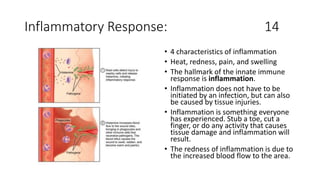
• 4 characteristics of inflammation
• Heat, redness, pain, and swelling
• The hallmark of the innate immune
response is inflammation.
• Inflammation does not have to be
initiated by an infection, but can also
be caused by tissue injuries.
• Inflammation is something everyone
has experienced. Stub a toe, cut a
finger, or do any activity that causes
tissue damage and inflammation will
result.
• The redness of inflammation is due to
the increased blood flow to the area.
Adaptive Immune Response 15
• The adaptive immune response,
which is slower in its development
during an initial infection with a
pathogen, but is highly specific and
effective at attacking a wide variety of
pathogens.
• The specificity of the adaptive
immune response—its ability to
specifically recognize and make a
response against a wide variety of
pathogens—is its great strength.
• The immune system’s first exposure to a pathogen is
called a primary adaptive response. Symptoms of a first
infection, called primary disease, are always relatively
severe because it takes time for an initial adaptive
immune response to a pathogen to become effective.
• Upon re-exposure to the same pathogen, a secondary
adaptive immune response is generated, which is
stronger and faster that the primary response.
• The secondary adaptive response often eliminates a
pathogen before it can cause significant tissue damage or
any symptoms. Without symptoms, there is no disease,
and the individual is not even aware of the infection.
• This secondary response is the basis of immunological
memory, which protects us from getting diseases
repeatedly from the same pathogen. By this mechanism,
an individual’s exposure to pathogens early in life spares
the person from these diseases later in life.
Classes of Antibodies & Functions 16
• IgA is the only antibody to leave
the interior of the body to protect
body surfaces. IgA is also of
importance to newborns, because
this antibody is present in mother’s
breast milk (colostrum), which
serves to protect the infant from
disease.
• IgE is usually associated with
allergies and anaphylaxis.
• IgM is usually the first antibody
made during a primary response.
• IgG is a major antibody of late
primary responses and the main
antibody of secondary responses in
the blood. This class of antibody is
the one that crosses the placenta
to protect the developing fetus
from disease exits the blood to the
interstitial fluid to fight
extracellular pathogens
Active and Passive Immunity Response 17
• Active immunity is the resistance to pathogens acquired
during an adaptive immune response within an individual.
• Artificially acquired active immunity involves the use of
vaccines. A vaccine is a killed or weakened pathogen or its
components that, when administered to a healthy individual,
leads to the development of immunological memory (a
weakened primary immune response) without causing much
in the way of symptoms.
• Thus, with the use of vaccines, one can avoid the damage
from disease that results from the first exposure to the
pathogen, yet reap the benefits of protection from
immunological memory.
• The advent of vaccines was one of the major medical
advances of the twentieth century and led to the eradication
of smallpox and the control of many infectious diseases,
including polio, measles, and whooping cough.
• In the case of Influenza, you must be immunized each year
due to mutation.
• Passive immunity arises from the transfer of antibodies to an
individual without requiring them to mount their own active
immune response.
• Naturally acquired passive immunity is seen during fetal
development. IgG is transferred from the maternal circulation
to the fetus via the placenta, protecting the fetus from
infection and protecting the newborn for the first few months
of its life.
• A newborn benefits from the IgA antibodies it obtains from
milk during breastfeeding. The fetus and newborn thus
benefit from the immunological memory of the mother to
the pathogens to which she has been exposed.
• In medicine, artificially acquired passive immunity usually
involves injections of immunoglobulins, taken from animals
previously exposed to a specific pathogen. This treatment is a
fast-acting method of temporarily protecting an individual
who was possibly exposed to a pathogen.
• The downside to both types of passive immunity is the lack of
the development of immunological memory.
• Once the antibodies are transferred, they are effective for
only a limited time before they degrade.
Hypersensitivities 18
• The word “hypersensitivity” simply
means sensitive beyond normal
levels of activation.
• Allergies and inflammatory
responses to nonpathogenic
environmental substances have
been observed since the dawn of
history.
• Hypersensitivity is a medical term
describing symptoms that are now
known to be caused by unrelated
mechanisms of immunity.
• Type I: Immediate Hypersensitivity
• Type II: Hypersensitivity
• Type III: Hypersensitivity
• Type IV: Delayed Hypersensitivity
Type I: Immediate Hypersensitivity 19
• Type I hypersensitivity reactions are
usually rapid and occur within just a few
minutes, hence the term immediate
hypersensitivity.
• Example: Some may develop severe
allergies that may cause anaphylactic
shock, which can potentially be fatal
within 20 to 30 minutes if untreated.
• This drop in blood pressure (shock) with
accompanying contractions of bronchial
smooth muscle is caused by systemic
mast cell degranulation when an allergen
is eaten (for example, shellfish and
peanuts), injected (by a bee sting or being
administered penicillin), or inhaled
(asthma).
• Because epinephrine raises blood
pressure and relaxes bronchial smooth
muscle, it is routinely used to counteract
the effects of anaphylaxis and can be
lifesaving.
• Patients with known severe allergies are
encouraged to keep automatic
epinephrine injectors with them at all
times, especially when away from easy
access to hospitals.
Type II and III Hypersensitivities 20
• III hypersensitivity occurs with
diseases such as systemic lupus
erythematosus, where soluble
antigens, mostly DNA and other
material from the nucleus, and
antibodies accumulate in the blood
to the point that the antigen and
antibody precipitate along blood
vessel linings.
• These immune complexes often
lodge in the kidneys, joints, and
other organs where they can
activate complement proteins and
cause inflammation.
• Type II hypersensitivity, which
involves IgG-mediated lysis of cells
by complement proteins, occurs
during mismatched blood
transfusions and blood
compatibility diseases such as
erythroblastosis fetalis .
Type IV: Delayed Hypersensitivity 21
• The classical test for delayed
hypersensitivity is the tuberculin test
for tuberculosis, where bacterial
proteins from M. tuberculosis are
injected into the skin.
• A couple of days later, a positive test
is indicated by a raised red area that is
hard to the touch, called an
induration, which is a consequence of
the cellular infiltrate, an accumulation
of activated macrophages.
• A positive tuberculin test means that
the patient has been exposed to the
bacteria and exhibits a cellular
immune response to it.
STRESS: Effect on Immune Response 22
• Most short-term stress does not impair the
immune system in healthy individuals enough
to lead to a greater incidence of diseases.
• Older individuals and those with suppressed
immune responses due to disease or
immunosuppressive drugs may respond even
to short-term stressors by getting sicker more
often.
• It has been found that short-term stress
diverts the body’s resources towards
enhancing innate immune responses, which
have the ability to act fast and would seem to
help the body prepare better for possible
infections associated with the trauma that
may result from a fight-or-flight exchange.
• The diverting of resources away from the
adaptive immune response, however, causes
its own share of problems in fighting disease.
• Chronic stress, unlike short-term stress, may
inhibit immune responses even in otherwise
healthy adults. The suppression of both
innate and adaptive immune responses is
clearly associated with increases in some
diseases, as seen when individuals lose a
spouse or have other long-term stresses, such
as taking care of a spouse with a fatal disease
or dementia.
• The new science of psychoneuroimmunology,
while still in its relative infancy, has great
potential to make exciting advances in our
understanding of how the nervous,
endocrine, and immune systems have evolved
together and communicate with each other.

Basic ap chapter 21 powerpoint 2017

  • 1.
    Chapter 21: LYMPHATICSYSTEM 1 • The lymphatic system is the system of vessels, cells, and organs that carries excess fluids to the bloodstream and filters pathogens from the blood. • The swelling of lymph nodes during an infection and the transport of lymphocytes via the lymphatic vessels are but two examples of the many connections between these critical organ systems
  • 2.
    Function of LymphaticSystem 2 • A major function of the lymphatic system is to drain body fluids and return them to the bloodstream. • Blood pressure: causes leakage of fluid from the capillaries, result accumulation of fluid interstitial space(spaces between individual cells in the tissues.) • 20 liters plasma released into the interstitial space of the tissues each day due to capillary filtration. Once this filtrate is out of the bloodstream and in the tissue spaces, it is referred to as interstitial fluid. Of this, 17 liters is reabsorbed directly by the blood vessels. • Where do the other 3 liters go??? Lymphatic system drains the excess fluid and empties it back into the bloodstream via a series of vessels, trunks, and ducts. • Lymph is the term used to describe interstitial fluid once it has entered the lymphatic system. If the system is blocked by something (cancer), the accumulated fluid enters the tissue causing lymphedema.
  • 3.
    Structure of LymphaticSystem 3 • Lymph is not actively pumped by the heart, but is forced through the vessels by the movements of the body, the contraction of skeletal muscles during body movements, and breathing. • One-way valves (semi-lunar valves) in lymphatic vessels keep the lymph moving toward the heart. Lymph flows from the lymphatic capillaries, through lymphatic vessels, and then is dumped into the circulatory system via the lymphatic ducts located at the junction of the jugular and subclavian veins in the neck. • The lymphatic vessels begin as open- ended capillaries, which feed into larger and larger lymphatic vessels, and eventually empty into the bloodstream by a series of ducts. • Along the way, the lymph travels through the lymph nodes, which are commonly found near the groin, armpits, neck, chest, and abdomen. • Humans have about 500–600 lymph nodes throughout the body.
  • 4.
    PRIMARY LYMPHOID ORGANS:4 • The primary lymphoid organs are the bone marrow, spleen, and thymus gland. • The lymphoid organs are where lymphocytes mature, proliferate, and are selected, which enables them to attack pathogens without harming the cells of the body. Tonsils are lymphoid nodules located along the inner surface of the pharynx and are important in developing immunity to oral pathogens. The tonsil located at the back of the throat, the pharyngeal tonsil, is sometimes referred to as the adenoid when swollen. Swelling is an indication of an active immune response to infection. These structures, which accumulate all sorts of materials taken into the body through eating and breathing, actually “encourage” pathogens to penetrate deep into the tonsillar tissues where they are acted upon by numerous lymphoid follicles and eliminated. This seems to be the major function of tonsils—to help children’s bodies recognize, destroy, and develop immunity to common environmental pathogens so that they will be protected in their later lives. Tonsils are often removed in those children who have recurring throat infections, especially those involving the palatine tonsils on either side of the throat, whose swelling may interfere with their breathing and/or swallowing.
  • 5.
    Lymph 5 • Thecentral nervous system, bone marrow, bones, teeth, and the cornea of the eye do not contain lymph vessels. • The overall drainage system of the body is asymmetrical. The right lymphatic duct receives lymph from only the upper right side of the body. The lymph from the rest of the body enters the bloodstream through the thoracic duct. The thoracic duct allows the lymph to go from the right lower limb into the bloodstream. • In general, lymphatic vessels of the subcutaneous tissues of the skin, that is, the superficial lymphatics, follow the same routes as veins, whereas the deep lymphatic vessels of the viscera generally follow the paths of arteries. Lymphatic capillaries, also called the terminal lymphatics, are vessels where interstitial fluid enters the lymphatic system to become lymph fluid.
  • 6.
    IMMUNE SYSTEM 6 •The immune system is a collection of barriers, cells, and soluble proteins that interact and communicate with each other in extraordinarily complex ways.
  • 7.
    Immune System 7 •The modern model of immune function is organized into three phases based on the timing of their effects. The three temporal phases consist of the following: • Barrier defenses such as the skin and mucous membranes, which act instantaneously to prevent pathogenic invasion into the body tissues • The rapid but nonspecific innate immune response, which consists of a variety of specialized cells and soluble factors • The slower but more specific and effective adaptive immune response, which involves many cell types and soluble factors, but is primarily controlled by white blood cells (leukocytes) known as lymphocytes, which help control immune responses. • All the cells of the immune response as well as of the blood arise by differentiation from hematopoietic stem cells. • These cells can be divided into three classes based on function: • Phagocytic cells, which ingest pathogens to destroy them • Lymphocytes, which specifically coordinate the activities of adaptive immunity • Cells containing cytoplasmic granules, which help mediate immune responses against parasites and intracellular pathogens such as viruses
  • 8.
    Lymphocytes: B- CellT-Cell 8 • T cells migrate from bone marrow to the thymus gland where they further mature. • B cells and T cells are found in many parts of the body, circulating in the bloodstream and lymph, and residing in secondary lymphoid organs, including the spleen and lymph nodes. The human body contains approximately 1012 lymphocytes. • B and T cells: identical morphologically- a large central nucleus surrounded by a thin layer of cytoplasm. Distinguished from each other by their surface protein markers as well as by the molecules they secrete. • B cells mature in red bone marrow and T cells mature in the thymus. Both initially develop from bone marrow.
  • 9.
    Lymphocytes: B-Cell &T-Cell 9 • B cells are immune cells that function primarily by producing antibodies. • An antibody is any of the group of proteins that binds specifically to pathogen-associated molecules known as antigens. • An antigen is a chemical structure on the surface of a pathogen that binds to T or B lymphocyte antigen receptors. • Once activated by binding to antigen, B cells differentiate into cells that secrete a soluble form of their surface antibodies. • These activated B cells are known as plasma cells. • The T cell, on the other hand, does not secrete antibody but performs a variety of functions in the adaptive immune response. • Different T cell types have the ability to either secrete soluble factors that communicate with other cells of the adaptive immune response or destroy cells infected with intracellular pathogens.
  • 10.
    Lymphocytes: Plasma &Natural Killer (NK) 10 • The natural killer cell is a participant in the innate immune response. • A natural killer cell (NK) is a circulating blood cell that contains cytotoxic (cell-killing) granules in its extensive cytoplasm. • It shares this mechanism with the cytotoxic T cells of the adaptive immune response. • NK cells are among the body’s first lines of defense against viruses and certain types of cancer. • A plasma cell is a B cell that has differentiated in response to antigen binding, and has thereby gained the ability to secrete soluble antibodies. • These cells differ in morphology from standard B and T cells in that they contain a large amount of cytoplasm packed with the protein- synthesizing machinery known as rough endoplasmic reticulum.
  • 11.
    Innate Immune Response& Barriers 11 • The innate immune response, which is relatively rapid but nonspecific and thus not always effective. • Usually begins with the physical barriers that prevent pathogens from entering the body, destroy them after they enter, or flush them out before they can establish themselves in the hospitable environment of the body’s soft tissues. Barrier defenses are part of the body’s most basic defense mechanisms. • The barrier defenses are not a response to infections, but they are continuously working to protect against a broad range of pathogens. • The different modes of barrier defenses are associated with the external surfaces of the body, where pathogens may try to enter. The primary barrier to the entrance of microorganisms into the body is the skin. Not only is the skin covered with a layer of dead, keratinized epithelium that is too dry for bacteria in which to grow, but as these cells are continuously sloughed off from the skin, they carry bacteria and other pathogens with them. • Additionally, sweat and other skin secretions may lower pH, contain toxic lipids, and physically wash microbes away. • Another barrier is the saliva in the mouth, which is rich in lysozyme—an enzyme that destroys bacteria by digesting their cell walls. • The acidic environment of the stomach, which is fatal to many pathogens, is also a barrier. • Additionally, the mucus layer of the gastrointestinal tract, respiratory tract, reproductive tract, eyes, ears, and nose traps both microbes and debris, and facilitates their removal. In the case of the upper respiratory tract, ciliated epithelial cells move potentially contaminated mucus upwards to the mouth, where it is then swallowed into the digestive tract, ending up in the harsh acidic environment of the stomach. • Considering how often you breathe compared to how often you eat or perform other activities that expose you to pathogens, it is not surprising that multiple barrier mechanisms have evolved to work in concert to protect this vital area.
  • 12.
    Phagocytes & Phagocytosis12 • A phagocyte is a cell that is able to surround and engulf a particle or cell, a process called phagocytosis. • The phagocytes of the immune system engulf other particles or cells, either to clean an area of debris, old cells, or to kill pathogenic organisms such as bacteria. • The phagocytes are the body’s fast acting, first line of immunological defense against organisms that have breached barrier defenses and have entered the vulnerable tissues of the body. • Phagocytosis is an important and effective mechanism of destroying pathogens during innate immune responses.
  • 13.
    Macrophages & Neutrophils13 • A neutrophil is a phagocytic cell that is attracted via chemotaxis from the bloodstream to infected tissues. • Neutrophils can be thought of as military reinforcements that are called into a battle to hasten the destruction of the enemy. • A macrophage is an irregularly shaped phagocyte that is amoeboid in nature and is the most versatile of the phagocytes in the body. • Macrophages move through tissues and squeeze through capillary walls using pseudopodia. • They not only participate and are important in innate immune responses but have also evolved to cooperate with lymphocytes as part of the adaptive immune response.
  • 14.
    Inflammatory Response: 14 •4 characteristics of inflammation • Heat, redness, pain, and swelling • The hallmark of the innate immune response is inflammation. • Inflammation does not have to be initiated by an infection, but can also be caused by tissue injuries. • Inflammation is something everyone has experienced. Stub a toe, cut a finger, or do any activity that causes tissue damage and inflammation will result. • The redness of inflammation is due to the increased blood flow to the area.
  • 15.
    Adaptive Immune Response15 • The adaptive immune response, which is slower in its development during an initial infection with a pathogen, but is highly specific and effective at attacking a wide variety of pathogens. • The specificity of the adaptive immune response—its ability to specifically recognize and make a response against a wide variety of pathogens—is its great strength. • The immune system’s first exposure to a pathogen is called a primary adaptive response. Symptoms of a first infection, called primary disease, are always relatively severe because it takes time for an initial adaptive immune response to a pathogen to become effective. • Upon re-exposure to the same pathogen, a secondary adaptive immune response is generated, which is stronger and faster that the primary response. • The secondary adaptive response often eliminates a pathogen before it can cause significant tissue damage or any symptoms. Without symptoms, there is no disease, and the individual is not even aware of the infection. • This secondary response is the basis of immunological memory, which protects us from getting diseases repeatedly from the same pathogen. By this mechanism, an individual’s exposure to pathogens early in life spares the person from these diseases later in life.
  • 16.
    Classes of Antibodies& Functions 16 • IgA is the only antibody to leave the interior of the body to protect body surfaces. IgA is also of importance to newborns, because this antibody is present in mother’s breast milk (colostrum), which serves to protect the infant from disease. • IgE is usually associated with allergies and anaphylaxis. • IgM is usually the first antibody made during a primary response. • IgG is a major antibody of late primary responses and the main antibody of secondary responses in the blood. This class of antibody is the one that crosses the placenta to protect the developing fetus from disease exits the blood to the interstitial fluid to fight extracellular pathogens
  • 17.
    Active and PassiveImmunity Response 17 • Active immunity is the resistance to pathogens acquired during an adaptive immune response within an individual. • Artificially acquired active immunity involves the use of vaccines. A vaccine is a killed or weakened pathogen or its components that, when administered to a healthy individual, leads to the development of immunological memory (a weakened primary immune response) without causing much in the way of symptoms. • Thus, with the use of vaccines, one can avoid the damage from disease that results from the first exposure to the pathogen, yet reap the benefits of protection from immunological memory. • The advent of vaccines was one of the major medical advances of the twentieth century and led to the eradication of smallpox and the control of many infectious diseases, including polio, measles, and whooping cough. • In the case of Influenza, you must be immunized each year due to mutation. • Passive immunity arises from the transfer of antibodies to an individual without requiring them to mount their own active immune response. • Naturally acquired passive immunity is seen during fetal development. IgG is transferred from the maternal circulation to the fetus via the placenta, protecting the fetus from infection and protecting the newborn for the first few months of its life. • A newborn benefits from the IgA antibodies it obtains from milk during breastfeeding. The fetus and newborn thus benefit from the immunological memory of the mother to the pathogens to which she has been exposed. • In medicine, artificially acquired passive immunity usually involves injections of immunoglobulins, taken from animals previously exposed to a specific pathogen. This treatment is a fast-acting method of temporarily protecting an individual who was possibly exposed to a pathogen. • The downside to both types of passive immunity is the lack of the development of immunological memory. • Once the antibodies are transferred, they are effective for only a limited time before they degrade.
  • 18.
    Hypersensitivities 18 • Theword “hypersensitivity” simply means sensitive beyond normal levels of activation. • Allergies and inflammatory responses to nonpathogenic environmental substances have been observed since the dawn of history. • Hypersensitivity is a medical term describing symptoms that are now known to be caused by unrelated mechanisms of immunity. • Type I: Immediate Hypersensitivity • Type II: Hypersensitivity • Type III: Hypersensitivity • Type IV: Delayed Hypersensitivity
  • 19.
    Type I: ImmediateHypersensitivity 19 • Type I hypersensitivity reactions are usually rapid and occur within just a few minutes, hence the term immediate hypersensitivity. • Example: Some may develop severe allergies that may cause anaphylactic shock, which can potentially be fatal within 20 to 30 minutes if untreated. • This drop in blood pressure (shock) with accompanying contractions of bronchial smooth muscle is caused by systemic mast cell degranulation when an allergen is eaten (for example, shellfish and peanuts), injected (by a bee sting or being administered penicillin), or inhaled (asthma). • Because epinephrine raises blood pressure and relaxes bronchial smooth muscle, it is routinely used to counteract the effects of anaphylaxis and can be lifesaving. • Patients with known severe allergies are encouraged to keep automatic epinephrine injectors with them at all times, especially when away from easy access to hospitals.
  • 20.
    Type II andIII Hypersensitivities 20 • III hypersensitivity occurs with diseases such as systemic lupus erythematosus, where soluble antigens, mostly DNA and other material from the nucleus, and antibodies accumulate in the blood to the point that the antigen and antibody precipitate along blood vessel linings. • These immune complexes often lodge in the kidneys, joints, and other organs where they can activate complement proteins and cause inflammation. • Type II hypersensitivity, which involves IgG-mediated lysis of cells by complement proteins, occurs during mismatched blood transfusions and blood compatibility diseases such as erythroblastosis fetalis .
  • 21.
    Type IV: DelayedHypersensitivity 21 • The classical test for delayed hypersensitivity is the tuberculin test for tuberculosis, where bacterial proteins from M. tuberculosis are injected into the skin. • A couple of days later, a positive test is indicated by a raised red area that is hard to the touch, called an induration, which is a consequence of the cellular infiltrate, an accumulation of activated macrophages. • A positive tuberculin test means that the patient has been exposed to the bacteria and exhibits a cellular immune response to it.
  • 22.
    STRESS: Effect onImmune Response 22 • Most short-term stress does not impair the immune system in healthy individuals enough to lead to a greater incidence of diseases. • Older individuals and those with suppressed immune responses due to disease or immunosuppressive drugs may respond even to short-term stressors by getting sicker more often. • It has been found that short-term stress diverts the body’s resources towards enhancing innate immune responses, which have the ability to act fast and would seem to help the body prepare better for possible infections associated with the trauma that may result from a fight-or-flight exchange. • The diverting of resources away from the adaptive immune response, however, causes its own share of problems in fighting disease. • Chronic stress, unlike short-term stress, may inhibit immune responses even in otherwise healthy adults. The suppression of both innate and adaptive immune responses is clearly associated with increases in some diseases, as seen when individuals lose a spouse or have other long-term stresses, such as taking care of a spouse with a fatal disease or dementia. • The new science of psychoneuroimmunology, while still in its relative infancy, has great potential to make exciting advances in our understanding of how the nervous, endocrine, and immune systems have evolved together and communicate with each other.