Cell membrane
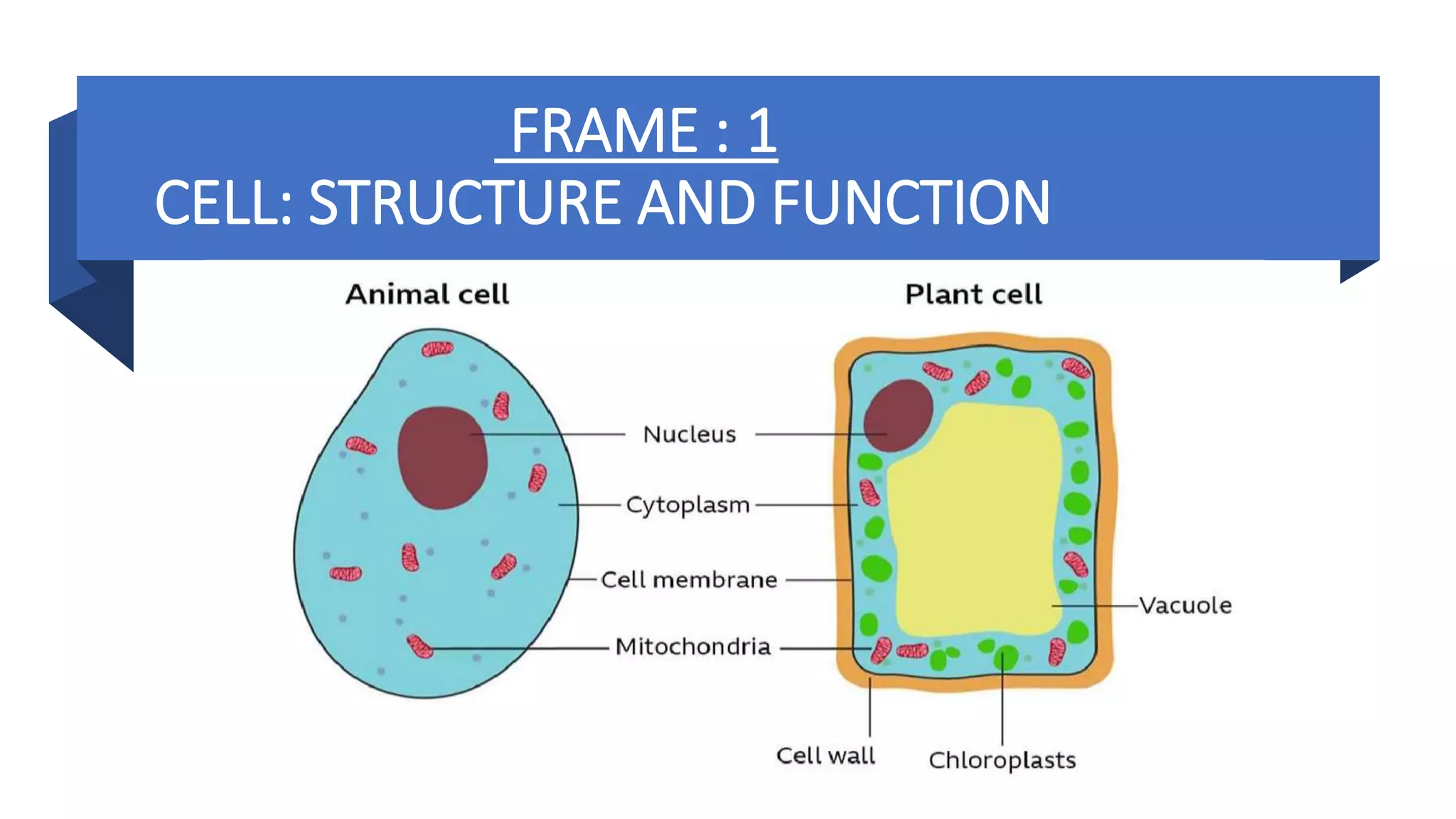
FRAME : 1
CELL: STRUCTURE AND FUNCTION
INTRODUCTION
• Fundamental unit of life.
• Self replicating structure.
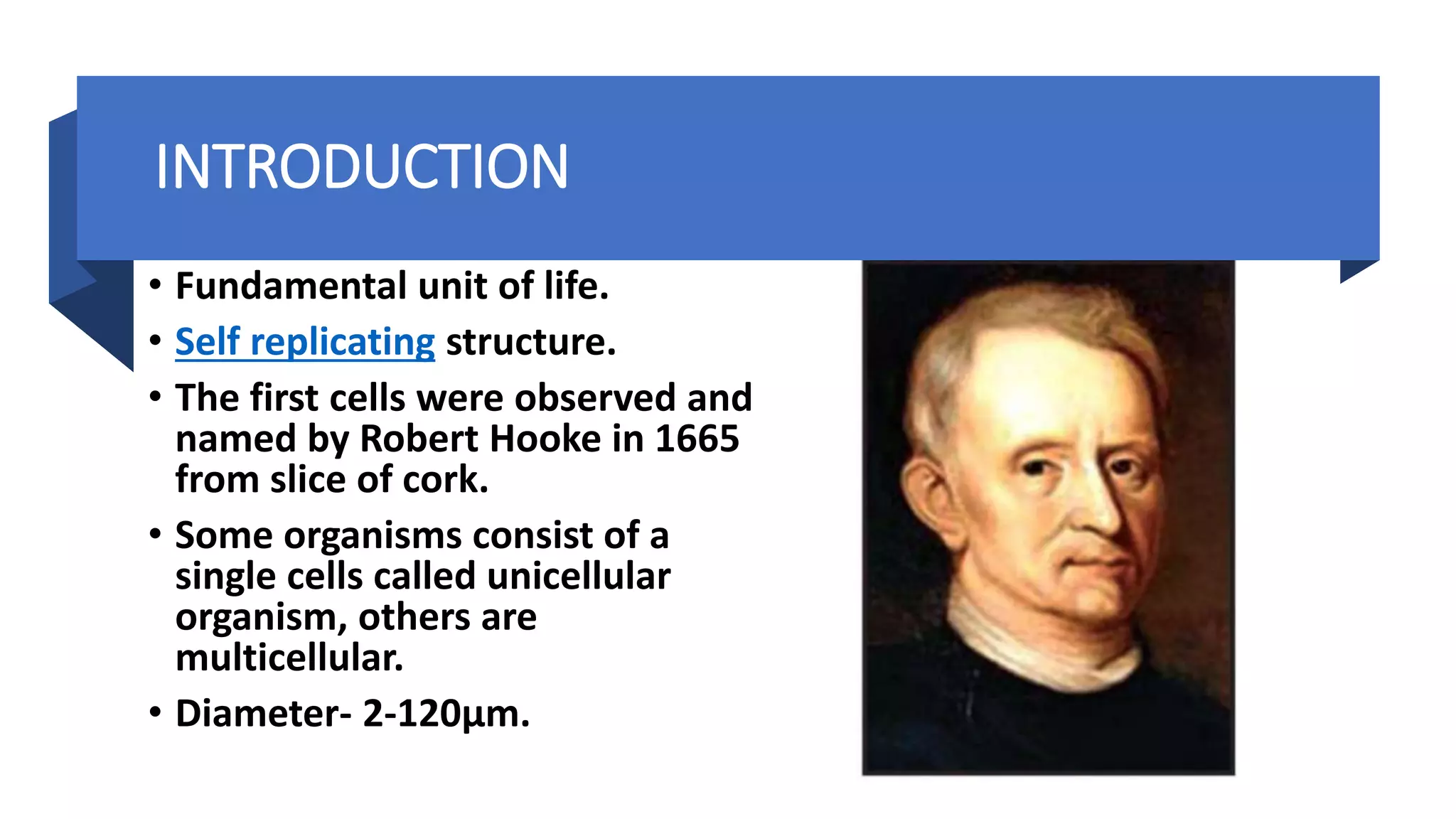
• The first cells were observed and
named by Robert Hooke in 1665
from slice of cork.
• Some organisms consist of a
single cells called unicellular
organism, others are
multicellular.
• Diameter- 2-120μm.
INTRODUCTION
Proposed by Matthias Schleiden and Theodor Schwann in 1839:-
• All living organisms are made up of cells.
• Cells are the smallest working unit of all living things.
• All cells come from pre-existing cells through cell division.
CELL THEORY
• Different substances that make a cell are collectively called
Protoplasm.
• Protoplasm is composed of :-
1. Water - 70-80% Water is present in cell.
2. Carbohydrates
3. Lipids
4. Proteins
5. Electrolyte - Sodium (Na+), Potassium (K+), Magnesium (Mg2+),
Calcium (Ca2+), Phosphate , Chloride (Cl-), and Bicarbonate (HC03 - ).
CONSTITUENTS
1. Who gave cell theory.
a.) Robert Hooke
b.) Schleiden and Schwann
c.) Albert Von kolliker
2. Who coined the term Cell.
a.) Virchow
b.) Robert Hooke
c.) Fleming
Quiz : Frame 1
FRAME : 2
CELL MEMBRANE
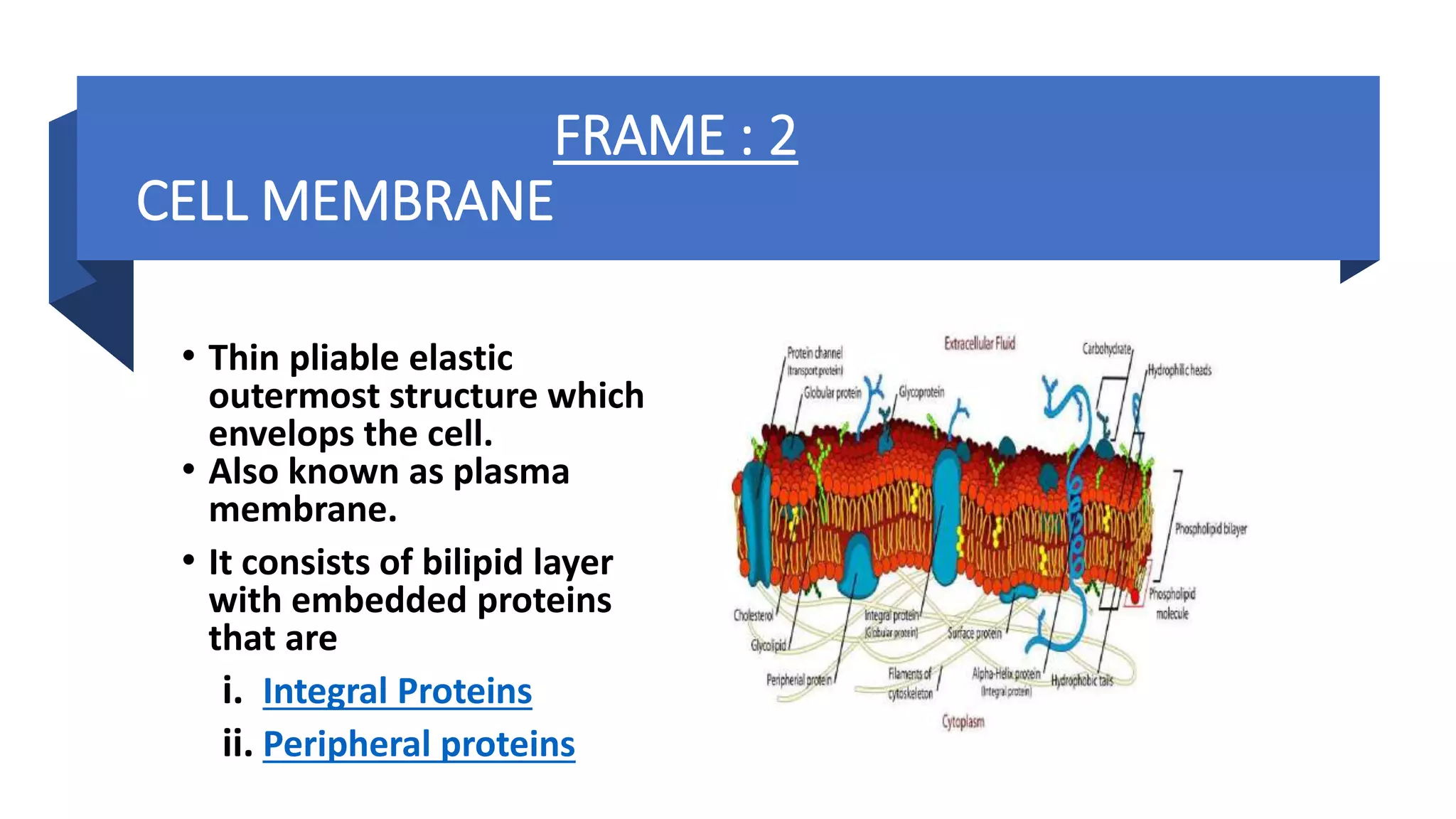
• Thin pliable elastic
outermost structure which
envelops the cell.
• Also known as plasma
membrane.
• It consists of bilipid layer
with embedded proteins
that are
i. Integral Proteins
ii. Peripheral proteins
FUNCTIONS OF CELL MEMBRANE
• Protective:- Forms
outermost boundary of the
cell organelles.
• Digestive:- Takes in food and
excretes waste products.
• Selective Permeability:
a) Non-Polar Molecules-
Gases (like O2 ,CO2, N2 ),
Lipids, Steroid Hormones,
Alcohols move rapidly
across the membrane.
a) Polar molecules:- H2O soluble ions
, Glucose, urea etc. have much
lower solubility . Therefore
Penetrate the membrane much
more slowly.
b) Chemical and Physical Properties
of membrane control the free
passage of ions in and out of cell.
1. The other name of cell membrane
a.) Plasma membrane
b.) Cell wall
c.) Nuclear membrane
2. Cell membrane is …………. permeable.
a.) Fully permeable
b.) Selectively permeable
c.) Non permeable
Quiz : Frame 2
FRAME : 3
CYTOPLASM and its ORGANELLES
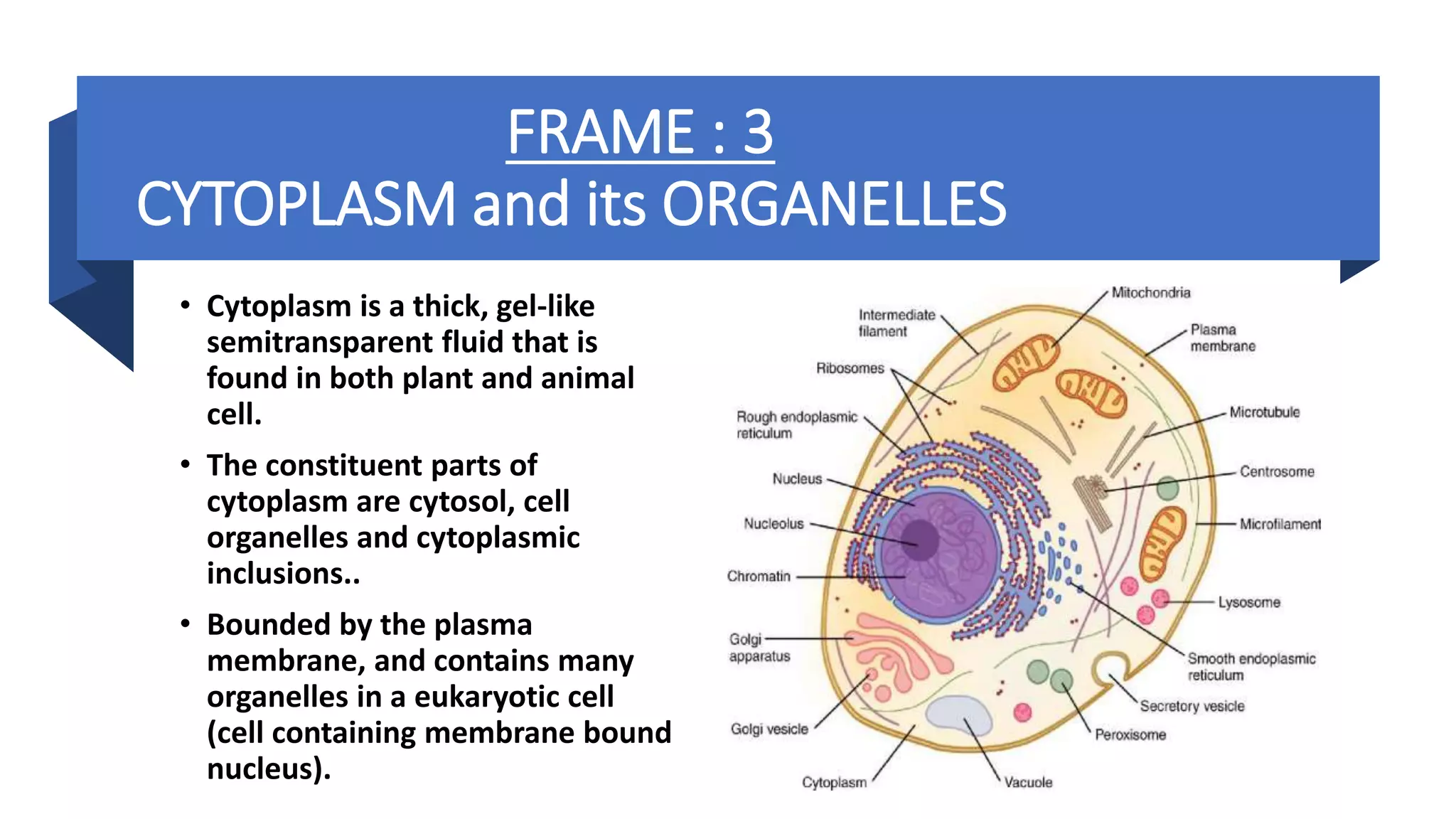
• Cytoplasm is a thick, gel-like
semitransparent fluid that is
found in both plant and animal
cell.
• The constituent parts of
cytoplasm are cytosol, cell
organelles and cytoplasmic
inclusions..
• Bounded by the plasma
membrane, and contains many
organelles in a eukaryotic cell
(cell containing membrane bound
nucleus).
CYTOSOL
• The cytosol, the aqueous part of the cytoplasm outside all of the
organelles, also contains its own distinctive proteins.
• It accounts for almost 70% of the total cell volume.
• Gelatinous substance consisting mainly of cytoskeleton filaments,
organic molecules, salt and water.
• Chemically, the cytoplasmic matrix is composed of many chemical
elements in the form of atoms, ions and molecules.
• Following organelles are present in the Cytoplasm:-.
I. Mitochondria
II. Endoplasmic Reticulum
III. Lysosomes
IV. Golgi Apparatus
V. Peroxisomes
VI. Vacuole
• Each organelle is bounded by a lipid membrane and has specific
functions.
ORGANELLES
MITOCHONDRIA
• The mitochondria were first
observed by Kolliker in 1850 as
granular structures in the
striated muscles.
• Mitochondria are called the
'powerhouse of the cell'.
• STRUCTURE-
• Length- 5-12μm
• Diameter- 0.5-1μm
• Filamentous or globular in shape.
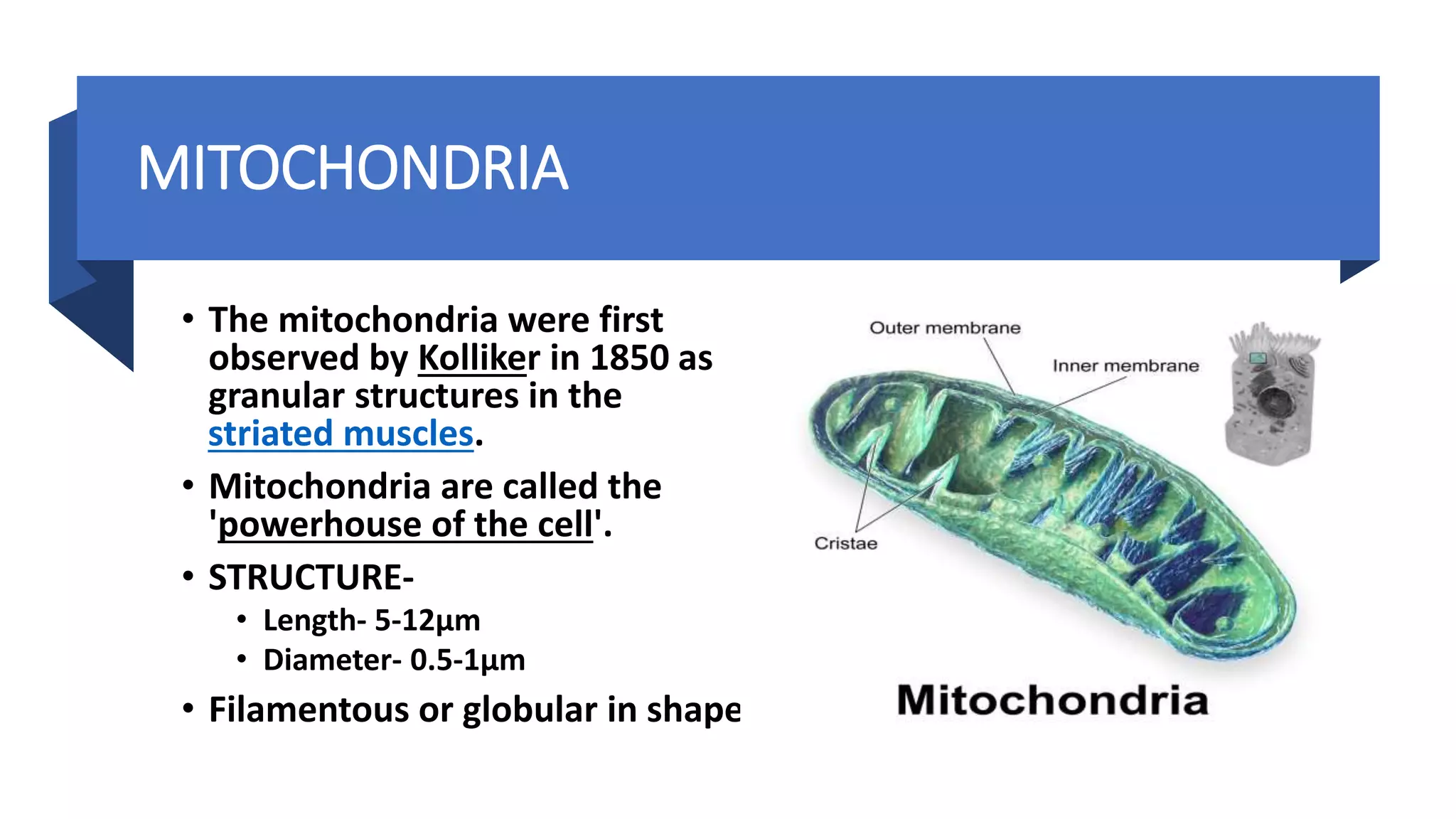
COMPONENTS OF MITOCHONDRIA
I. Outer Membrane
II. Inner Membrane
III. Intermediate Space- space
between outer and inner
membranes
IV. Cristae-Infoldings of inner
membrane
V. Matrix- The space enclosed
by inner membrane.
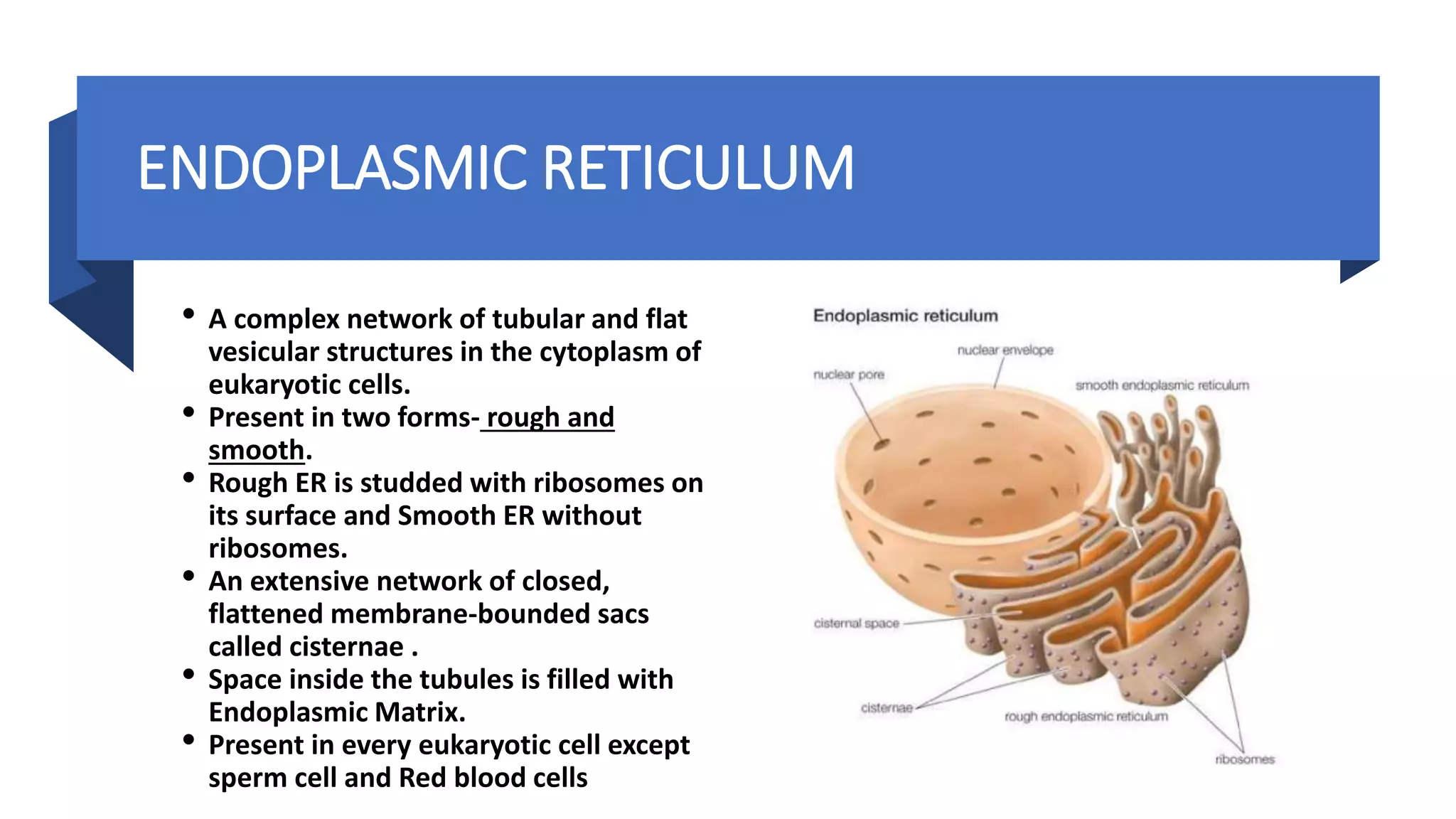
ENDOPLASMIC RETICULUM
• A complex network of tubular and flat
vesicular structures in the cytoplasm of
eukaryotic cells.
• Present in two forms- rough and
smooth.
• Rough ER is studded with ribosomes on
its surface and Smooth ER without
ribosomes.
• An extensive network of closed,
flattened membrane-bounded sacs
called cisternae .
• Space inside the tubules is filled with
Endoplasmic Matrix.
• Present in every eukaryotic cell except
sperm cell and Red blood cells
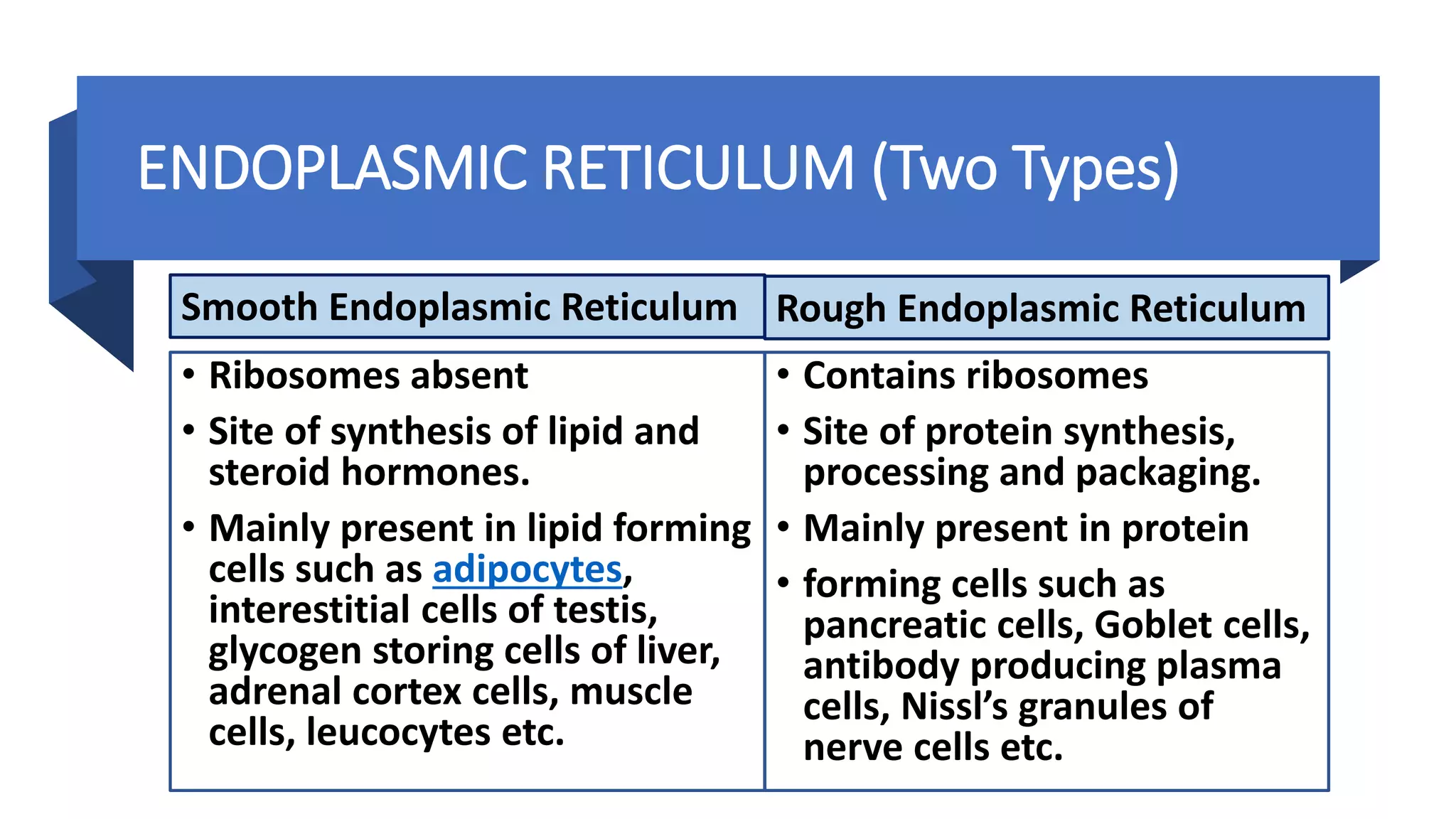
ENDOPLASMIC RETICULUM (Two Types)
• Ribosomes absent
• Site of synthesis of lipid and
steroid hormones.
• Mainly present in lipid forming
cells such as adipocytes,
interestitial cells of testis,
glycogen storing cells of liver,
adrenal cortex cells, muscle
cells, leucocytes etc.
• Contains ribosomes
• Site of protein synthesis,
processing and packaging.
• Mainly present in protein
• forming cells such as
pancreatic cells, Goblet cells,
antibody producing plasma
cells, Nissl’s granules of
nerve cells etc.
Smooth Endoplasmic Reticulum Rough Endoplasmic Reticulum
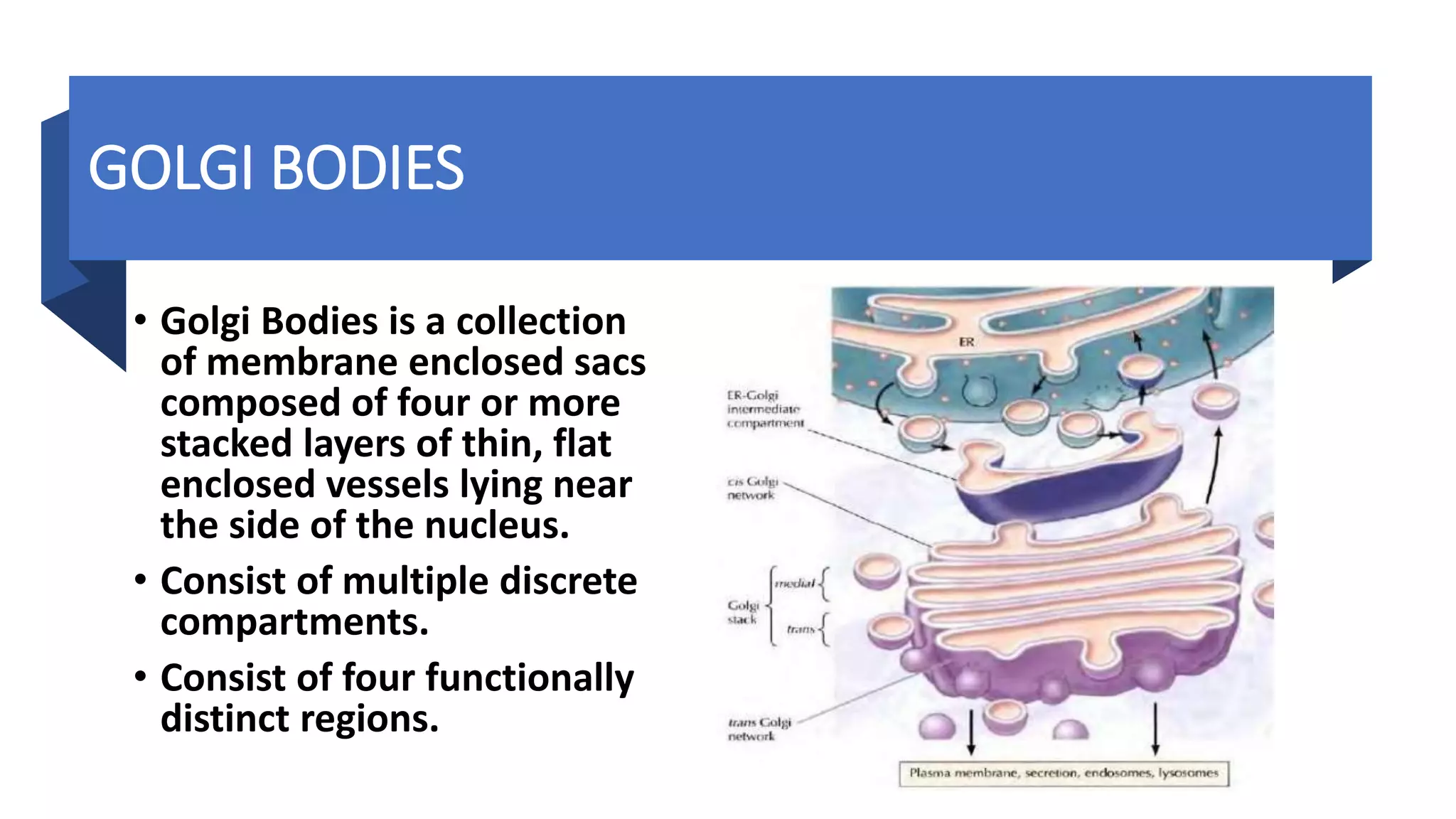
GOLGI BODIES
• Golgi Bodies is a collection
of membrane enclosed sacs
composed of four or more
stacked layers of thin, flat
enclosed vessels lying near
the side of the nucleus.
• Consist of multiple discrete
compartments.
• Consist of four functionally
distinct regions.
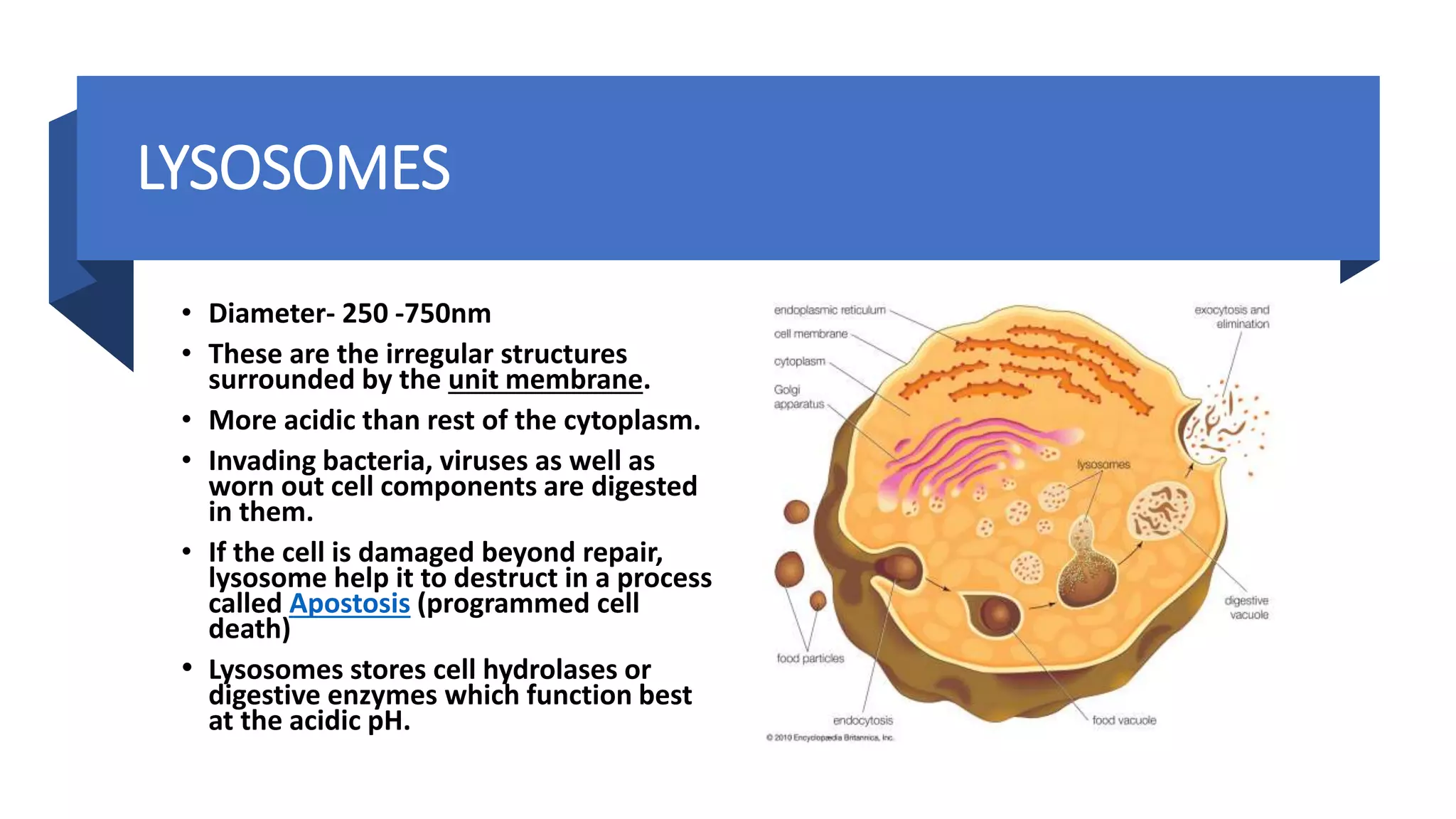
LYSOSOMES
• Diameter- 250 -750nm
• These are the irregular structures
surrounded by the unit membrane.
• More acidic than rest of the cytoplasm.
• Invading bacteria, viruses as well as
worn out cell components are digested
in them.
• If the cell is damaged beyond repair,
lysosome help it to destruct in a process
called Apostosis (programmed cell
death)
• Lysosomes stores cell hydrolases or
digestive enzymes which function best
at the acidic pH.
a) Ribosome
b) Lysosome
c) Mitochondria
1. Name an organelle which serves as primary packaging area for molecules
a) Golgi body
b) Vacuole
c) Peroxisomes
Quiz : Frame 3
2. What is known as the power house of the cell
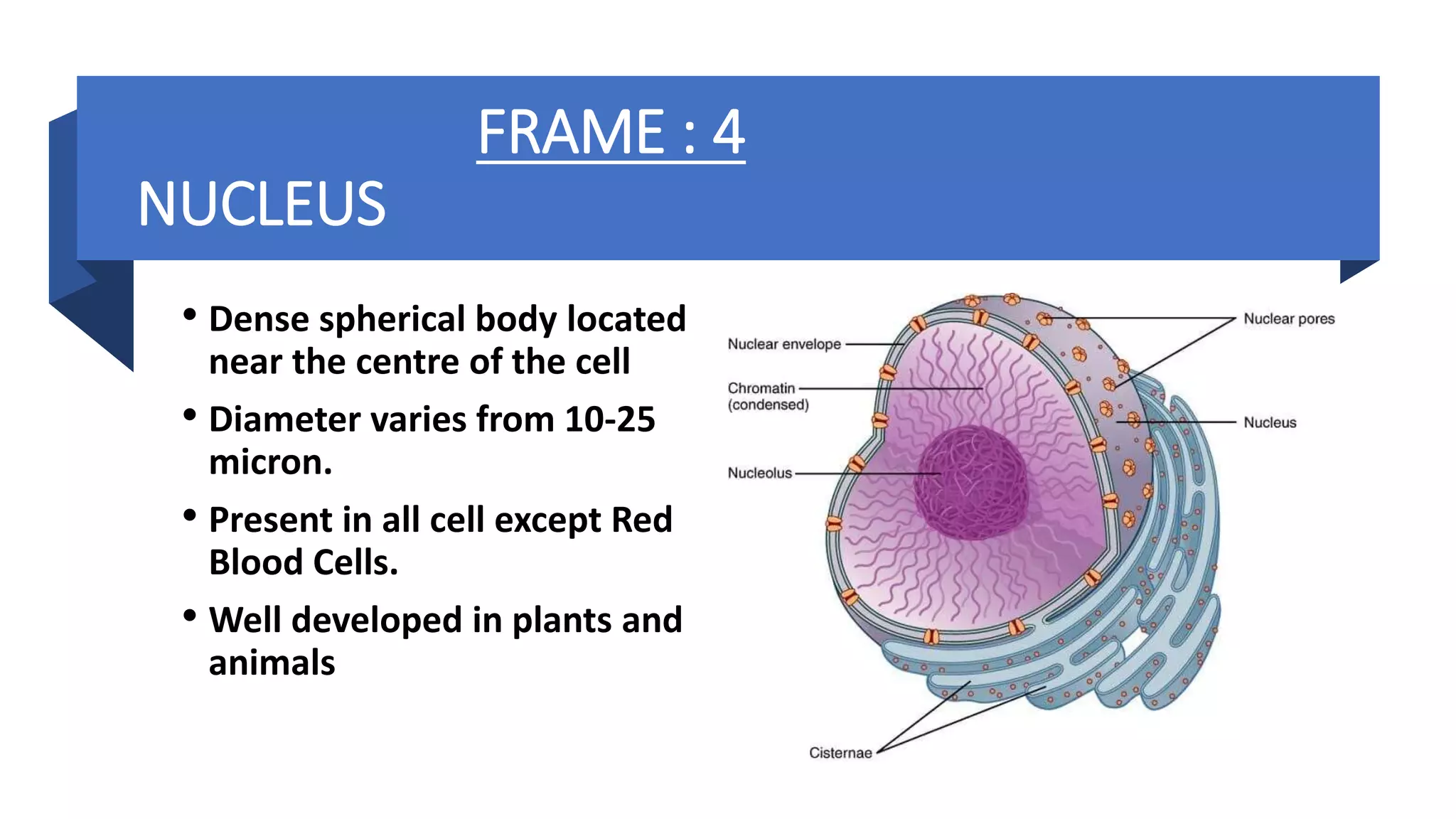
FRAME : 4
NUCLEUS
• Dense spherical body located
near the centre of the cell
• Diameter varies from 10-25
micron.
• Present in all cell except Red
Blood Cells.
• Well developed in plants and
animals
NUCLEUS…
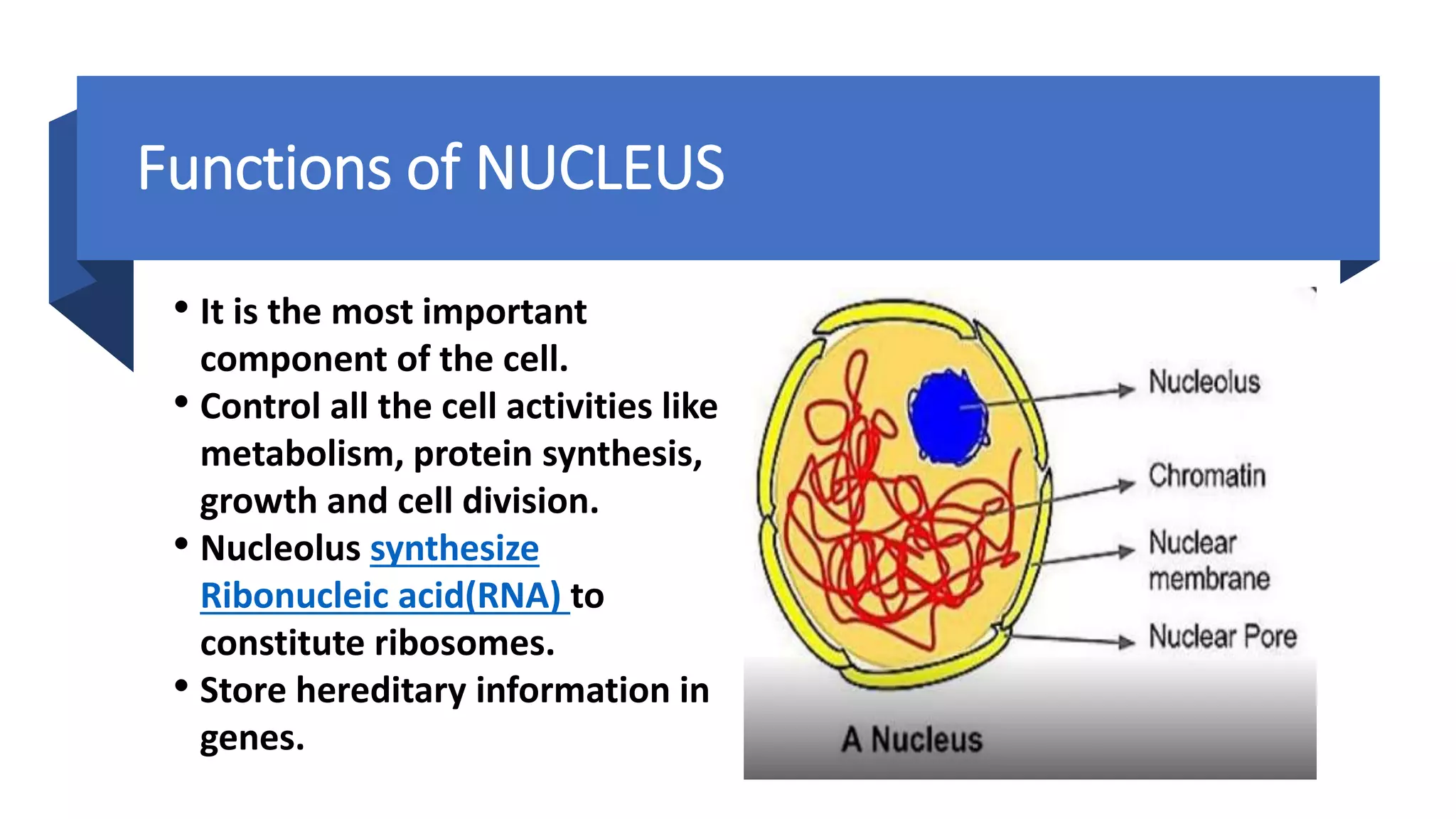
• Colorless dense sap present inside the nucleus known as nucleoplasm.
• Nucleoplasm contains round shaped nucleolus and network of
chromatin fibers.
• Fibers are composed of deoxyribonucleic acid (DNA) and protein
histone.
• These fibers condense to form chromosomes during cell division.
• Chromosomes contain stretches of DNA called genes.
• Genes transfer the hereditary information from one generation to the
next.
Functions of NUCLEUS
• It is the most important
component of the cell.
• Control all the cell activities like
metabolism, protein synthesis,
growth and cell division.
• Nucleolus synthesize
Ribonucleic acid(RNA) to
constitute ribosomes.
• Store hereditary information in
genes.
Quiz : Frame 4
1. Which protein is present chromatin fibers inside nucleus.
a) Histone protein
b) Actin protein
c) Tubulin protein
2. The organelle which controls all the activities of the cell
a) Mitochondria
b) Plastids
c) Nucleus

Cell structure and Function

  • 1.
    Cell membrane FRAME :1 CELL: STRUCTURE AND FUNCTION
  • 2.
    INTRODUCTION • Fundamental unitof life. • Self replicating structure. • The first cells were observed and named by Robert Hooke in 1665 from slice of cork. • Some organisms consist of a single cells called unicellular organism, others are multicellular. • Diameter- 2-120μm. INTRODUCTION
  • 3.
    Proposed by MatthiasSchleiden and Theodor Schwann in 1839:- • All living organisms are made up of cells. • Cells are the smallest working unit of all living things. • All cells come from pre-existing cells through cell division. CELL THEORY
  • 4.
    • Different substancesthat make a cell are collectively called Protoplasm. • Protoplasm is composed of :- 1. Water - 70-80% Water is present in cell. 2. Carbohydrates 3. Lipids 4. Proteins 5. Electrolyte - Sodium (Na+), Potassium (K+), Magnesium (Mg2+), Calcium (Ca2+), Phosphate , Chloride (Cl-), and Bicarbonate (HC03 - ). CONSTITUENTS
  • 5.
    1. Who gavecell theory. a.) Robert Hooke b.) Schleiden and Schwann c.) Albert Von kolliker 2. Who coined the term Cell. a.) Virchow b.) Robert Hooke c.) Fleming Quiz : Frame 1
  • 6.
    FRAME : 2 CELLMEMBRANE • Thin pliable elastic outermost structure which envelops the cell. • Also known as plasma membrane. • It consists of bilipid layer with embedded proteins that are i. Integral Proteins ii. Peripheral proteins
  • 7.
    FUNCTIONS OF CELLMEMBRANE • Protective:- Forms outermost boundary of the cell organelles. • Digestive:- Takes in food and excretes waste products. • Selective Permeability: a) Non-Polar Molecules- Gases (like O2 ,CO2, N2 ), Lipids, Steroid Hormones, Alcohols move rapidly across the membrane. a) Polar molecules:- H2O soluble ions , Glucose, urea etc. have much lower solubility . Therefore Penetrate the membrane much more slowly. b) Chemical and Physical Properties of membrane control the free passage of ions in and out of cell.
  • 8.
    1. The othername of cell membrane a.) Plasma membrane b.) Cell wall c.) Nuclear membrane 2. Cell membrane is …………. permeable. a.) Fully permeable b.) Selectively permeable c.) Non permeable Quiz : Frame 2
  • 9.
    FRAME : 3 CYTOPLASMand its ORGANELLES • Cytoplasm is a thick, gel-like semitransparent fluid that is found in both plant and animal cell. • The constituent parts of cytoplasm are cytosol, cell organelles and cytoplasmic inclusions.. • Bounded by the plasma membrane, and contains many organelles in a eukaryotic cell (cell containing membrane bound nucleus).
  • 10.
    CYTOSOL • The cytosol,the aqueous part of the cytoplasm outside all of the organelles, also contains its own distinctive proteins. • It accounts for almost 70% of the total cell volume. • Gelatinous substance consisting mainly of cytoskeleton filaments, organic molecules, salt and water. • Chemically, the cytoplasmic matrix is composed of many chemical elements in the form of atoms, ions and molecules.
  • 11.
    • Following organellesare present in the Cytoplasm:-. I. Mitochondria II. Endoplasmic Reticulum III. Lysosomes IV. Golgi Apparatus V. Peroxisomes VI. Vacuole • Each organelle is bounded by a lipid membrane and has specific functions. ORGANELLES
  • 12.
    MITOCHONDRIA • The mitochondriawere first observed by Kolliker in 1850 as granular structures in the striated muscles. • Mitochondria are called the 'powerhouse of the cell'. • STRUCTURE- • Length- 5-12μm • Diameter- 0.5-1μm • Filamentous or globular in shape.
  • 13.
    COMPONENTS OF MITOCHONDRIA I.Outer Membrane II. Inner Membrane III. Intermediate Space- space between outer and inner membranes IV. Cristae-Infoldings of inner membrane V. Matrix- The space enclosed by inner membrane.
  • 14.
    ENDOPLASMIC RETICULUM • Acomplex network of tubular and flat vesicular structures in the cytoplasm of eukaryotic cells. • Present in two forms- rough and smooth. • Rough ER is studded with ribosomes on its surface and Smooth ER without ribosomes. • An extensive network of closed, flattened membrane-bounded sacs called cisternae . • Space inside the tubules is filled with Endoplasmic Matrix. • Present in every eukaryotic cell except sperm cell and Red blood cells
  • 15.
    ENDOPLASMIC RETICULUM (TwoTypes) • Ribosomes absent • Site of synthesis of lipid and steroid hormones. • Mainly present in lipid forming cells such as adipocytes, interestitial cells of testis, glycogen storing cells of liver, adrenal cortex cells, muscle cells, leucocytes etc. • Contains ribosomes • Site of protein synthesis, processing and packaging. • Mainly present in protein • forming cells such as pancreatic cells, Goblet cells, antibody producing plasma cells, Nissl’s granules of nerve cells etc. Smooth Endoplasmic Reticulum Rough Endoplasmic Reticulum
  • 16.
    GOLGI BODIES • GolgiBodies is a collection of membrane enclosed sacs composed of four or more stacked layers of thin, flat enclosed vessels lying near the side of the nucleus. • Consist of multiple discrete compartments. • Consist of four functionally distinct regions.
  • 17.
    LYSOSOMES • Diameter- 250-750nm • These are the irregular structures surrounded by the unit membrane. • More acidic than rest of the cytoplasm. • Invading bacteria, viruses as well as worn out cell components are digested in them. • If the cell is damaged beyond repair, lysosome help it to destruct in a process called Apostosis (programmed cell death) • Lysosomes stores cell hydrolases or digestive enzymes which function best at the acidic pH.
  • 18.
    a) Ribosome b) Lysosome c)Mitochondria 1. Name an organelle which serves as primary packaging area for molecules a) Golgi body b) Vacuole c) Peroxisomes Quiz : Frame 3 2. What is known as the power house of the cell
  • 19.
    FRAME : 4 NUCLEUS •Dense spherical body located near the centre of the cell • Diameter varies from 10-25 micron. • Present in all cell except Red Blood Cells. • Well developed in plants and animals
  • 20.
    NUCLEUS… • Colorless densesap present inside the nucleus known as nucleoplasm. • Nucleoplasm contains round shaped nucleolus and network of chromatin fibers. • Fibers are composed of deoxyribonucleic acid (DNA) and protein histone. • These fibers condense to form chromosomes during cell division. • Chromosomes contain stretches of DNA called genes. • Genes transfer the hereditary information from one generation to the next.
  • 21.
    Functions of NUCLEUS •It is the most important component of the cell. • Control all the cell activities like metabolism, protein synthesis, growth and cell division. • Nucleolus synthesize Ribonucleic acid(RNA) to constitute ribosomes. • Store hereditary information in genes.
  • 22.
    Quiz : Frame4 1. Which protein is present chromatin fibers inside nucleus. a) Histone protein b) Actin protein c) Tubulin protein 2. The organelle which controls all the activities of the cell a) Mitochondria b) Plastids c) Nucleus