Image Pre-Processing:
    Image Restoration
            Ashish Khare
 Imagerestoration - suppressing image
 degradation using knowledge about its nature
Image restoration as inverse
    convolution of the whole image
   Most image restoration methods are based on
    convolution applied globally to the whole image.

   Degradation causes:
       defects of optical lenses,
       nonlinearity of the electro-optical sensor,
       graininess of the film material,
       relative motion between an object and camera
       wrong focus,
       atmospheric turbulence in remote sensing or astronomy,
       etc.
 Theobjective of image restoration is to
 reconstruct the original image from its
 degraded version.

 Image   restoration techniques - two groups:
   Deterministic methods - applicable to images with
    little noise and a known degradation function.
       The original image is obtained from the degraded one by a
        transformation inverse to the degradation.

   Stochastic techniques - the best restoration is
    sought according to some stochastic criterion, e.g.,
    a least squares method.
       In some cases the degradation transformation must be
        estimated first.
   It is advantageous to know the degradation function
    explicitly.

   The better this knowledge is, the better are the
    results of the restoration.

   There are three typical degradations with a simple
    function:
       Relative constant speed movement of the object with
        respect to the camera,
       wrong lens focus,
       and atmospheric turbulence.
 Inmost practical cases, there is insufficient
  knowledge about the degradation, and it must
  be estimated and modeled.
   Methods:
       A priori knowledge about degradation - either known in
        advance or obtained before restoration.
       If it is clear in advance that the image was degraded by
        relative motion of an object with respect to the sensor then
        the modeling only determines the speed and direction of
        the motion.

   An example of parameters obtained before
    restoration is an attempt to estimate parameters of a
    capturing device such as a TV camera or digitizer.
   A posteriori knowledge is obtained by analyzing
    the degraded image.

   A typical example is to find some interest points in
    the image (e.g. corners, straight lines) and guess
    how they looked before degradation.

   Another possibility is to use spectral characteristics
    of the regions in the image that are relatively
    homogeneous.
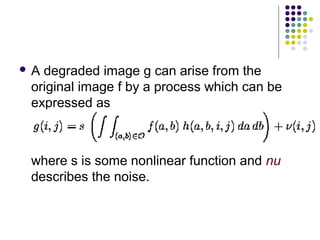
A degraded image g can arise from the
 original image f by a process which can be
 expressed as


 where s is some nonlinear function and nu
 describes the noise.
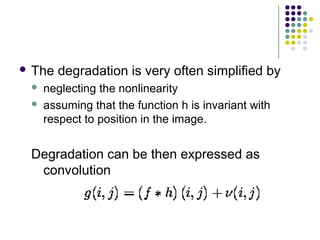
 The   degradation is very often simplified by
    neglecting the nonlinearity
    assuming that the function h is invariant with
     respect to position in the image.


 Degradation can be then expressed as
  convolution
 Ifthe degradation is given by above equation
  and the noise is not significant then image
  restoration equates to inverse convolution
  (also called deconvolution).

 Ifnoise is not negligible then the inverse
  convolution is solved as an overdetermined
  system of linear equations.
Degradations that are
           easy to restore
 Some  degradations can be easily expressed
 mathematically (convolution) and also
 restored simply in images.

 TheFourier transform H of the convolution
 function is used.
Relative motion of
     the camera and object
 Assume an image is acquired with a camera
 with a mechanical shutter.

 Relativemotion of the camera and the
 photographed object during the shutter open
 time T causes smoothing of the object in the
 image.
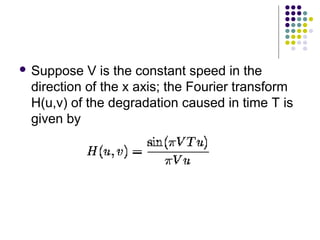
 Suppose  V is the constant speed in the
 direction of the x axis; the Fourier transform
 H(u,v) of the degradation caused in time T is
 given by
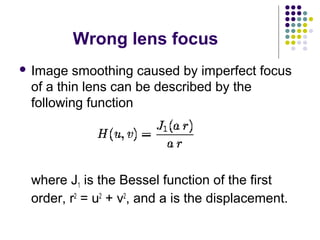
Wrong lens focus
 Image  smoothing caused by imperfect focus
 of a thin lens can be described by the
 following function


 where J1 is the Bessel function of the first
 order, r2 = u2 + v2, and a is the displacement.
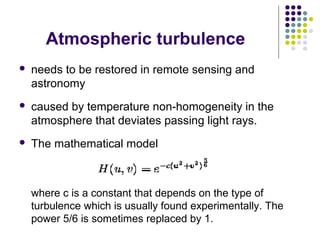
Atmospheric turbulence
   needs to be restored in remote sensing and
    astronomy
   caused by temperature non-homogeneity in the
    atmosphere that deviates passing light rays.
   The mathematical model


    where c is a constant that depends on the type of
    turbulence which is usually found experimentally. The
    power 5/6 is sometimes replaced by 1.
Inverse filtration
 based on the assumption that degradation
  was caused by a linear function h(i,j)

 theadditive noise nu is another source of
  degradation.

 Itis further assumed that nu is independent
  of the signal.
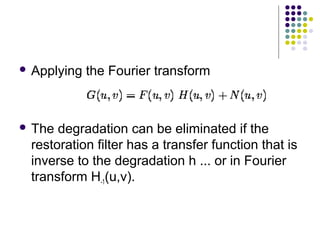
 Applying   the Fourier transform


 The degradation can be eliminated if the
 restoration filter has a transfer function that is
 inverse to the degradation h ... or in Fourier
 transform H-1(u,v).
 Theundegraded image F is derived from its
 degraded version G.


 Thisequation shows that inverse filtration
 works well for images that are not corrupted
 by noise.
   If noise is present and additive error occurs, its
    influence is significant for frequencies where H(u,v)
    has small magnitude. These usually correspond to
    high frequencies u,v and thus fine details are blurred
    in the image.
   The changing level of noise may cause problems as
    well because small magnitudes of H(u,v) can cause
    large changes in the result.
   Inverse filter values should not be of zero value so
    as to avoid zero divides in above equation.
Wiener filtration
 Itis no surprise that inverse filtration gives
  poor results in pixels suffering from noise
  since the noise is not taken into account.

 Wiener  filtration explores a priori knowledge
  about the noise.
 Restoration by the Wiener filter gives an
 estimate of the original uncorrupted image f
 with minimal mean square error e2
 No   constraints applied to above equation
    optimal estimate ^f is the conditional mean value
     of the ideal image f under the condition g
    complicated from the computational point of view
    also, the conditional probability density between
     the optimal image f and the corrupted image g is
     not usually known.
    the optimal estimate is in general a nonlinear
     function of the image g.
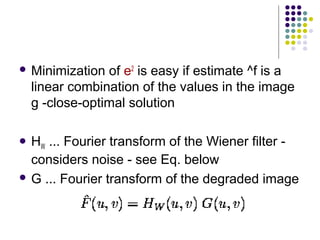
 Minimization of e2 is easy if estimate ^f is a
  linear combination of the values in the image
  g -close-optimal solution

H   ... Fourier transform of the Wiener filter -
     W
  considers noise - see Eq. below
 G ... Fourier transform of the degraded image
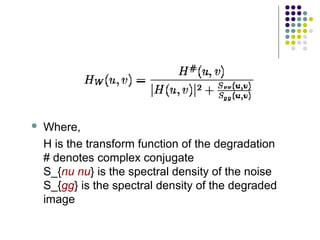
   Where,
    H is the transform function of the degradation
    # denotes complex conjugate
    S_{nu nu} is the spectral density of the noise
    S_{gg} is the spectral density of the degraded
    image
   If Wiener filtration is used, the nature of degradation
    H and statistical parameters of the noise need to be
    known.

   Wiener filtration theory solves the problem of a
    posteriori linear mean square estimate -- all statistics
    (e.g., power spectrum) should be available in
    advance.

   Note that the inverse filter discussed earlier is a
    special case of the Wiener filter where noise is
    absent i.e. S_{nu nu} = 0.

Image pre processing-restoration

  • 1.
    Image Pre-Processing: Image Restoration Ashish Khare
  • 2.
     Imagerestoration -suppressing image degradation using knowledge about its nature
  • 3.
    Image restoration asinverse convolution of the whole image  Most image restoration methods are based on convolution applied globally to the whole image.  Degradation causes:  defects of optical lenses,  nonlinearity of the electro-optical sensor,  graininess of the film material,  relative motion between an object and camera  wrong focus,  atmospheric turbulence in remote sensing or astronomy,  etc.
  • 4.
     Theobjective ofimage restoration is to reconstruct the original image from its degraded version.  Image restoration techniques - two groups:
  • 5.
    Deterministic methods - applicable to images with little noise and a known degradation function.  The original image is obtained from the degraded one by a transformation inverse to the degradation.  Stochastic techniques - the best restoration is sought according to some stochastic criterion, e.g., a least squares method.  In some cases the degradation transformation must be estimated first.
  • 6.
    It is advantageous to know the degradation function explicitly.  The better this knowledge is, the better are the results of the restoration.  There are three typical degradations with a simple function:  Relative constant speed movement of the object with respect to the camera,  wrong lens focus,  and atmospheric turbulence.
  • 7.
     Inmost practicalcases, there is insufficient knowledge about the degradation, and it must be estimated and modeled.
  • 8.
    Methods:  A priori knowledge about degradation - either known in advance or obtained before restoration.  If it is clear in advance that the image was degraded by relative motion of an object with respect to the sensor then the modeling only determines the speed and direction of the motion.  An example of parameters obtained before restoration is an attempt to estimate parameters of a capturing device such as a TV camera or digitizer.
  • 9.
    A posteriori knowledge is obtained by analyzing the degraded image.  A typical example is to find some interest points in the image (e.g. corners, straight lines) and guess how they looked before degradation.  Another possibility is to use spectral characteristics of the regions in the image that are relatively homogeneous.
  • 10.
    A degraded imageg can arise from the original image f by a process which can be expressed as where s is some nonlinear function and nu describes the noise.
  • 11.
     The degradation is very often simplified by  neglecting the nonlinearity  assuming that the function h is invariant with respect to position in the image. Degradation can be then expressed as convolution
  • 12.
     Ifthe degradationis given by above equation and the noise is not significant then image restoration equates to inverse convolution (also called deconvolution).  Ifnoise is not negligible then the inverse convolution is solved as an overdetermined system of linear equations.
  • 13.
    Degradations that are easy to restore  Some degradations can be easily expressed mathematically (convolution) and also restored simply in images.  TheFourier transform H of the convolution function is used.
  • 14.
    Relative motion of the camera and object  Assume an image is acquired with a camera with a mechanical shutter.  Relativemotion of the camera and the photographed object during the shutter open time T causes smoothing of the object in the image.
  • 15.
     Suppose V is the constant speed in the direction of the x axis; the Fourier transform H(u,v) of the degradation caused in time T is given by
  • 16.
    Wrong lens focus Image smoothing caused by imperfect focus of a thin lens can be described by the following function where J1 is the Bessel function of the first order, r2 = u2 + v2, and a is the displacement.
  • 17.
    Atmospheric turbulence  needs to be restored in remote sensing and astronomy  caused by temperature non-homogeneity in the atmosphere that deviates passing light rays.  The mathematical model where c is a constant that depends on the type of turbulence which is usually found experimentally. The power 5/6 is sometimes replaced by 1.
  • 18.
    Inverse filtration  basedon the assumption that degradation was caused by a linear function h(i,j)  theadditive noise nu is another source of degradation.  Itis further assumed that nu is independent of the signal.
  • 19.
     Applying the Fourier transform  The degradation can be eliminated if the restoration filter has a transfer function that is inverse to the degradation h ... or in Fourier transform H-1(u,v).
  • 20.
     Theundegraded imageF is derived from its degraded version G.  Thisequation shows that inverse filtration works well for images that are not corrupted by noise.
  • 21.
    If noise is present and additive error occurs, its influence is significant for frequencies where H(u,v) has small magnitude. These usually correspond to high frequencies u,v and thus fine details are blurred in the image.  The changing level of noise may cause problems as well because small magnitudes of H(u,v) can cause large changes in the result.  Inverse filter values should not be of zero value so as to avoid zero divides in above equation.
  • 22.
    Wiener filtration  Itisno surprise that inverse filtration gives poor results in pixels suffering from noise since the noise is not taken into account.  Wiener filtration explores a priori knowledge about the noise.
  • 23.
     Restoration bythe Wiener filter gives an estimate of the original uncorrupted image f with minimal mean square error e2
  • 24.
     No constraints applied to above equation  optimal estimate ^f is the conditional mean value of the ideal image f under the condition g  complicated from the computational point of view  also, the conditional probability density between the optimal image f and the corrupted image g is not usually known.  the optimal estimate is in general a nonlinear function of the image g.
  • 25.
     Minimization ofe2 is easy if estimate ^f is a linear combination of the values in the image g -close-optimal solution H ... Fourier transform of the Wiener filter - W considers noise - see Eq. below  G ... Fourier transform of the degraded image
  • 26.
    Where, H is the transform function of the degradation # denotes complex conjugate S_{nu nu} is the spectral density of the noise S_{gg} is the spectral density of the degraded image
  • 27.
    If Wiener filtration is used, the nature of degradation H and statistical parameters of the noise need to be known.  Wiener filtration theory solves the problem of a posteriori linear mean square estimate -- all statistics (e.g., power spectrum) should be available in advance.  Note that the inverse filter discussed earlier is a special case of the Wiener filter where noise is absent i.e. S_{nu nu} = 0.