


Introduction
       to
Computer Vision

ashishkhare@jkinstitute.org
goals of field of vision
• understand how animals represent and
  process information carried by light, by
  – measuring and modeling visual performance
    in humans and other animals
  – finding ways to build artificial visual systems
  – characterizing neural mechanisms that
• implement visual systems
  – apply this understanding to obtain medical,
    technological advances
processing of images in humans
• as a first approximation, rods and cones
  (sensory cells in the retina) represent image as
  large 2D array of light intensities
  – about 126 million sensory cells!
• this image representation is processed by brain
  enabling complex cognitive functions
  – recognize a familiar face or scene
  – disambiguate overlapping objects
  – read sloppy handwriting
• how does the brain do all of this? how might
  image processing be partitioned into subtasks?
image processing tasks of brain
• possible tasks:
  – extraction of contour (e.g. sharp light intensity
    changes in the image)
  – extraction of motion
  – identification of object parts
• still unclear: how are these integrated to
  enable us to extract meaning from what
  we see?
psychophysical experiments
• used to test hypotheses about how the
  brain/mind processes optical information
Examples
• Inattentional Blindness
• Change Blindness
• Figure-Ground Segregation
Inattentional Blindness
Mack & Rock (1998)
• Definition: the failure to see consciously, caused by
  lack of attention
• We can miss perceiving very obvious changes if we
  are not attending. Subjects do not consciously
  perceive features of the visual scene that they do
  not attend to.
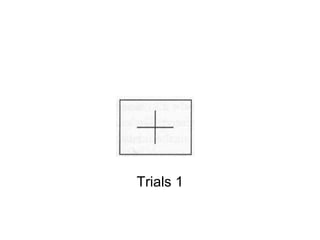
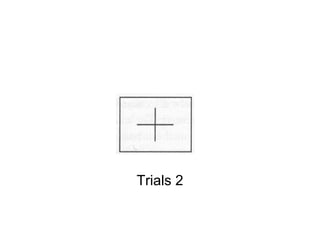
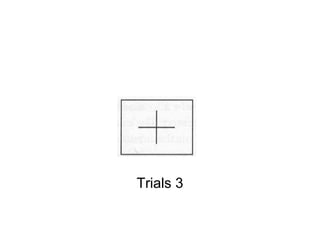
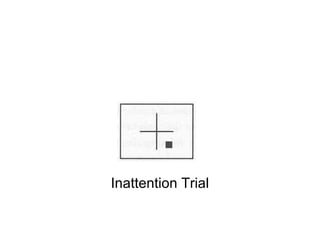
• Subjects were engaged in tasks that demanded a
  high degree of attention, such as looking at a cross
  and trying to determine which arm is longer.
Trials 1
Trials 2
Trials 3
Inattention Trial
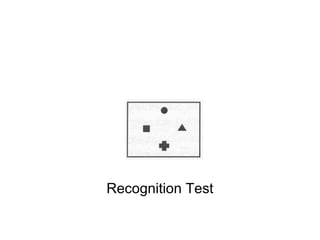
Recognition Test
Inattentional Blindness
• 25% of subjects failed to see the square when it was
  presented in the parafovea (2° from fixation).
• But 65% failed to see it when it was at fixation!
• What is missed?
   – Sad or Neutral face
   – A word (priming for the word is present)
• What is not missed?
   – Name
   – Smiling face
Change Blindness
• Change Blindness is the phenomena were
  we fail to perceive large changes, in our
  surroundings as well as in experimental
  conditions.
• Change could be in existence, properties,
  semantic identity and spatial layout.
• Attention is required to perceive change,
  and in the absence of localized motion
  signals, attention is directed by high level
  of interest (Rensink et al, 1997).
Flicker paradigm


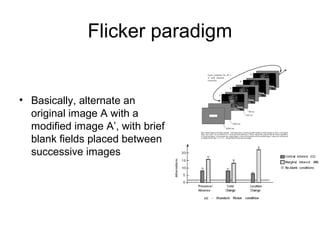
• Basically, alternate an
  original image A with a
  modified image A’, with brief
  blank fields placed between
  successive images
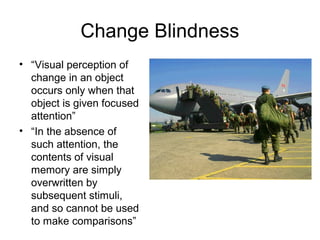
Change Blindness
• “Visual perception of
  change in an object
  occurs only when that
  object is given focused
  attention”
• “In the absence of
  such attention, the
  contents of visual
  memory are simply
  overwritten by
  subsequent stimuli,
  and so cannot be used
  to make comparisons”
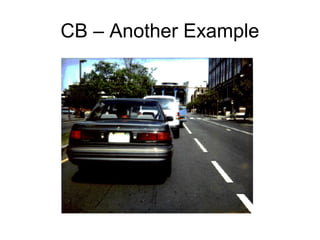
CB – Another Example
Why CB?
• Change blindness could be due to –
  – Poor representation of pre- and post change
    scene or
  – Pre change representation gets over-written
    by post change representation or
  – Capacity to retrieve and compare information
    is limited (Hollingworth, 2003).
• Color change detection with multi-element
  displays
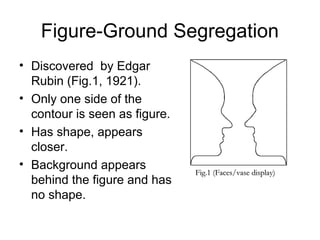
Figure-Ground Segregation
• Discovered by Edgar
  Rubin (Fig.1, 1921).
• Only one side of the
  contour is seen as figure.
• Has shape, appears
  closer.
• Background appears
                               Fig.1 (Faces/vase display)
  behind the figure and has
  no shape.
Background
• Configural cues:
            – symmetry
            – convexity
            – area        ………….. Gestalt psychologists


• Lower region
•      lower region of a display will be seen as figure than the upper
  region.           (Vecera et al. 2002)

• Top-bottom polarity
•       Stimuli having wide base and narrow top were perceived as
  figures than the ones which had narrow base and wide top.
•                                 (Hulleman and Humphreys, 2004)
• Higher cognitive processes
                 » Object memory (Mary Peterson et al. 1991)
                 » Attention ( Vecera et al. 2004)
Motivation
• Palmer and his colleagues conducted a study in which
  they used temporal frequency (flicker) and manipulated
  edge synchrony with the two regions (left and right).
• They concluded from their studies that edge plays the
  key role in determining figure-ground segregation. In
  their study they found that the region with which the
  edge synchronizes will be seen as figure irrespective of
  whether the region is flickering or not.
• Wong and Weisstein (1987) demonstrated that spatial
  and temporal frequencies play a major role in assigning
  figural status to a region.
Reference Books
• Fundamentals of Digital Image Processing:
  Anil K. Jain
• Digital Image Processing: Gonzalez & Woods
• The Image Processing Handbook: J.C. Russ
• Digital Image Processing: B. Jahne

• Image Processing, Analysis and Machine
  Vision: M. Sonka, V. Hlavac, R. Boyle
• Computer Vision Handbook: B. Jahne
• Computer Vision: M. Brady

Introduction vision

  • 1.
    Introduction to Computer Vision ashishkhare@jkinstitute.org
  • 24.
    goals of fieldof vision • understand how animals represent and process information carried by light, by – measuring and modeling visual performance in humans and other animals – finding ways to build artificial visual systems – characterizing neural mechanisms that • implement visual systems – apply this understanding to obtain medical, technological advances
  • 25.
    processing of imagesin humans • as a first approximation, rods and cones (sensory cells in the retina) represent image as large 2D array of light intensities – about 126 million sensory cells! • this image representation is processed by brain enabling complex cognitive functions – recognize a familiar face or scene – disambiguate overlapping objects – read sloppy handwriting • how does the brain do all of this? how might image processing be partitioned into subtasks?
  • 27.
    image processing tasksof brain • possible tasks: – extraction of contour (e.g. sharp light intensity changes in the image) – extraction of motion – identification of object parts • still unclear: how are these integrated to enable us to extract meaning from what we see?
  • 28.
    psychophysical experiments • usedto test hypotheses about how the brain/mind processes optical information
  • 29.
    Examples • Inattentional Blindness •Change Blindness • Figure-Ground Segregation
  • 30.
    Inattentional Blindness Mack &Rock (1998) • Definition: the failure to see consciously, caused by lack of attention • We can miss perceiving very obvious changes if we are not attending. Subjects do not consciously perceive features of the visual scene that they do not attend to. • Subjects were engaged in tasks that demanded a high degree of attention, such as looking at a cross and trying to determine which arm is longer.
  • 31.
  • 32.
  • 33.
  • 34.
  • 35.
  • 36.
    Inattentional Blindness • 25%of subjects failed to see the square when it was presented in the parafovea (2° from fixation). • But 65% failed to see it when it was at fixation! • What is missed? – Sad or Neutral face – A word (priming for the word is present) • What is not missed? – Name – Smiling face
  • 37.
    Change Blindness • ChangeBlindness is the phenomena were we fail to perceive large changes, in our surroundings as well as in experimental conditions. • Change could be in existence, properties, semantic identity and spatial layout. • Attention is required to perceive change, and in the absence of localized motion signals, attention is directed by high level of interest (Rensink et al, 1997).
  • 38.
    Flicker paradigm • Basically,alternate an original image A with a modified image A’, with brief blank fields placed between successive images
  • 39.
    Change Blindness • “Visualperception of change in an object occurs only when that object is given focused attention” • “In the absence of such attention, the contents of visual memory are simply overwritten by subsequent stimuli, and so cannot be used to make comparisons”
  • 40.
  • 41.
    Why CB? • Changeblindness could be due to – – Poor representation of pre- and post change scene or – Pre change representation gets over-written by post change representation or – Capacity to retrieve and compare information is limited (Hollingworth, 2003). • Color change detection with multi-element displays
  • 42.
    Figure-Ground Segregation • Discoveredby Edgar Rubin (Fig.1, 1921). • Only one side of the contour is seen as figure. • Has shape, appears closer. • Background appears Fig.1 (Faces/vase display) behind the figure and has no shape.
  • 43.
    Background • Configural cues: – symmetry – convexity – area ………….. Gestalt psychologists • Lower region • lower region of a display will be seen as figure than the upper region. (Vecera et al. 2002) • Top-bottom polarity • Stimuli having wide base and narrow top were perceived as figures than the ones which had narrow base and wide top. • (Hulleman and Humphreys, 2004) • Higher cognitive processes » Object memory (Mary Peterson et al. 1991) » Attention ( Vecera et al. 2004)
  • 44.
    Motivation • Palmer andhis colleagues conducted a study in which they used temporal frequency (flicker) and manipulated edge synchrony with the two regions (left and right). • They concluded from their studies that edge plays the key role in determining figure-ground segregation. In their study they found that the region with which the edge synchronizes will be seen as figure irrespective of whether the region is flickering or not. • Wong and Weisstein (1987) demonstrated that spatial and temporal frequencies play a major role in assigning figural status to a region.
  • 45.
    Reference Books • Fundamentalsof Digital Image Processing: Anil K. Jain • Digital Image Processing: Gonzalez & Woods • The Image Processing Handbook: J.C. Russ • Digital Image Processing: B. Jahne • Image Processing, Analysis and Machine Vision: M. Sonka, V. Hlavac, R. Boyle • Computer Vision Handbook: B. Jahne • Computer Vision: M. Brady