Image Restoration
Image Restoration
◼ Restoration is a process of reconstruction or
recovering an image that has been degraded by
using some a priori knowledge of the
degradation phenomenon.
◼ It is objective which means that restoration
techniques are oriented toward modeling the
degradation and applying the inverse process in
order to recover the original image.
2
Degradations
4
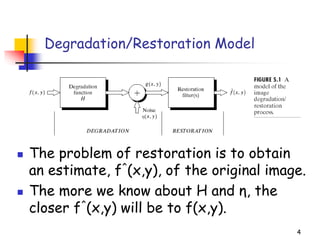
Degradation/Restoration Model
◼ The problem of restoration is to obtain
an estimate, f^(x,y), of the original image.
◼ The more we know about H and η, the
closer f^(x,y) will be to f(x,y).
Degradation/Restoration Model
◼ In the Spatial domain
◼ In the Frequency domain
◼ IF we know the values of H and N, we could
recover F as given
◼ This may not practical. Even though we may have
some statistical information about the noise. As
well H(,u,v) may be close to, or equal to zero. 5
)
,
(
)
,
(
*
)
,
(
)
,
( y
x
y
x
f
y
x
h
y
x
g 
+
=
)
,
(
)
,
(
).
,
(
)
,
( v
u
N
v
u
F
v
u
H
v
u
G +
=
)
,
(
)
,
(
)
,
(
)
,
(
v
u
H
v
u
N
v
u
G
v
u
F
−
=
Noise Properties and models
◼ The principle source of noise arises during image
acquisition and/or transmission.
◼ Assuming noise is independent of spatial coordinates
and uncorrelated with respect to the image itself.
◼ Concerning with the statistical behavior of the gray-
level values in the noise component.
◼ Considering random variables characterized by a
Probability Density Function (PDF).
6
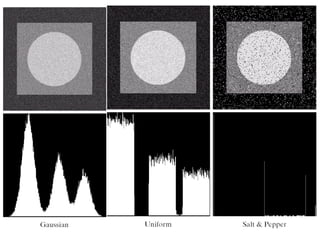
Gaussian noise
◼ It is used frequently in practice
7
Uniform noise







−
=
otherwise
0
if
1
)
(
b
z
a
a
b
z
p
12
)
(
2
2
2 a
b
b
a
−
=
+
=


Mean:
Variance:
◼ Less practical, used for random number
generator
9
Impulse (salt-and-pepper) noise
• If b>a, gray-level b will appear
as a light dot. Conversely, level
a will appear like a dark dot if
either Pa or Pb is zero.
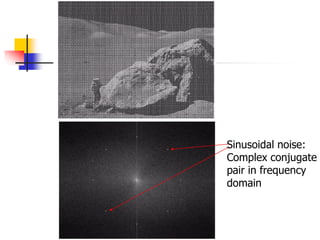
Periodic noise
◼ Arise from electrical or
electromechanical interference during
image acquisition
◼ Spatial dependence
◼ Observed in the frequency domain
Sinusoidal noise:
Complex conjugate
pair in frequency
domain
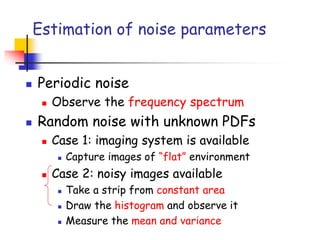
Estimation of noise parameters
◼ Periodic noise
◼ Observe the frequency spectrum
◼ Random noise with unknown PDFs
◼ Case 1: imaging system is available
◼ Capture images of “flat” environment
◼ Case 2: noisy images available
◼ Take a strip from constant area
◼ Draw the histogram and observe it
◼ Measure the mean and variance
Observe the histogram
Gaussian uniform
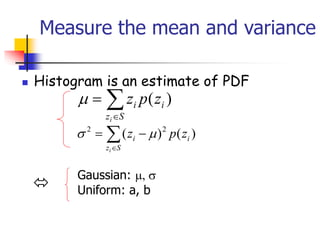
◼ Histogram is an estimate of PDF
Measure the mean and variance


=
S
z
i
i
i
z
p
z )
(



−
=
S
z
i
i
i
z
p
z )
(
)
( 2
2



Gaussian: , 
Uniform: a, b
Restoration in the presence of noise-
spatial filtering
◼ A method of choice in situations when
only additive noise is present
◼ Enhancement and restoration become
almost indistinguishable disciplines when
only additive noise is present
16
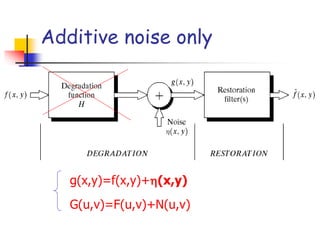
Additive noise only
g(x,y)=f(x,y)+(x,y)
G(u,v)=F(u,v)+N(u,v)
Spatial filters for de-noising
additive noise
◼ Skills similar to image enhancement
◼ Mean filters
◼ Order-statistics filters
◼ Adaptive filters
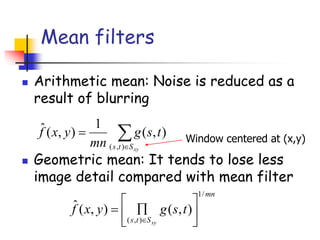
Mean filters
◼ Arithmetic mean: Noise is reduced as a
result of blurring
◼ Geometric mean: It tends to lose less
image detail compared with mean filter


=
xy
S
t
s
t
s
g
mn
y
x
f
)
,
(
)
,
(
1
)
,
(
ˆ
Window centered at (x,y)
mn
S
t
s
t
s
g
y
x
f
xy
/
1
)
,
(
)
,
(
)
,
(
ˆ







=

Mean filters (cont.)
◼ Harmonic mean filter
◼ Contra-harmonic mean filter




+
=
xy
xy
S
t
s
Q
S
t
s
Q
t
s
g
t
s
g
y
x
f
)
,
(
)
,
(
1
)
,
(
)
,
(
)
,
(
ˆ


=
xy
S
t
s t
s
g
mn
y
x
f
)
,
( )
,
(
1
)
,
(
ˆ
Q=-1, harmonic
Q=0, airth. mean
Q=+, ?
21
22
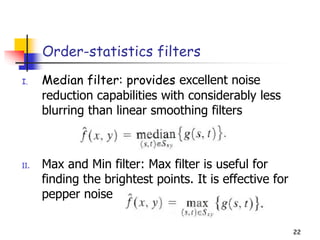
Order-statistics filters
I. Median filter: provides excellent noise
reduction capabilities with considerably less
blurring than linear smoothing filters
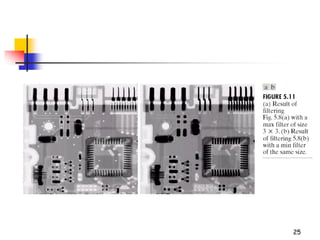
II. Max and Min filter: Max filter is useful for
finding the brightest points. It is effective for
pepper noise
22
23
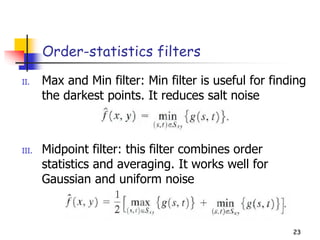
Order-statistics filters
II. Max and Min filter: Min filter is useful for finding
the darkest points. It reduces salt noise
III. Midpoint filter: this filter combines order
statistics and averaging. It works well for
Gaussian and uniform noise
23
24
25
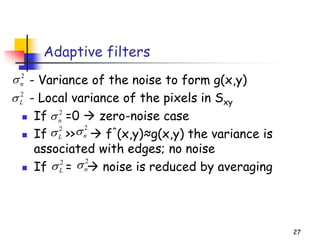
Adaptive filters
◼ The behavior changes based on statistical
characteristics of the image inside the filter
region defined by window Sxy.
◼ Its performance superior to the previous
filter
◼ Local noise reduction filter:
ML-local mean of the pixels in Sxy
26
Adaptive filters
- Variance of the noise to form g(x,y)
- Local variance of the pixels in Sxy
◼ If =0 → zero-noise case
◼ If >> → f^(x,y)≈g(x,y) the variance is
associated with edges; no noise
◼ If = → noise is reduced by averaging
27
2
n

2
L

2
n

2
n

2
L

2
n

2
L

28
Periodic noise reduction
◼ Pure sine wave
◼ Appear as a pair of impulse (conjugate) in
the frequency domain
)
sin(
)
,
( 0
0 y
v
x
u
A
y
x
f +
=






+
+
−
−
−
−
= )
2
,
2
(
)
2
,
2
(
2
)
,
( 0
0
0
0






v
v
u
u
v
v
u
u
A
j
v
u
F
Periodic noise reduction
(cont.)
◼ Bandreject filters
◼ Bandpass filters
◼ Notch filters
Bandreject filters
* Reject an isotropic frequency
ideal Butterworth Gaussian
Bandreject filters
32
Bandreject filters (Cont.)
noisy spectrum
bandreject
filtered
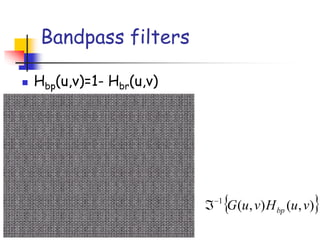
Bandpass filters
◼ Hbp(u,v)=1- Hbr(u,v)
 
)
,
(
)
,
(
1
v
u
H
v
u
G bp
−

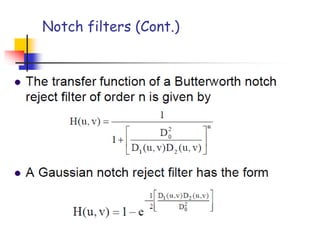
Notch filters
◼ Reject(or pass) frequencies in predefined
neighborhoods about a center frequency
ideal
Butterworth Gaussian
Notch filters (Cont.)
Horizontal
Scan lines
Notch
pass
DFT
Notch
pass
Notch
reject
Estimating the degradation function
◼ Estimation by Image observation
◼ Estimation by experimentation
◼ Estimation by modeling
Estimation by image observation
◼ Take a window in the image
◼ Simple structure
◼ Strong signal content
◼ Estimate the original image in the window
)
,
(
ˆ
)
,
(
)
,
(
v
u
F
v
u
G
v
u
H
s
s
s =
known
estimate
Estimation by experimentation
◼ If the image acquisition system is ready
◼ Obtain the impulse response
impulse Impulse response
Estimation by experimentation
(Cont.)
43
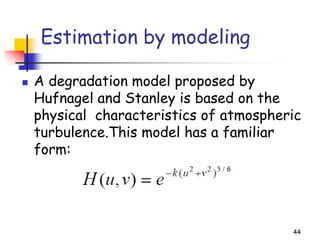
Estimation by modeling
◼ A degradation model proposed by
Hufnagel and Stanley is based on the
physical characteristics of atmospheric
turbulence.This model has a familiar
form:
44
Estimation by modeling
◼ Ex. Atmospheric model
6
/
5
2
2
)
(
)
,
( v
u
k
e
v
u
H +
−
=
original k=0.0025
k=0.001 k=0.00025
Estimation by modeling
Estimation by modeling: example
original Apply motion model
Inverse filtering
◼ The simplest approach is direct inverse filtering
In the presence of noise, substituting the
following eqn. into the above Eqn.
Yields,
49
Inverse filtering
◼ With the estimated degradation function
H(u,v)
G(u,v)=F(u,v)H(u,v)+N(u,v)
=>
)
,
(
)
,
(
)
,
(
)
,
(
)
,
(
)
,
(
ˆ
v
u
H
v
u
N
v
u
F
v
u
H
v
u
G
v
u
F +
=
=
Estimate of
original image
Problem: 0 or small values
Unknown
noise
Sol: limit the frequency
around the origin
Min. Mean Square Error (Wiener)
filtering
◼ Incorporating both the degradation fn. and
statistical characteristics of noise into the
restoration process
◼ Assume noise and image are uncorrelated
◼ Based on these conditions, the minimum of the
error function is given in the frequency domain
by the expression
51
Min. Mean Square Error (Wiener)
filtering
Min. Mean Square Error (Wiener)
filtering
Where,
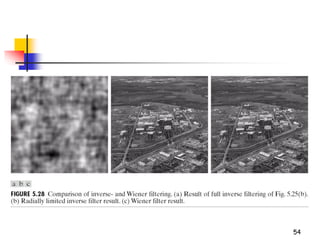
53
• If Sη and Sf are not known, we set ratio (Sη /Sf ) with
specified constant K
• If Sη =0 (absence of noise), the filter reduces to the ideal
inverse filter
54
Image Restoration in Matlab
Image Restoration in Matlab (Cont.)

Ch5_Restoration (1).pdf

  • 1.
  • 2.
    Image Restoration ◼ Restorationis a process of reconstruction or recovering an image that has been degraded by using some a priori knowledge of the degradation phenomenon. ◼ It is objective which means that restoration techniques are oriented toward modeling the degradation and applying the inverse process in order to recover the original image. 2
  • 3.
  • 4.
    4 Degradation/Restoration Model ◼ Theproblem of restoration is to obtain an estimate, f^(x,y), of the original image. ◼ The more we know about H and η, the closer f^(x,y) will be to f(x,y).
  • 5.
    Degradation/Restoration Model ◼ Inthe Spatial domain ◼ In the Frequency domain ◼ IF we know the values of H and N, we could recover F as given ◼ This may not practical. Even though we may have some statistical information about the noise. As well H(,u,v) may be close to, or equal to zero. 5 ) , ( ) , ( * ) , ( ) , ( y x y x f y x h y x g  + = ) , ( ) , ( ). , ( ) , ( v u N v u F v u H v u G + = ) , ( ) , ( ) , ( ) , ( v u H v u N v u G v u F − =
  • 6.
    Noise Properties andmodels ◼ The principle source of noise arises during image acquisition and/or transmission. ◼ Assuming noise is independent of spatial coordinates and uncorrelated with respect to the image itself. ◼ Concerning with the statistical behavior of the gray- level values in the noise component. ◼ Considering random variables characterized by a Probability Density Function (PDF). 6
  • 7.
    Gaussian noise ◼ Itis used frequently in practice 7
  • 8.
  • 9.
    9 Impulse (salt-and-pepper) noise •If b>a, gray-level b will appear as a light dot. Conversely, level a will appear like a dark dot if either Pa or Pb is zero.
  • 11.
    Periodic noise ◼ Arisefrom electrical or electromechanical interference during image acquisition ◼ Spatial dependence ◼ Observed in the frequency domain
  • 12.
  • 13.
    Estimation of noiseparameters ◼ Periodic noise ◼ Observe the frequency spectrum ◼ Random noise with unknown PDFs ◼ Case 1: imaging system is available ◼ Capture images of “flat” environment ◼ Case 2: noisy images available ◼ Take a strip from constant area ◼ Draw the histogram and observe it ◼ Measure the mean and variance
  • 14.
  • 15.
    ◼ Histogram isan estimate of PDF Measure the mean and variance   = S z i i i z p z ) (    − = S z i i i z p z ) ( ) ( 2 2    Gaussian: ,  Uniform: a, b
  • 16.
    Restoration in thepresence of noise- spatial filtering ◼ A method of choice in situations when only additive noise is present ◼ Enhancement and restoration become almost indistinguishable disciplines when only additive noise is present 16
  • 17.
  • 18.
    Spatial filters forde-noising additive noise ◼ Skills similar to image enhancement ◼ Mean filters ◼ Order-statistics filters ◼ Adaptive filters
  • 19.
    Mean filters ◼ Arithmeticmean: Noise is reduced as a result of blurring ◼ Geometric mean: It tends to lose less image detail compared with mean filter   = xy S t s t s g mn y x f ) , ( ) , ( 1 ) , ( ˆ Window centered at (x,y) mn S t s t s g y x f xy / 1 ) , ( ) , ( ) , ( ˆ        = 
  • 20.
    Mean filters (cont.) ◼Harmonic mean filter ◼ Contra-harmonic mean filter     + = xy xy S t s Q S t s Q t s g t s g y x f ) , ( ) , ( 1 ) , ( ) , ( ) , ( ˆ   = xy S t s t s g mn y x f ) , ( ) , ( 1 ) , ( ˆ Q=-1, harmonic Q=0, airth. mean Q=+, ?
  • 21.
  • 22.
    22 Order-statistics filters I. Medianfilter: provides excellent noise reduction capabilities with considerably less blurring than linear smoothing filters II. Max and Min filter: Max filter is useful for finding the brightest points. It is effective for pepper noise 22
  • 23.
    23 Order-statistics filters II. Maxand Min filter: Min filter is useful for finding the darkest points. It reduces salt noise III. Midpoint filter: this filter combines order statistics and averaging. It works well for Gaussian and uniform noise 23
  • 24.
  • 25.
  • 26.
    Adaptive filters ◼ Thebehavior changes based on statistical characteristics of the image inside the filter region defined by window Sxy. ◼ Its performance superior to the previous filter ◼ Local noise reduction filter: ML-local mean of the pixels in Sxy 26
  • 27.
    Adaptive filters - Varianceof the noise to form g(x,y) - Local variance of the pixels in Sxy ◼ If =0 → zero-noise case ◼ If >> → f^(x,y)≈g(x,y) the variance is associated with edges; no noise ◼ If = → noise is reduced by averaging 27 2 n  2 L  2 n  2 n  2 L  2 n  2 L 
  • 28.
  • 29.
    Periodic noise reduction ◼Pure sine wave ◼ Appear as a pair of impulse (conjugate) in the frequency domain ) sin( ) , ( 0 0 y v x u A y x f + =       + + − − − − = ) 2 , 2 ( ) 2 , 2 ( 2 ) , ( 0 0 0 0       v v u u v v u u A j v u F
  • 30.
    Periodic noise reduction (cont.) ◼Bandreject filters ◼ Bandpass filters ◼ Notch filters
  • 31.
    Bandreject filters * Rejectan isotropic frequency ideal Butterworth Gaussian
  • 32.
  • 33.
  • 34.
  • 35.
    Bandpass filters ◼ Hbp(u,v)=1-Hbr(u,v)   ) , ( ) , ( 1 v u H v u G bp − 
  • 36.
    Notch filters ◼ Reject(orpass) frequencies in predefined neighborhoods about a center frequency ideal Butterworth Gaussian
  • 37.
  • 38.
  • 39.
  • 40.
    Estimating the degradationfunction ◼ Estimation by Image observation ◼ Estimation by experimentation ◼ Estimation by modeling
  • 41.
    Estimation by imageobservation ◼ Take a window in the image ◼ Simple structure ◼ Strong signal content ◼ Estimate the original image in the window ) , ( ˆ ) , ( ) , ( v u F v u G v u H s s s = known estimate
  • 42.
    Estimation by experimentation ◼If the image acquisition system is ready ◼ Obtain the impulse response impulse Impulse response
  • 43.
  • 44.
    Estimation by modeling ◼A degradation model proposed by Hufnagel and Stanley is based on the physical characteristics of atmospheric turbulence.This model has a familiar form: 44
  • 45.
    Estimation by modeling ◼Ex. Atmospheric model 6 / 5 2 2 ) ( ) , ( v u k e v u H + − = original k=0.0025 k=0.001 k=0.00025
  • 46.
  • 47.
  • 48.
    Estimation by modeling:example original Apply motion model
  • 49.
    Inverse filtering ◼ Thesimplest approach is direct inverse filtering In the presence of noise, substituting the following eqn. into the above Eqn. Yields, 49
  • 50.
    Inverse filtering ◼ Withthe estimated degradation function H(u,v) G(u,v)=F(u,v)H(u,v)+N(u,v) => ) , ( ) , ( ) , ( ) , ( ) , ( ) , ( ˆ v u H v u N v u F v u H v u G v u F + = = Estimate of original image Problem: 0 or small values Unknown noise Sol: limit the frequency around the origin
  • 51.
    Min. Mean SquareError (Wiener) filtering ◼ Incorporating both the degradation fn. and statistical characteristics of noise into the restoration process ◼ Assume noise and image are uncorrelated ◼ Based on these conditions, the minimum of the error function is given in the frequency domain by the expression 51
  • 52.
    Min. Mean SquareError (Wiener) filtering
  • 53.
    Min. Mean SquareError (Wiener) filtering Where, 53 • If Sη and Sf are not known, we set ratio (Sη /Sf ) with specified constant K • If Sη =0 (absence of noise), the filter reduces to the ideal inverse filter
  • 54.
  • 55.
  • 56.
    Image Restoration inMatlab (Cont.)