Resource
Management
Introduction

• A resource can be logical, such as a
  shared file or physical such as CPU.

• The set of available resources in a
  distributed system acts like a single
  virtual system.
Cont…
• Resource manager:
  – Controls the assignment of resources to
    processes.
  – Routes the processes to suitable nodes of
    the system in such a manner that resource
    usage, response time, network congestion,
    and scheduling overhead are optimized.
Techniques

Task assignment approach:
• Each process submitted by a user for
  processing is viewed as a collection of
  related tasks.

• Tasks are scheduled to suitable nodes to
  improve performance.
Cont…
Load-balancing approach:
• All the processes submitted by the users are
  distributed among the nodes of the system.

• Equalizes the workload among the nodes.
Cont…
Load-sharing approach:
• Attempts to conserve the ability of the
  system, assuring that no node is idle while
  processes wait for being processed.
Desirable features of a good
         Scheduling Algorithms
•   No a priori knowledge about the processes.
•   Dynamic in nature.
•   Quick decision-making capability.
•   Balanced system performance.
•   Stability.
•   Scalability.
•   Fault tolerance.
•   Fairness of service.
Task assignment approach
• A process is considered to be composed
  of multiple task.

• Goal is to find an optimal assignment
  policy for the task of an individual
  process.
Cont…
Assumptions:
 1. A process has already been split into
   pieces called tasks.
 2. Amount of computation required by each
   task and speed of each processor are
   known.
 3. The cost of processing each task on
   every node of the system is known.
 4. The IPC costs between every pair of task
   is known.
Cont…
5. Other constraints, like Resource
  requirements of the tasks and the
  available resources at each node are
  also known.

6. Reassignment of the tasks is generally
  not possible.
Cont…

• Goals:
   Minimization of IPC costs
   Quick turnaround time for the complete process
   A high degree of parallelism
   Efficient utilization of system resources in general


• These goals often conflict with each other.
Cont…
• Two task assignment parameters
  – Task execution cost and

  – Inter-task communication cost
Cont…: Example
• Total tasks = 6

• Total nodes = 2
Cont…

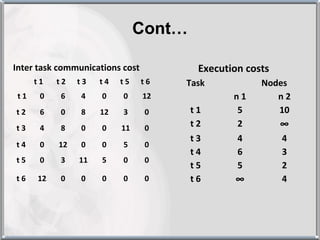
Inter task communications cost          Execution costs
      t1   t2   t3   t4   t5     t6   Task           Nodes
 t1    0   6    4    0    0      12            n1       n2
t2     6   0    8    12   3      0     t1      5        10
t3     4   8    0    0    11     0     t2      2          ∞
                                       t3       4         4
t4     0   12   0    0    5      0
                                       t4       6         3
t5     0   3    11   5    0      0
                                       t5       5         2
t6    12   0    0    0    0      0     t6      ∞          4
Cont…
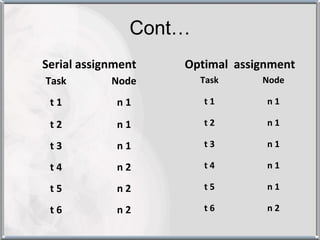
Serial assignment   Optimal assignment
Task        Node       Task     Node

 t1          n1        t1        n1

 t2          n1        t2        n1

 t3          n1        t3        n1

 t4          n2        t4        n1

 t5          n2        t5        n1

 t6          n2        t6        n2
Cont…
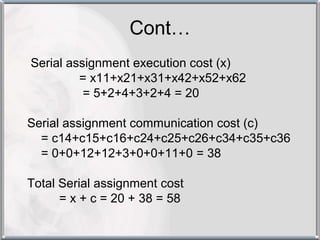
Serial assignment execution cost (x)
         = x11+x21+x31+x42+x52+x62
          = 5+2+4+3+2+4 = 20

Serial assignment communication cost (c)
  = c14+c15+c16+c24+c25+c26+c34+c35+c36
  = 0+0+12+12+3+0+0+11+0 = 38

Total Serial assignment cost
      = x + c = 20 + 38 = 58
Cont…
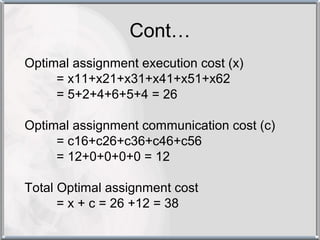
Optimal assignment execution cost (x)
     = x11+x21+x31+x41+x51+x62
     = 5+2+4+6+5+4 = 26

Optimal assignment communication cost (c)
     = c16+c26+c36+c46+c56
     = 12+0+0+0+0 = 12

Total Optimal assignment cost
      = x + c = 26 +12 = 38
Load balancing approach
• Load balancing Algorithms are also known as
  load-leveling algorithms.
  – Based on the intuition of better resource utilization.

• Algorithm tries to balance the total system load
  by transparently transferring the workload from
  heavily loaded nodes to lightly loaded nodes.

• Goal: maximize the total system throughput.
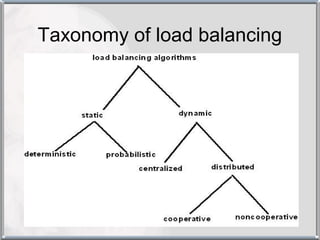
Taxonomy of load balancing
Static vs. Dynamic

• Static algorithms:
  • Use only information about the average
    behavior of the system, ignoring the current
    state of the system.

  • Simpler because no need to maintain and
    process system state information.

  • Do not react to the current system state.
Cont…
• Dynamic algorithms:
  • React to the system state that changes
    dynamically.

  • Able to avoid those state with unnecessarily
    poor performance.

  • More complex than static algorithms.
Deterministic vs. Probabilistic

• Both are Static load balancing algorithms.

• Deterministic algorithms:
  – Use the information about the properties of
    the node and characteristics of the processes.

  – Difficult to   optimize   and   cost   more   to
    implement.
Cont…
• Probabilistic algorithms:
  – Use information regarding static attributes of
    the system.

  – Easier to implement.

  – Suffer from having poor performance.
Centralized vs. Distributed
• Centralized algorithm:
  – The responsibility of scheduling       physically
    resides on a single node.

  – System state information is collected at a single
    node at which all the scheduling decisions are
    made.
     • Known as Centralized server node.
Cont…
– Problem : reliability
   • If the centralized server fails, all scheduling in the
     system would cease.

– Solution : replicate the server on K+1 nodes if it
  is to survive k faults.
Cont…

• Distributed algorithms:
  – The work involved in making process assignment
    decisions is physically distributed among the
    various nodes of the system.

  – Avoids the bottleneck of        collecting   state
    information at a single node.

  – Allows the scheduler to react quickly to dynamic
    changes in the state.
Cont…


– Algorithm is composed of entities known as local
  controllers.

– Each entity is responsible for making scheduling
  decisions for the processes of its own node.
Co-operative vs. Non-Cooperative
•        Non-cooperative algorithms :
     •     Individual entities act as autonomous entities
           and make scheduling decisions independently of
           the actions of other entities.
Cont…
• Cooperative algorithms:
  • Distributed entities cooperate with each other to
    make scheduling decisions.

  • More complex and involve larger overhead than
    non-cooperative.
Issues in designing load
           balancing algorithms
•   Load estimation policy
•   Process transfer policy
•   State information exchange policy
•   Location policy
•   Priority assignment policy
•   Migration limiting policy
Cont…
• Local Process
  – A process which is processed at its
    originated node.


• Remote Process
  – A process which is processed at a node
    different than the one on which it
    originated.
Load Estimation Policies

• Estimation based on parameters like:
  1. Total no. of processes on the node at the
    time of load estimation.

  2. Resource demands of these processes.

  3. Instruction mixes of these processes.

  4. Architecture and speed of the node’s
    processor.
Cont…
• Sum of the remaining service times of
  all the processes on a node can be a
  measure for estimating a node’s
  workload.

• Issue: how to estimate the remaining
  service time of the processes?
Cont…
•   Solutions:
    1. Memoryless method
      •   This method assumes that all processes have
          the same expected remaining service time,
          independent of the time used so far.

      •   It reduces the load estimation method to that
          of total number of processes.
Cont…
2.Pastrepeats
  •   This method assumes that the remaining
      service time of a process is equal to the time
      used so far by it.


3.Distribution method
  •   If the distribution of service times is known,
      the associated process’s remaining service
      time is the expected remaining time
      conditioned by the time already used.
Process Transfer Policies
• Load balancing algorithms use the threshold
  policy to decide whether a node is lightly or
  heavily loaded.

• The threshold value of a node:
  – the limiting value of its workload,
  – used to decide whether a node is lightly or heavily
    loaded.
Cont…
•    Methods to determine the threshold
     value of a node:

    1. Static policy
       •   Each node has a predefined threshold value
           depending on its processing capability.
       •   This value does not vary with the dynamic
           changes in workload at local or remote nodes.
       •   No exchange of state information among the
           nodes to decide this value.
Cont…
2. Dynamic policy
   • The threshold value of a node is calculated as a
     product of the average workload of all the nodes
     and a predefined constant (ci).

   • Nodes exchange state information by using one of
     the state information exchange policies.

   • It gives a more realistic value of threshold for each
     node.

   • Involves overhead in exchange of state information.
Cont…
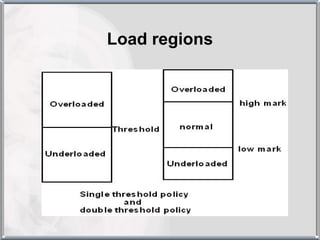
• Most load balancing algorithms uses a single
  threshold and thus only have overloaded and
  under loaded regions.
Load regions
Cont… : Single-threshold policy
• A node accepts new processes (either local or
  remote) based on its load.
  – Accepts if load is below the threshold value.

  – Rejects if load is above the threshold value.


• It makes scheduling algorithms unstable.
Cont…
– A node should only transfer one or more of its
  processes to another node if such transfers
  greatly improves the performance of the rest of
  its local processes.

– A node should accept remote processes if its
  load is such that the added workload of
  processing these incoming processes does not
  significantly affect the service to the local ones.
Cont… : Double-threshold policy

• Also known as high-low policy.

• Use of two threshold values: high mark
  and low mark.

• Three regions :
  – Overloaded
  – Normal
  – Under loaded
Cont…
• For overloaded region:
  – New local processes are sent to be run
    remotely and requests to accept remote
    processes are rejected.


• For normal region:
  – New local processes run locally and
    requests to accept remote processes are
    rejected.
Cont…

• For underloaded region:
  – New local processes run locally and
    requests to accept remote processes are
    accepted.
Location policies

1.   Threshold
2.   Shortest
3.   Bidding
4.   Pairing
Cont… : Threshold
• A destination node is selected at random.

• A check is made to determine
  – whether the transfer of the process to that
    node would place it in a state that prohibits
    the node to accept remote processes.

  – If not, the process is transferred to the
    selected node, which must execute the
    process regardless of its state when the
    process actually arrives.
Cont…
• If the check indicates that the selected node is
  in a state that prohibits it to accept remote
  processes, another node is selected at random
  and probed in the same manner.

• A static probe limit LP is used here.

• The performance with a small probe limit (e.g.
  3 or 5) is almost as good as the performance
  with a large probe limit (e.g. 20).
Cont… : Shortest
• LP distinct nodes are chosen at random and
  each is polled in turn to determine its load.

• The process is transferred to the node having
  the minimum load value, unless that node’s
  load is such that it prohibits the node to
  accept remote processes.
Cont…
• If none of the polled node can accept the
  process, it is executed at its originating node.

• Discontinue probing whenever a node with
  zero load is encountered.
Cont… : Bidding
• Each node in the network is responsible for
  two roles : manager and contractor.

• The Manager represents a node having a
  process in need of a location to execute.

• The Contractor represents a node that is able
  to accept remote processes.
Cont…
• To select a node for its processes, a manager
  broadcasts a request-for-bids message to all
  other nodes in the system.

• The contractors return bids to the manager
  node.

• Manager transfers the process to the node
  with best bid.
Cont…
• Problem:
  – A contractor may win many bids from many
    other manager nodes and thus becomes
    overloaded.


• Solution:
  – On choosing best bid, manager node may
    send a message to the owner of that bid
    and send process on acknowledgement.
Cont…
• Both manager and contractor are free
  to take decisions.

• Drawback of bidding policy:
  – Communication overhead
  – Difficult to decide a good pricing policy.
Cont… : Pairing
• This policy reduces the variance of loads only
  between pairs of nodes of the system.

• Two nodes that differ greatly in load are
  temporarily paired with each other.

• The load-balancing operation is carried out
  between the nodes belonging to the same
  pair.
Cont…
• A node only tries to find a partner if it has at
  least two processes; otherwise migration from
  this node is never reasonable.

• Use of random selection of pair.

• The pair is broken as soon as the process
  migration is over.
State information exchange
               policies

1.   Periodic broadcast
2.   Broadcast when state changes
3.   On- demand exchange
4.   Exchange by polling
Cont…: Periodic broadcast
• Each node broadcasts its state information
  after the elapse of every t units of time.

• Generates heavy traffic.

• Possibility of   fruitless   messages   being
  broadcast.

• Poor scalability problem.
Cont…: Broadcast when state
            changes

• A node broadcasts its state information
  only when its state changes.
  – When a process arrives at that node or
    when a process departs from that node.

  – When its state switches from the normal
    load region to either the underloaded
    region or the overloaded region.
    • Works with two-threshold transfer policy.
Cont…: On- demand exchange
• A node broadcasts a StateInformationRequest
  message when its state switches from the
  normal load region to either the underloaded
  region or the overloaded region.

• Receiving nodes send their current state to the
  requesting node.

• Policy works with two-threshold transfer policy.
Cont…
• The status of the requesting node is included
  in the StateInformationRequest message.

• If this status is
   – Underloaded, only overloaded nodes will
      respond to it.

  – Overloaded, only underloaded nodes will
    respond to it.
Cont…: Exchange by polling
• No need for a node to exchange its state
  information with all other nodes in the system.

• When a node needs the cooperation of some
  other node for load balancing, it can search
  for a suitable partner by randomly polling the
  other nodes one by one.
Priority Assignment Policies


1. Selfish
2. Altruistic
3. Intermediate
Cont…
• Selfish:
  – Local processes are given higher priority
    than remote processes.

  – Yields   the  worst    response              time
    performance among other policies.
     • Poor performance of remote processes.

     • Best response time for local processes.
Cont…
• Altruistic:
  – Remote processes are given higher priority
    than local processes.

  – Policy has best response time of the three
    policies.
Cont…
• Intermediate:
   – The priority of processes depends on the
     number of local processes and the number
     of remote processes at the concerned
     node.
   – If no. of local nodes is greater than or
     equal to the no. of remote processes,
     priority will be given to local processes
     otherwise to remote processes.
   – Overall response time performance is
     much closer to that of the altruistic policy.
Migration- limiting policies

• A decision about the total no. of times a
  process should be allowed to migrate.

• Two migration-limiting policies:
  – Uncontrolled
  – Controlled
Cont…

• Uncontrolled
  – A remote process arriving at a node is treated just
    as a process originating at the node.
  – A process may be migrated any no of times.
Cont…
• Controlled
  – To overcome the instability problem of the
    uncontrolled policy, most system treat remote
    processes different from local processes and
    use a migration count parameter.
Load sharing approach
• For the proper utilization of the resources of
  a distributed system it is not required to
  balance the load on all the nodes.

• It is necessary and sufficient to prevent the
  nodes from being idle while some other
  node have more than two processes.
Cont…
• This rectification is often called dynamic load
  sharing instead of dynamic load balancing.
Issues in designing load-sharing
            algorithms

• Load sharing algorithms do not attempt to balance the
  average workload on all the nodes of the system,
  rather they only attempt to ensure that no node is idle
  when a node is heavily loaded.

• The priority assignment policies and migration limiting
  policies are same as that for the load-balancing
  algorithms. Other policies are described here.
Cont… : Load Estimation Policy

• It is sufficient to know whether a node is busy
  or idle.

• Methods for estimating load:
  – Count the total number of processes on a node.
  – Measure CPU utilization.
Cont… : Process transfer policies
• All-or-nothing strategy:
  – Uses the single threshold policy with the threshold
    value of all the node fixed at 1 and some uses 2.

  – Drawback : Loss of available processing power in
    the system.

  – Solution : use a threshold value of 2 instead of 1.
Location policies

1. Sender-initiated policy
2. Receiver-initiated policy
Sender initiated location policy
• Heavily loaded nodes search for lightly loaded
  node to which work may be transferred.

• When load becomes more than the threshold
  value, it either broadcasts a message or randomly
  probes the other nodes one by one to find a lightly
  loaded node.
Cont…
• In the broadcasting method, the presence or
  absence of a suitable receiver node is known as
  soon as the sender node receives reply messages
  from the other nodes.
Cont…

• In the random probing method, the probing
  continues until either a suitable node is found or
  the no. of probes reaches a static probe limit, Lp.

• Fixed limit has better scalability than broadcast
  method.
Receiver-initiated location policy
• Lightly loaded node search for heavily loaded nodes
  from which work may be transferred.

• When a node’s load falls below the threshold value
  either it broadcasts a message indicating its
  willingness to receive processes or randomly probes
  the other nodes one by one to find a heavily loaded
  node.

•    In the broadcast method, a suitable node is found as
    soon as the receiver node receives reply messages
    from the other nodes.
Cont…
• In the random probing method, the probing
  continues until either a suitable node is found
  or the no. of probes reaches a static probe
  limit, Lp.
Cont…
• Both sender-initiated and receiver-initiated
  policies   offer    substantial performance
  advantages over the situation in which no
  load sharing is attempted.

• Sender-initiated policies are preferable at
  light to moderate system loads, while
  receiver-initiated policies are preferable at
  high system loads.
Cont…
• If the cost of process transfer under receiver-
  initiated policies is significantly greater than
  under the sender-initiated policies due to the
  preemptive transfer of processes, sender-
  initiated policies provide uniformly better
  performance.
State information Exchange Policy

1. Broadcast when state changes.
2. Poll when state changes.

resource management

  • 1.
  • 2.
    Introduction • A resourcecan be logical, such as a shared file or physical such as CPU. • The set of available resources in a distributed system acts like a single virtual system.
  • 3.
    Cont… • Resource manager: – Controls the assignment of resources to processes. – Routes the processes to suitable nodes of the system in such a manner that resource usage, response time, network congestion, and scheduling overhead are optimized.
  • 4.
    Techniques Task assignment approach: •Each process submitted by a user for processing is viewed as a collection of related tasks. • Tasks are scheduled to suitable nodes to improve performance.
  • 5.
    Cont… Load-balancing approach: • Allthe processes submitted by the users are distributed among the nodes of the system. • Equalizes the workload among the nodes.
  • 6.
    Cont… Load-sharing approach: • Attemptsto conserve the ability of the system, assuring that no node is idle while processes wait for being processed.
  • 7.
    Desirable features ofa good Scheduling Algorithms • No a priori knowledge about the processes. • Dynamic in nature. • Quick decision-making capability. • Balanced system performance. • Stability. • Scalability. • Fault tolerance. • Fairness of service.
  • 8.
    Task assignment approach •A process is considered to be composed of multiple task. • Goal is to find an optimal assignment policy for the task of an individual process.
  • 9.
    Cont… Assumptions: 1. Aprocess has already been split into pieces called tasks. 2. Amount of computation required by each task and speed of each processor are known. 3. The cost of processing each task on every node of the system is known. 4. The IPC costs between every pair of task is known.
  • 10.
    Cont… 5. Other constraints,like Resource requirements of the tasks and the available resources at each node are also known. 6. Reassignment of the tasks is generally not possible.
  • 11.
    Cont… • Goals:  Minimization of IPC costs  Quick turnaround time for the complete process  A high degree of parallelism  Efficient utilization of system resources in general • These goals often conflict with each other.
  • 12.
    Cont… • Two taskassignment parameters – Task execution cost and – Inter-task communication cost
  • 13.
    Cont…: Example • Totaltasks = 6 • Total nodes = 2
  • 14.
    Cont… Inter task communicationscost Execution costs t1 t2 t3 t4 t5 t6 Task Nodes t1 0 6 4 0 0 12 n1 n2 t2 6 0 8 12 3 0 t1 5 10 t3 4 8 0 0 11 0 t2 2 ∞ t3 4 4 t4 0 12 0 0 5 0 t4 6 3 t5 0 3 11 5 0 0 t5 5 2 t6 12 0 0 0 0 0 t6 ∞ 4
  • 15.
    Cont… Serial assignment Optimal assignment Task Node Task Node t1 n1 t1 n1 t2 n1 t2 n1 t3 n1 t3 n1 t4 n2 t4 n1 t5 n2 t5 n1 t6 n2 t6 n2
  • 16.
    Cont… Serial assignment executioncost (x) = x11+x21+x31+x42+x52+x62 = 5+2+4+3+2+4 = 20 Serial assignment communication cost (c) = c14+c15+c16+c24+c25+c26+c34+c35+c36 = 0+0+12+12+3+0+0+11+0 = 38 Total Serial assignment cost = x + c = 20 + 38 = 58
  • 17.
    Cont… Optimal assignment executioncost (x) = x11+x21+x31+x41+x51+x62 = 5+2+4+6+5+4 = 26 Optimal assignment communication cost (c) = c16+c26+c36+c46+c56 = 12+0+0+0+0 = 12 Total Optimal assignment cost = x + c = 26 +12 = 38
  • 18.
    Load balancing approach •Load balancing Algorithms are also known as load-leveling algorithms. – Based on the intuition of better resource utilization. • Algorithm tries to balance the total system load by transparently transferring the workload from heavily loaded nodes to lightly loaded nodes. • Goal: maximize the total system throughput.
  • 19.
  • 20.
    Static vs. Dynamic •Static algorithms: • Use only information about the average behavior of the system, ignoring the current state of the system. • Simpler because no need to maintain and process system state information. • Do not react to the current system state.
  • 21.
    Cont… • Dynamic algorithms: • React to the system state that changes dynamically. • Able to avoid those state with unnecessarily poor performance. • More complex than static algorithms.
  • 22.
    Deterministic vs. Probabilistic •Both are Static load balancing algorithms. • Deterministic algorithms: – Use the information about the properties of the node and characteristics of the processes. – Difficult to optimize and cost more to implement.
  • 23.
    Cont… • Probabilistic algorithms: – Use information regarding static attributes of the system. – Easier to implement. – Suffer from having poor performance.
  • 24.
    Centralized vs. Distributed •Centralized algorithm: – The responsibility of scheduling physically resides on a single node. – System state information is collected at a single node at which all the scheduling decisions are made. • Known as Centralized server node.
  • 25.
    Cont… – Problem :reliability • If the centralized server fails, all scheduling in the system would cease. – Solution : replicate the server on K+1 nodes if it is to survive k faults.
  • 26.
    Cont… • Distributed algorithms: – The work involved in making process assignment decisions is physically distributed among the various nodes of the system. – Avoids the bottleneck of collecting state information at a single node. – Allows the scheduler to react quickly to dynamic changes in the state.
  • 27.
    Cont… – Algorithm iscomposed of entities known as local controllers. – Each entity is responsible for making scheduling decisions for the processes of its own node.
  • 28.
    Co-operative vs. Non-Cooperative • Non-cooperative algorithms : • Individual entities act as autonomous entities and make scheduling decisions independently of the actions of other entities.
  • 29.
    Cont… • Cooperative algorithms: • Distributed entities cooperate with each other to make scheduling decisions. • More complex and involve larger overhead than non-cooperative.
  • 30.
    Issues in designingload balancing algorithms • Load estimation policy • Process transfer policy • State information exchange policy • Location policy • Priority assignment policy • Migration limiting policy
  • 31.
    Cont… • Local Process – A process which is processed at its originated node. • Remote Process – A process which is processed at a node different than the one on which it originated.
  • 32.
    Load Estimation Policies •Estimation based on parameters like: 1. Total no. of processes on the node at the time of load estimation. 2. Resource demands of these processes. 3. Instruction mixes of these processes. 4. Architecture and speed of the node’s processor.
  • 33.
    Cont… • Sum ofthe remaining service times of all the processes on a node can be a measure for estimating a node’s workload. • Issue: how to estimate the remaining service time of the processes?
  • 34.
    Cont… • Solutions: 1. Memoryless method • This method assumes that all processes have the same expected remaining service time, independent of the time used so far. • It reduces the load estimation method to that of total number of processes.
  • 35.
    Cont… 2.Pastrepeats • This method assumes that the remaining service time of a process is equal to the time used so far by it. 3.Distribution method • If the distribution of service times is known, the associated process’s remaining service time is the expected remaining time conditioned by the time already used.
  • 36.
    Process Transfer Policies •Load balancing algorithms use the threshold policy to decide whether a node is lightly or heavily loaded. • The threshold value of a node: – the limiting value of its workload, – used to decide whether a node is lightly or heavily loaded.
  • 37.
    Cont… • Methods to determine the threshold value of a node: 1. Static policy • Each node has a predefined threshold value depending on its processing capability. • This value does not vary with the dynamic changes in workload at local or remote nodes. • No exchange of state information among the nodes to decide this value.
  • 38.
    Cont… 2. Dynamic policy • The threshold value of a node is calculated as a product of the average workload of all the nodes and a predefined constant (ci). • Nodes exchange state information by using one of the state information exchange policies. • It gives a more realistic value of threshold for each node. • Involves overhead in exchange of state information.
  • 39.
    Cont… • Most loadbalancing algorithms uses a single threshold and thus only have overloaded and under loaded regions.
  • 40.
  • 41.
    Cont… : Single-thresholdpolicy • A node accepts new processes (either local or remote) based on its load. – Accepts if load is below the threshold value. – Rejects if load is above the threshold value. • It makes scheduling algorithms unstable.
  • 42.
    Cont… – A nodeshould only transfer one or more of its processes to another node if such transfers greatly improves the performance of the rest of its local processes. – A node should accept remote processes if its load is such that the added workload of processing these incoming processes does not significantly affect the service to the local ones.
  • 43.
    Cont… : Double-thresholdpolicy • Also known as high-low policy. • Use of two threshold values: high mark and low mark. • Three regions : – Overloaded – Normal – Under loaded
  • 44.
    Cont… • For overloadedregion: – New local processes are sent to be run remotely and requests to accept remote processes are rejected. • For normal region: – New local processes run locally and requests to accept remote processes are rejected.
  • 45.
    Cont… • For underloadedregion: – New local processes run locally and requests to accept remote processes are accepted.
  • 46.
    Location policies 1. Threshold 2. Shortest 3. Bidding 4. Pairing
  • 47.
    Cont… : Threshold •A destination node is selected at random. • A check is made to determine – whether the transfer of the process to that node would place it in a state that prohibits the node to accept remote processes. – If not, the process is transferred to the selected node, which must execute the process regardless of its state when the process actually arrives.
  • 48.
    Cont… • If thecheck indicates that the selected node is in a state that prohibits it to accept remote processes, another node is selected at random and probed in the same manner. • A static probe limit LP is used here. • The performance with a small probe limit (e.g. 3 or 5) is almost as good as the performance with a large probe limit (e.g. 20).
  • 49.
    Cont… : Shortest •LP distinct nodes are chosen at random and each is polled in turn to determine its load. • The process is transferred to the node having the minimum load value, unless that node’s load is such that it prohibits the node to accept remote processes.
  • 50.
    Cont… • If noneof the polled node can accept the process, it is executed at its originating node. • Discontinue probing whenever a node with zero load is encountered.
  • 51.
    Cont… : Bidding •Each node in the network is responsible for two roles : manager and contractor. • The Manager represents a node having a process in need of a location to execute. • The Contractor represents a node that is able to accept remote processes.
  • 52.
    Cont… • To selecta node for its processes, a manager broadcasts a request-for-bids message to all other nodes in the system. • The contractors return bids to the manager node. • Manager transfers the process to the node with best bid.
  • 53.
    Cont… • Problem: – A contractor may win many bids from many other manager nodes and thus becomes overloaded. • Solution: – On choosing best bid, manager node may send a message to the owner of that bid and send process on acknowledgement.
  • 54.
    Cont… • Both managerand contractor are free to take decisions. • Drawback of bidding policy: – Communication overhead – Difficult to decide a good pricing policy.
  • 55.
    Cont… : Pairing •This policy reduces the variance of loads only between pairs of nodes of the system. • Two nodes that differ greatly in load are temporarily paired with each other. • The load-balancing operation is carried out between the nodes belonging to the same pair.
  • 56.
    Cont… • A nodeonly tries to find a partner if it has at least two processes; otherwise migration from this node is never reasonable. • Use of random selection of pair. • The pair is broken as soon as the process migration is over.
  • 57.
    State information exchange policies 1. Periodic broadcast 2. Broadcast when state changes 3. On- demand exchange 4. Exchange by polling
  • 58.
    Cont…: Periodic broadcast •Each node broadcasts its state information after the elapse of every t units of time. • Generates heavy traffic. • Possibility of fruitless messages being broadcast. • Poor scalability problem.
  • 59.
    Cont…: Broadcast whenstate changes • A node broadcasts its state information only when its state changes. – When a process arrives at that node or when a process departs from that node. – When its state switches from the normal load region to either the underloaded region or the overloaded region. • Works with two-threshold transfer policy.
  • 60.
    Cont…: On- demandexchange • A node broadcasts a StateInformationRequest message when its state switches from the normal load region to either the underloaded region or the overloaded region. • Receiving nodes send their current state to the requesting node. • Policy works with two-threshold transfer policy.
  • 61.
    Cont… • The statusof the requesting node is included in the StateInformationRequest message. • If this status is – Underloaded, only overloaded nodes will respond to it. – Overloaded, only underloaded nodes will respond to it.
  • 62.
    Cont…: Exchange bypolling • No need for a node to exchange its state information with all other nodes in the system. • When a node needs the cooperation of some other node for load balancing, it can search for a suitable partner by randomly polling the other nodes one by one.
  • 63.
    Priority Assignment Policies 1.Selfish 2. Altruistic 3. Intermediate
  • 64.
    Cont… • Selfish: – Local processes are given higher priority than remote processes. – Yields the worst response time performance among other policies. • Poor performance of remote processes. • Best response time for local processes.
  • 65.
    Cont… • Altruistic: – Remote processes are given higher priority than local processes. – Policy has best response time of the three policies.
  • 66.
    Cont… • Intermediate: – The priority of processes depends on the number of local processes and the number of remote processes at the concerned node. – If no. of local nodes is greater than or equal to the no. of remote processes, priority will be given to local processes otherwise to remote processes. – Overall response time performance is much closer to that of the altruistic policy.
  • 67.
    Migration- limiting policies •A decision about the total no. of times a process should be allowed to migrate. • Two migration-limiting policies: – Uncontrolled – Controlled
  • 68.
    Cont… • Uncontrolled – A remote process arriving at a node is treated just as a process originating at the node. – A process may be migrated any no of times.
  • 69.
    Cont… • Controlled – To overcome the instability problem of the uncontrolled policy, most system treat remote processes different from local processes and use a migration count parameter.
  • 70.
    Load sharing approach •For the proper utilization of the resources of a distributed system it is not required to balance the load on all the nodes. • It is necessary and sufficient to prevent the nodes from being idle while some other node have more than two processes.
  • 71.
    Cont… • This rectificationis often called dynamic load sharing instead of dynamic load balancing.
  • 72.
    Issues in designingload-sharing algorithms • Load sharing algorithms do not attempt to balance the average workload on all the nodes of the system, rather they only attempt to ensure that no node is idle when a node is heavily loaded. • The priority assignment policies and migration limiting policies are same as that for the load-balancing algorithms. Other policies are described here.
  • 73.
    Cont… : LoadEstimation Policy • It is sufficient to know whether a node is busy or idle. • Methods for estimating load: – Count the total number of processes on a node. – Measure CPU utilization.
  • 74.
    Cont… : Processtransfer policies • All-or-nothing strategy: – Uses the single threshold policy with the threshold value of all the node fixed at 1 and some uses 2. – Drawback : Loss of available processing power in the system. – Solution : use a threshold value of 2 instead of 1.
  • 75.
    Location policies 1. Sender-initiatedpolicy 2. Receiver-initiated policy
  • 76.
    Sender initiated locationpolicy • Heavily loaded nodes search for lightly loaded node to which work may be transferred. • When load becomes more than the threshold value, it either broadcasts a message or randomly probes the other nodes one by one to find a lightly loaded node.
  • 77.
    Cont… • In thebroadcasting method, the presence or absence of a suitable receiver node is known as soon as the sender node receives reply messages from the other nodes.
  • 78.
    Cont… • In therandom probing method, the probing continues until either a suitable node is found or the no. of probes reaches a static probe limit, Lp. • Fixed limit has better scalability than broadcast method.
  • 79.
    Receiver-initiated location policy •Lightly loaded node search for heavily loaded nodes from which work may be transferred. • When a node’s load falls below the threshold value either it broadcasts a message indicating its willingness to receive processes or randomly probes the other nodes one by one to find a heavily loaded node. • In the broadcast method, a suitable node is found as soon as the receiver node receives reply messages from the other nodes.
  • 80.
    Cont… • In therandom probing method, the probing continues until either a suitable node is found or the no. of probes reaches a static probe limit, Lp.
  • 81.
    Cont… • Both sender-initiatedand receiver-initiated policies offer substantial performance advantages over the situation in which no load sharing is attempted. • Sender-initiated policies are preferable at light to moderate system loads, while receiver-initiated policies are preferable at high system loads.
  • 82.
    Cont… • If thecost of process transfer under receiver- initiated policies is significantly greater than under the sender-initiated policies due to the preemptive transfer of processes, sender- initiated policies provide uniformly better performance.
  • 83.
    State information ExchangePolicy 1. Broadcast when state changes. 2. Poll when state changes.