1
Chapter 4
Image Restoration and
Reconstruction
Outlines
⏵Introduction
⏵Models of images and noise
⏵Estimation of noise parameters
⏵ Restoration in the presence of noise
Noise in images is the vital factor which degrades
the quality of the images.
Reducing noise from the satellite images,
medical images etc., is a challenge for the
researchers in digital image processing.
Several approaches are there for noise reduction.
3
Introduction
What is image restoration?
– Image restoration is the process of recovering the
original image that has been degraded by noise using
a prior knowledge of the degradation phenomenon.
Goal of image restoration
 Improve the quality and naturalness of an image in some predefined
sense
– Image restoration and reconstruction are essential tasks
in the field of image processing, aiming to improve the
quality of images and reconstruct missing or corrupted
parts.
– Image Restoration: Image restoration focuses on
improving the quality of an image by removing noise,
correcting blurs, and addressing other forms of
degradation.
– The goal is to recover the original image as closely as
Noise in an image
⏵Noise in image is any degradation in an image signal,
caused by external disturbances during image
digitalization and/or image transmission.
⏵Source of noise
⏵ Image acquisition: sensor heat while capturing an image
⏵ e.g., light levels, sensor temperature, etc
⏵ Image digitization: involves sampling, quantization and
compression
⏵ e.g. Aliasing effects due to inadequate sampling
⏵ Image transmission: Error occurs in image signal while an image
is being sent electronically from one place to another via
Satellite, Wireless, and Network cable.
⏵ e.g., lightning or other atmospheric disturbance in wireless
network
⏵Model the degradation and applying the inverse process
in order to recover the original image
Types of Image Noise
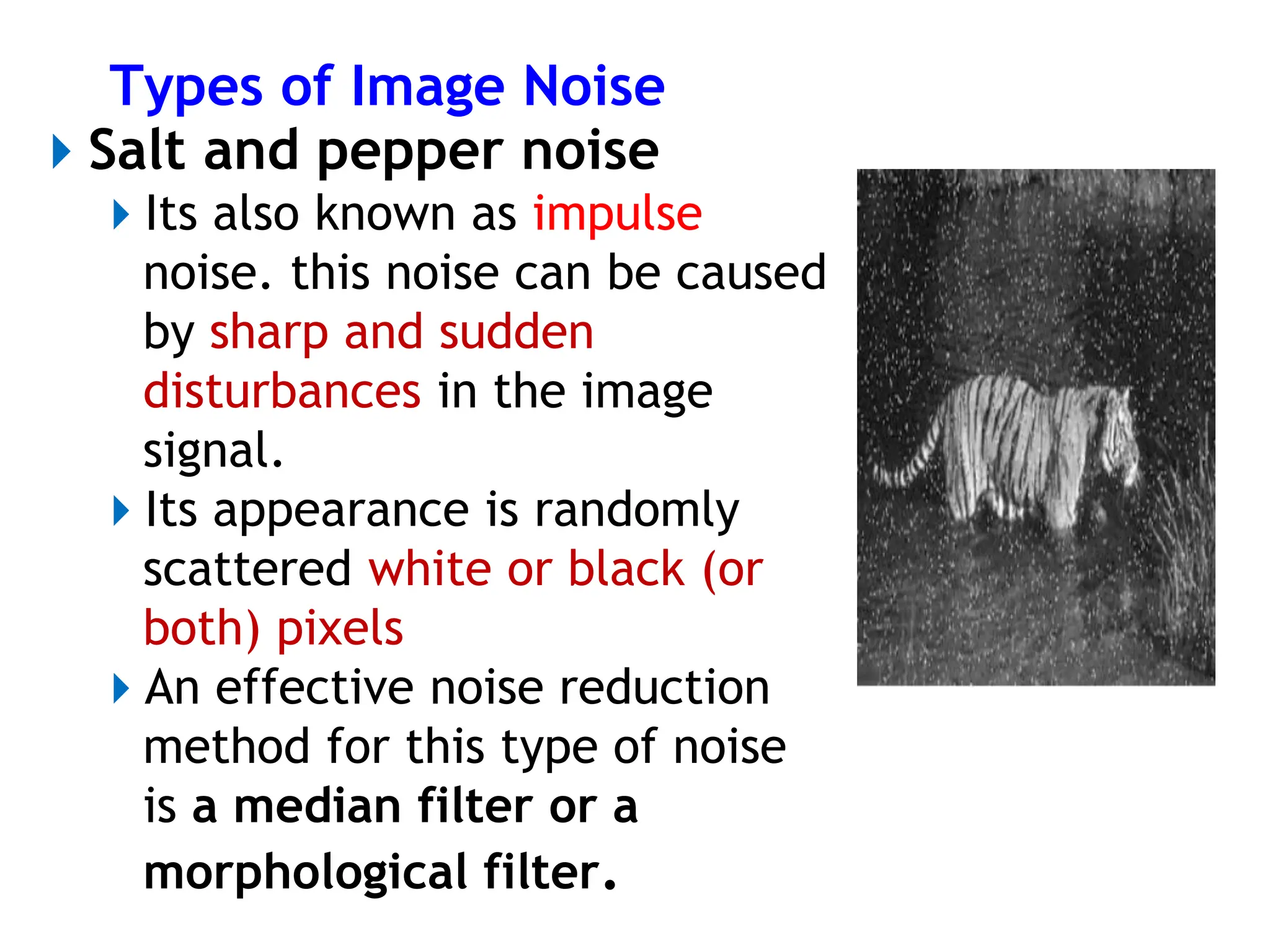
⏵Salt and pepper noise
⏵Its also known as impulse
noise. this noise can be caused
by sharp and sudden
disturbances in the image
signal.
⏵Its appearance is randomly
scattered white or black (or
both) pixels
⏵An effective noise reduction
method for this type of noise
is a median filter or a
morphological filter.
con’t
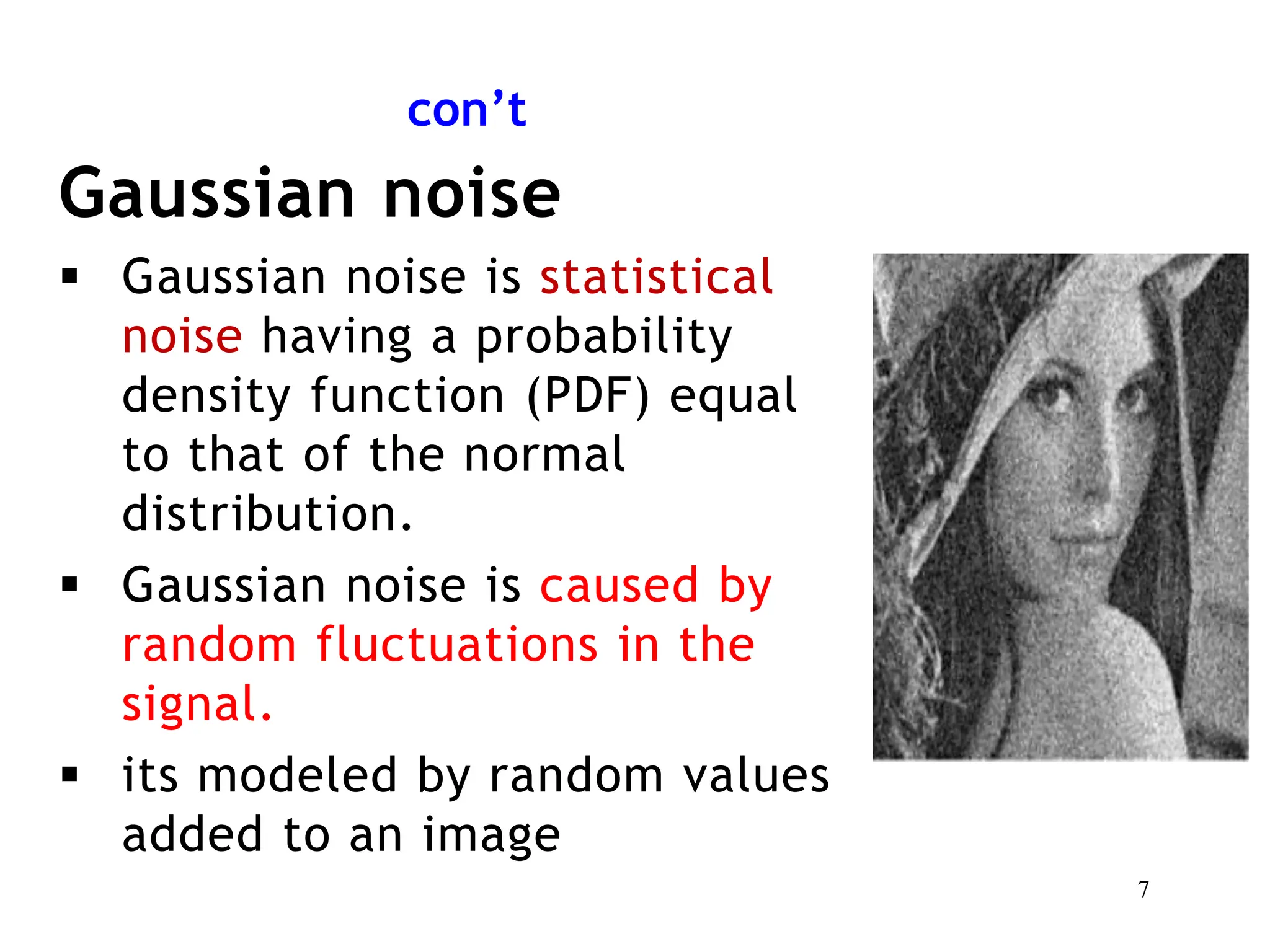
Gaussian noise
 Gaussian noise is statistical
noise having a probability
density function (PDF) equal
to that of the normal
distribution.
 Gaussian noise is caused by
random fluctuations in the
signal.
 its modeled by random values
added to an image
7
Con’t
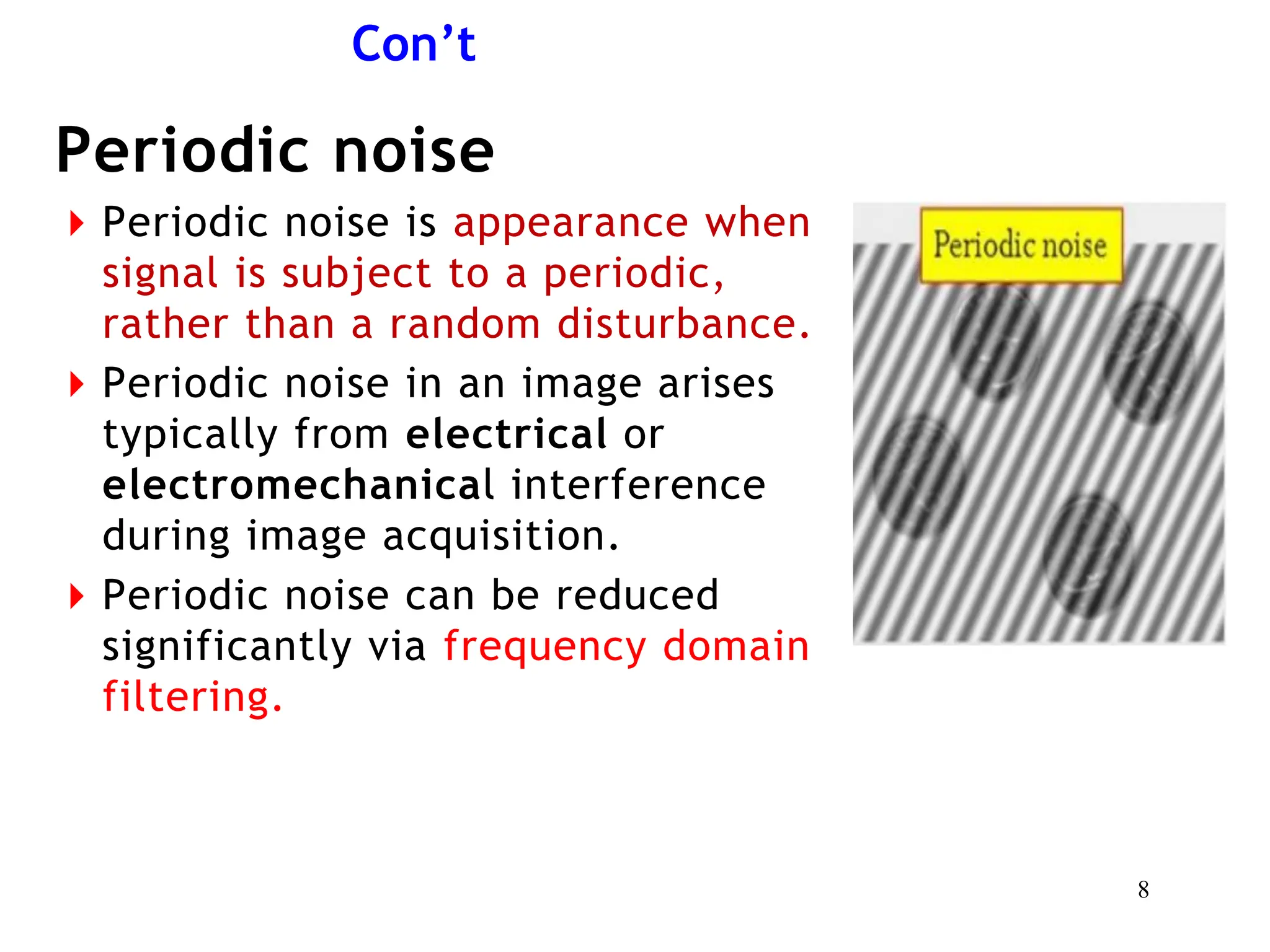
Periodic noise
⏵Periodic noise is appearance when
signal is subject to a periodic,
rather than a random disturbance.
⏵Periodic noise in an image arises
typically from electrical or
electromechanical interference
during image acquisition.
⏵Periodic noise can be reduced
significantly via frequency domain
filtering.
8
Con’t
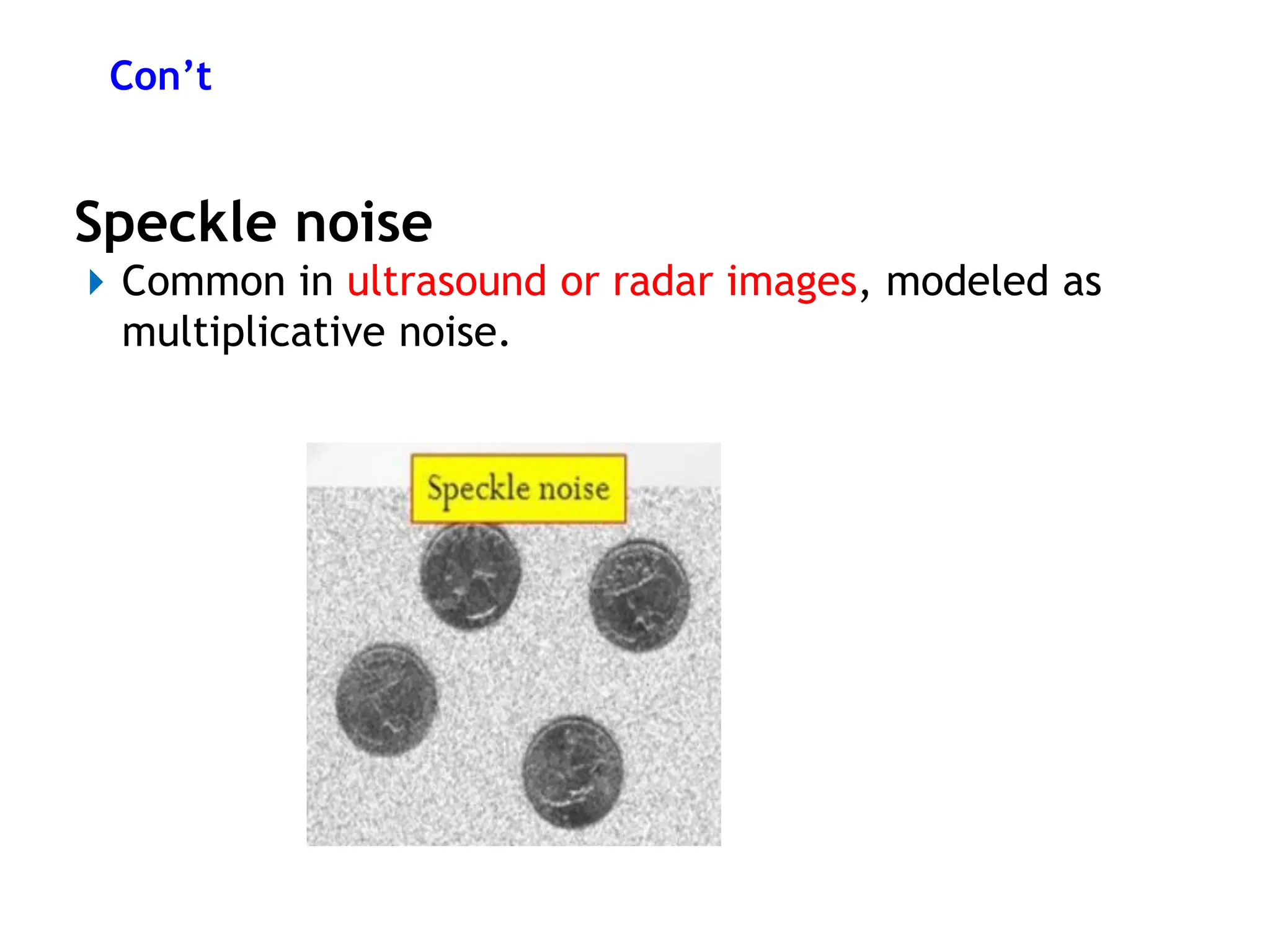
Speckle noise
⏵Common in ultrasound or radar images, modeled as
multiplicative noise.
Estimation of noise parameter
Estimating noise parameter in image
restoration is crucial step for effectively
removing noise and restoring the original
image.
The noise parameters help in modeling the
noise distribution, which is essential for
designing appropriate filters or algorithms.
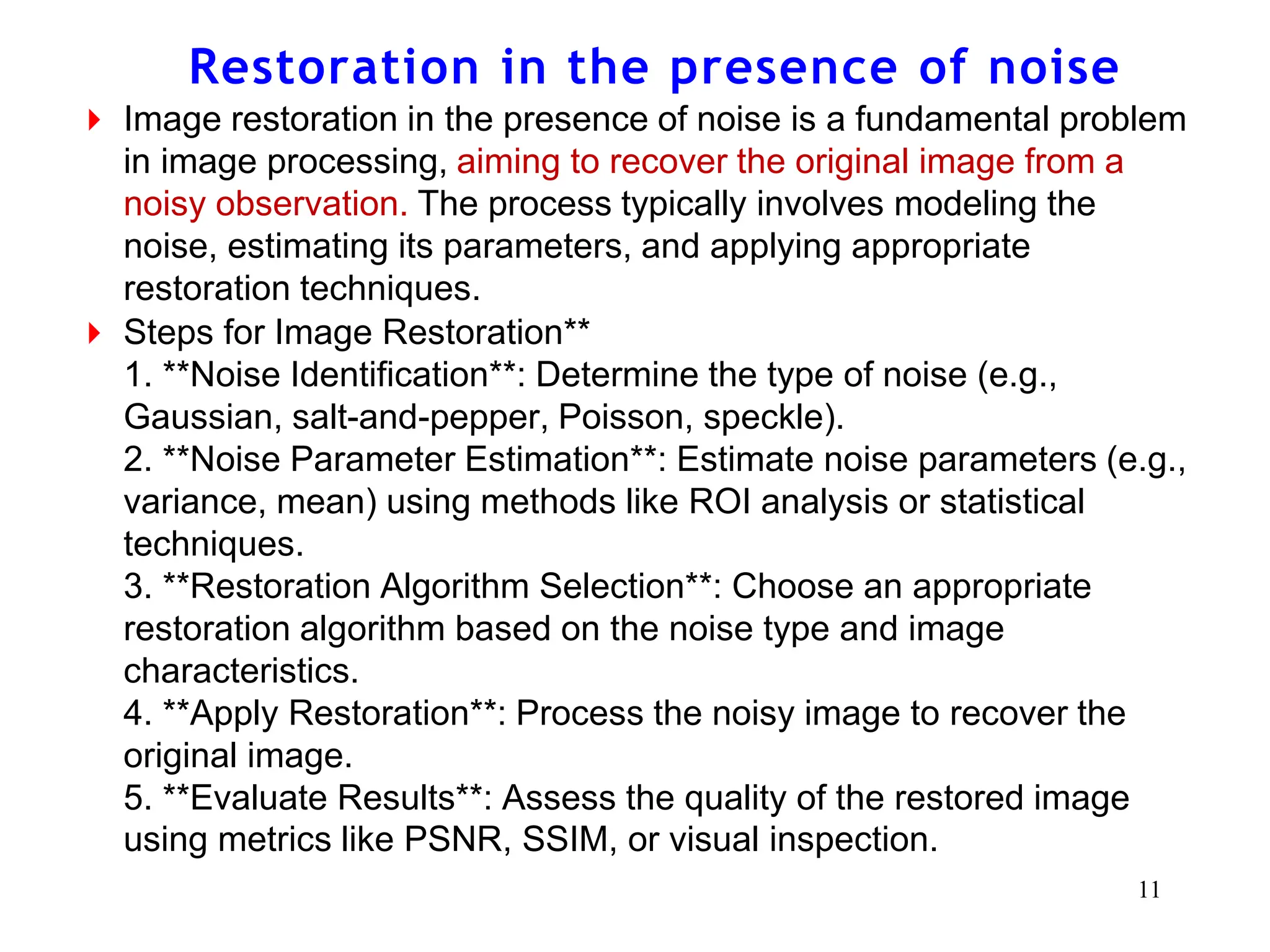
Restoration in the presence of noise
⏵ Image restoration in the presence of noise is a fundamental problem
in image processing, aiming to recover the original image from a
noisy observation. The process typically involves modeling the
noise, estimating its parameters, and applying appropriate
restoration techniques.
⏵ Steps for Image Restoration**
1. **Noise Identification**: Determine the type of noise (e.g.,
Gaussian, salt-and-pepper, Poisson, speckle).
2. **Noise Parameter Estimation**: Estimate noise parameters (e.g.,
variance, mean) using methods like ROI analysis or statistical
techniques.
3. **Restoration Algorithm Selection**: Choose an appropriate
restoration algorithm based on the noise type and image
characteristics.
4. **Apply Restoration**: Process the noisy image to recover the
original image.
5. **Evaluate Results**: Assess the quality of the restored image
using metrics like PSNR, SSIM, or visual inspection.
11
Restoration Techniques
A. Linear Filters**
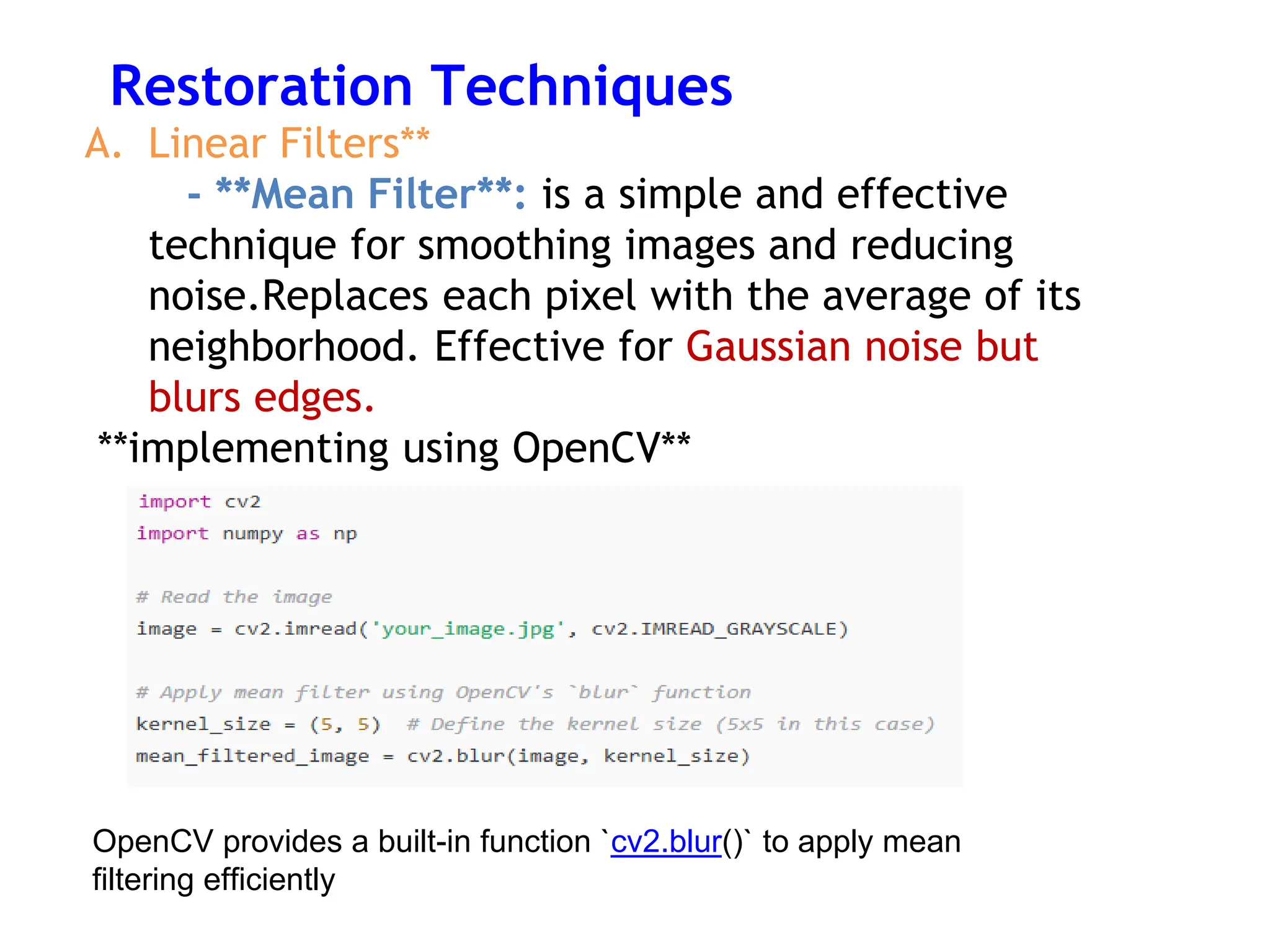
- **Mean Filter**: is a simple and effective
technique for smoothing images and reducing
noise.Replaces each pixel with the average of its
neighborhood. Effective for Gaussian noise but
blurs edges.
**implementing using OpenCV**
OpenCV provides a built-in function `cv2.blur()` to apply mean
filtering efficiently
Con’t
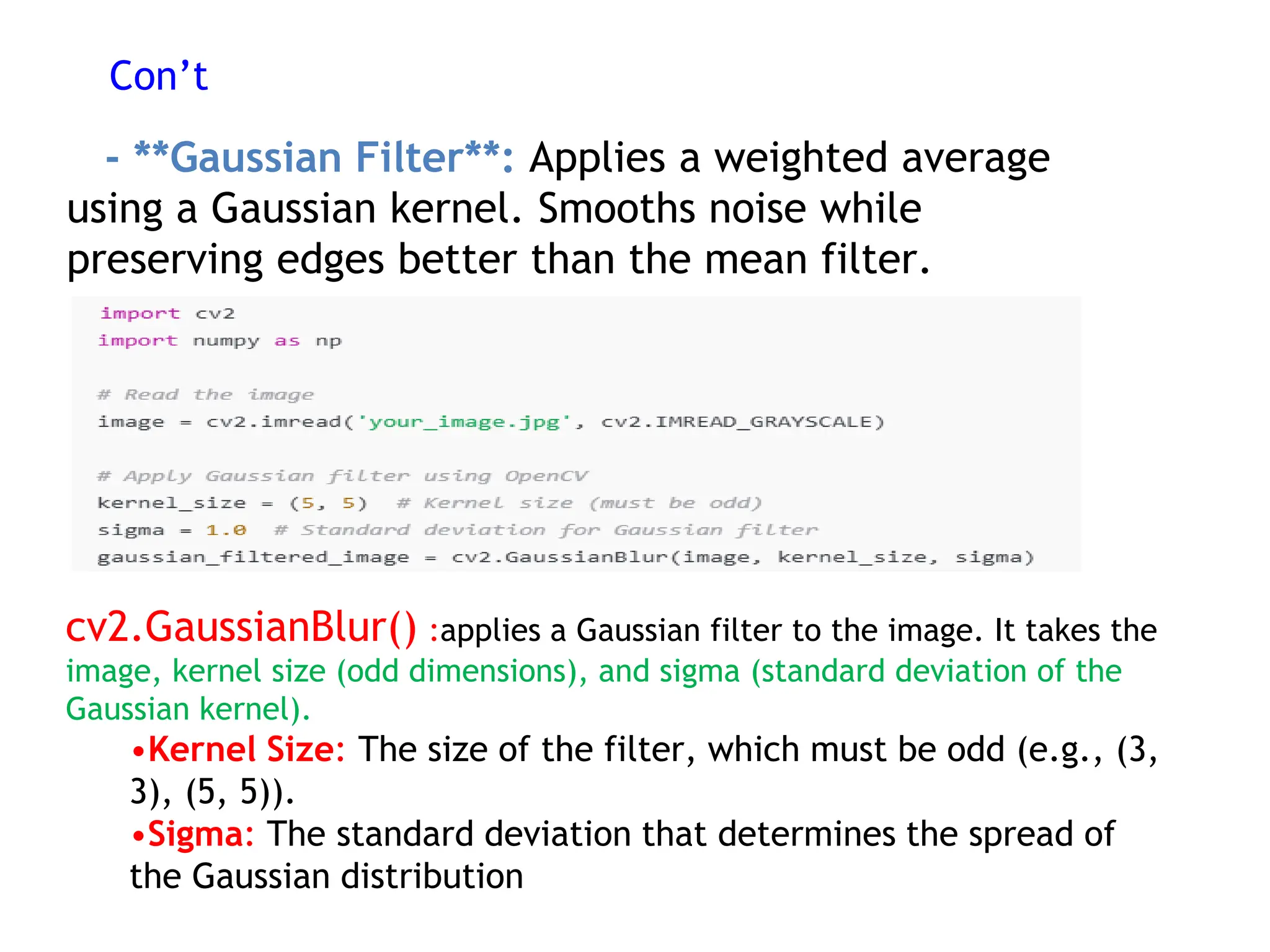
- **Gaussian Filter**: Applies a weighted average
using a Gaussian kernel. Smooths noise while
preserving edges better than the mean filter.
cv2.GaussianBlur() :applies a Gaussian filter to the image. It takes the
image, kernel size (odd dimensions), and sigma (standard deviation of the
Gaussian kernel).
•Kernel Size: The size of the filter, which must be odd (e.g., (3,
3), (5, 5)).
•Sigma: The standard deviation that determines the spread of
the Gaussian distribution
Con’t
**B. Non-Linear Filters**
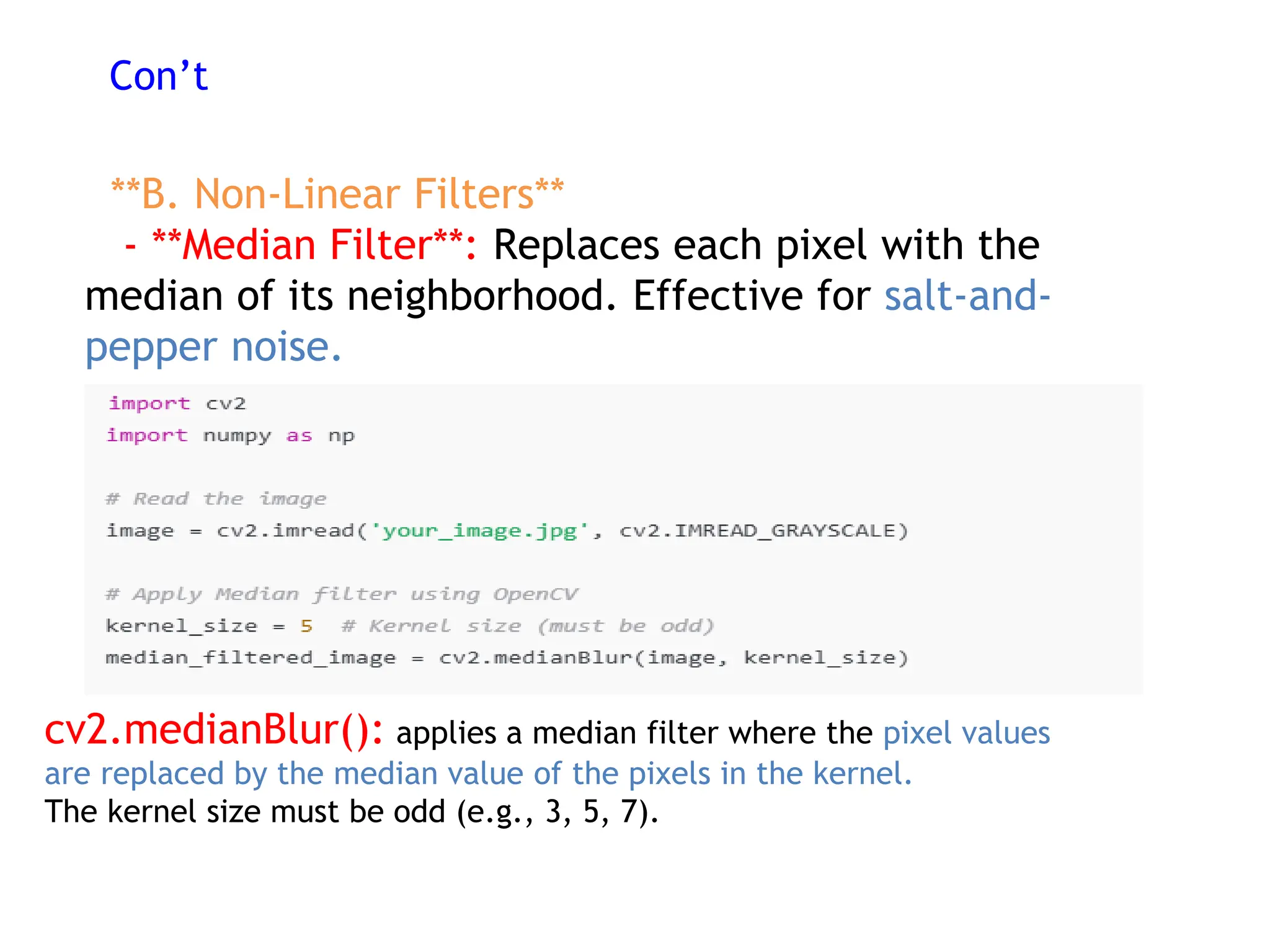
- **Median Filter**: Replaces each pixel with the
median of its neighborhood. Effective for salt-and-
pepper noise.
cv2.medianBlur(): applies a median filter where the pixel values
are replaced by the median value of the pixels in the kernel.
The kernel size must be odd (e.g., 3, 5, 7).
Con’t
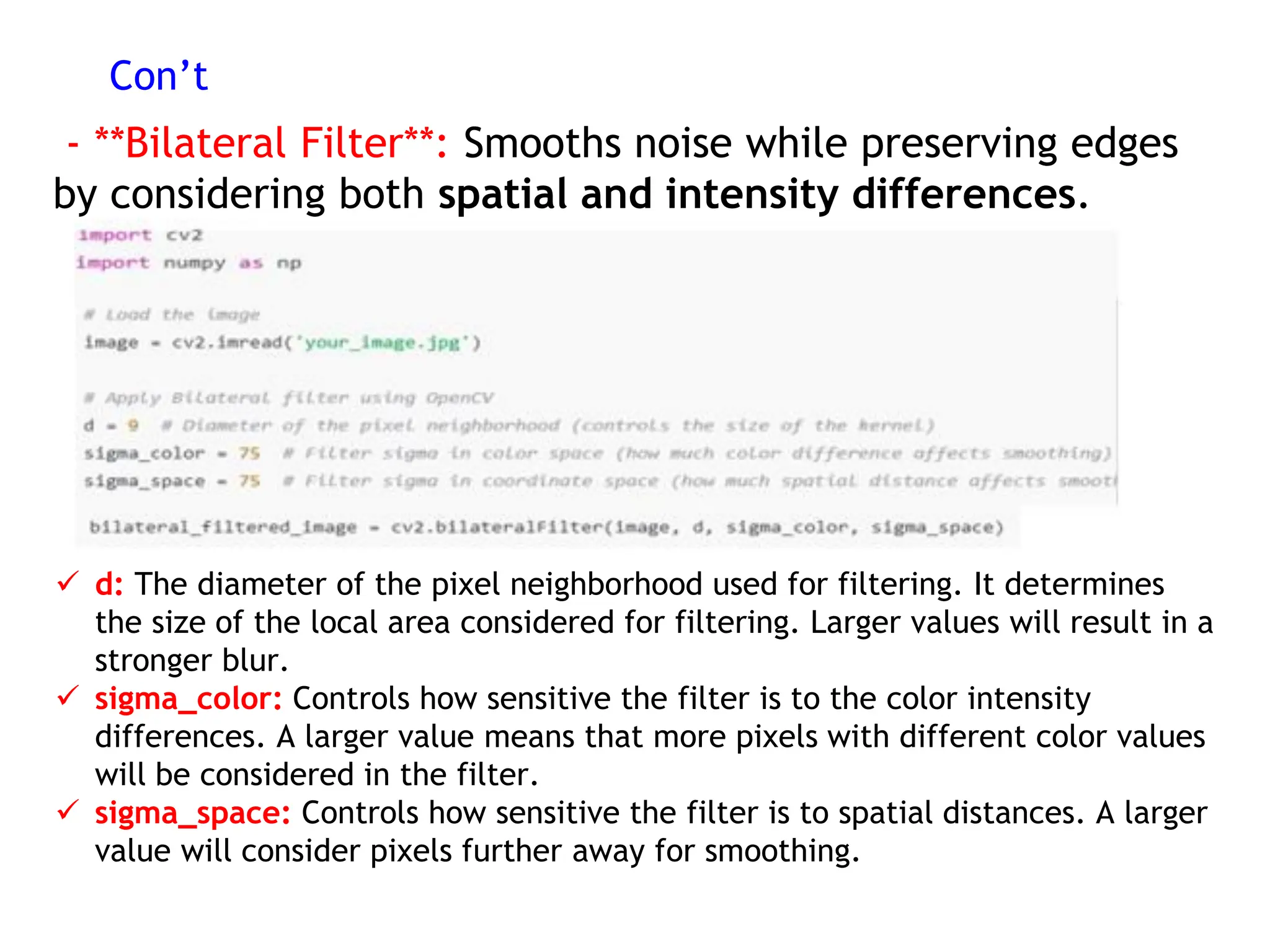
- **Bilateral Filter**: Smooths noise while preserving edges
by considering both spatial and intensity differences.
 d: The diameter of the pixel neighborhood used for filtering. It determines
the size of the local area considered for filtering. Larger values will result in a
stronger blur.
 sigma_color: Controls how sensitive the filter is to the color intensity
differences. A larger value means that more pixels with different color values
will be considered in the filter.
 sigma_space: Controls how sensitive the filter is to spatial distances. A larger
value will consider pixels further away for smoothing.
C. Frequency Domain Filters**
- **Fourier Transform**: Removes noise by thresholding or
masking in the frequency domain.
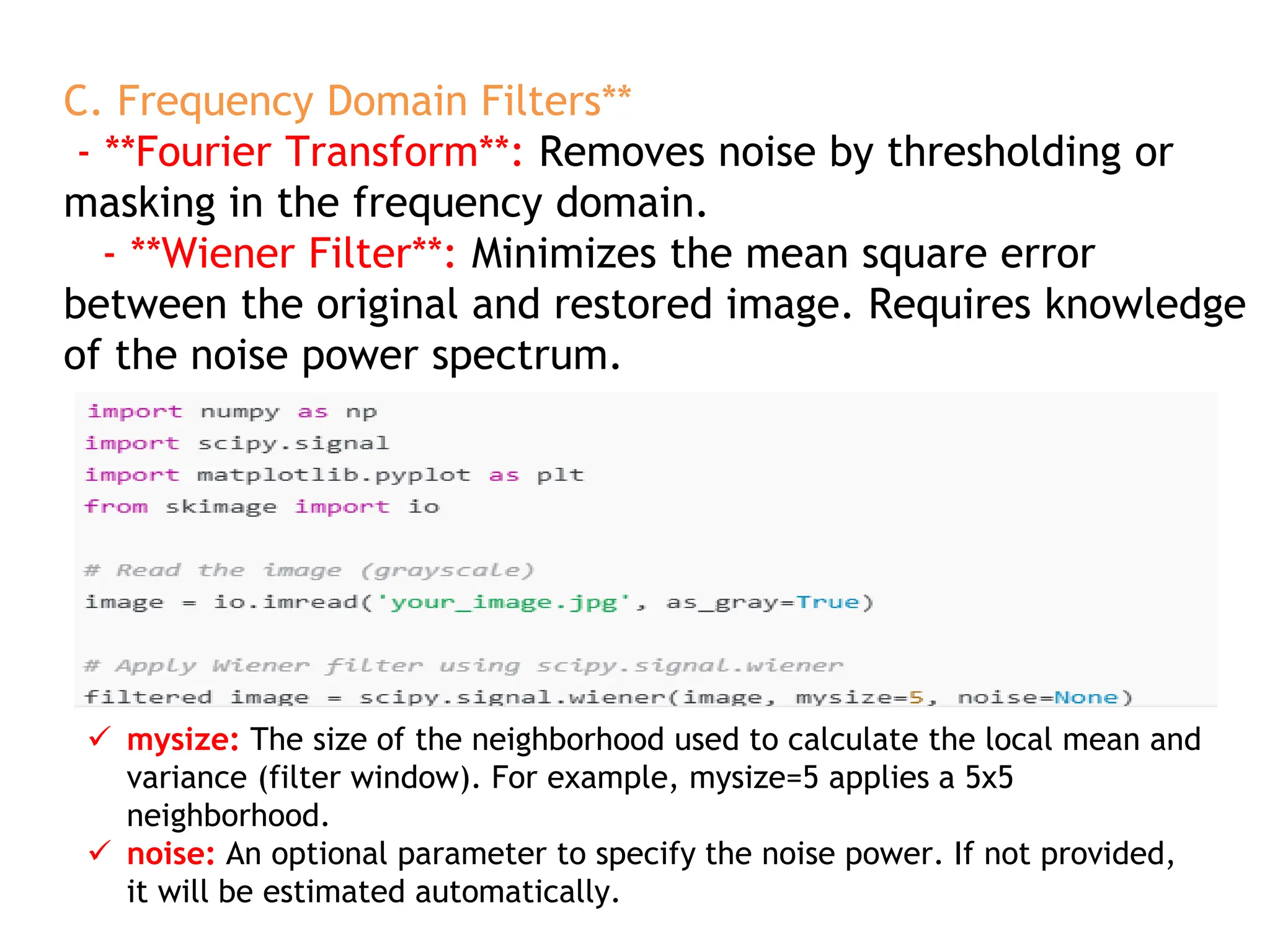
- **Wiener Filter**: Minimizes the mean square error
between the original and restored image. Requires knowledge
of the noise power spectrum.
 mysize: The size of the neighborhood used to calculate the local mean and
variance (filter window). For example, mysize=5 applies a 5x5
neighborhood.
 noise: An optional parameter to specify the noise power. If not provided,
it will be estimated automatically.
Advanced image restoration techniques
 Image restoration techniques are used to recover or improve the
quality of an image that has been degraded by various factors, such
as noise, blurring, or other distortions.
 While basic methods like Gaussian filtering, median filtering, and
Wiener filtering are effective for simple tasks, more advanced
image restoration techniques are required for handling complex
degradation.
 Deep Learning-Based Methods: Deep learning offers powerful
techniques for image restoration.
 Convolutional Neural Networks (CNNs): Train networks to map noisy
images to clean ones (e.g., DnCNN, UNet).
 Denoising Autoencoders (DAEs): are deep learning models that are
used for image restoration tasks where the model learns to reconstruct
clean images from noisy ones.
 Generative Adversarial Networks (GANs): Use adversarial training to
generate high-quality restored images.
Evaluation Metrics
– Peak Signal-to-Noise Ratio (PSNR): is one of the most
commonly used metrics for evaluating image quality,
particularly in tasks like image denoising, compression,
or restoration.
– Measures the ratio between the maximum possible
power of a signal and the power of noise.
– Higher PSNR values indicate better quality (less
distortion).
– Structural Similarity Index (SSIM): Measures the similarity
between the original and restored images.
– Mean Squared Error (MSE): Computes the average
squared difference between the original and restored
images.
– Lower MSE values indicate a better match between the
filtered and original image
Con’t
⏵By carefully selecting and applying the appropriate
restoration technique, you can effectively remove
noise while preserving the important features of the
image
19
Thank you
60

CH-4.pdf image restoration and what are

  • 1.
  • 2.
    Outlines ⏵Introduction ⏵Models of imagesand noise ⏵Estimation of noise parameters ⏵ Restoration in the presence of noise
  • 3.
    Noise in imagesis the vital factor which degrades the quality of the images. Reducing noise from the satellite images, medical images etc., is a challenge for the researchers in digital image processing. Several approaches are there for noise reduction. 3 Introduction
  • 4.
    What is imagerestoration? – Image restoration is the process of recovering the original image that has been degraded by noise using a prior knowledge of the degradation phenomenon. Goal of image restoration  Improve the quality and naturalness of an image in some predefined sense – Image restoration and reconstruction are essential tasks in the field of image processing, aiming to improve the quality of images and reconstruct missing or corrupted parts. – Image Restoration: Image restoration focuses on improving the quality of an image by removing noise, correcting blurs, and addressing other forms of degradation. – The goal is to recover the original image as closely as
  • 5.
    Noise in animage ⏵Noise in image is any degradation in an image signal, caused by external disturbances during image digitalization and/or image transmission. ⏵Source of noise ⏵ Image acquisition: sensor heat while capturing an image ⏵ e.g., light levels, sensor temperature, etc ⏵ Image digitization: involves sampling, quantization and compression ⏵ e.g. Aliasing effects due to inadequate sampling ⏵ Image transmission: Error occurs in image signal while an image is being sent electronically from one place to another via Satellite, Wireless, and Network cable. ⏵ e.g., lightning or other atmospheric disturbance in wireless network ⏵Model the degradation and applying the inverse process in order to recover the original image
  • 6.
    Types of ImageNoise ⏵Salt and pepper noise ⏵Its also known as impulse noise. this noise can be caused by sharp and sudden disturbances in the image signal. ⏵Its appearance is randomly scattered white or black (or both) pixels ⏵An effective noise reduction method for this type of noise is a median filter or a morphological filter.
  • 7.
    con’t Gaussian noise  Gaussiannoise is statistical noise having a probability density function (PDF) equal to that of the normal distribution.  Gaussian noise is caused by random fluctuations in the signal.  its modeled by random values added to an image 7
  • 8.
    Con’t Periodic noise ⏵Periodic noiseis appearance when signal is subject to a periodic, rather than a random disturbance. ⏵Periodic noise in an image arises typically from electrical or electromechanical interference during image acquisition. ⏵Periodic noise can be reduced significantly via frequency domain filtering. 8
  • 9.
    Con’t Speckle noise ⏵Common inultrasound or radar images, modeled as multiplicative noise.
  • 10.
    Estimation of noiseparameter Estimating noise parameter in image restoration is crucial step for effectively removing noise and restoring the original image. The noise parameters help in modeling the noise distribution, which is essential for designing appropriate filters or algorithms.
  • 11.
    Restoration in thepresence of noise ⏵ Image restoration in the presence of noise is a fundamental problem in image processing, aiming to recover the original image from a noisy observation. The process typically involves modeling the noise, estimating its parameters, and applying appropriate restoration techniques. ⏵ Steps for Image Restoration** 1. **Noise Identification**: Determine the type of noise (e.g., Gaussian, salt-and-pepper, Poisson, speckle). 2. **Noise Parameter Estimation**: Estimate noise parameters (e.g., variance, mean) using methods like ROI analysis or statistical techniques. 3. **Restoration Algorithm Selection**: Choose an appropriate restoration algorithm based on the noise type and image characteristics. 4. **Apply Restoration**: Process the noisy image to recover the original image. 5. **Evaluate Results**: Assess the quality of the restored image using metrics like PSNR, SSIM, or visual inspection. 11
  • 12.
    Restoration Techniques A. LinearFilters** - **Mean Filter**: is a simple and effective technique for smoothing images and reducing noise.Replaces each pixel with the average of its neighborhood. Effective for Gaussian noise but blurs edges. **implementing using OpenCV** OpenCV provides a built-in function `cv2.blur()` to apply mean filtering efficiently
  • 13.
    Con’t - **Gaussian Filter**:Applies a weighted average using a Gaussian kernel. Smooths noise while preserving edges better than the mean filter. cv2.GaussianBlur() :applies a Gaussian filter to the image. It takes the image, kernel size (odd dimensions), and sigma (standard deviation of the Gaussian kernel). •Kernel Size: The size of the filter, which must be odd (e.g., (3, 3), (5, 5)). •Sigma: The standard deviation that determines the spread of the Gaussian distribution
  • 14.
    Con’t **B. Non-Linear Filters** -**Median Filter**: Replaces each pixel with the median of its neighborhood. Effective for salt-and- pepper noise. cv2.medianBlur(): applies a median filter where the pixel values are replaced by the median value of the pixels in the kernel. The kernel size must be odd (e.g., 3, 5, 7).
  • 15.
    Con’t - **Bilateral Filter**:Smooths noise while preserving edges by considering both spatial and intensity differences.  d: The diameter of the pixel neighborhood used for filtering. It determines the size of the local area considered for filtering. Larger values will result in a stronger blur.  sigma_color: Controls how sensitive the filter is to the color intensity differences. A larger value means that more pixels with different color values will be considered in the filter.  sigma_space: Controls how sensitive the filter is to spatial distances. A larger value will consider pixels further away for smoothing.
  • 16.
    C. Frequency DomainFilters** - **Fourier Transform**: Removes noise by thresholding or masking in the frequency domain. - **Wiener Filter**: Minimizes the mean square error between the original and restored image. Requires knowledge of the noise power spectrum.  mysize: The size of the neighborhood used to calculate the local mean and variance (filter window). For example, mysize=5 applies a 5x5 neighborhood.  noise: An optional parameter to specify the noise power. If not provided, it will be estimated automatically.
  • 17.
    Advanced image restorationtechniques  Image restoration techniques are used to recover or improve the quality of an image that has been degraded by various factors, such as noise, blurring, or other distortions.  While basic methods like Gaussian filtering, median filtering, and Wiener filtering are effective for simple tasks, more advanced image restoration techniques are required for handling complex degradation.  Deep Learning-Based Methods: Deep learning offers powerful techniques for image restoration.  Convolutional Neural Networks (CNNs): Train networks to map noisy images to clean ones (e.g., DnCNN, UNet).  Denoising Autoencoders (DAEs): are deep learning models that are used for image restoration tasks where the model learns to reconstruct clean images from noisy ones.  Generative Adversarial Networks (GANs): Use adversarial training to generate high-quality restored images.
  • 18.
    Evaluation Metrics – PeakSignal-to-Noise Ratio (PSNR): is one of the most commonly used metrics for evaluating image quality, particularly in tasks like image denoising, compression, or restoration. – Measures the ratio between the maximum possible power of a signal and the power of noise. – Higher PSNR values indicate better quality (less distortion). – Structural Similarity Index (SSIM): Measures the similarity between the original and restored images. – Mean Squared Error (MSE): Computes the average squared difference between the original and restored images. – Lower MSE values indicate a better match between the filtered and original image
  • 19.
    Con’t ⏵By carefully selectingand applying the appropriate restoration technique, you can effectively remove noise while preserving the important features of the image 19
  • 20.