Welcome to our
Presentation
Presentation Topic: Digital Image Processing
Group Members
Mohammad Salim Hosen (162-15-1044)
Md. Rifat Rahman (162-15-1049)
Arifur Jaman (153-15-607)
Shahedul Islam Rishad (162-15-1029)
Team: Dream Crushers
CONTENTS:
 What is Digital Image?
 What is digital image processing?
 Pixel
 Applications
 Examples of digital image processing
Digital Image:
 A digital image is a representation of a two-dimensional image as a finite set of
digital values, called picture elements or pixels.
Digital Image Processing:
Digital image processing focuses on two major tasks:
 Improvement of pictorial information for human interpretation.
 Processing of image data for storage, transmission and representation for
autonomous machine perception.
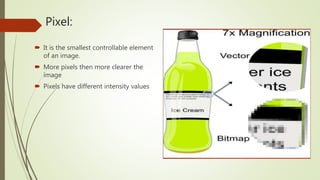
Pixel:
 It is the smallest controllable element
of an image.
 More pixels then more clearer the
image
 Pixels have different intensity values
History
 In 1920s Submarine cables were used to transmit digitized newspaper
pictures between London and New York using Bartlane systems.
 Specialized printing equipments were used to code the images and
reproduced at receiver using telegraphic printers.
Fig. Image produced using telegraphic printer
History
In 1921, photographic printing press improved the resolution and tonal
quality of images.
Bartlane system was capable of coding 5 distinct brightness levels.
It increased to 15 by 1929
History
 After 35 years of improvement in processing technique
In 1964, Computer processing techniques were used to improve picture of
moon transmitted by Ranger 7 at JPL.
This was the basis of modern image processing technique.
The continuum from image processing to computer vision can
be broken up into low, mid and high-level processes:
Block Diagram of a Typical
Image Processing Sequence:
Components of Image Processing System
Applications:
 Noise filtering
 Content Enhancement
 Remote sensing
Filtering:
Image Enhancement:
 Contrast enhancement
 Deblurring
Image Deblurring:
Remote Sensing:
Remote Sensing:
Examples of digital image processing:
 IMAGE ENHANCEMENT: One of the most common uses of DIP
techniques: improve quality, remove noise etc
THE HUBBLE TELESCOPE:
 Launched in 1990 the Hubble telescope can take images of very distant objects However,
an incorrect mirror made many of Hubble’s images useless Image processing techniques
were used to fix this.
ARTISTIC EFFECTS:
 Artistic effects are used to make
images more visually appealing,
to add special effects and to
make composite images.
MEDICINE:
Take slice from MRI scan of canine heart, and find boundaries between types
of tissue:
 Image with gray levels representing tissue density
 Use a suitable filter to highlight edges
GIS:
Geographic Information Systems:
 Digital image processing techniques are used extensively to manipulate satellite
imagery
 Terrain classification
 Meteorology
Industrial Inspection:
 Human operators are expensive,
slow and unreliable
 Make machines do the job instead
 Industrial vision systems are used in
all kinds of industries
PCB INSPECTION:
Printed Circuit Board (PCB) inspection
 Machine inspection is used to determine that all components are present and that
all solder joints are acceptable.
 Both conventional imaging and x-ray imaging are used.
LAW ENFORCEMENT:
 Number plate recognition for speed cameras/automated toll systems
 Fingerprint recognition
 Enhancement of CCTV images
HCI: Try to make human computer interfaces more natural
 Face recognition
 Gesture recognition
THANK YOU

Presentation on Digital Image Processing

  • 1.
    Welcome to our Presentation PresentationTopic: Digital Image Processing
  • 2.
    Group Members Mohammad SalimHosen (162-15-1044) Md. Rifat Rahman (162-15-1049) Arifur Jaman (153-15-607) Shahedul Islam Rishad (162-15-1029) Team: Dream Crushers
  • 3.
    CONTENTS:  What isDigital Image?  What is digital image processing?  Pixel  Applications  Examples of digital image processing
  • 4.
    Digital Image:  Adigital image is a representation of a two-dimensional image as a finite set of digital values, called picture elements or pixels.
  • 5.
    Digital Image Processing: Digitalimage processing focuses on two major tasks:  Improvement of pictorial information for human interpretation.  Processing of image data for storage, transmission and representation for autonomous machine perception.
  • 6.
    Pixel:  It isthe smallest controllable element of an image.  More pixels then more clearer the image  Pixels have different intensity values
  • 7.
    History  In 1920sSubmarine cables were used to transmit digitized newspaper pictures between London and New York using Bartlane systems.  Specialized printing equipments were used to code the images and reproduced at receiver using telegraphic printers. Fig. Image produced using telegraphic printer
  • 8.
    History In 1921, photographicprinting press improved the resolution and tonal quality of images. Bartlane system was capable of coding 5 distinct brightness levels. It increased to 15 by 1929
  • 9.
    History  After 35years of improvement in processing technique In 1964, Computer processing techniques were used to improve picture of moon transmitted by Ranger 7 at JPL. This was the basis of modern image processing technique.
  • 10.
    The continuum fromimage processing to computer vision can be broken up into low, mid and high-level processes:
  • 11.
    Block Diagram ofa Typical Image Processing Sequence:
  • 12.
    Components of ImageProcessing System
  • 13.
    Applications:  Noise filtering Content Enhancement  Remote sensing
  • 14.
  • 15.
    Image Enhancement:  Contrastenhancement  Deblurring
  • 16.
  • 17.
  • 18.
  • 19.
    Examples of digitalimage processing:  IMAGE ENHANCEMENT: One of the most common uses of DIP techniques: improve quality, remove noise etc
  • 20.
    THE HUBBLE TELESCOPE: Launched in 1990 the Hubble telescope can take images of very distant objects However, an incorrect mirror made many of Hubble’s images useless Image processing techniques were used to fix this.
  • 21.
    ARTISTIC EFFECTS:  Artisticeffects are used to make images more visually appealing, to add special effects and to make composite images.
  • 22.
    MEDICINE: Take slice fromMRI scan of canine heart, and find boundaries between types of tissue:  Image with gray levels representing tissue density  Use a suitable filter to highlight edges
  • 23.
    GIS: Geographic Information Systems: Digital image processing techniques are used extensively to manipulate satellite imagery  Terrain classification  Meteorology
  • 24.
    Industrial Inspection:  Humanoperators are expensive, slow and unreliable  Make machines do the job instead  Industrial vision systems are used in all kinds of industries
  • 25.
    PCB INSPECTION: Printed CircuitBoard (PCB) inspection  Machine inspection is used to determine that all components are present and that all solder joints are acceptable.  Both conventional imaging and x-ray imaging are used.
  • 26.
    LAW ENFORCEMENT:  Numberplate recognition for speed cameras/automated toll systems  Fingerprint recognition  Enhancement of CCTV images
  • 27.
    HCI: Try tomake human computer interfaces more natural  Face recognition  Gesture recognition
  • 28.