The document discusses MHEG (Multimedia and Hypermedia Experts Group), an ISO standard for defining multimedia presentations that can run across different hardware platforms. It describes the evolution of MHEG standards over time from MHEG-1 to MHEG-7, with each version adding new capabilities like interactivity (MHEG-3) or support for client-server applications (MHEG-5). MHEG defines classes, properties, and a framework to structure multimedia objects and presentations in a platform-neutral way so they can be viewed on different machines.
Overview of MHEG, a standard for interactive multimedia presentations across various platforms.
MHEG aims to provide a multimedia framework that is resource-efficient, allowing digital presentations in diverse applications like CD-ROM encyclopedias and e-learning.
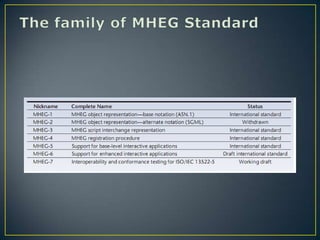
Discussion on MHEG versions (MHEG-1 to MHEG-7), highlighting enhancements, interactivity, and platform support.
Structure of MHEG classes which define audio-visual display, user interaction, and information exchange.
MHEG-5's widespread use in multiple regions, supporting HD broadcasting and interactive functionalities.
Positive outlook for MHEG, with potential ISO standardization and interest from major companies.
Citations and online resources about MHEG standards and their implications in multimedia.
• The Multimediaand Hypermedia Experts Group (MHEG)
was formed by a subcommittee of the International
Standards Organization (ISO) to address the problems of
trying to design a software-neutral interactive multimedia
presentation tool.
• In this way, a presentation created on one hardware
platform should be viewable on others.
4.
• To providea simple, easy to implement framework for
multimedia applications using the minimum system
resources.
• To define a digital form for presentations, which may run
on different machines no matter what the platform are.
• To provide extensibility
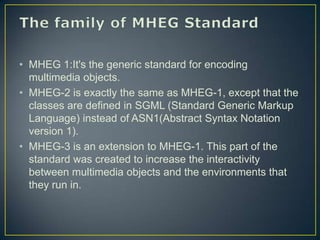
• MHEG 1:It'sthe generic standard for encoding
multimedia objects.
• MHEG-2 is exactly the same as MHEG-1, except that the
classes are defined in SGML (Standard Generic Markup
Language) instead of ASN1(Abstract Syntax Notation
version 1).
• MHEG-3 is an extension to MHEG-1. This part of the
standard was created to increase the interactivity
between multimedia objects and the environments that
they run in.
8.
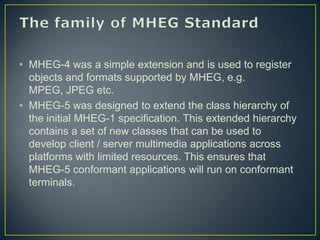
• MHEG-4 wasa simple extension and is used to register
objects and formats supported by MHEG, e.g.
MPEG, JPEG etc.
• MHEG-5 was designed to extend the class hierarchy of
the initial MHEG-1 specification. This extended hierarchy
contains a set of new classes that can be used to
develop client / server multimedia applications across
platforms with limited resources. This ensures that
MHEG-5 conformant applications will run on conformant
terminals.
9.
• MHEG-6 extendsthe declarative MHEG-5 approach with
procedural code capabilities typical of a scripting
language. It defines the interface and a script engine's
runtime environment on top of an MHEG-5.
• MHEG-7, a new standard, addresses the conformance
and interoperability of MHEG-5 engines and applications.
11.
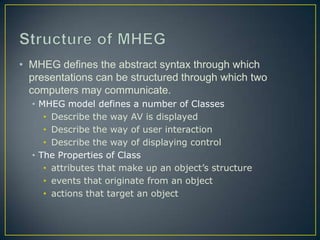
• MHEG definesthe abstract syntax through which
presentations can be structured through which two
computers may communicate.
• MHEG model defines a number of Classes
• Describe the way AV is displayed
• Describe the way of user interaction
• Describe the way of displaying control
• The Properties of Class
• attributes that make up an object’s structure
• events that originate from an object
• actions that target an object
12.
• There aremany more classes defined by MHEG. Some
are concerned with the structure of the presentation and
grouping of objects, whilst others are involved in the
interchange of information between machines.
13.
• MHEG-5 isthe world largest deployment in presentation
in U.K,AUS,IRELAND,NEW ZELAND,HONG KONG & S
AFRICA.
• It supports HD broadcast;
• Enhanced clarity in the graphic interface;
• Non Destructive tuning;
• Two way interactive functionality;
• In client server model MHEG-5 applications are stored on
server and downloaded to the terminal for the RTE to
interpret.
14.
• The outlookfor MHEG is good.
• The ideas are not yet an ISO standard
• Several large companies including IBM are already
developing software that conforms to the standard.
• This standard will allow the interchange and playback of
multimedia information on any platform.
15.
• Paper
• "MHEG-5-aims, concepts, and implementation issues”, M.
Echiffre, C. Marchisio, P. Marchisio, P. Panicciari, S. Del
Rossi, IEEE Multimedia, Vol.5
• “MHEG: An Introduction to the future International Standard for
Hypermedia Object Interchange” - Roger Price; Proceedings of the
conference on Multimedia
16.
• Web Documents
• About MHEG ( A Guided Tour to MHEG ... )
• http://www.mhegcentre.com/mheg/tour.htm
• Multimedia Standards
• http://www.ctf.imc.exec.nhs.uk/published/step/stepdocs/H224-
2.html
• MHEG - A Multimedia Presentation Standard
• http://www-dse.doc.ic.ac.uk/~nd/surprise_96/
journal/vol2/srd2/article2.html
• MHEG-5: An Overview
• http://www.fokus.gmd.de/ovma/mug/archives/doc/mheg-
reader/rd1206.html