Image restoration
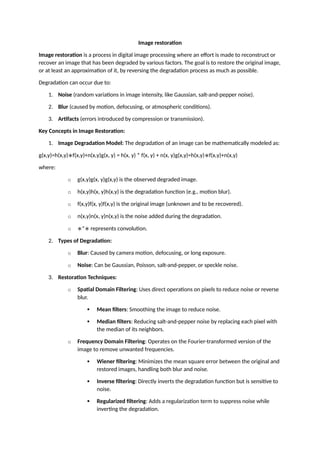
Image restoration is a process in digital image processing where an effort is made to reconstruct or
recover an image that has been degraded by various factors. The goal is to restore the original image,
or at least an approximation of it, by reversing the degradation process as much as possible.
Degradation can occur due to:
1. Noise (random variations in image intensity, like Gaussian, salt-and-pepper noise).
2. Blur (caused by motion, defocusing, or atmospheric conditions).
3. Artifacts (errors introduced by compression or transmission).
Key Concepts in Image Restoration:
1. Image Degradation Model: The degradation of an image can be mathematically modeled as:
g(x,y)=h(x,y)∗f(x,y)+n(x,y)g(x, y) = h(x, y) * f(x, y) + n(x, y)g(x,y)=h(x,y)∗f(x,y)+n(x,y)
where:
o g(x,y)g(x, y)g(x,y) is the observed degraded image.
o h(x,y)h(x, y)h(x,y) is the degradation function (e.g., motion blur).
o f(x,y)f(x, y)f(x,y) is the original image (unknown and to be recovered).
o n(x,y)n(x, y)n(x,y) is the noise added during the degradation.
o ∗*∗ represents convolution.
2. Types of Degradation:
o Blur: Caused by camera motion, defocusing, or long exposure.
o Noise: Can be Gaussian, Poisson, salt-and-pepper, or speckle noise.
3. Restoration Techniques:
o Spatial Domain Filtering: Uses direct operations on pixels to reduce noise or reverse
blur.
 Mean filters: Smoothing the image to reduce noise.
 Median filters: Reducing salt-and-pepper noise by replacing each pixel with
the median of its neighbors.
o Frequency Domain Filtering: Operates on the Fourier-transformed version of the
image to remove unwanted frequencies.
 Wiener filtering: Minimizes the mean square error between the original and
restored images, handling both blur and noise.
 Inverse filtering: Directly inverts the degradation function but is sensitive to
noise.
 Regularized filtering: Adds a regularization term to suppress noise while
inverting the degradation.
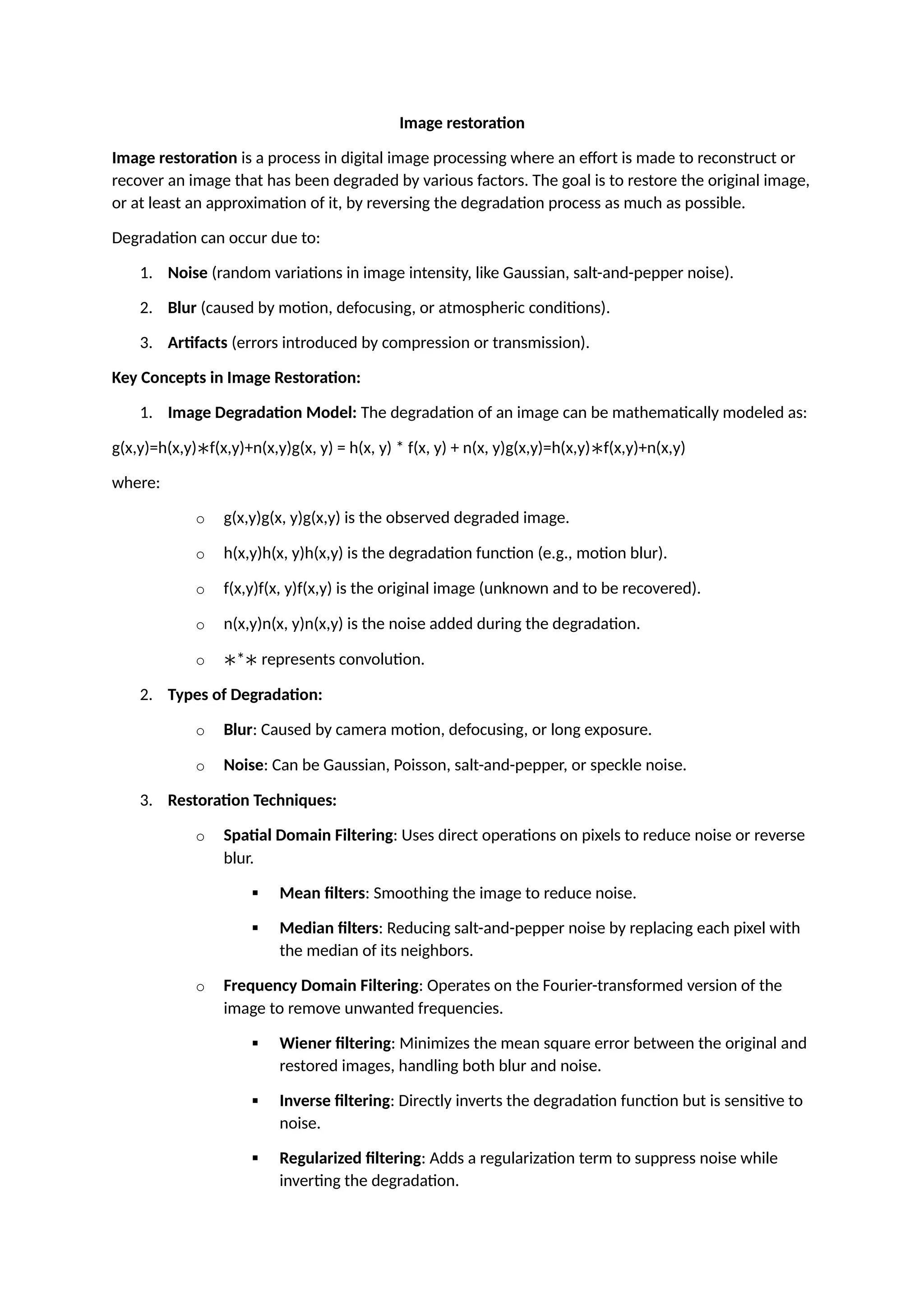
4. Noise Models: Common noise models include:
o Gaussian noise: Statistically distributed noise that affects each pixel independently.
o Salt-and-pepper noise: Randomly occurring black or white pixels scattered
throughout the image.
o Poisson noise: Associated with photon-limited imaging systems.
5. Inverse Filtering: One of the simplest restoration techniques that assumes the degradation
function is known. The restored image is obtained by:
F(u,v)=G(u,v)H(u,v)F(u, v) = frac{G(u, v)}{H(u, v)}F(u,v)=H(u,v)G(u,v)
where:
o F(u,v)F(u, v)F(u,v) is the Fourier transform of the restored image.
o G(u,v)G(u, v)G(u,v) is the Fourier transform of the degraded image.
o H(u,v)H(u, v)H(u,v) is the degradation function in the frequency domain.
6. Wiener Filtering: A more advanced method that accounts for both noise and blur. It
minimizes the mean square error between the original and restored image, and it performs
well even in noisy environments. The Wiener filter is given by:
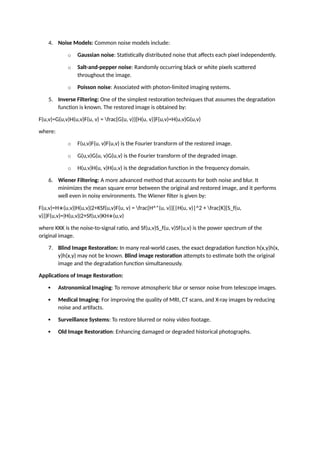
F(u,v)=H∗(u,v)∣H(u,v)∣2+KSf(u,v)F(u, v) = frac{H^*(u, v)}{|H(u, v)|^2 + frac{K}{S_f(u,
v)}}F(u,v)=∣H(u,v)∣2+Sf(u,v)KH∗(u,v)
where KKK is the noise-to-signal ratio, and Sf(u,v)S_f(u, v)Sf(u,v) is the power spectrum of the
original image.
7. Blind Image Restoration: In many real-world cases, the exact degradation function h(x,y)h(x,
y)h(x,y) may not be known. Blind image restoration attempts to estimate both the original
image and the degradation function simultaneously.
Applications of Image Restoration:
 Astronomical Imaging: To remove atmospheric blur or sensor noise from telescope images.
 Medical Imaging: For improving the quality of MRI, CT scans, and X-ray images by reducing
noise and artifacts.
 Surveillance Systems: To restore blurred or noisy video footage.
 Old Image Restoration: Enhancing damaged or degraded historical photographs.

Image restoration and Compression in Digital Image Processing.docx

  • 1.
    Image restoration Image restorationis a process in digital image processing where an effort is made to reconstruct or recover an image that has been degraded by various factors. The goal is to restore the original image, or at least an approximation of it, by reversing the degradation process as much as possible. Degradation can occur due to: 1. Noise (random variations in image intensity, like Gaussian, salt-and-pepper noise). 2. Blur (caused by motion, defocusing, or atmospheric conditions). 3. Artifacts (errors introduced by compression or transmission). Key Concepts in Image Restoration: 1. Image Degradation Model: The degradation of an image can be mathematically modeled as: g(x,y)=h(x,y)∗f(x,y)+n(x,y)g(x, y) = h(x, y) * f(x, y) + n(x, y)g(x,y)=h(x,y)∗f(x,y)+n(x,y) where: o g(x,y)g(x, y)g(x,y) is the observed degraded image. o h(x,y)h(x, y)h(x,y) is the degradation function (e.g., motion blur). o f(x,y)f(x, y)f(x,y) is the original image (unknown and to be recovered). o n(x,y)n(x, y)n(x,y) is the noise added during the degradation. o ∗*∗ represents convolution. 2. Types of Degradation: o Blur: Caused by camera motion, defocusing, or long exposure. o Noise: Can be Gaussian, Poisson, salt-and-pepper, or speckle noise. 3. Restoration Techniques: o Spatial Domain Filtering: Uses direct operations on pixels to reduce noise or reverse blur.  Mean filters: Smoothing the image to reduce noise.  Median filters: Reducing salt-and-pepper noise by replacing each pixel with the median of its neighbors. o Frequency Domain Filtering: Operates on the Fourier-transformed version of the image to remove unwanted frequencies.  Wiener filtering: Minimizes the mean square error between the original and restored images, handling both blur and noise.  Inverse filtering: Directly inverts the degradation function but is sensitive to noise.  Regularized filtering: Adds a regularization term to suppress noise while inverting the degradation.
  • 2.
    4. Noise Models:Common noise models include: o Gaussian noise: Statistically distributed noise that affects each pixel independently. o Salt-and-pepper noise: Randomly occurring black or white pixels scattered throughout the image. o Poisson noise: Associated with photon-limited imaging systems. 5. Inverse Filtering: One of the simplest restoration techniques that assumes the degradation function is known. The restored image is obtained by: F(u,v)=G(u,v)H(u,v)F(u, v) = frac{G(u, v)}{H(u, v)}F(u,v)=H(u,v)G(u,v) where: o F(u,v)F(u, v)F(u,v) is the Fourier transform of the restored image. o G(u,v)G(u, v)G(u,v) is the Fourier transform of the degraded image. o H(u,v)H(u, v)H(u,v) is the degradation function in the frequency domain. 6. Wiener Filtering: A more advanced method that accounts for both noise and blur. It minimizes the mean square error between the original and restored image, and it performs well even in noisy environments. The Wiener filter is given by: F(u,v)=H∗(u,v)∣H(u,v)∣2+KSf(u,v)F(u, v) = frac{H^*(u, v)}{|H(u, v)|^2 + frac{K}{S_f(u, v)}}F(u,v)=∣H(u,v)∣2+Sf(u,v)KH∗(u,v) where KKK is the noise-to-signal ratio, and Sf(u,v)S_f(u, v)Sf(u,v) is the power spectrum of the original image. 7. Blind Image Restoration: In many real-world cases, the exact degradation function h(x,y)h(x, y)h(x,y) may not be known. Blind image restoration attempts to estimate both the original image and the degradation function simultaneously. Applications of Image Restoration:  Astronomical Imaging: To remove atmospheric blur or sensor noise from telescope images.  Medical Imaging: For improving the quality of MRI, CT scans, and X-ray images by reducing noise and artifacts.  Surveillance Systems: To restore blurred or noisy video footage.  Old Image Restoration: Enhancing damaged or degraded historical photographs.