IMAGE SEGMENTATION
Introduction
 Image segmentation divides an image into regions
that are connected and have some similarity within
the region and some difference between adjacent
regions.
 The goal is usually to find individual objects in an
image.
 For the most part there are fundamentally two kinds
of approaches to segmentation: discontinuity and
similarity.
 Similarity may be due to pixel intensity, color or texture.
 Differences are sudden changes (discontinuities) in any of these, but
especially sudden changes in intensity along a boundary line, which is
called an edge.
Detection of Discontinuities
 There are three kinds of discontinuities of intensity:
points, lines and edges.
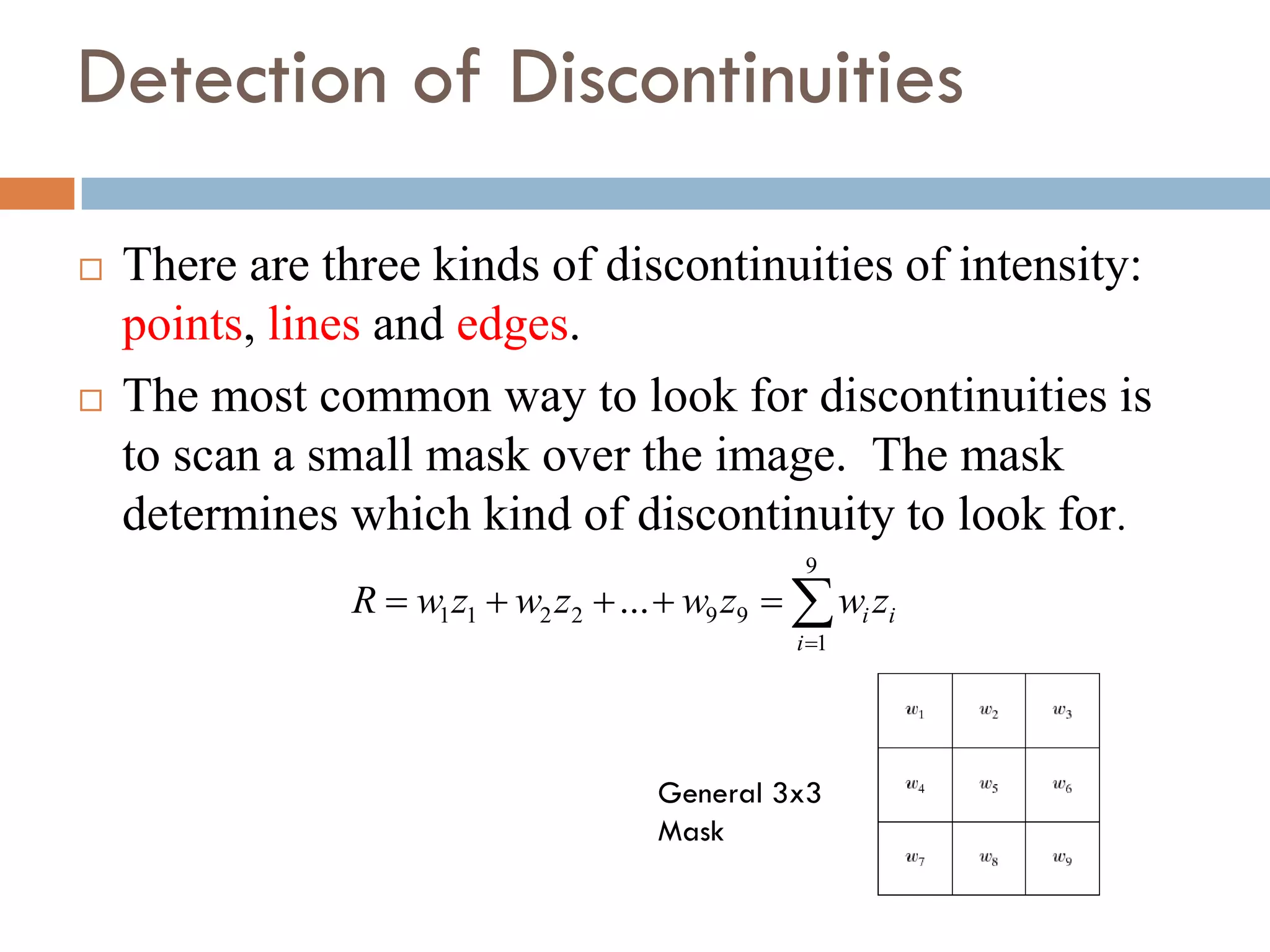
 The most common way to look for discontinuities is
to scan a small mask over the image. The mask
determines which kind of discontinuity to look for.







9
1
9
9
2
2
1
1 ...
i
i
i z
w
z
w
z
w
z
w
R
General 3x3
Mask
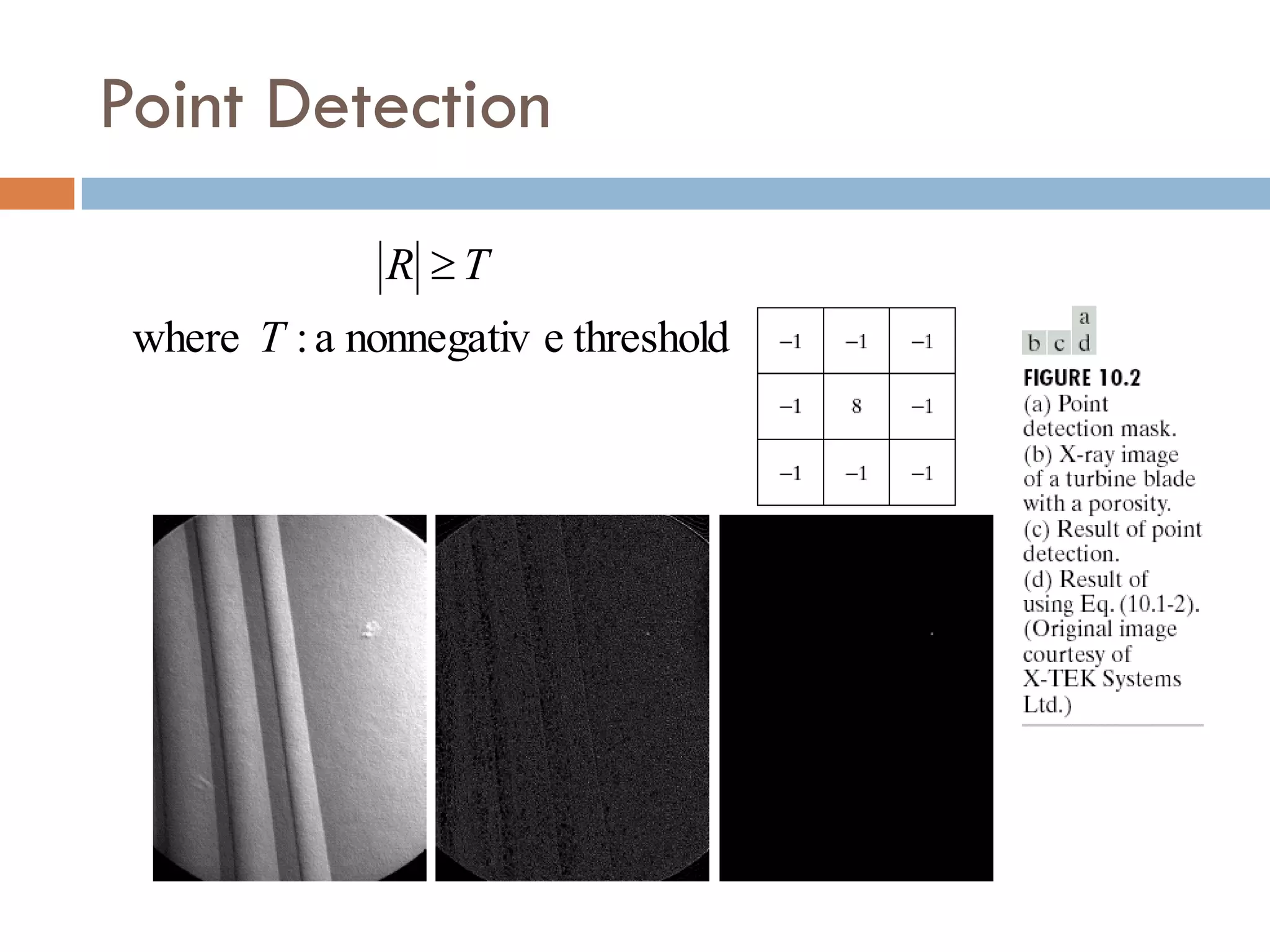
Point Detection
threshold
e
nonnegativ
a
:
where T
T
R 
Line Detection
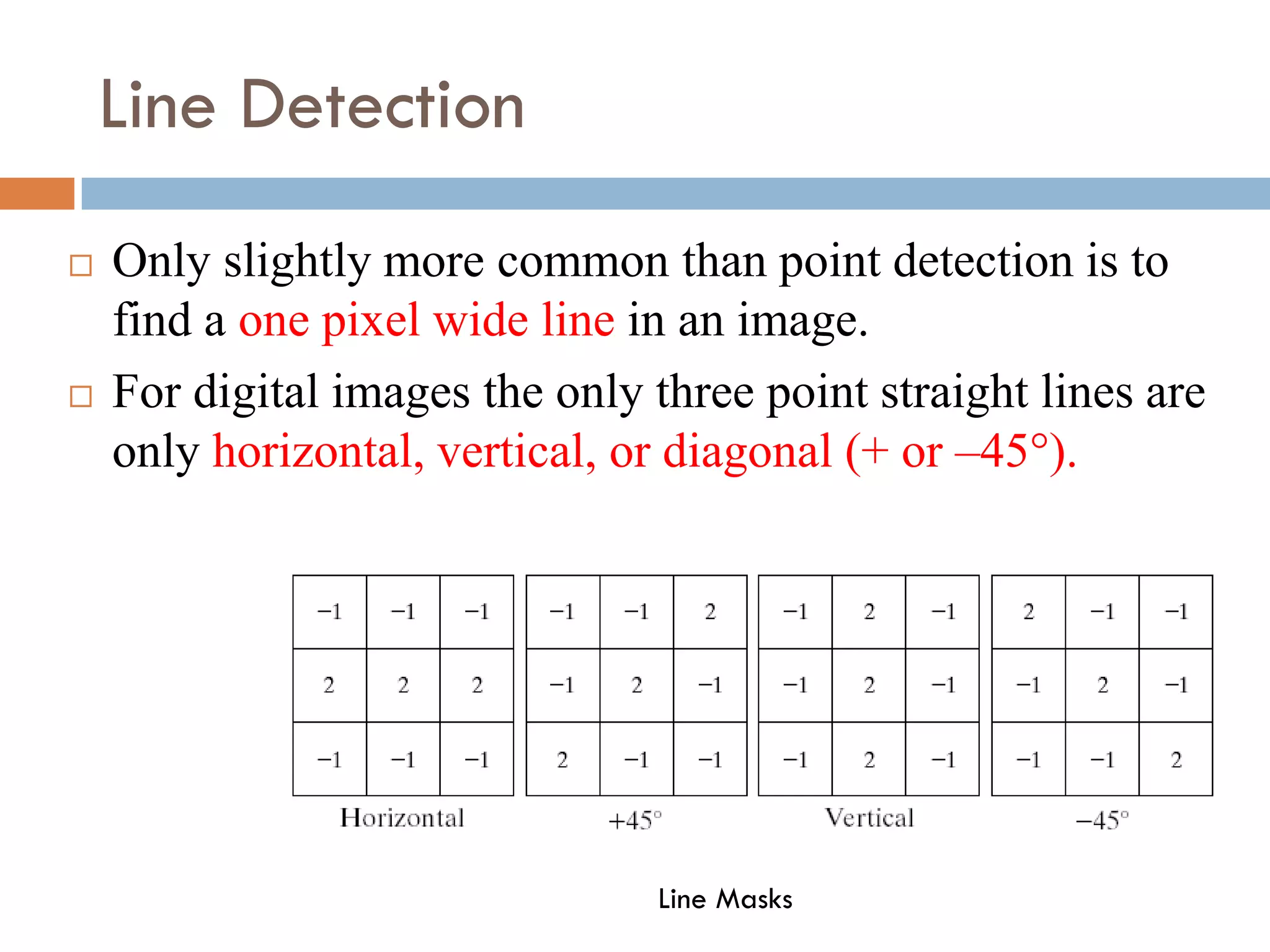
 Only slightly more common than point detection is to
find a one pixel wide line in an image.
 For digital images the only three point straight lines are
only horizontal, vertical, or diagonal (+ or –45).
Line Masks
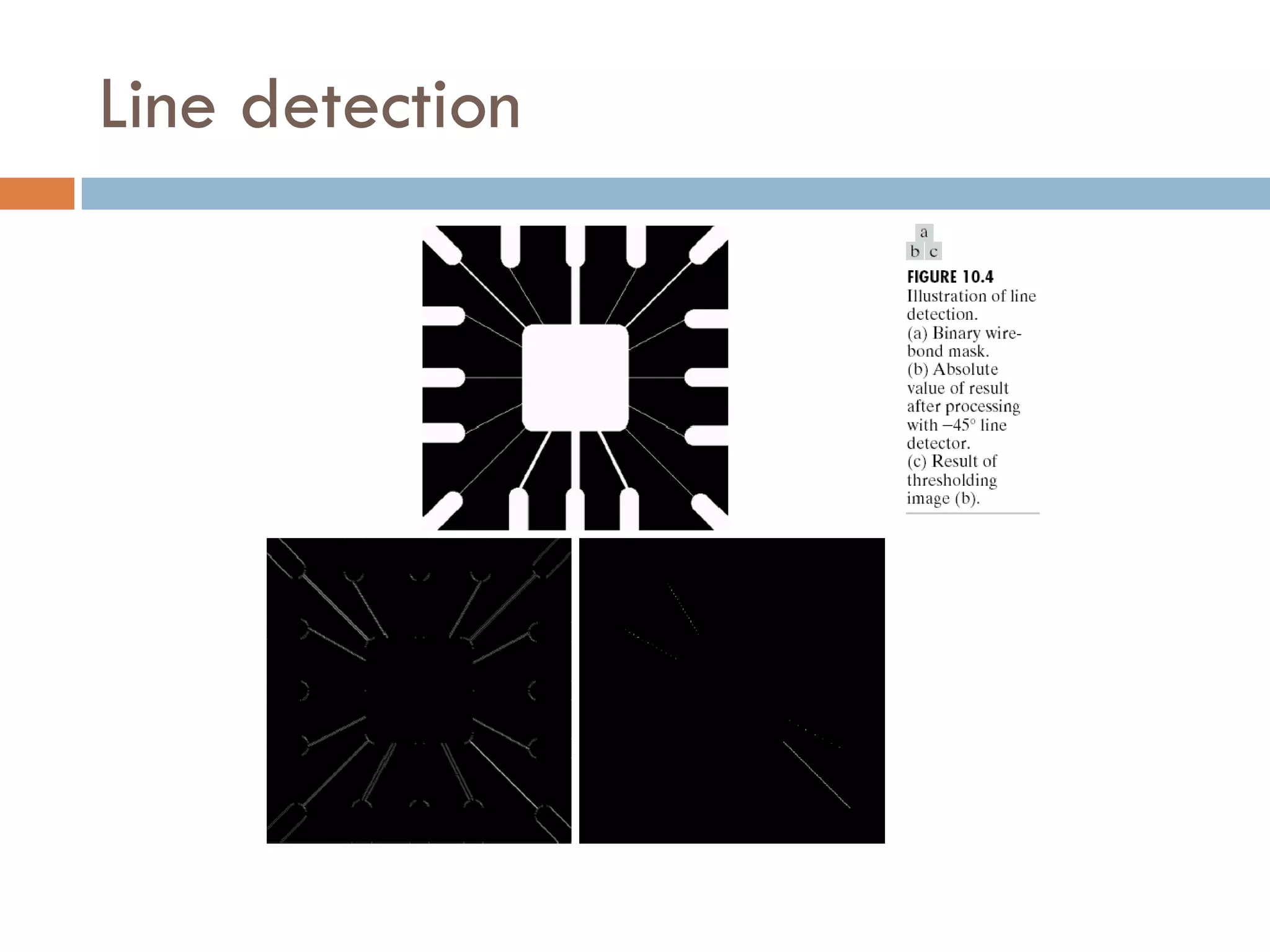
Line detection
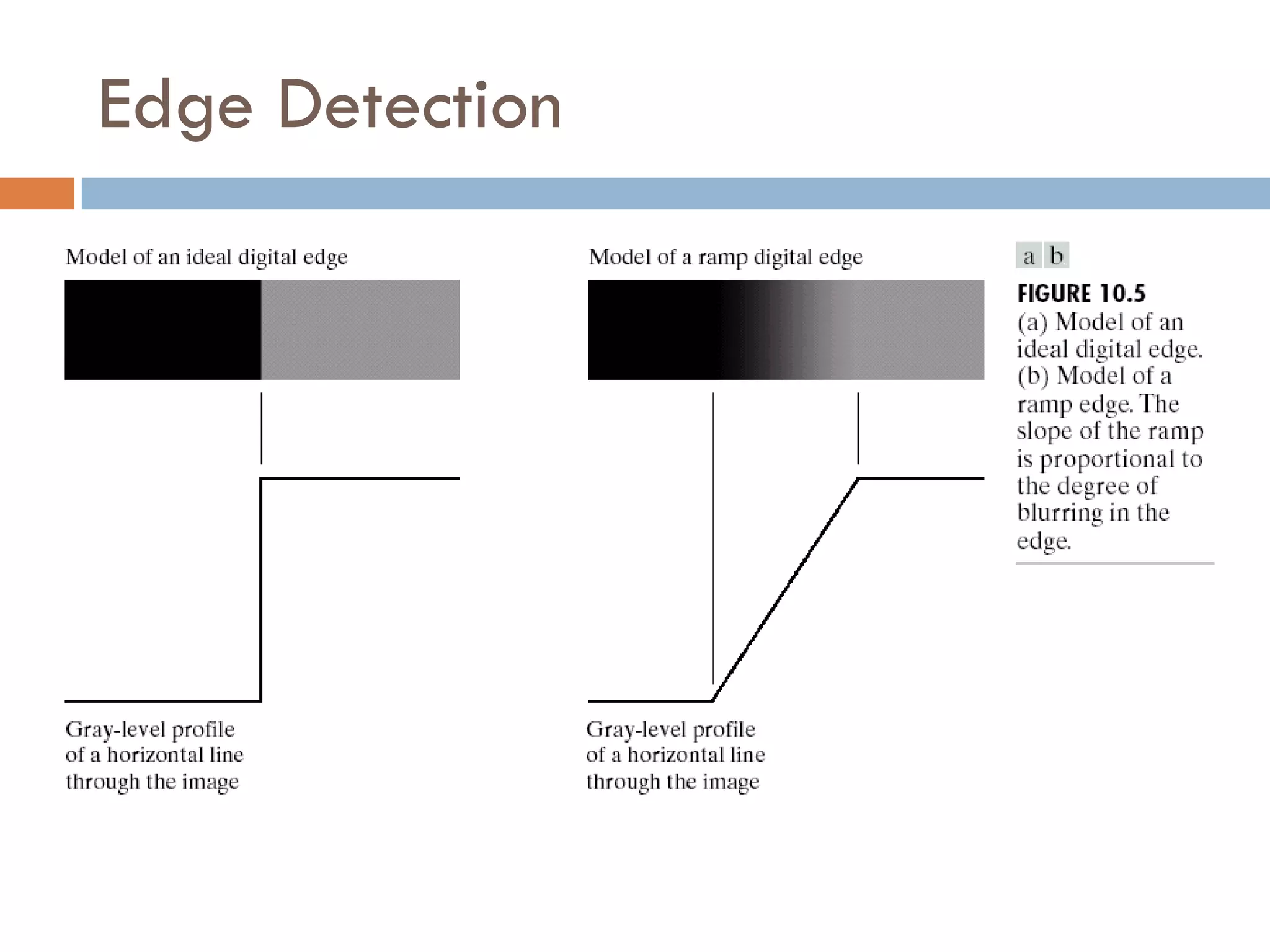
Edge Detection
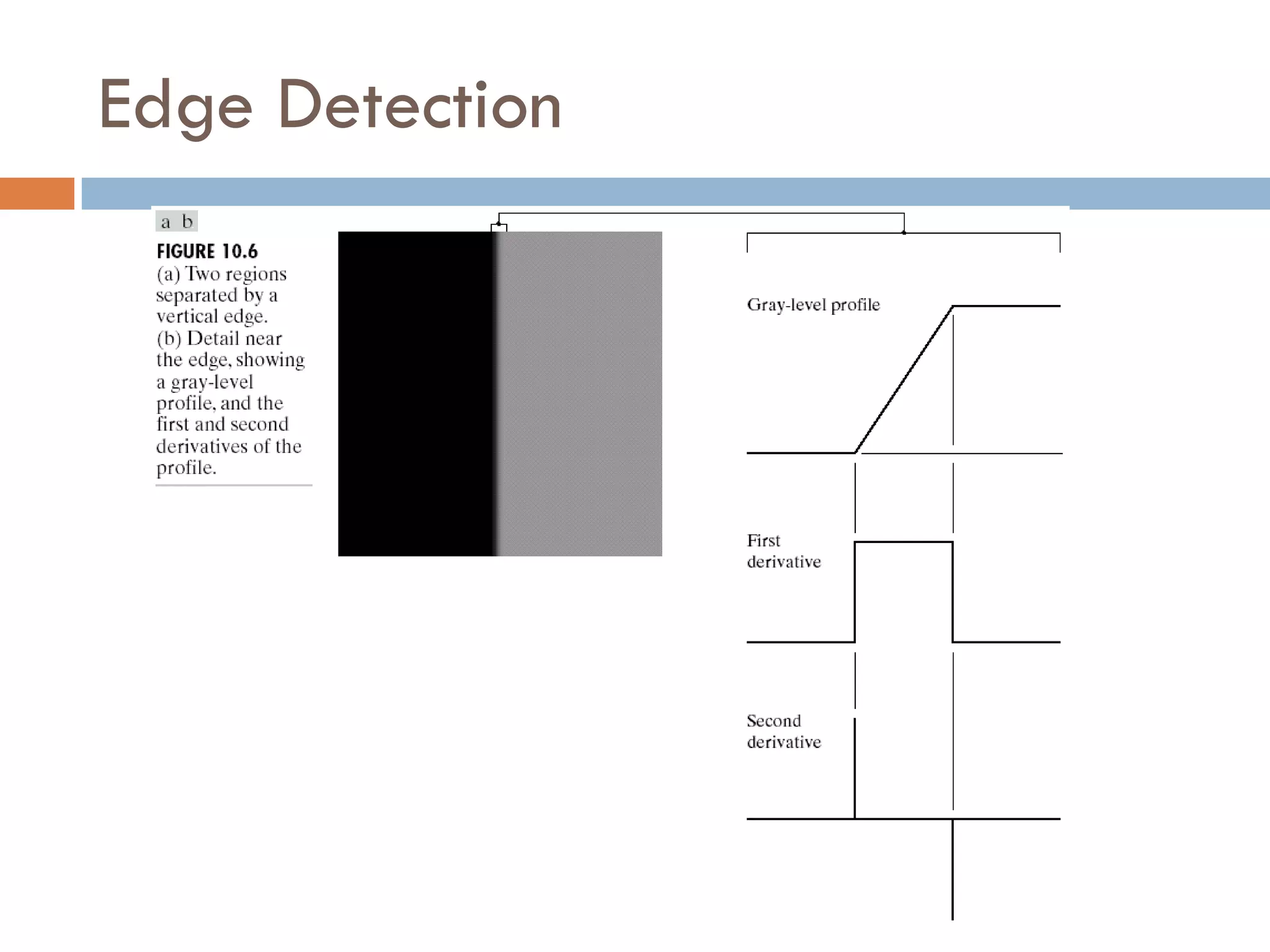
Edge Detection
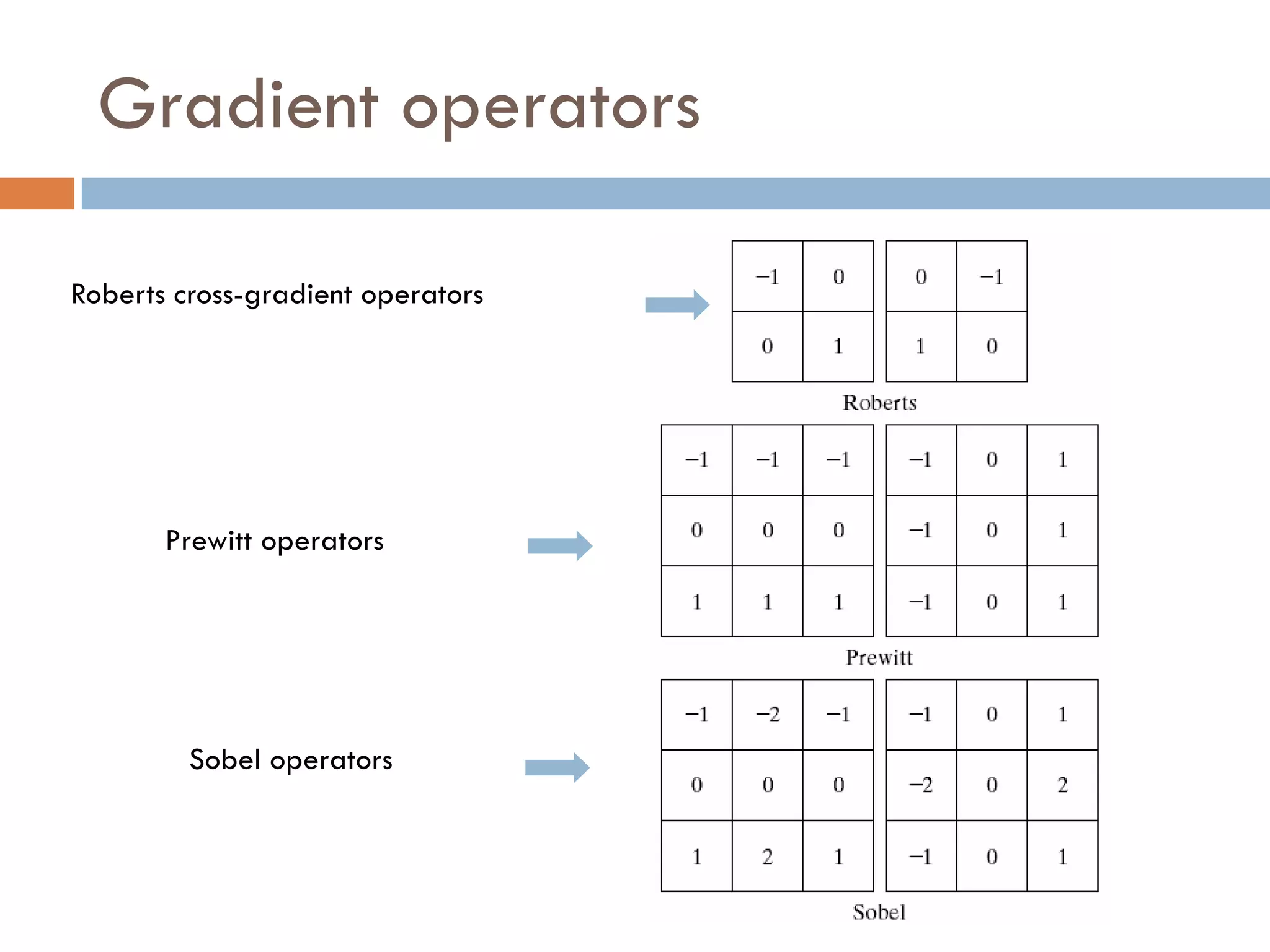
Gradient operators
Roberts cross-gradient operators
Prewitt operators
Sobel operators
Edge Linking and Boundary Detection
Local Processing
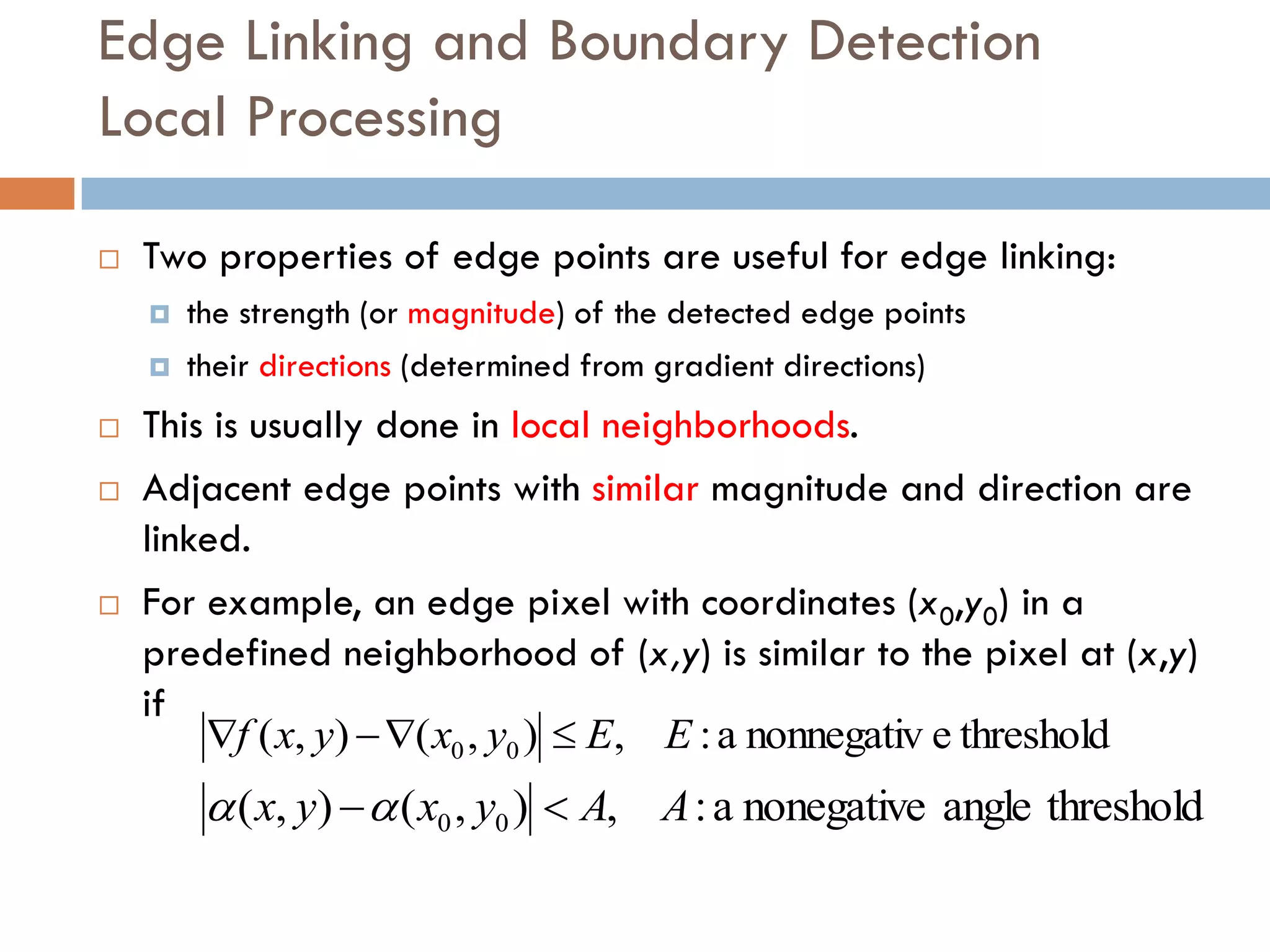
 Two properties of edge points are useful for edge linking:
 the strength (or magnitude) of the detected edge points
 their directions (determined from gradient directions)
 This is usually done in local neighborhoods.
 Adjacent edge points with similar magnitude and direction are
linked.
 For example, an edge pixel with coordinates (x0,y0) in a
predefined neighborhood of (x,y) is similar to the pixel at (x,y)
if
threshold
e
nonnegativ
a
:
,
)
,
(
)
,
( 0
0 E
E
y
x
y
x
f 



threshold
angle
nonegative
a
:
,
)
,
(
)
,
( 0
0 A
A
y
x
y
x 


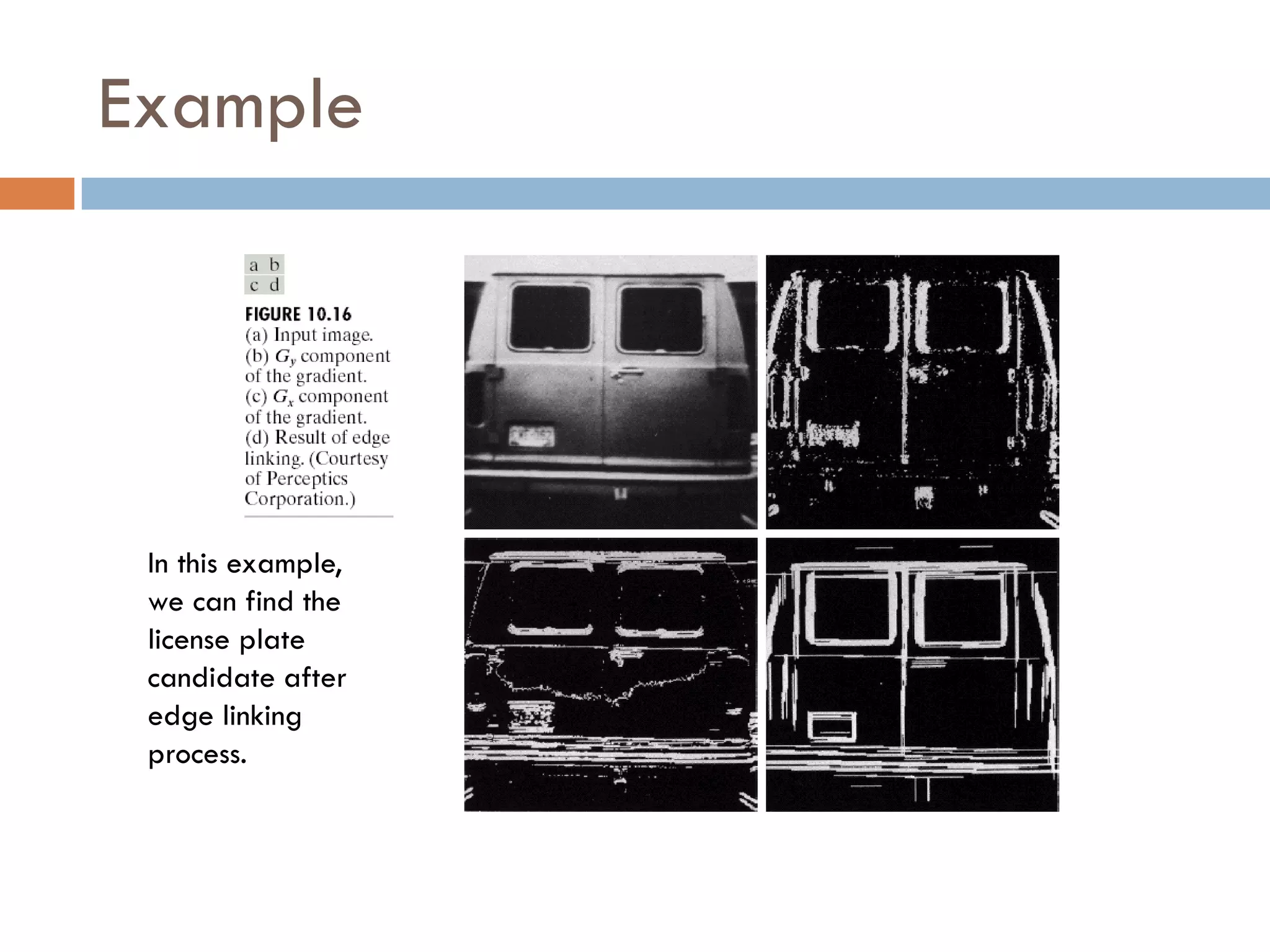
Example
In this example,
we can find the
license plate
candidate after
edge linking
process.
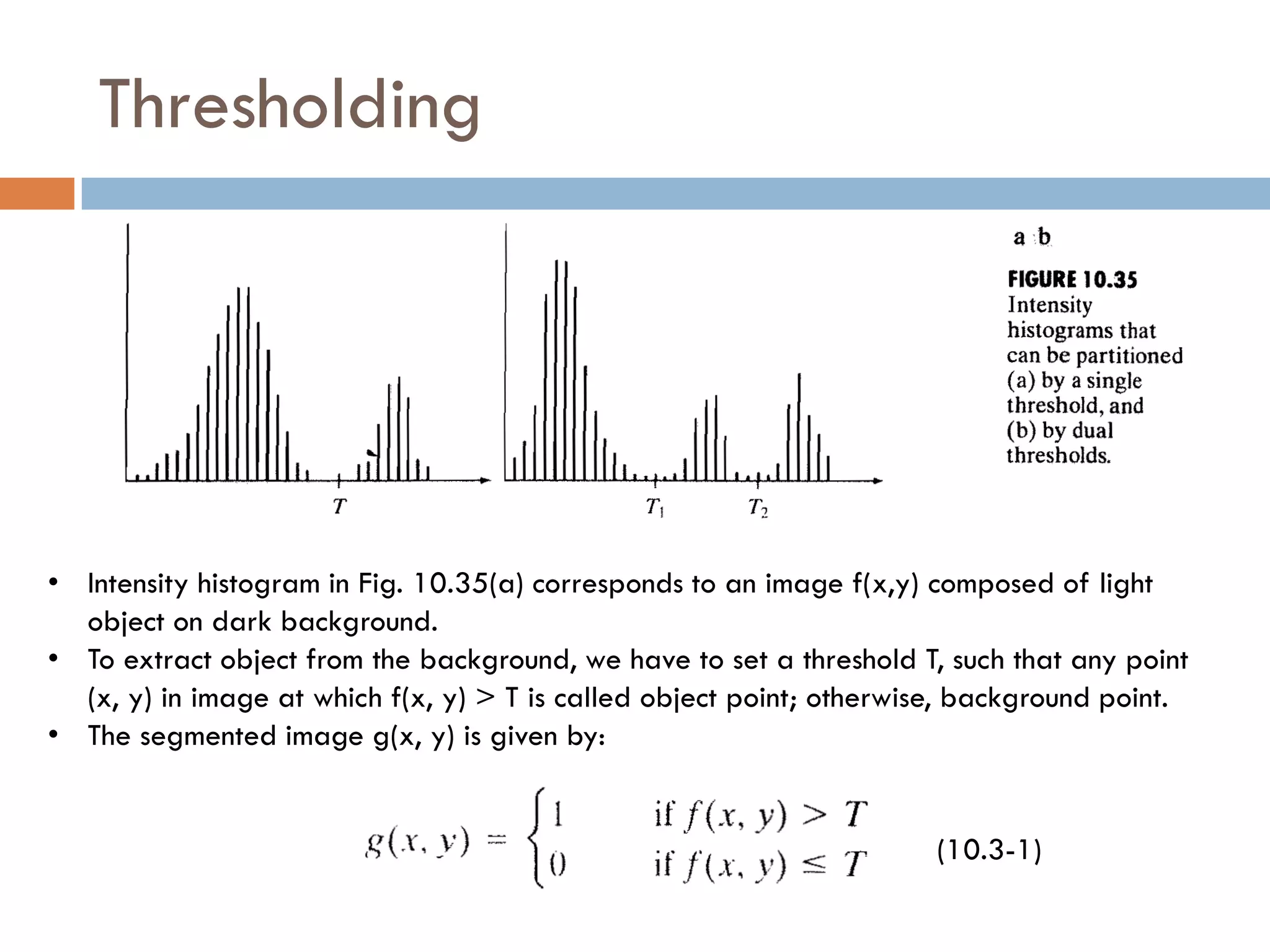
Thresholding
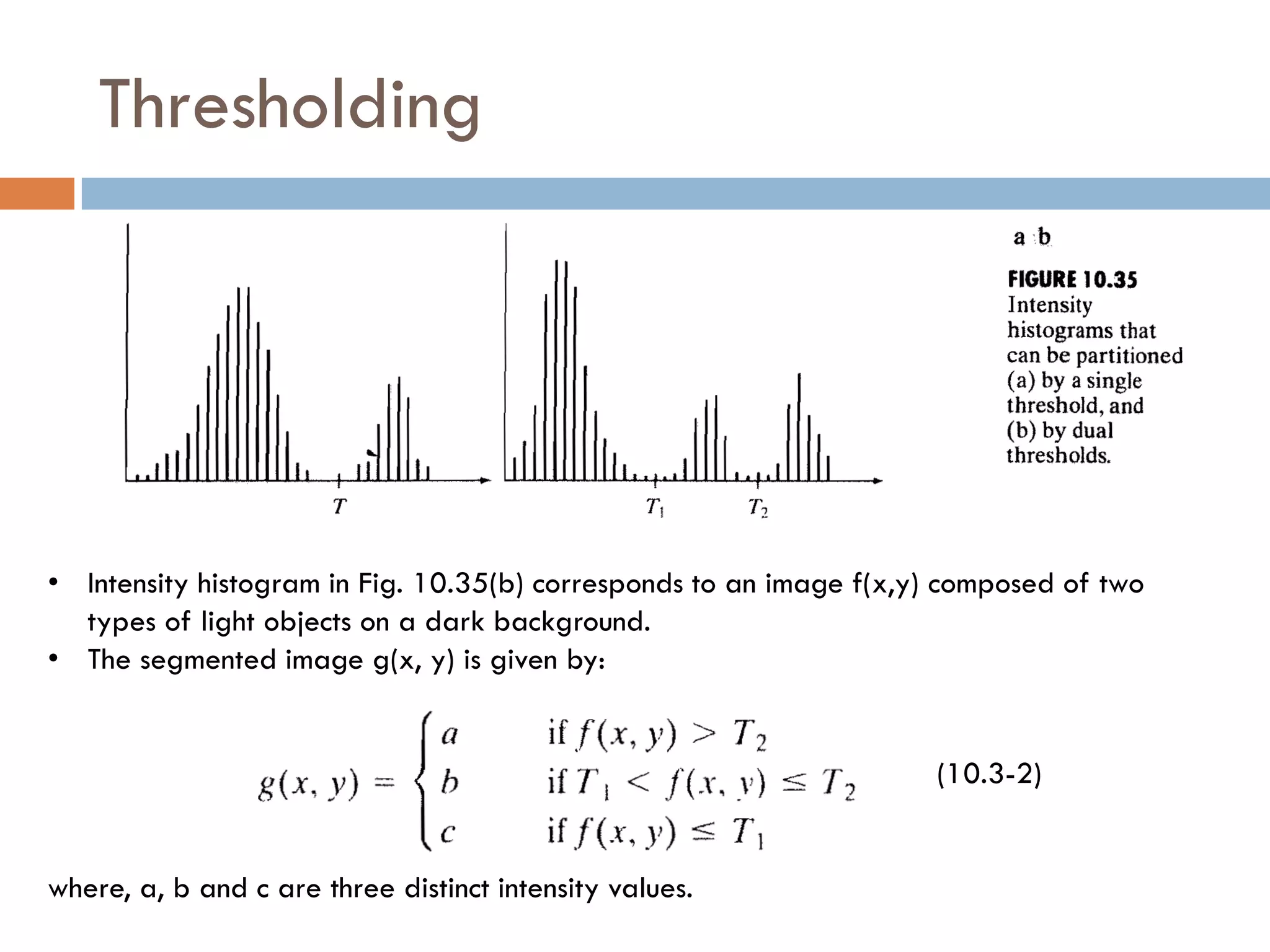
• Intensity histogram in Fig. 10.35(a) corresponds to an image f(x,y) composed of light
object on dark background.
• To extract object from the background, we have to set a threshold T, such that any point
(x, y) in image at which f(x, y) > T is called object point; otherwise, background point.
• The segmented image g(x, y) is given by:
(10.3-1)
Thresholding
• Intensity histogram in Fig. 10.35(b) corresponds to an image f(x,y) composed of two
types of light objects on a dark background.
• The segmented image g(x, y) is given by:
(10.3-2)
where, a, b and c are three distinct intensity values.
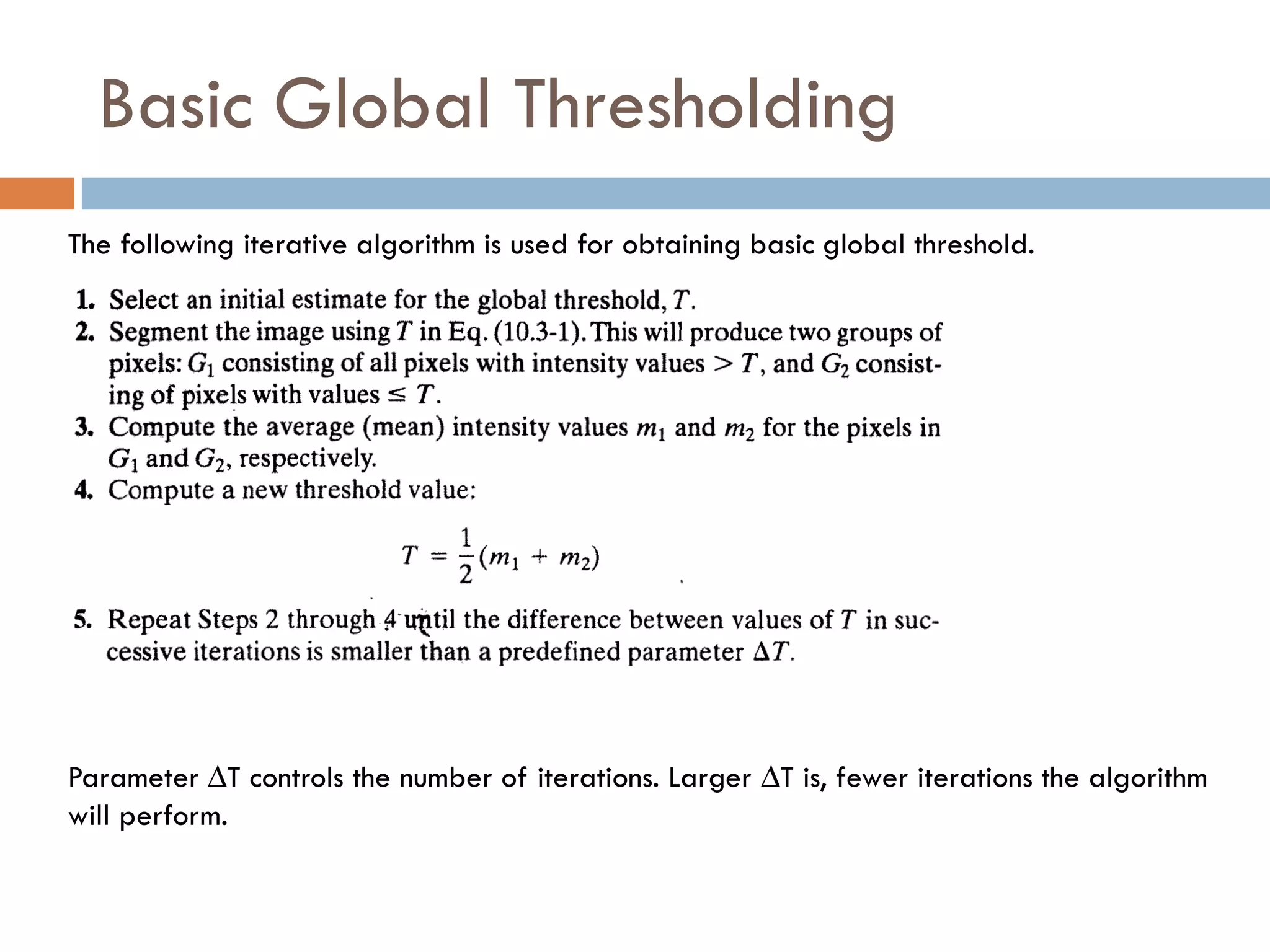
Basic Global Thresholding
The following iterative algorithm is used for obtaining basic global threshold.
Parameter ∆T controls the number of iterations. Larger ∆T is, fewer iterations the algorithm
will perform.
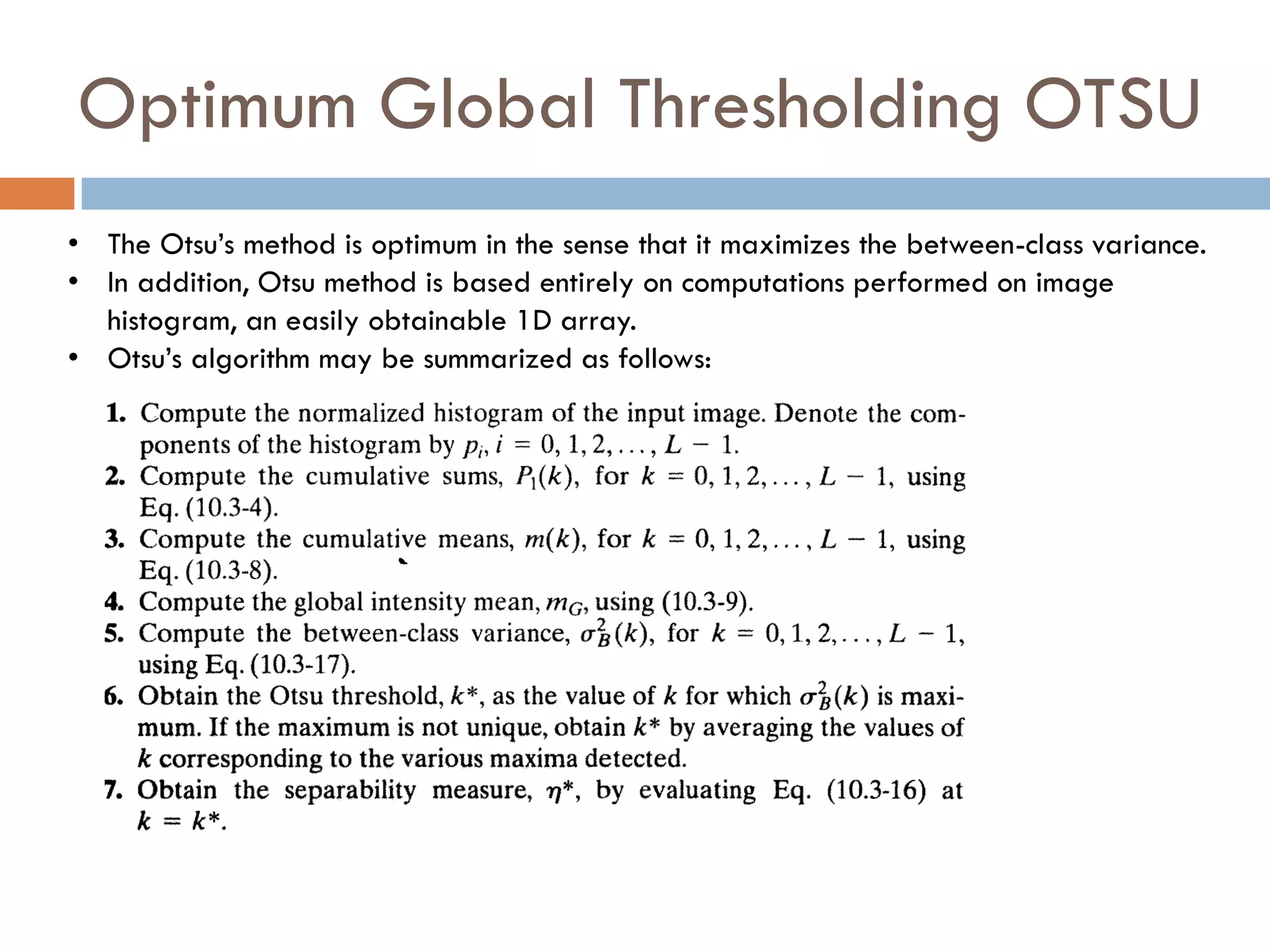
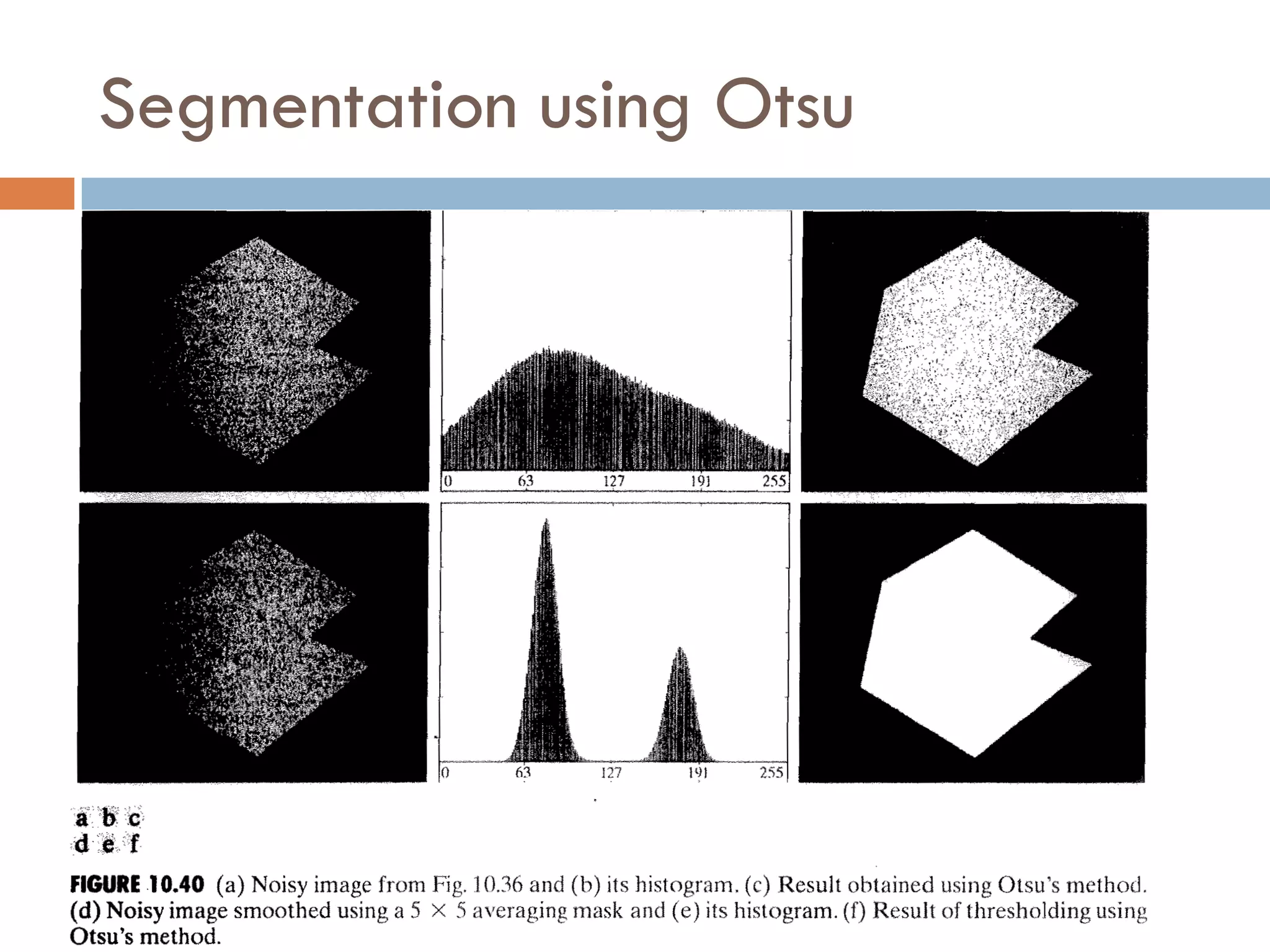
Optimum Global Thresholding OTSU
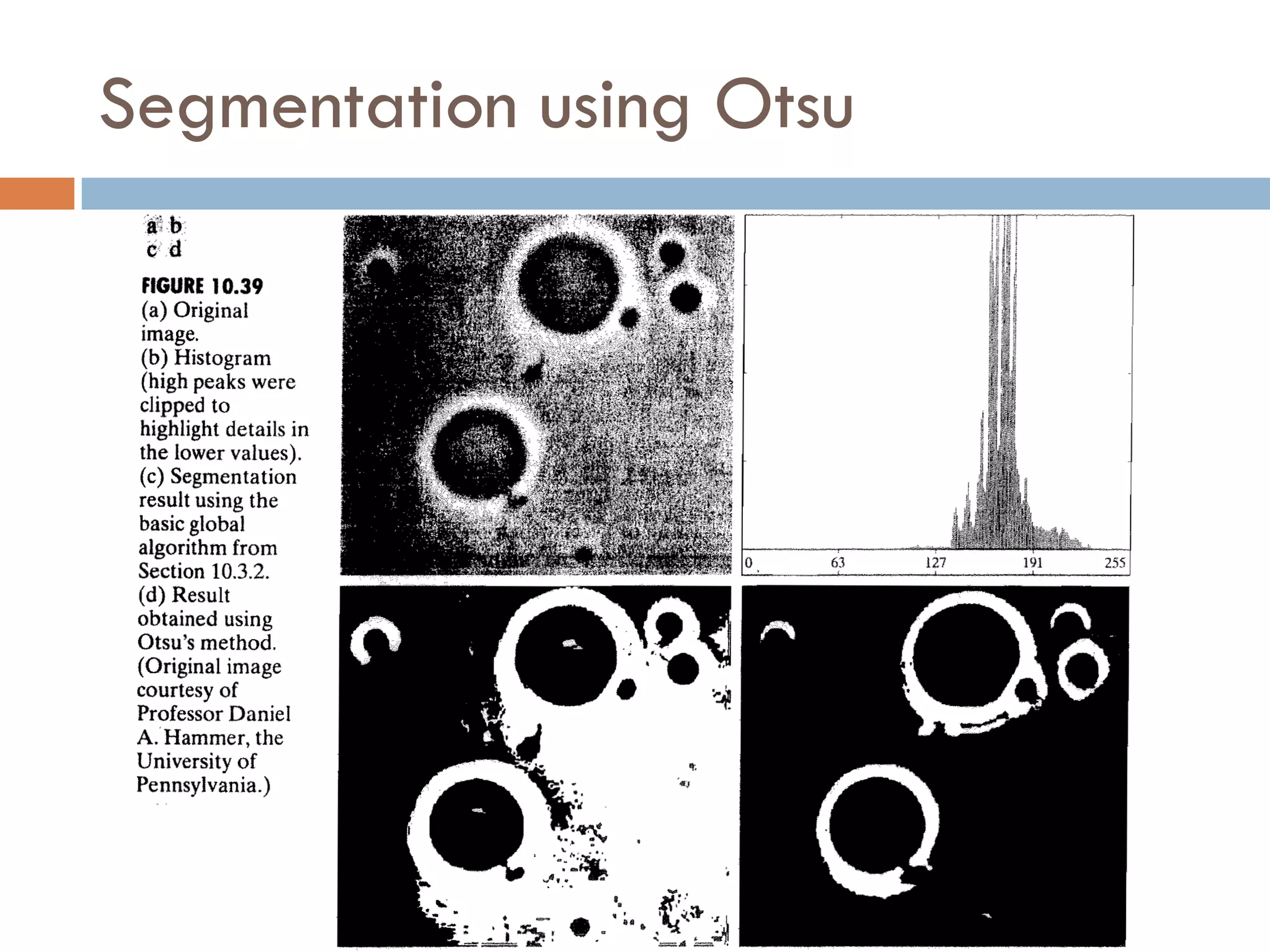
• The Otsu’s method is optimum in the sense that it maximizes the between-class variance.
• In addition, Otsu method is based entirely on computations performed on image
histogram, an easily obtainable 1D array.
• Otsu’s algorithm may be summarized as follows:
Segmentation using Otsu
Region based segmentation
 Edges and thresholds sometimes do not give good
results for segmentation.
 Region-based segmentation is based on the
connectivity of similar pixels in a region.
 Each region must be uniform.
 Connectivity of the pixels within the region is very important.
 There are two main approaches to region-based
segmentation: region growing and region splitting.
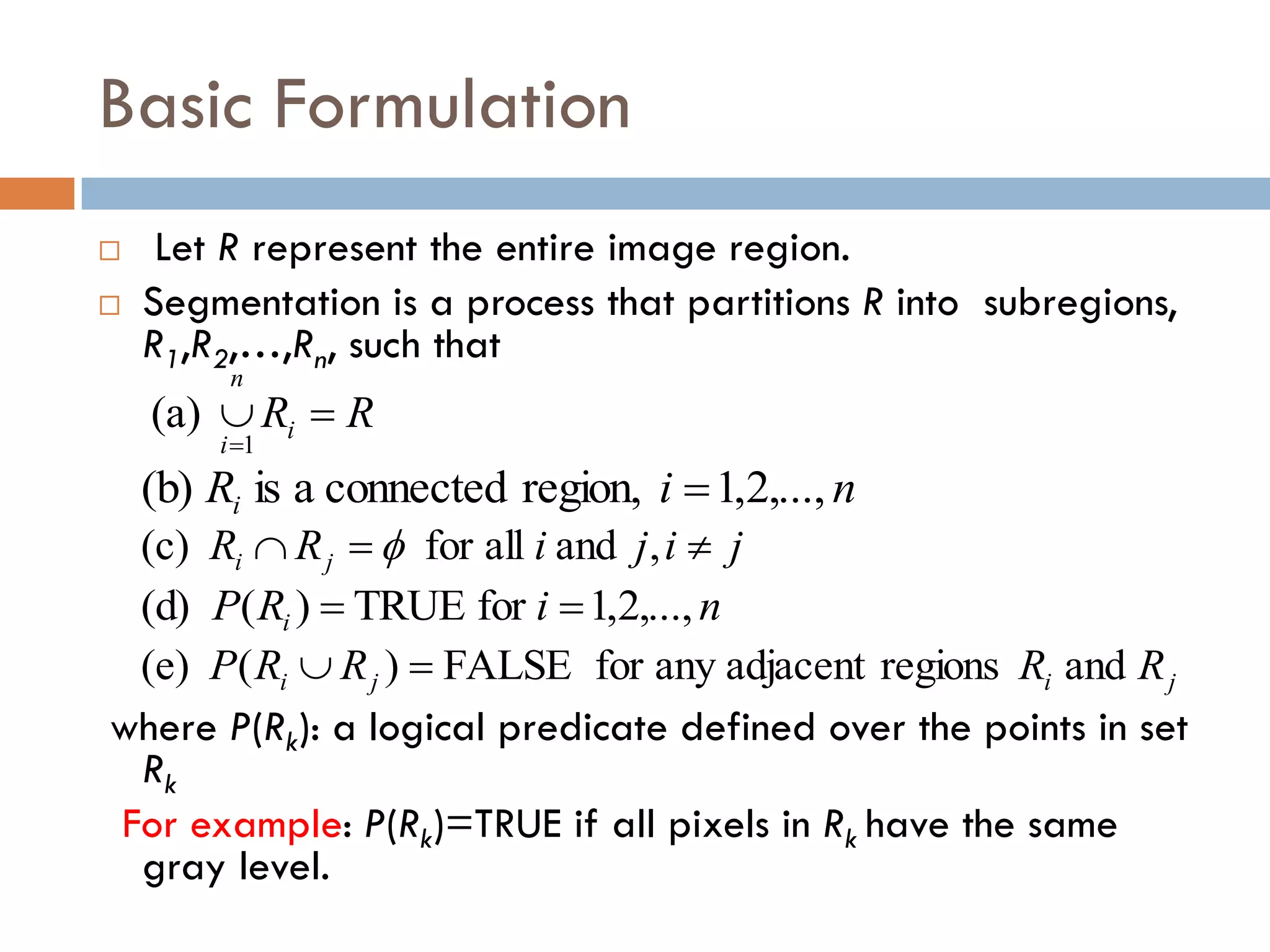
Basic Formulation
 Let R represent the entire image region.
 Segmentation is a process that partitions R into subregions,
R1,R2,…,Rn, such that
where P(Rk): a logical predicate defined over the points in set
Rk
For example: P(Rk)=TRUE if all pixels in Rk have the same
gray level.
R
Ri
n
i


1
(a)
n
i
Ri ,...,
2
,
1
region,
connected
a
is
(b) 
j
i
j
i
R
R j
i 

 ,
and
all
for
(c) 
n
i
R
P i ,...,
2
,
1
for
TRUE
)
(
(d) 

j
i
j
i R
R
R
R
P and
regions
adjacent
any
for
FALSE
)
(
(e) 

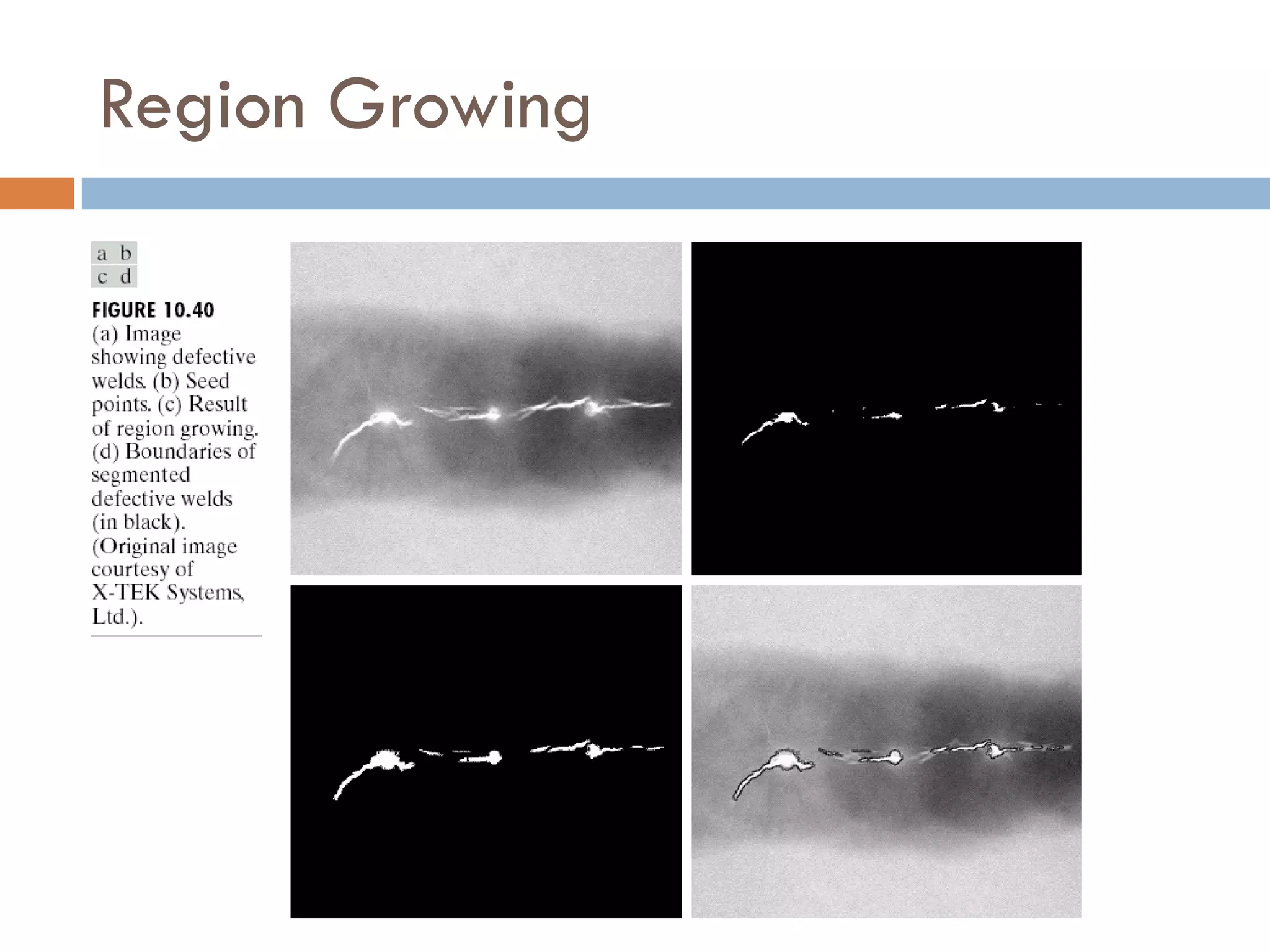
Region Growing
Region splitting and merging
 Region splitting is the opposite of region growing.
 First there is a large region (possible the entire image).
 Then a predicate (measurement) is used to determine if the
region is uniform.
 If not, then the method requires that the region be split into
two regions.
 Then each of these two regions is independently tested by
the predicate (measurement).
 This procedure continues until all resulting regions are
uniform.
Region splitting and merging
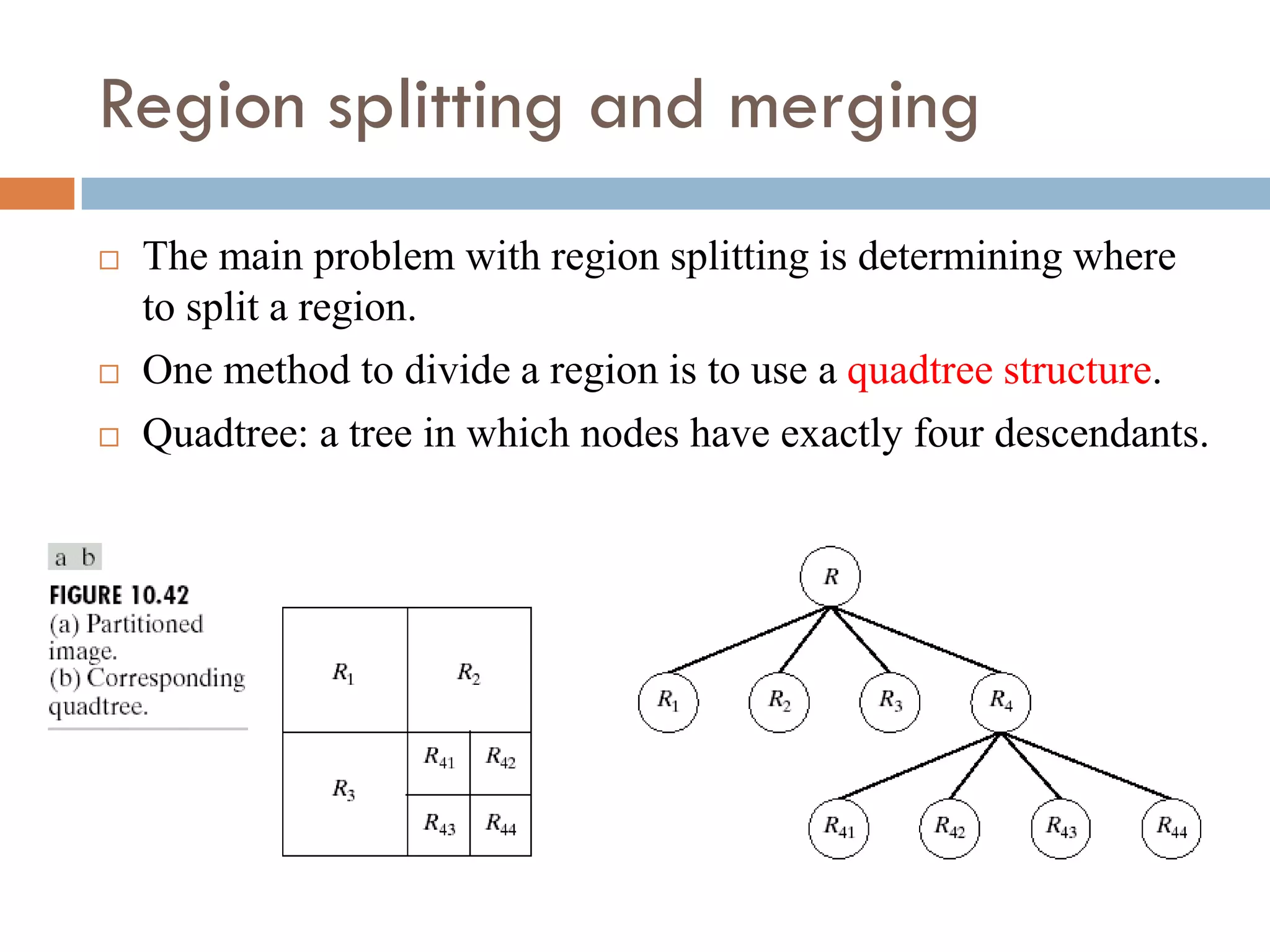
 The main problem with region splitting is determining where
to split a region.
 One method to divide a region is to use a quadtree structure.
 Quadtree: a tree in which nodes have exactly four descendants.
Region splitting and merging
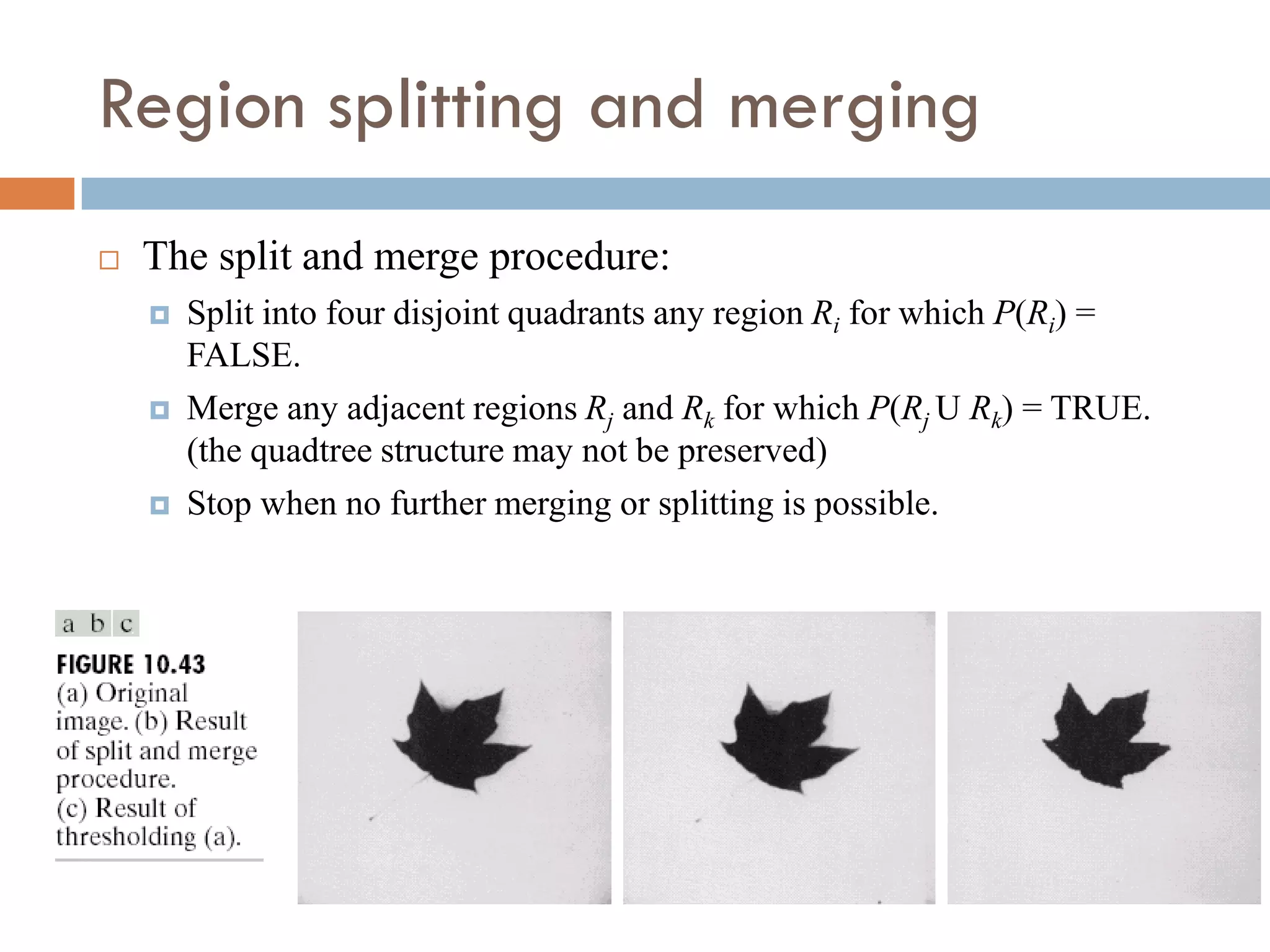
 The split and merge procedure:
 Split into four disjoint quadrants any region Ri for which P(Ri) =
FALSE.
 Merge any adjacent regions Rj and Rk for which P(Rj U Rk) = TRUE.
(the quadtree structure may not be preserved)
 Stop when no further merging or splitting is possible.

Image segmentation

  • 1.
  • 2.
    Introduction  Image segmentationdivides an image into regions that are connected and have some similarity within the region and some difference between adjacent regions.  The goal is usually to find individual objects in an image.  For the most part there are fundamentally two kinds of approaches to segmentation: discontinuity and similarity.  Similarity may be due to pixel intensity, color or texture.  Differences are sudden changes (discontinuities) in any of these, but especially sudden changes in intensity along a boundary line, which is called an edge.
  • 3.
    Detection of Discontinuities There are three kinds of discontinuities of intensity: points, lines and edges.  The most common way to look for discontinuities is to scan a small mask over the image. The mask determines which kind of discontinuity to look for.        9 1 9 9 2 2 1 1 ... i i i z w z w z w z w R General 3x3 Mask
  • 4.
  • 5.
    Line Detection  Onlyslightly more common than point detection is to find a one pixel wide line in an image.  For digital images the only three point straight lines are only horizontal, vertical, or diagonal (+ or –45). Line Masks
  • 6.
  • 7.
  • 8.
  • 9.
    Gradient operators Roberts cross-gradientoperators Prewitt operators Sobel operators
  • 10.
    Edge Linking andBoundary Detection Local Processing  Two properties of edge points are useful for edge linking:  the strength (or magnitude) of the detected edge points  their directions (determined from gradient directions)  This is usually done in local neighborhoods.  Adjacent edge points with similar magnitude and direction are linked.  For example, an edge pixel with coordinates (x0,y0) in a predefined neighborhood of (x,y) is similar to the pixel at (x,y) if threshold e nonnegativ a : , ) , ( ) , ( 0 0 E E y x y x f     threshold angle nonegative a : , ) , ( ) , ( 0 0 A A y x y x   
  • 11.
    Example In this example, wecan find the license plate candidate after edge linking process.
  • 12.
    Thresholding • Intensity histogramin Fig. 10.35(a) corresponds to an image f(x,y) composed of light object on dark background. • To extract object from the background, we have to set a threshold T, such that any point (x, y) in image at which f(x, y) > T is called object point; otherwise, background point. • The segmented image g(x, y) is given by: (10.3-1)
  • 13.
    Thresholding • Intensity histogramin Fig. 10.35(b) corresponds to an image f(x,y) composed of two types of light objects on a dark background. • The segmented image g(x, y) is given by: (10.3-2) where, a, b and c are three distinct intensity values.
  • 14.
    Basic Global Thresholding Thefollowing iterative algorithm is used for obtaining basic global threshold. Parameter ∆T controls the number of iterations. Larger ∆T is, fewer iterations the algorithm will perform.
  • 15.
    Optimum Global ThresholdingOTSU • The Otsu’s method is optimum in the sense that it maximizes the between-class variance. • In addition, Otsu method is based entirely on computations performed on image histogram, an easily obtainable 1D array. • Otsu’s algorithm may be summarized as follows:
  • 16.
  • 17.
  • 18.
    Region based segmentation Edges and thresholds sometimes do not give good results for segmentation.  Region-based segmentation is based on the connectivity of similar pixels in a region.  Each region must be uniform.  Connectivity of the pixels within the region is very important.  There are two main approaches to region-based segmentation: region growing and region splitting.
  • 19.
    Basic Formulation  LetR represent the entire image region.  Segmentation is a process that partitions R into subregions, R1,R2,…,Rn, such that where P(Rk): a logical predicate defined over the points in set Rk For example: P(Rk)=TRUE if all pixels in Rk have the same gray level. R Ri n i   1 (a) n i Ri ,..., 2 , 1 region, connected a is (b)  j i j i R R j i    , and all for (c)  n i R P i ,..., 2 , 1 for TRUE ) ( (d)   j i j i R R R R P and regions adjacent any for FALSE ) ( (e)  
  • 20.
  • 21.
    Region splitting andmerging  Region splitting is the opposite of region growing.  First there is a large region (possible the entire image).  Then a predicate (measurement) is used to determine if the region is uniform.  If not, then the method requires that the region be split into two regions.  Then each of these two regions is independently tested by the predicate (measurement).  This procedure continues until all resulting regions are uniform.
  • 22.
    Region splitting andmerging  The main problem with region splitting is determining where to split a region.  One method to divide a region is to use a quadtree structure.  Quadtree: a tree in which nodes have exactly four descendants.
  • 23.
    Region splitting andmerging  The split and merge procedure:  Split into four disjoint quadrants any region Ri for which P(Ri) = FALSE.  Merge any adjacent regions Rj and Rk for which P(Rj U Rk) = TRUE. (the quadtree structure may not be preserved)  Stop when no further merging or splitting is possible.