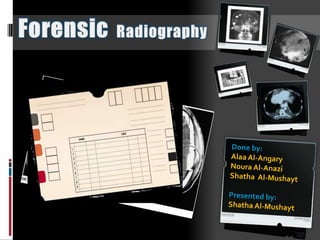
ForensicRadiographyDone by: Alaa Al-AngaryNoura Al-AnaziShatha  Al-MushaytPresented by: Shatha Al-Mushayt
History
Definition
Modalities
Using Medical Imaging in Forensic Science
Projections
Radiographer RoleOutline
Forensic Radiology HistoryUsing x-ray to produce  images was discovered by Wilhelm  Roentgen  in 1895.  Only weeks later, the forensic use of x-ray  was tested.Helped in convicting an American murderer.Weeks later, the technique was first used in UK.http://www2.le.ac.uk/departments/emfpu/imaging/brief-history
Definition ofForensic RadiologyIt is a specialized area of medical imaging using radiological techniques to assist physicians and pathologists in matters related to the law. Radiographs must   be taken before dissection.	Earliest photograph of roentgenography of a cadaver found by the author.http://www2.le.ac.uk/departments/emfpu/imaging/brief-history
ModalitiesGeneral X-ray FluoroscopyNMCTMRIDental IdentificationAngiography and venographyUS
General X-ray:Shard of glass (arrows) from a broken beer bottle remain in the lung of  this stabbing victim.Fluoroscopy:Post-operative chest x-ray and intra-bronchial contrast material with initial tracheal stent in place. http://www.sahha.gov.mt/pages.aspx?page=559
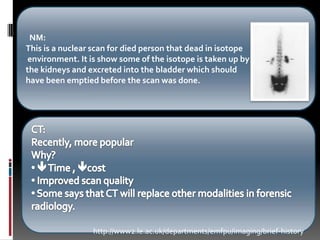
   NM:This is a nuclear scan for died person that dead in isotope  environment. It is show some of the isotope is taken up by the kidneys and excreted into the bladder which shouldhave been emptied before the scan was done. CT: Recently, more popularWhy?  Time , cost
 Improved scan quality
 Some says that CT will replace other modalities in forensic radiology.http://www2.le.ac.uk/departments/emfpu/imaging/brief-history
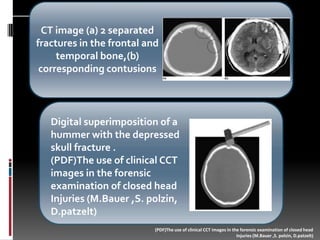
CT image (a) 2 separated fractures in the frontal and temporal bone,(b) corresponding contusionsDigital superimposition of a hummer with the depressed skull fracture .(PDF)The use of clinical CCT images in the forensic examination of closed headInjuries (M.Bauer ,S. polzin, D.patzelt) (PDF)The use of clinical CCT images in the forensic examination of closed head Injuries (M.Bauer ,S. polzin, D.patzelt)
MRI:Used also in FR but has a limited role to play. Why?
The strong magnetic currents required,
costsDental Radiography: for identification and ageing purposes93% rate for identification of subjects from dental radiographs. PDF)The use of clinical CCT images in the forensic examination of closed headInjuries (M.Bauer ,S. polzin, D.patzelt)
MRI:Used also in FR but has a limited role to play. Why?
The strong magnetic currents required,
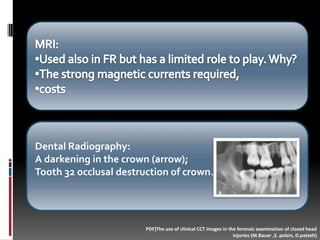
costsDental Radiography:A darkening in the crown (arrow);Tooth 32 occlusal destruction of crown.Dental Radiography: for identification and ageing purposes93% rate for identification of subjects from dental radiographs. PDF)The use of clinical CCT images in the forensic examination of closed headInjuries (M.Bauer ,S. polzin, D.patzelt)
Angiography and venography:For determining blood flow  although it is not  common.Cerebral angiogram demonstrates small, acute stroke (arrowhead) in internal capsule – thalamic junction. Used  to  detect  intracranial  and  intraventricular  bleeding.
  It  is possible  that  this  may  also  be  used  post-mortem.Bilateral intraventricularhaemorrhage: enlarged lateral ventricles with oval contours. Macrogranular choroid vascular plexuses show a large textured cohesion. Visible enlarged thirdventricle with a diameter of 7-8 mm.THE  USE  OF  RADIOGRAPHY  IN FORENSIC  MEDICINE (Nigel Hughes and Mary Baker )http://www.czytelniamedyczna.pl/new_medicine-92
Using Of Forensic RadiologyWidely used in:IdentificationEstablishing cause of deathfive bullets, overlying  in the  skullForensic Radiology by B. G. Brogdon, M.D.
A. IdentificationTo  bring evidence to help confirm, determine, or eliminate the identity of both living and dead persons. AgeGenderRaceThe comparison of ante & post mortem radiographs is one of the most accurate means of identification.Forensic Radiology by B. G. Brogdon, M.D.
A. IdentificationAge Child: by the appearance of centers of ossification for hand and wrist.Young adult: by the state of fusion of epiphyses.RaceImages basically for skull. Skeletal racial Groups:Negroid – elongated craniumMongoloid – rounded cranium Caucasoid- Head is curved at the top, not completely flat, The chin is prominent.Forensic Radiology by B. G. Brogdon, M.D.
A. IdentificationGenderUsually the 1st step in ID process.The sexual characteristics recognizable by radiography begin to appear after puberty.RT takes Images for the skull, long bones and pelvis.SKULLF, more vertical foreheadM, less rounded forehead
A. IdentificationGenderUsually the 1st step in ID process.The sexual characteristics recognizable by radiography begin to appear after puberty.RT takes Images for the skull, long bones and pelvis.SKULLF, more vertical foreheadM, less rounded foreheadPELVISF, larger & more roundM, more oval
A. IdentificationGenderUsually the 1st step in ID process.The sexual characteristics recognizable by radiography begin to appear after puberty.RT takes Images for the skull, long bones and pelvis.LONG BONESF,  shorter & thinner M, longer & thicker
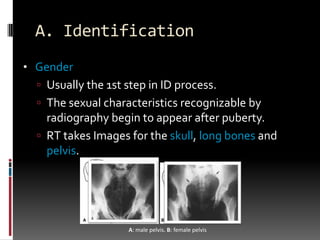
A. IdentificationGenderUsually the 1st step in ID process.The sexual characteristics recognizable by radiography begin to appear after puberty.RT takes Images for the skull, long bones and pelvis.A: male pelvis. B: female pelvis

Forensic Radiography

  • 1.
    ForensicRadiographyDone by: AlaaAl-AngaryNoura Al-AnaziShatha Al-MushaytPresented by: Shatha Al-Mushayt
  • 2.
  • 3.
  • 4.
  • 5.
    Using Medical Imagingin Forensic Science
  • 6.
  • 7.
  • 8.
    Forensic Radiology HistoryUsingx-ray to produce images was discovered by Wilhelm Roentgen in 1895. Only weeks later, the forensic use of x-ray was tested.Helped in convicting an American murderer.Weeks later, the technique was first used in UK.http://www2.le.ac.uk/departments/emfpu/imaging/brief-history
  • 9.
    Definition ofForensic RadiologyItis a specialized area of medical imaging using radiological techniques to assist physicians and pathologists in matters related to the law. Radiographs must be taken before dissection. Earliest photograph of roentgenography of a cadaver found by the author.http://www2.le.ac.uk/departments/emfpu/imaging/brief-history
  • 10.
    ModalitiesGeneral X-ray FluoroscopyNMCTMRIDentalIdentificationAngiography and venographyUS
  • 11.
    General X-ray:Shard ofglass (arrows) from a broken beer bottle remain in the lung of this stabbing victim.Fluoroscopy:Post-operative chest x-ray and intra-bronchial contrast material with initial tracheal stent in place. http://www.sahha.gov.mt/pages.aspx?page=559
  • 12.
      NM:Thisis a nuclear scan for died person that dead in isotope environment. It is show some of the isotope is taken up by the kidneys and excreted into the bladder which shouldhave been emptied before the scan was done. CT: Recently, more popularWhy?  Time , cost
  • 13.
  • 14.
    Some saysthat CT will replace other modalities in forensic radiology.http://www2.le.ac.uk/departments/emfpu/imaging/brief-history
  • 15.
    CT image (a)2 separated fractures in the frontal and temporal bone,(b) corresponding contusionsDigital superimposition of a hummer with the depressed skull fracture .(PDF)The use of clinical CCT images in the forensic examination of closed headInjuries (M.Bauer ,S. polzin, D.patzelt) (PDF)The use of clinical CCT images in the forensic examination of closed head Injuries (M.Bauer ,S. polzin, D.patzelt)
  • 16.
    MRI:Used also inFR but has a limited role to play. Why?
  • 17.
    The strong magneticcurrents required,
  • 18.
    costsDental Radiography: foridentification and ageing purposes93% rate for identification of subjects from dental radiographs. PDF)The use of clinical CCT images in the forensic examination of closed headInjuries (M.Bauer ,S. polzin, D.patzelt)
  • 19.
    MRI:Used also inFR but has a limited role to play. Why?
  • 20.
    The strong magneticcurrents required,
  • 21.
    costsDental Radiography:A darkeningin the crown (arrow);Tooth 32 occlusal destruction of crown.Dental Radiography: for identification and ageing purposes93% rate for identification of subjects from dental radiographs. PDF)The use of clinical CCT images in the forensic examination of closed headInjuries (M.Bauer ,S. polzin, D.patzelt)
  • 22.
    Angiography and venography:Fordetermining blood flow although it is not common.Cerebral angiogram demonstrates small, acute stroke (arrowhead) in internal capsule – thalamic junction. Used to detect intracranial and intraventricular bleeding.
  • 23.
    It is possible that this may also be used post-mortem.Bilateral intraventricularhaemorrhage: enlarged lateral ventricles with oval contours. Macrogranular choroid vascular plexuses show a large textured cohesion. Visible enlarged thirdventricle with a diameter of 7-8 mm.THE USE OF RADIOGRAPHY IN FORENSIC MEDICINE (Nigel Hughes and Mary Baker )http://www.czytelniamedyczna.pl/new_medicine-92
  • 24.
    Using Of ForensicRadiologyWidely used in:IdentificationEstablishing cause of deathfive bullets, overlying in the skullForensic Radiology by B. G. Brogdon, M.D.
  • 25.
    A. IdentificationTo bring evidence to help confirm, determine, or eliminate the identity of both living and dead persons. AgeGenderRaceThe comparison of ante & post mortem radiographs is one of the most accurate means of identification.Forensic Radiology by B. G. Brogdon, M.D.
  • 26.
    A. IdentificationAge Child:by the appearance of centers of ossification for hand and wrist.Young adult: by the state of fusion of epiphyses.RaceImages basically for skull. Skeletal racial Groups:Negroid – elongated craniumMongoloid – rounded cranium Caucasoid- Head is curved at the top, not completely flat, The chin is prominent.Forensic Radiology by B. G. Brogdon, M.D.
  • 27.
    A. IdentificationGenderUsually the1st step in ID process.The sexual characteristics recognizable by radiography begin to appear after puberty.RT takes Images for the skull, long bones and pelvis.SKULLF, more vertical foreheadM, less rounded forehead
  • 28.
    A. IdentificationGenderUsually the1st step in ID process.The sexual characteristics recognizable by radiography begin to appear after puberty.RT takes Images for the skull, long bones and pelvis.SKULLF, more vertical foreheadM, less rounded foreheadPELVISF, larger & more roundM, more oval
  • 29.
    A. IdentificationGenderUsually the1st step in ID process.The sexual characteristics recognizable by radiography begin to appear after puberty.RT takes Images for the skull, long bones and pelvis.LONG BONESF, shorter & thinner M, longer & thicker
  • 30.
    A. IdentificationGenderUsually the1st step in ID process.The sexual characteristics recognizable by radiography begin to appear after puberty.RT takes Images for the skull, long bones and pelvis.A: male pelvis. B: female pelvis
  • 31.
    A. IdentificationGenderUsually the1st step in ID process.The sexual characteristics recognizable by radiography begin to appear after puberty.RT takes Images for the skull, long bones and pelvis.A: male pelvis. B: female pelvis

Editor's Notes

  • #14 Post-mortem examination. an examination of the body made after the death of the patient; an autopsy
  • #23 The contrast medium must be introduced into the wound by gravity and not injected as pressure could from false channels.
  • #26 > 1st pt. formation—both visibility and sharpness of details.The radiographer should remember that kVp controls penetration and scale of contrast. mAs controls density. Why? Because decomposition, loss of tissue & gas will affect techniqueCR, every effort should be taken to to improve image quality, including increased FFD, small focal spot, close collimation, optimal (kVp), and sufficient (mAs) to make detail visible.
  • #27 in Mass Fatality Events ,Radiographer is usually a member of a formal forensics team.
  • #29 Although the radiographer may not be directly involved in the collection and preservation of evidence