DIATOMS IN FORENSIC SCIENCE
-Navnidhi kaur khatri, Pranav Panchbhai,
Anikesh Banik, Yashaswee purohit
INTRODUCTION
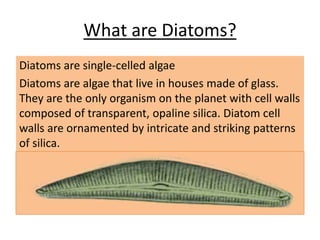
Diatoms are single-celled algae
Diatoms are algae that live in houses made of glass.
They are the only organism on the planet with cell walls
composed of transparent, opaline silica. Diatom cell
walls are ornamented by intricate and striking patterns
of silica.
What are Diatoms?
Morphological characteristics of diatoms.
• Cell size : Diatoms are commonly between 20-200 microns in diameter or
length, although sometimes they can be up to 2 millimeters long.
• Cell wall : SiO2 or glass frustule.
• Chloroplasts : Many/cell, 3-5 thylakoid membranes/stack.
• Photo-pigments : Chlorophyll a & c, carotenoids.
• Reproduction:Most often simple cell division, sexual reproduction.
• Ecological roles : Produce deposits (diatomaceous earth), toxicblooms.
• Common genera : Chaetoceros,Pseudonitzschia, Skeletonema.
EXTRACTION
PROCEDURE
TWO EXTRACTION METHODS:
• Nitric acid method.
• Sulphuric acid method.
NITRIC ACID METHOD:
• Samples are collected from the suspected drowning
victim. Care should be taken as to not contaminate the
sample with foreign diatoms during the process.
• Intact femurs, for example, are removed at autopsy and
washed in distilled water. Femurs are longitudinally
sectioned using a clean band saw, and the bone marrow
about 50g is removed using a clean spatula and placed
into a boiling flask.
• Approximately 50 mL of concentrated nitric acid is
added to the flask, and the marrow-acid suspension is
boiled on a hot plate for approximately 48 hours-under
a fume hood.
NITRIC ACID METHOD:
• The suspension is then cooled and centrifuged,
in some instances two separate times, with the
supernatant discarded and the resulting acid-
resistant material dropped onto clean
microscope slides and the sediment is
examined under the microscope.
NITRIC ACID METHOD:
A remarkable collection of most delicate and
beautiful skeletons of diatoms is seen in cases
of death from drowning. In favorable
circumstances, even the site of drowning can
be determined since the fresh water and the sea
water diatoms are different and the sea water
plants even vary from place to place along the
coast.
SULPHURIC ACID METHOD:
• This has the advantage of not causing violent
foaming. Check that all calcareous compounds
have been removed first; otherwise the sample
will become totally useless because gypsum
crystals will form.
• When sample has settled completely, discard
supernatant.
• Add concentrated sulphuric acid until the
volume is twice that of the original sample.
SULPHURIC ACID METHOD:
• Add potassium bichromate. In contrast to the
H2O2 method, no special care is necessary as no
violent reaction occurs. Just add enough
bichromate to make for a saturated solution.
• Let stand for 24 hours or more, or speed up the
reaction in a water-bath 60 degrees. Even so, it
may take several hours before the sample is clean.
The sediment should look grayish and no plant
fragments etc. should remain.
• Let settle completely, discard supernatant and
rinse several times as described above.
SULPHURIC ACID METHOD:
The sulphuric acid method seems to remove resistant
“dirt” somewhat better than the H2O2 method, mainly
because the oxidation reaction is not as abrupt as with
peroxide. But again, the principal point is patience, not
the chemistry involved.
Since diatoms resist putrefaction, the diatom test is
particularly valuable, where decomposition is
advanced. Diatom test is negative in dead bodies
thrown in water and in dry drowning. In diatom
examination invariably the control water samples must
be used for comparison purpose. Standard diatom
samples can be preserved on slides and can be used as
standards for comparison purpose.
Limitation of Diatoms in
Drowning Analyses
Studies on drowning cases
Analyses of drowning cases performed by
Pollanen (1998) demonstrated that diatoms
were found in human tissues in only 28% (205
from 738) of the cases studied. Similarly, Auer
& Mottonen (1988) found no diatoms in
11.2% (12 cases) of the drowning cases they
studied.
There are several explanations for
these results
• there was an absence or low abundance of
diatoms in the drowning medium.
• rapid death occurred due to other
circumstances.
• or there were methodological drawbacks
such as inefficient methods of extraction.
1. dissolution of the diatom valves during processing,
2. and a low sample weight or an inappropriate location
for tissue sampling Diatom abundance.
• In cases of drowning, the presence of diatoms in high
abundance in the water is essential for positive
findings.
• most studies do contain information about the
composition of diatoms in the drowning media but
rarely their abundance.
• important factor when considering the diatom
concentration in the media is the type of water
habitat.
• it can be concluded that most of the positive findings
originate from either the rivers or marine sites.
• In these habitats the diatoms are usually attached to
the bottom sediment or to macrophytes.
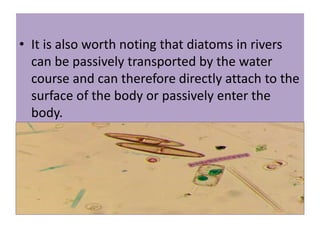
• It is also worth noting that diatoms in rivers
can be passively transported by the water
course and can therefore directly attach to the
surface of the body or passively enter the
body.
SUMMARY
• Qualitative and quantitative analysis of diatoms can be done by
detection of diatoms in the samples and by counting the number
of species. Results pertaining to such studies should also
interpreted in context to postmortem reports and the police
investigations. The diatom test is significant even occasionally
the diatoms may also have recovered from the internal organs
of non-drowning bodies. Since diatoms vary on the basis of
morphological and taxonomic characteristics on a particular
habitat, so it is possible to find the location/site of the
drowning. Water from the putative site of drowning should be
examined and compared with the organ sample to establish the
site of drowning in drowning deaths. Advanced technologies
such as Nuclear Magnetic Resonance (NMR), Fluorimetry,
Molecular biological techniques, Automatic Diatom
Identification and Classification (ADIAC) can be used for the
detection of diatoms in near future.
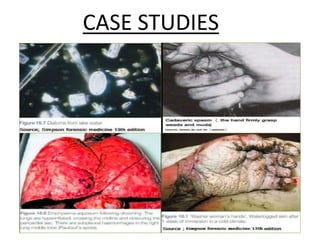
CASE STUDIES
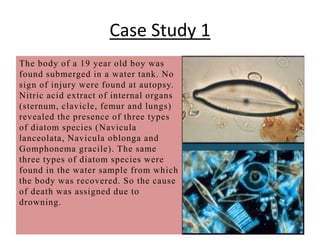
Case Study 1
The body of a 19 year old boy was
found submerged in a water tank. No
sign of injury were found at autopsy.
Nitric acid extract of internal organs
(sternum, clavicle, femur and lungs)
revealed the presence of three types
of diatom species (Navicula
lanceolata, Navicula oblonga and
Gomphonema gracile). The same
three types of diatom species were
found in the water sample from which
the body was recovered. So the cause
of death was assigned due to
drowning.
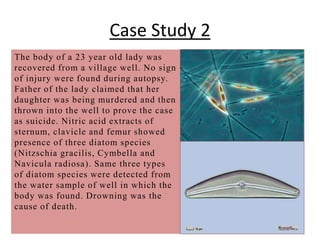
Case Study 2
The body of a 23 year old lady was
recovered from a village well. No sign
of injury were found during autopsy.
Father of the lady claimed that her
daughter was being murdered and then
thrown into the well to prove the case
as suicide. Nitric acid extracts of
sternum, clavicle and femur showed
presence of three diatom species
(Nitzschia gracilis, Cymbella and
Navicula radiosa). Same three types
of diatom species were detected from
the water sample of well in which the
body was found. Drowning was the
cause of death.
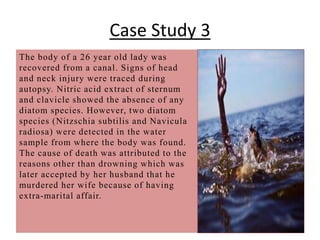
Case Study 3
The body of a 26 year old lady was
recovered from a canal. Signs of head
and neck injury were traced during
autopsy. Nitric acid extract of sternum
and clavicle showed the absence of any
diatom species. However, two diatom
species (Nitzschia subtilis and Navicula
radiosa) were detected in the water
sample from where the body was found.
The cause of death was attributed to the
reasons other than drowning which was
later accepted by her husband that he
murdered her wife because of having
extra-marital affair.
Conclusion Of The Case Studies
• The above mentioned cases describe the significance of diatom
test in medico-legal investigation of drowning cases.
• It is suggested that if proper care is taken with all specification
and analysis is performed without contamination, it can serve
as significant supportive evidence in investigation of crime. As
to contamination during sample preparation, it is generally
accepted that instruments, gloves, papers, water supplies, and
reagents represents potential contamination sources and tap
water may contain diatoms. However, in the present study, due
care is taken to avoid contamination and use of tap water is
avoided completely throughout the procedure of sample
preparation.

Diatoms in forensic science

  • 1.
    DIATOMS IN FORENSICSCIENCE -Navnidhi kaur khatri, Pranav Panchbhai, Anikesh Banik, Yashaswee purohit
  • 2.
  • 3.
    Diatoms are single-celledalgae Diatoms are algae that live in houses made of glass. They are the only organism on the planet with cell walls composed of transparent, opaline silica. Diatom cell walls are ornamented by intricate and striking patterns of silica. What are Diatoms?
  • 4.
    Morphological characteristics ofdiatoms. • Cell size : Diatoms are commonly between 20-200 microns in diameter or length, although sometimes they can be up to 2 millimeters long. • Cell wall : SiO2 or glass frustule. • Chloroplasts : Many/cell, 3-5 thylakoid membranes/stack. • Photo-pigments : Chlorophyll a & c, carotenoids. • Reproduction:Most often simple cell division, sexual reproduction. • Ecological roles : Produce deposits (diatomaceous earth), toxicblooms. • Common genera : Chaetoceros,Pseudonitzschia, Skeletonema.
  • 5.
  • 6.
    TWO EXTRACTION METHODS: •Nitric acid method. • Sulphuric acid method.
  • 7.
    NITRIC ACID METHOD: •Samples are collected from the suspected drowning victim. Care should be taken as to not contaminate the sample with foreign diatoms during the process. • Intact femurs, for example, are removed at autopsy and washed in distilled water. Femurs are longitudinally sectioned using a clean band saw, and the bone marrow about 50g is removed using a clean spatula and placed into a boiling flask. • Approximately 50 mL of concentrated nitric acid is added to the flask, and the marrow-acid suspension is boiled on a hot plate for approximately 48 hours-under a fume hood.
  • 8.
    NITRIC ACID METHOD: •The suspension is then cooled and centrifuged, in some instances two separate times, with the supernatant discarded and the resulting acid- resistant material dropped onto clean microscope slides and the sediment is examined under the microscope.
  • 9.
    NITRIC ACID METHOD: Aremarkable collection of most delicate and beautiful skeletons of diatoms is seen in cases of death from drowning. In favorable circumstances, even the site of drowning can be determined since the fresh water and the sea water diatoms are different and the sea water plants even vary from place to place along the coast.
  • 10.
    SULPHURIC ACID METHOD: •This has the advantage of not causing violent foaming. Check that all calcareous compounds have been removed first; otherwise the sample will become totally useless because gypsum crystals will form. • When sample has settled completely, discard supernatant. • Add concentrated sulphuric acid until the volume is twice that of the original sample.
  • 11.
    SULPHURIC ACID METHOD: •Add potassium bichromate. In contrast to the H2O2 method, no special care is necessary as no violent reaction occurs. Just add enough bichromate to make for a saturated solution. • Let stand for 24 hours or more, or speed up the reaction in a water-bath 60 degrees. Even so, it may take several hours before the sample is clean. The sediment should look grayish and no plant fragments etc. should remain. • Let settle completely, discard supernatant and rinse several times as described above.
  • 12.
    SULPHURIC ACID METHOD: Thesulphuric acid method seems to remove resistant “dirt” somewhat better than the H2O2 method, mainly because the oxidation reaction is not as abrupt as with peroxide. But again, the principal point is patience, not the chemistry involved. Since diatoms resist putrefaction, the diatom test is particularly valuable, where decomposition is advanced. Diatom test is negative in dead bodies thrown in water and in dry drowning. In diatom examination invariably the control water samples must be used for comparison purpose. Standard diatom samples can be preserved on slides and can be used as standards for comparison purpose.
  • 13.
    Limitation of Diatomsin Drowning Analyses
  • 14.
    Studies on drowningcases Analyses of drowning cases performed by Pollanen (1998) demonstrated that diatoms were found in human tissues in only 28% (205 from 738) of the cases studied. Similarly, Auer & Mottonen (1988) found no diatoms in 11.2% (12 cases) of the drowning cases they studied.
  • 15.
    There are severalexplanations for these results • there was an absence or low abundance of diatoms in the drowning medium. • rapid death occurred due to other circumstances. • or there were methodological drawbacks such as inefficient methods of extraction. 1. dissolution of the diatom valves during processing, 2. and a low sample weight or an inappropriate location for tissue sampling Diatom abundance.
  • 16.
    • In casesof drowning, the presence of diatoms in high abundance in the water is essential for positive findings. • most studies do contain information about the composition of diatoms in the drowning media but rarely their abundance. • important factor when considering the diatom concentration in the media is the type of water habitat. • it can be concluded that most of the positive findings originate from either the rivers or marine sites. • In these habitats the diatoms are usually attached to the bottom sediment or to macrophytes.
  • 17.
    • It isalso worth noting that diatoms in rivers can be passively transported by the water course and can therefore directly attach to the surface of the body or passively enter the body.
  • 18.
    SUMMARY • Qualitative andquantitative analysis of diatoms can be done by detection of diatoms in the samples and by counting the number of species. Results pertaining to such studies should also interpreted in context to postmortem reports and the police investigations. The diatom test is significant even occasionally the diatoms may also have recovered from the internal organs of non-drowning bodies. Since diatoms vary on the basis of morphological and taxonomic characteristics on a particular habitat, so it is possible to find the location/site of the drowning. Water from the putative site of drowning should be examined and compared with the organ sample to establish the site of drowning in drowning deaths. Advanced technologies such as Nuclear Magnetic Resonance (NMR), Fluorimetry, Molecular biological techniques, Automatic Diatom Identification and Classification (ADIAC) can be used for the detection of diatoms in near future.
  • 19.
  • 20.
    Case Study 1 Thebody of a 19 year old boy was found submerged in a water tank. No sign of injury were found at autopsy. Nitric acid extract of internal organs (sternum, clavicle, femur and lungs) revealed the presence of three types of diatom species (Navicula lanceolata, Navicula oblonga and Gomphonema gracile). The same three types of diatom species were found in the water sample from which the body was recovered. So the cause of death was assigned due to drowning.
  • 21.
    Case Study 2 Thebody of a 23 year old lady was recovered from a village well. No sign of injury were found during autopsy. Father of the lady claimed that her daughter was being murdered and then thrown into the well to prove the case as suicide. Nitric acid extracts of sternum, clavicle and femur showed presence of three diatom species (Nitzschia gracilis, Cymbella and Navicula radiosa). Same three types of diatom species were detected from the water sample of well in which the body was found. Drowning was the cause of death.
  • 22.
    Case Study 3 Thebody of a 26 year old lady was recovered from a canal. Signs of head and neck injury were traced during autopsy. Nitric acid extract of sternum and clavicle showed the absence of any diatom species. However, two diatom species (Nitzschia subtilis and Navicula radiosa) were detected in the water sample from where the body was found. The cause of death was attributed to the reasons other than drowning which was later accepted by her husband that he murdered her wife because of having extra-marital affair.
  • 23.
    Conclusion Of TheCase Studies • The above mentioned cases describe the significance of diatom test in medico-legal investigation of drowning cases. • It is suggested that if proper care is taken with all specification and analysis is performed without contamination, it can serve as significant supportive evidence in investigation of crime. As to contamination during sample preparation, it is generally accepted that instruments, gloves, papers, water supplies, and reagents represents potential contamination sources and tap water may contain diatoms. However, in the present study, due care is taken to avoid contamination and use of tap water is avoided completely throughout the procedure of sample preparation.