FIREARM
INJURIES
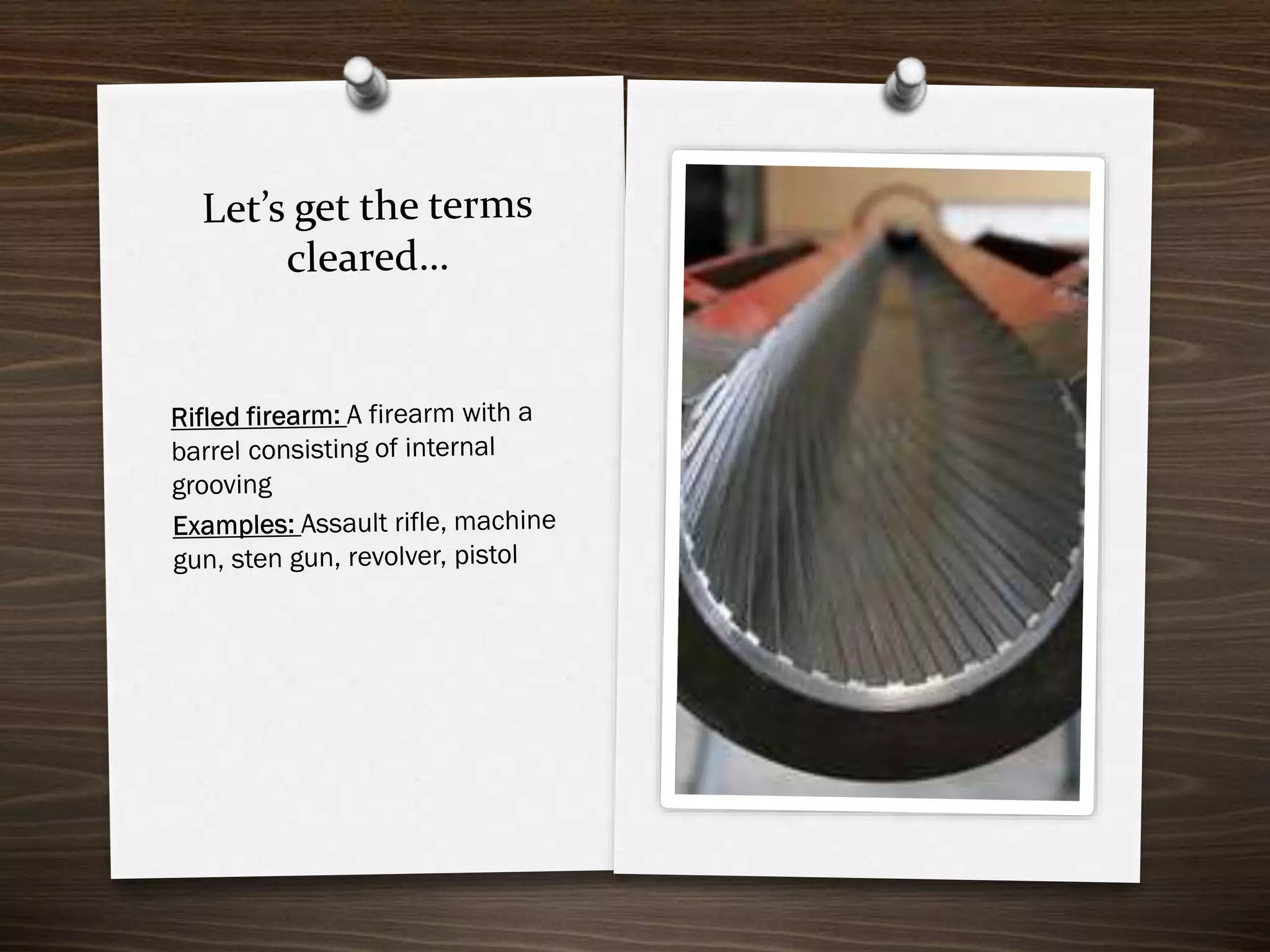
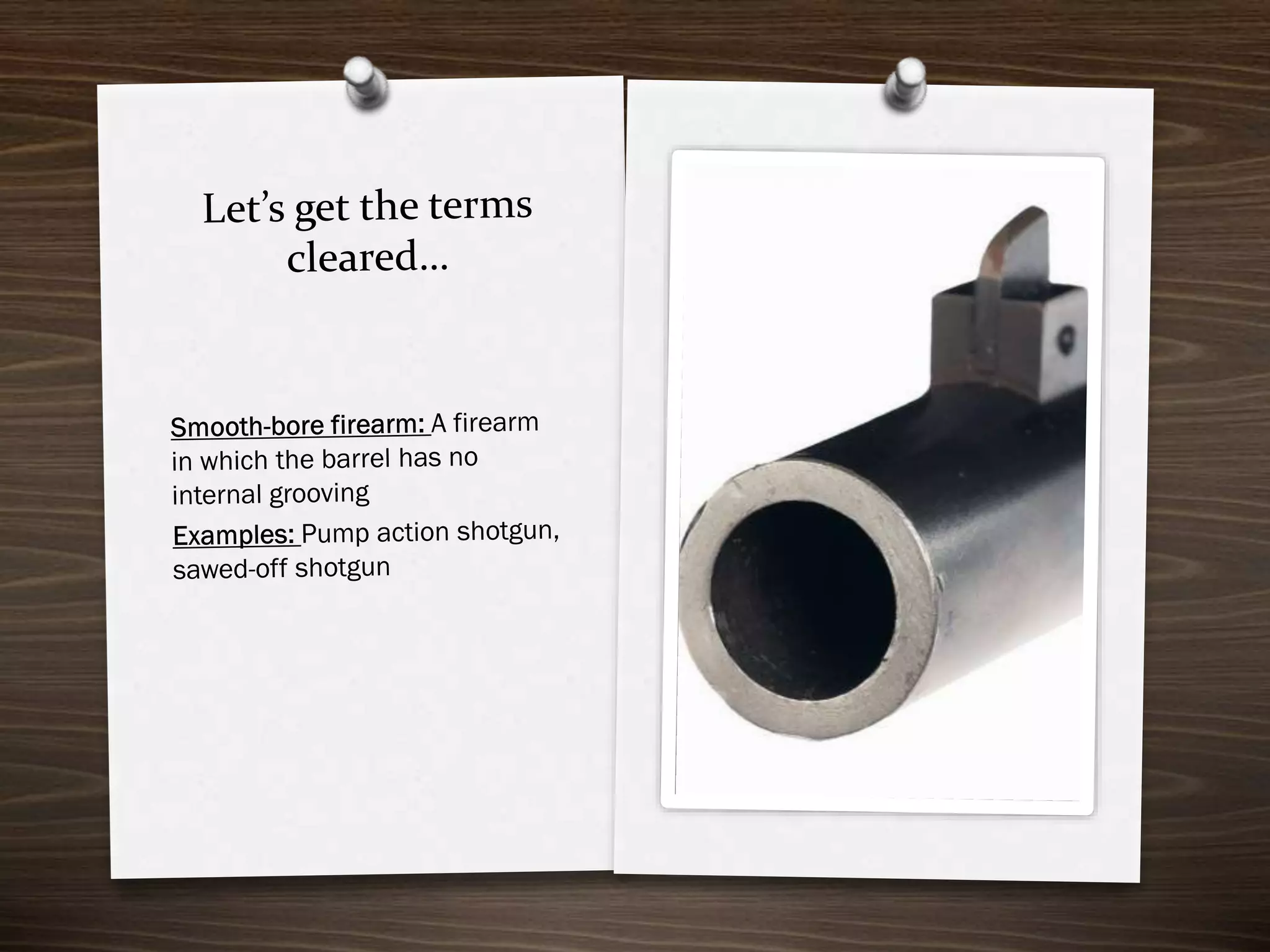
Rifled and Smooth-bore
firearm injury

Group B
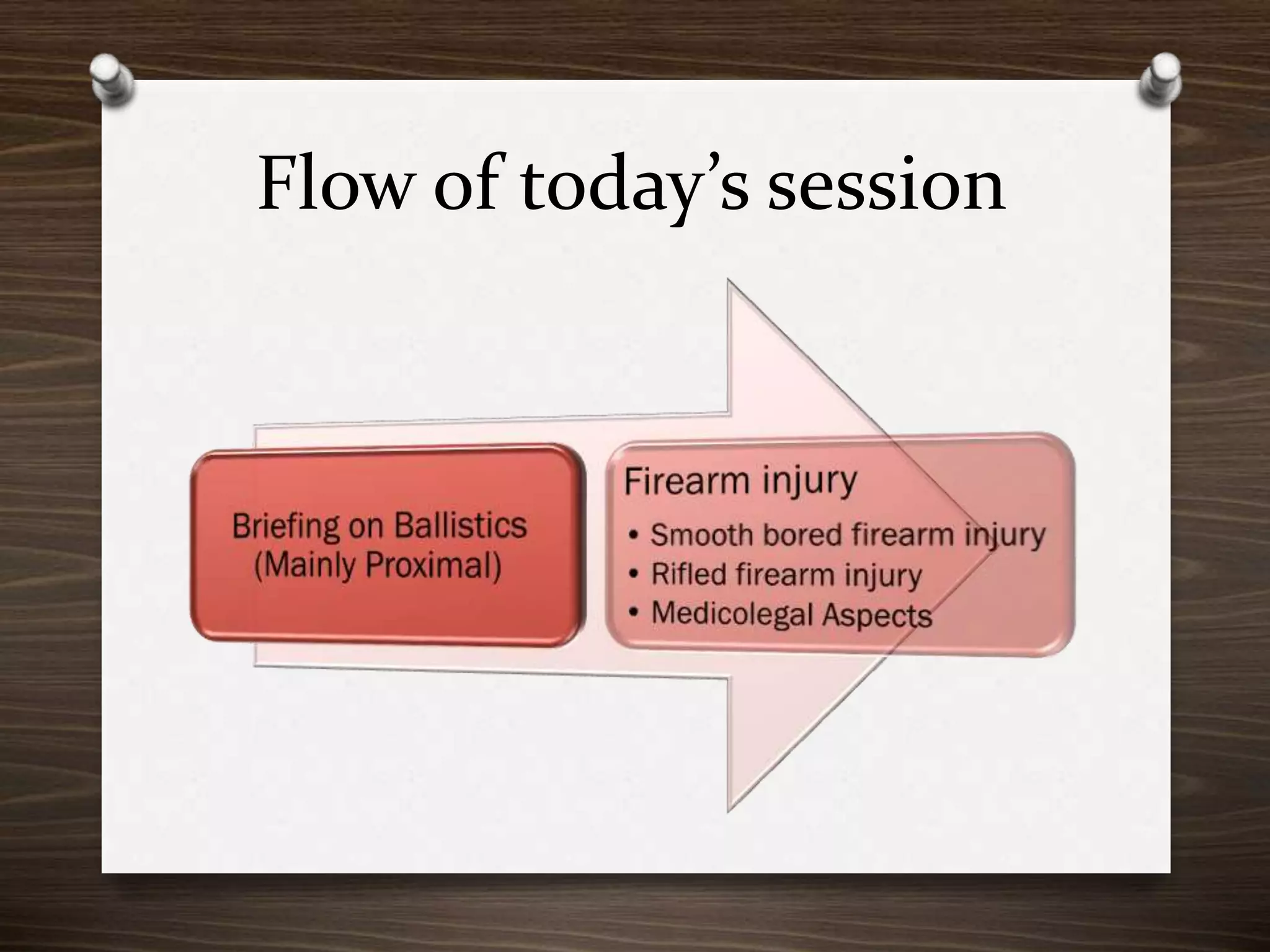
Flow of today’s session
Quick Briefing
Proximal Ballistics
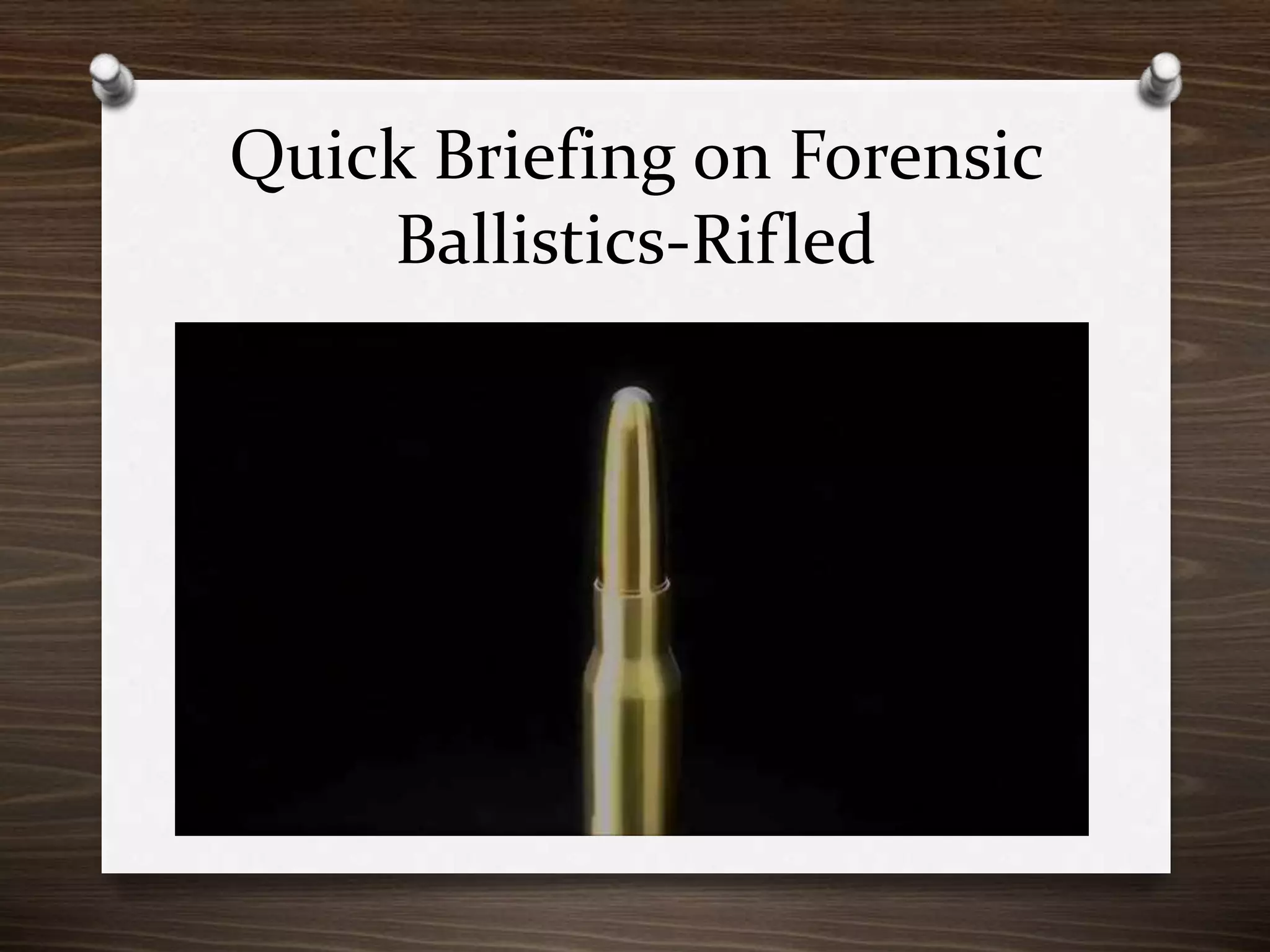
Quick Briefing on Forensic
Ballistics-Rifled
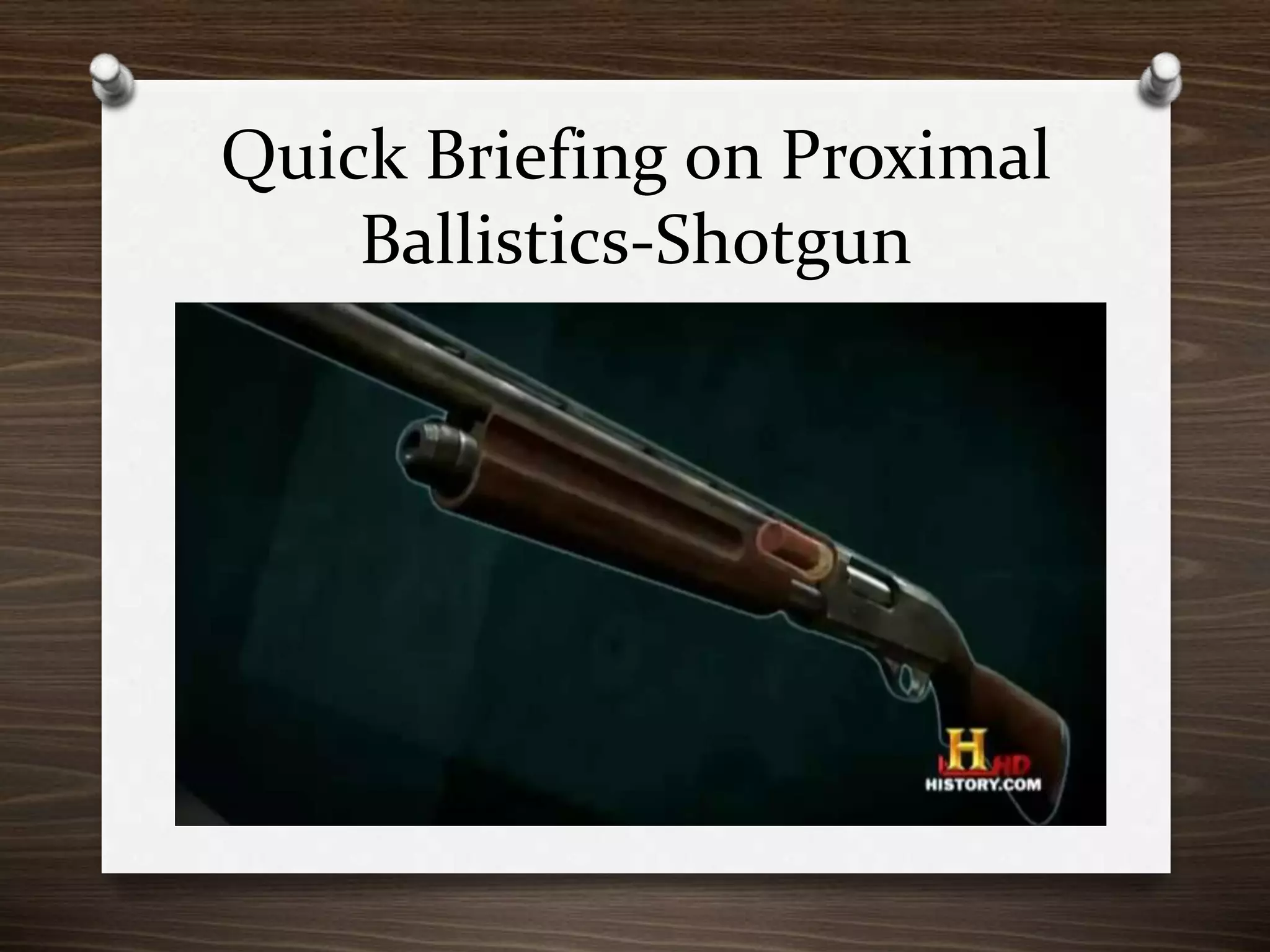
Quick Briefing on Proximal
Ballistics-Shotgun
Firearm Injury
General Aspects
Firearm injury-General
Aspects
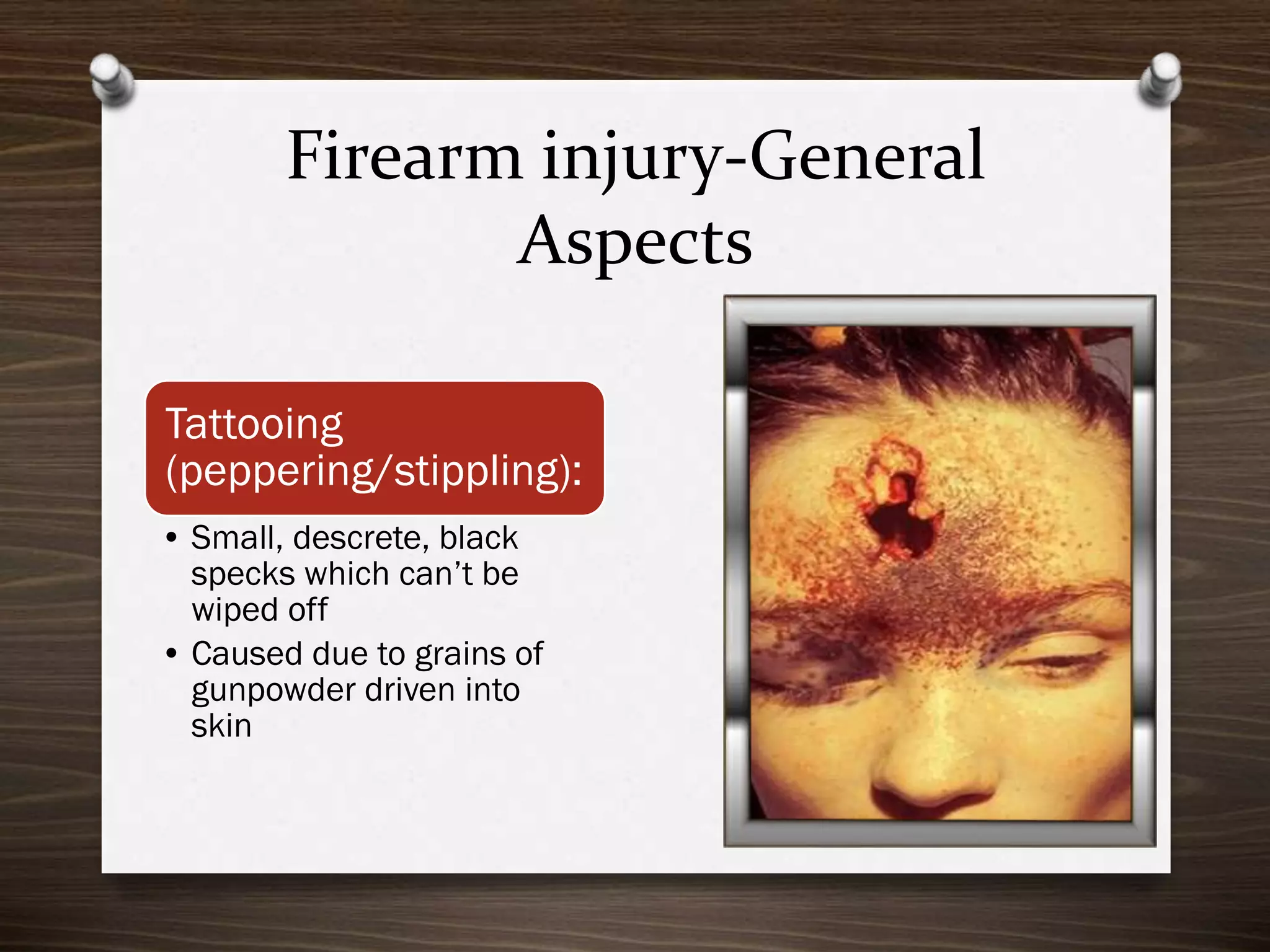
Tattooing
(peppering/stippling):
• Small, descrete, black
specks which can’t be
wiped off
• Caused due to grains of
gunpowder driven into
skin
Firearm injury-General
Aspects
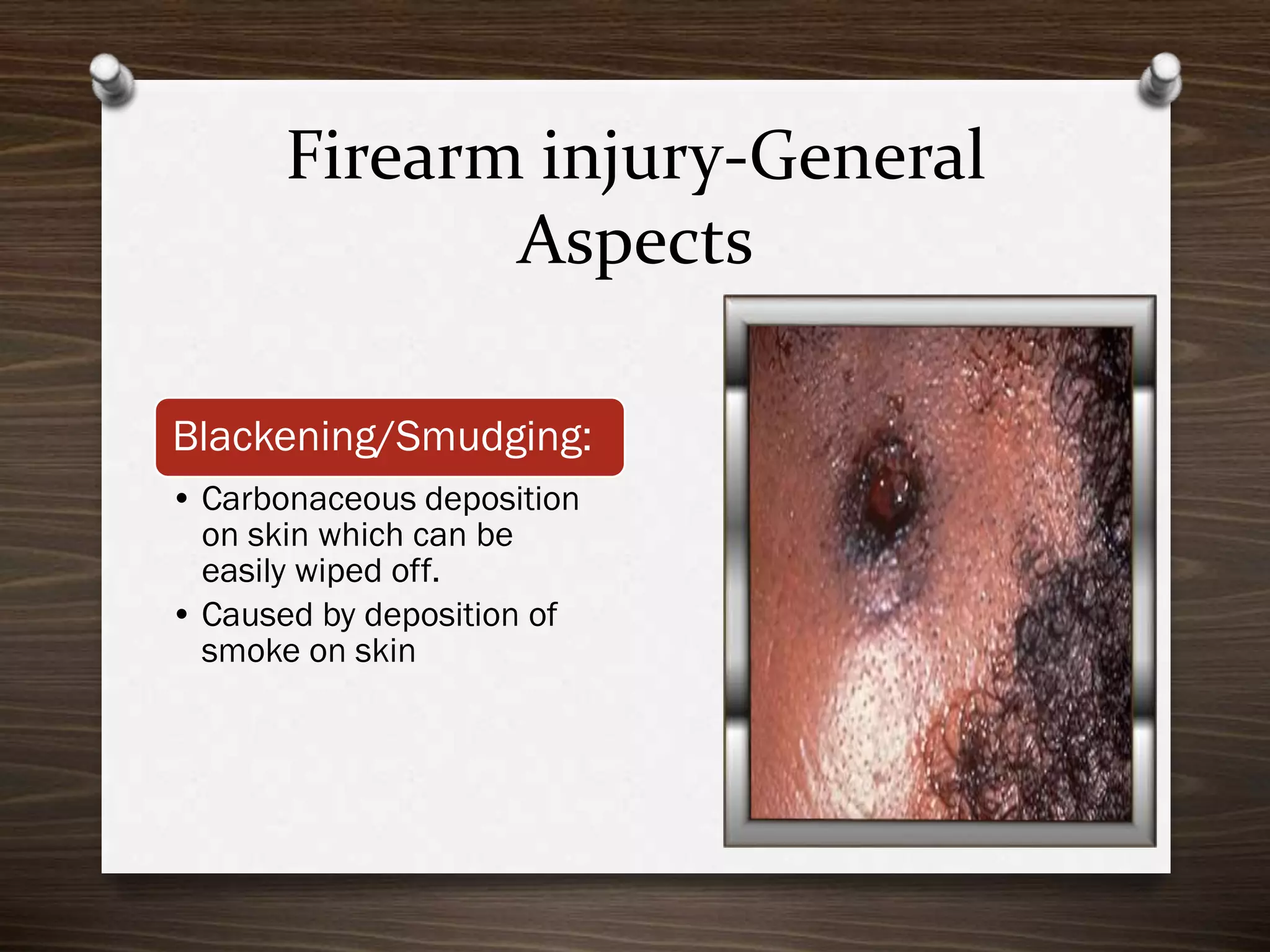
Blackening/Smudging:
• Carbonaceous deposition
on skin which can be
easily wiped off.
• Caused by deposition of
smoke on skin
Firearm injury-General
Aspects
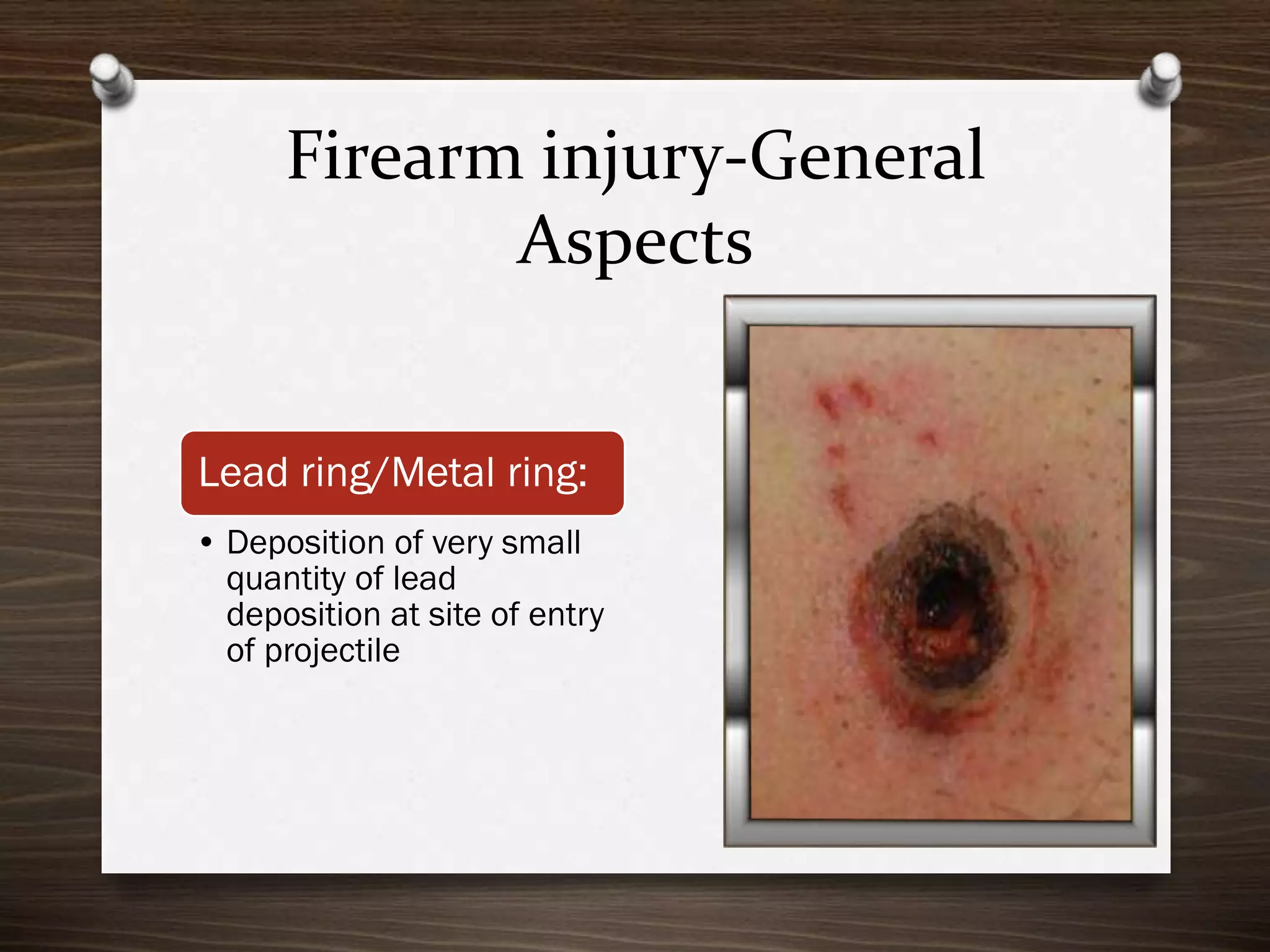
Lead ring/Metal ring:
• Deposition of very small
quantity of lead
deposition at site of entry
of projectile
Firearm injury-General
Aspects
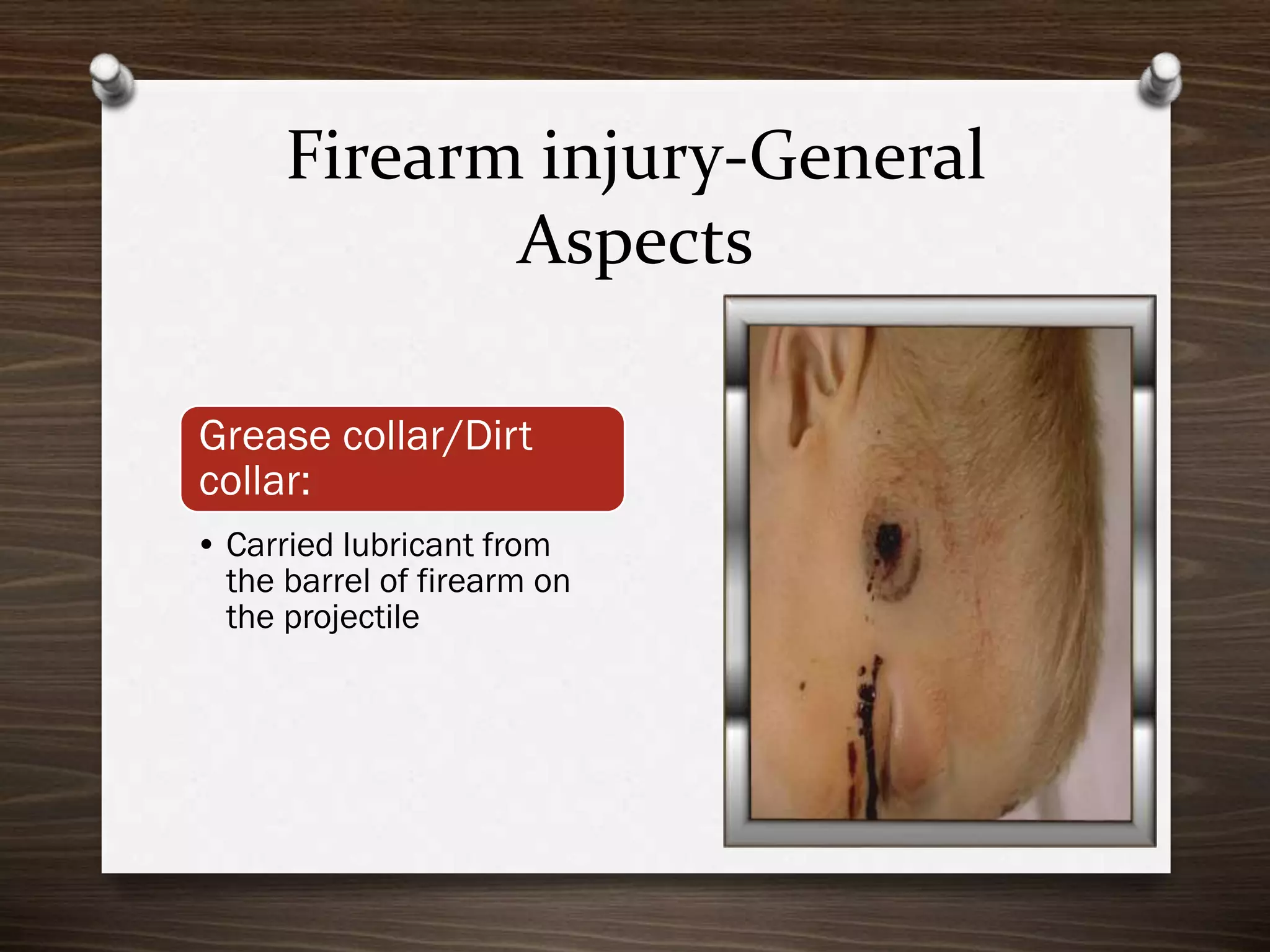
Grease collar/Dirt
collar:
• Carried lubricant from
the barrel of firearm on
the projectile
Firearm injury-General
Aspects
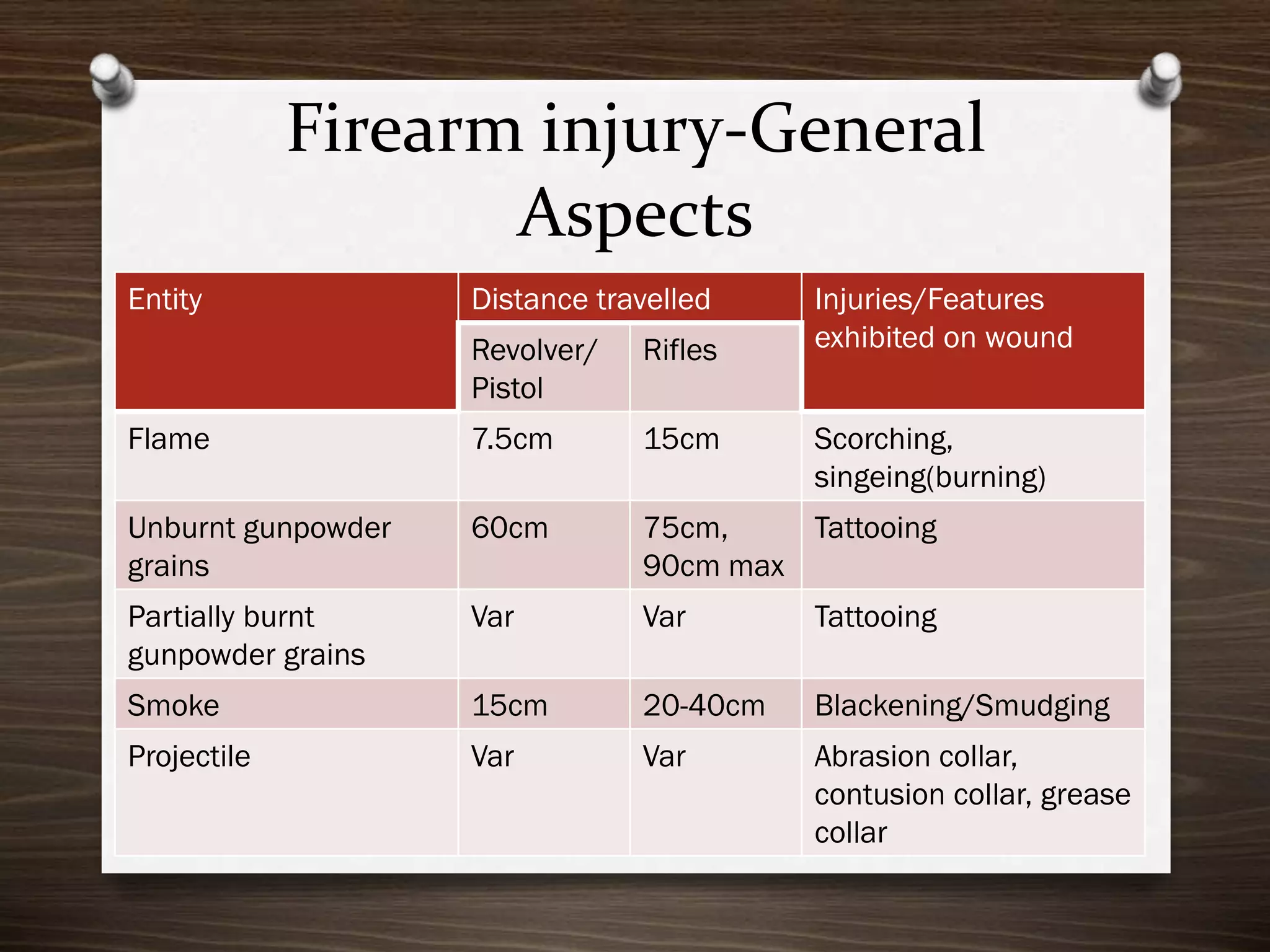
Entity

Distance travelled

Injuries/Features
exhibited on wound

Revolver/
Pistol

Rifles

Flame

7.5cm

15cm

Unburnt gunpowder
grains

60cm

75cm,
Tattooing
90cm max

Partially burnt
gunpowder grains

Var

Var

Tattooing

Smoke

15cm

20-40cm

Blackening/Smudging

Projectile

Var

Var

Abrasion collar,
contusion collar, grease
collar

Scorching,
singeing(burning)
Firearm injury-General
Aspects
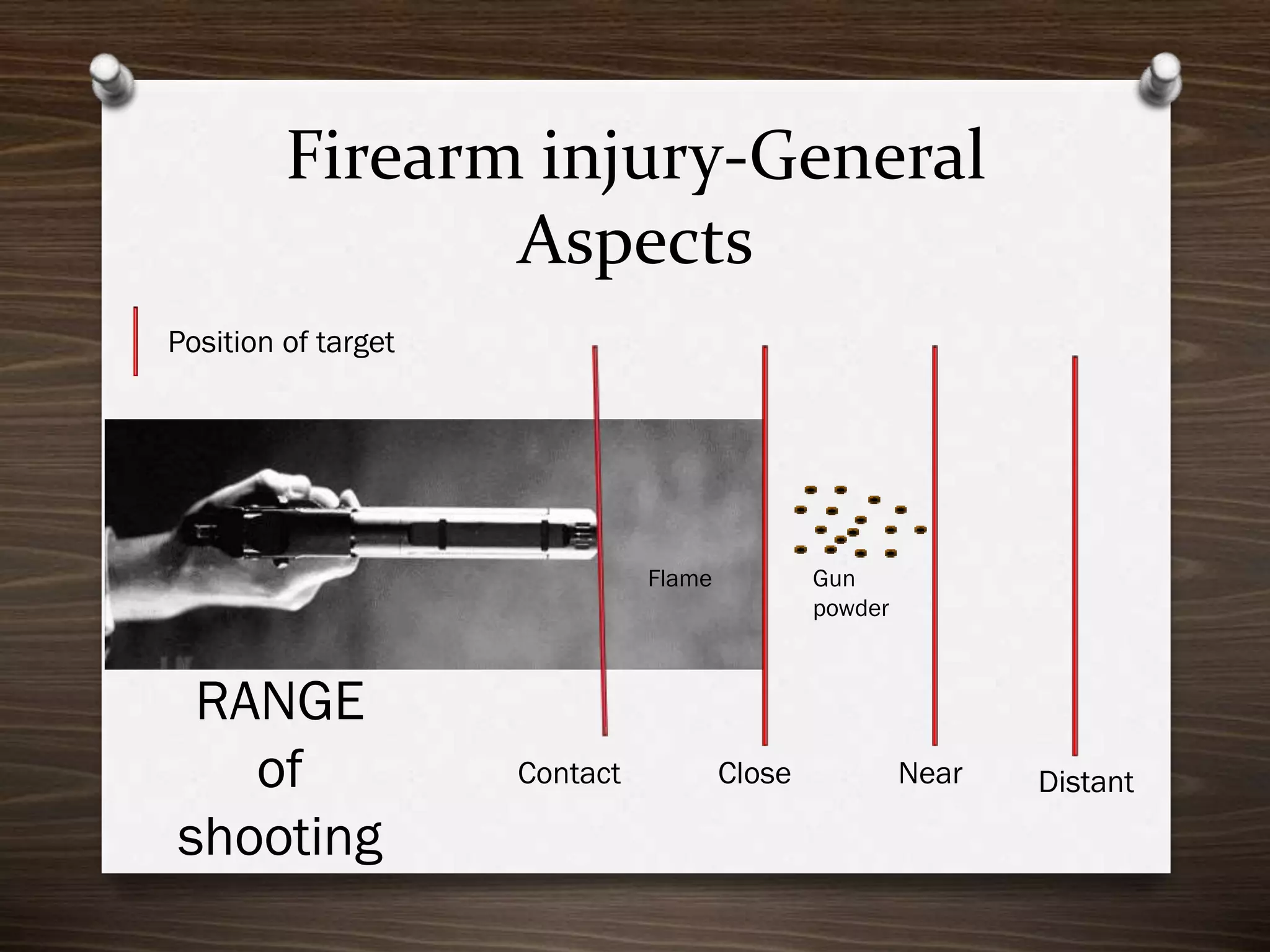
Position of target

Flame

RANGE
of
shooting

Contact

Gun
powder

Close

Near

Distant
Rifled-firearm injury
Entry wound and exit wound
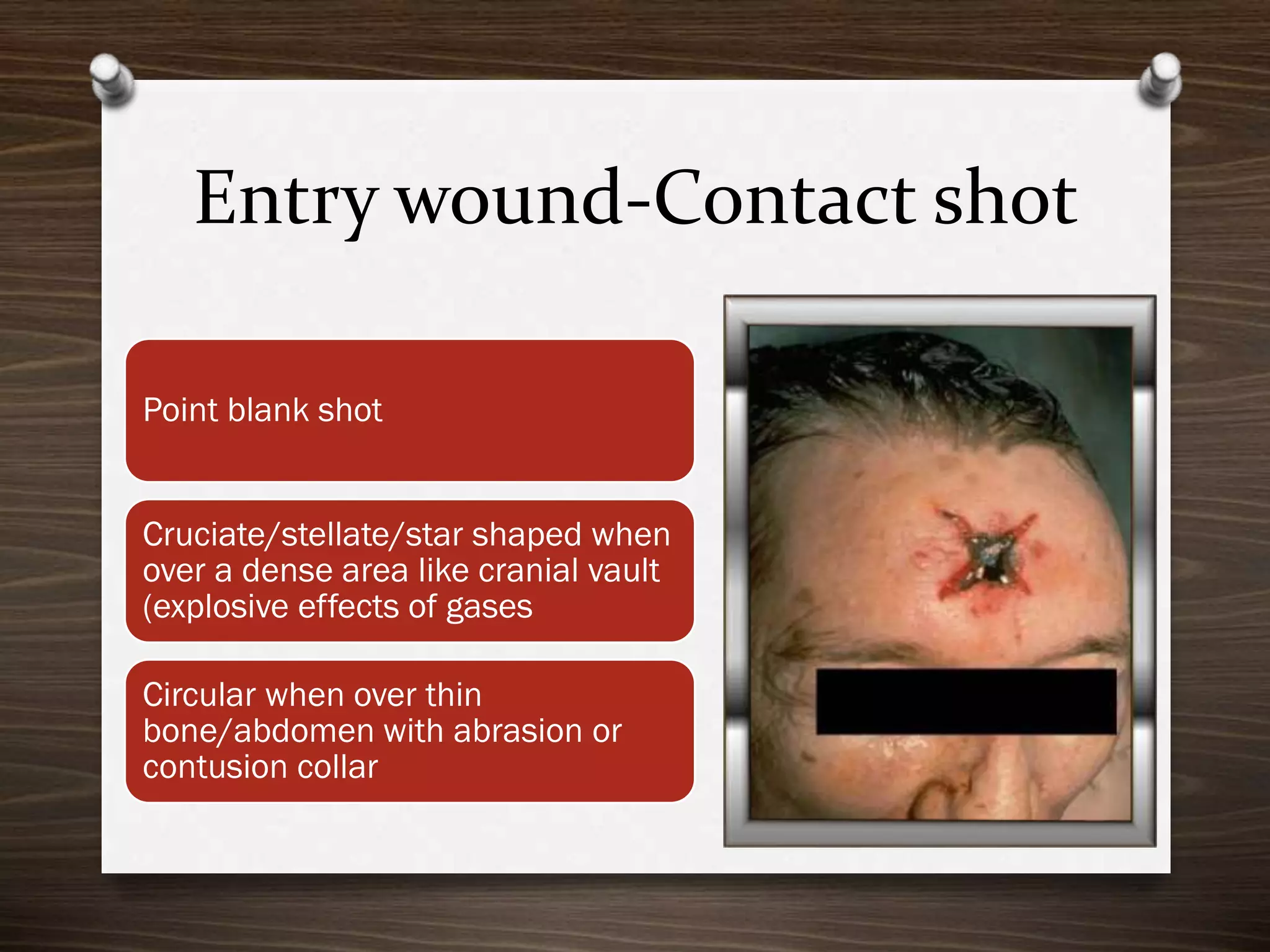
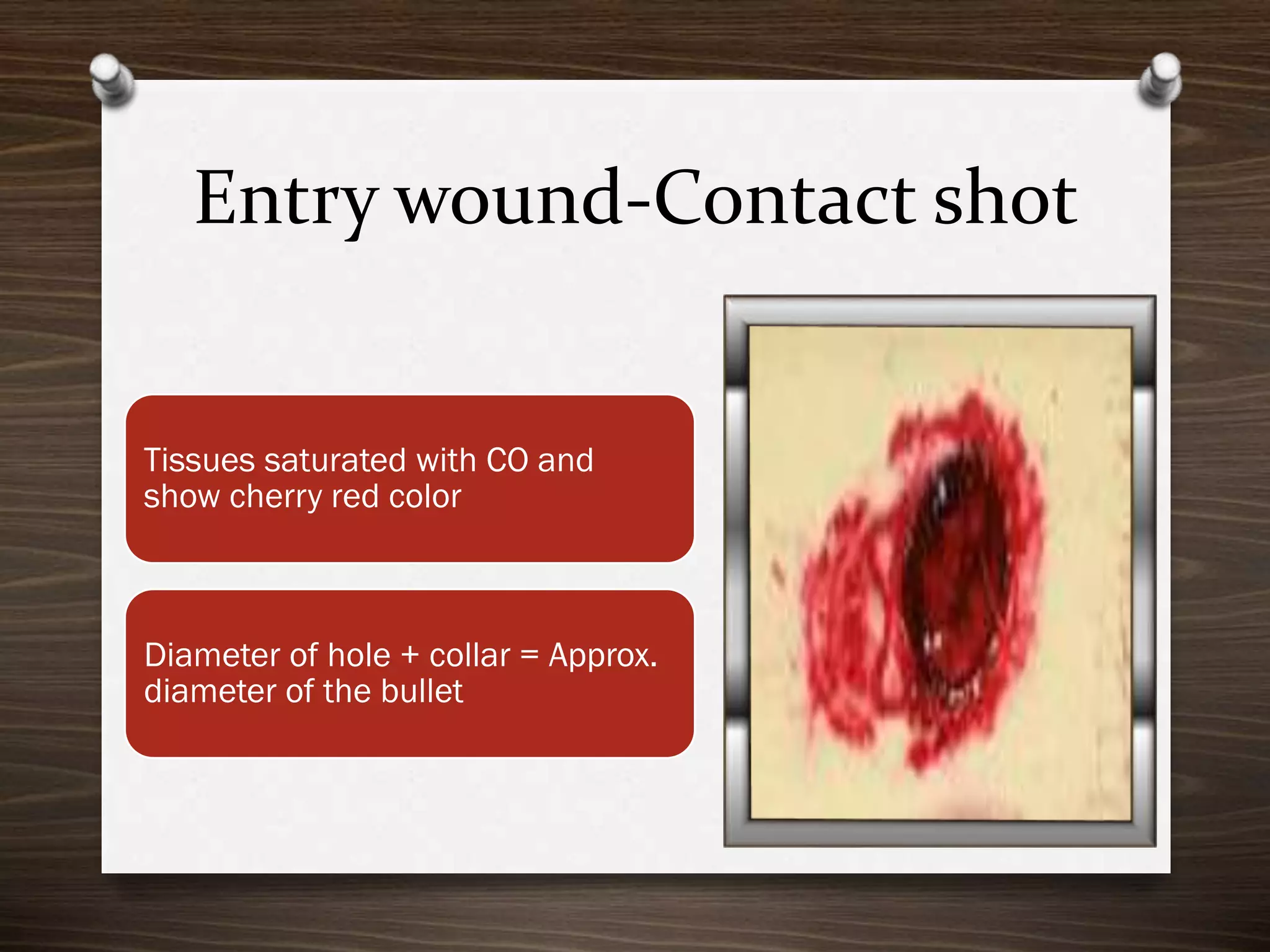
Entry wound-Contact shot
Point blank shot
Cruciate/stellate/star shaped when
over a dense area like cranial vault
(explosive effects of gases
Circular when over thin
bone/abdomen with abrasion or
contusion collar
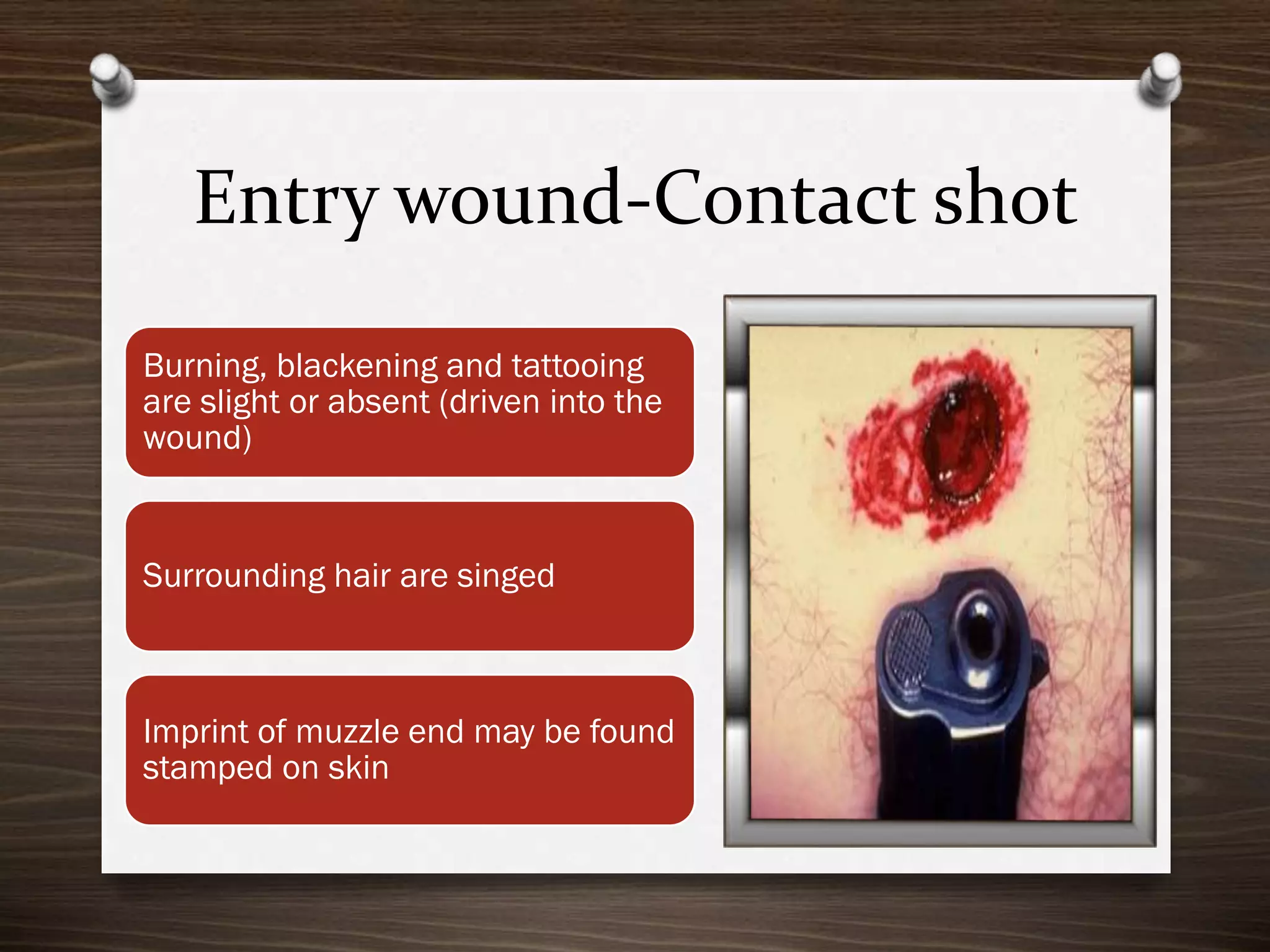
Entry wound-Contact shot
Burning, blackening and tattooing
are slight or absent (driven into the
wound)

Surrounding hair are singed

Imprint of muzzle end may be found
stamped on skin
Entry wound-Contact shot

Tissues saturated with CO and
show cherry red color

Diameter of hole + collar = Approx.
diameter of the bullet
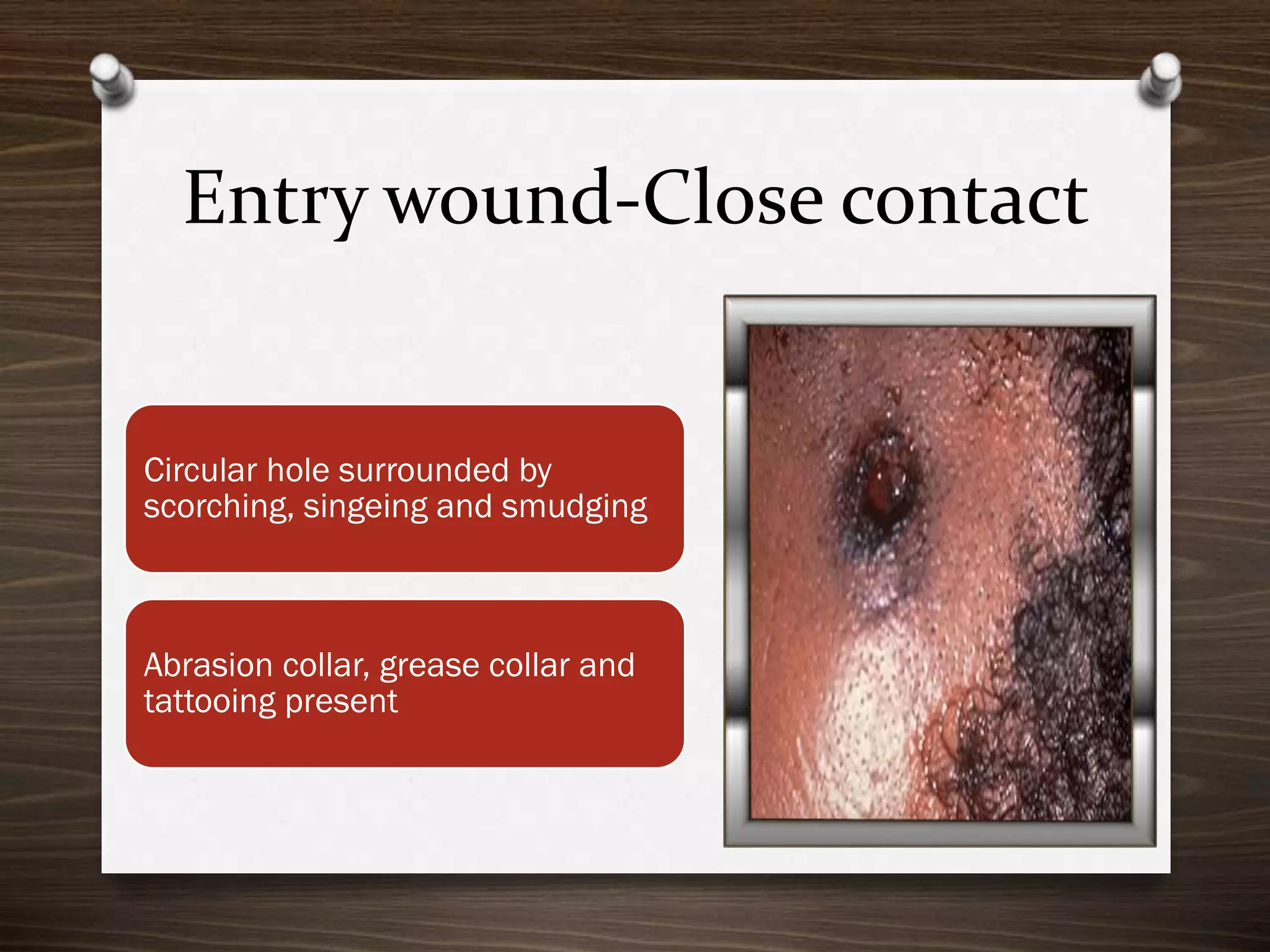
Entry wound-Close contact

Circular hole surrounded by
scorching, singeing and smudging

Abrasion collar, grease collar and
tattooing present
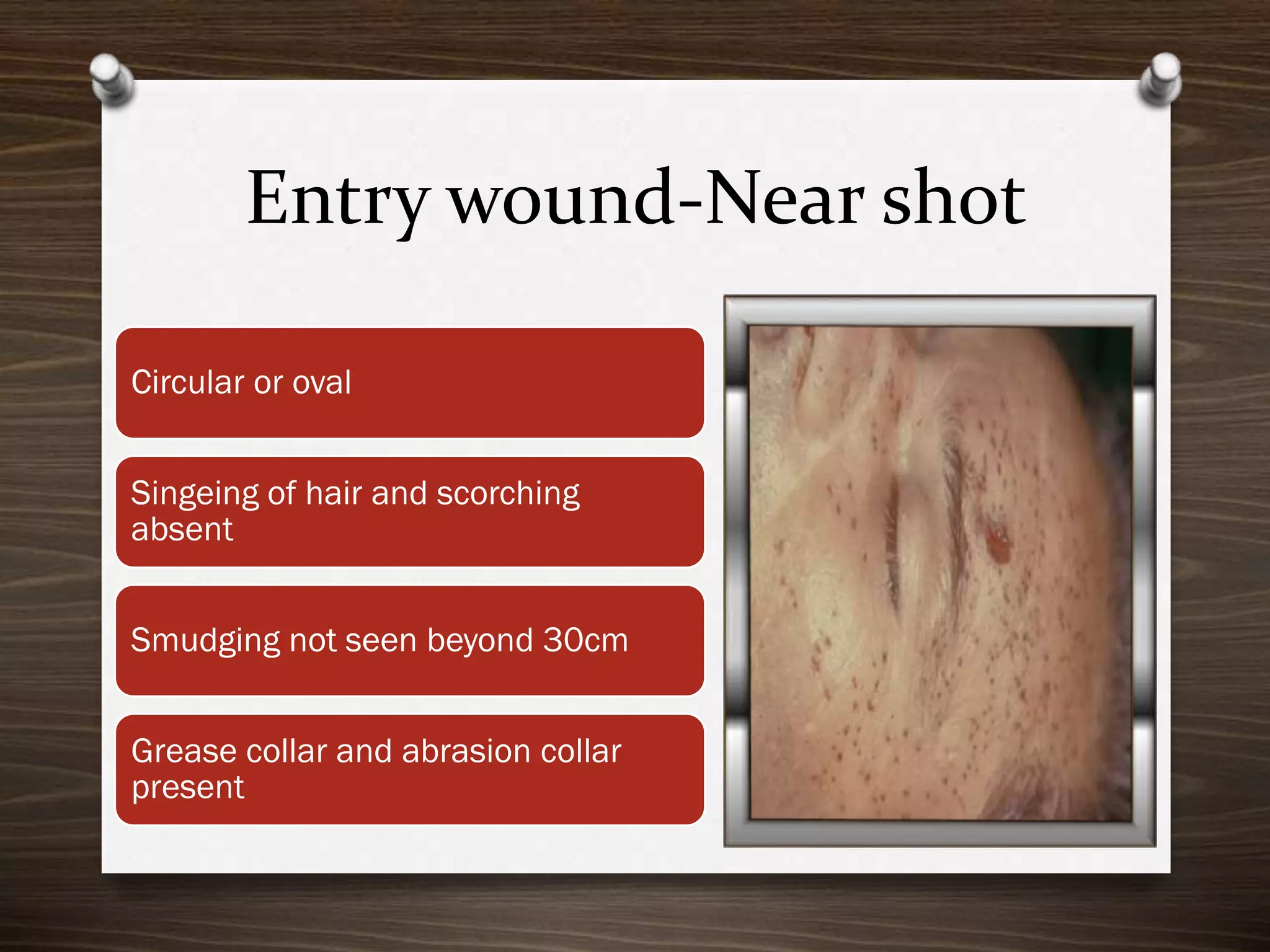
Entry wound-Near shot
Circular or oval

Singeing of hair and scorching
absent
Smudging not seen beyond 30cm
Grease collar and abrasion collar
present
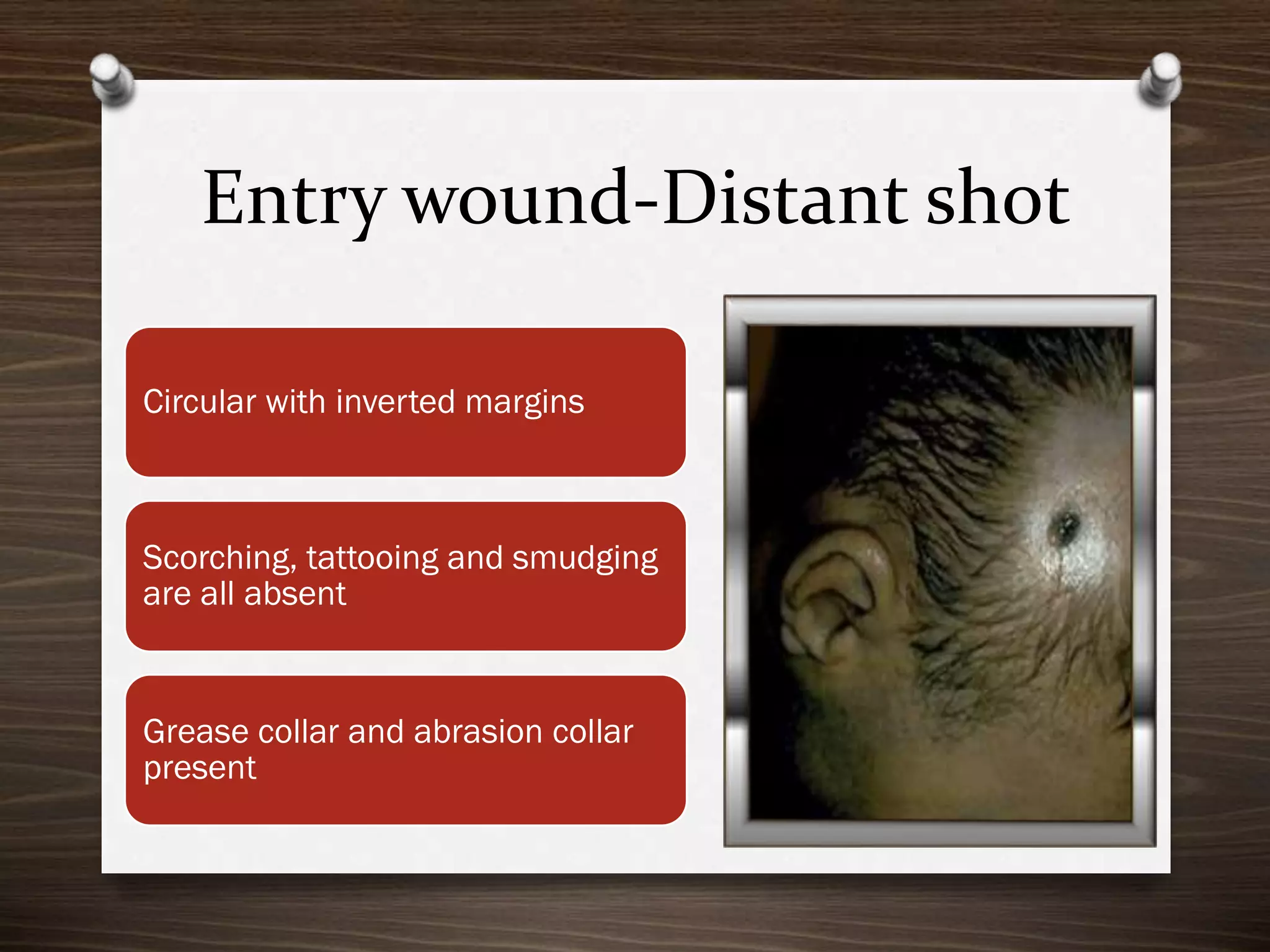
Entry wound-Distant shot
Circular with inverted margins

Scorching, tattooing and smudging
are all absent

Grease collar and abrasion collar
present
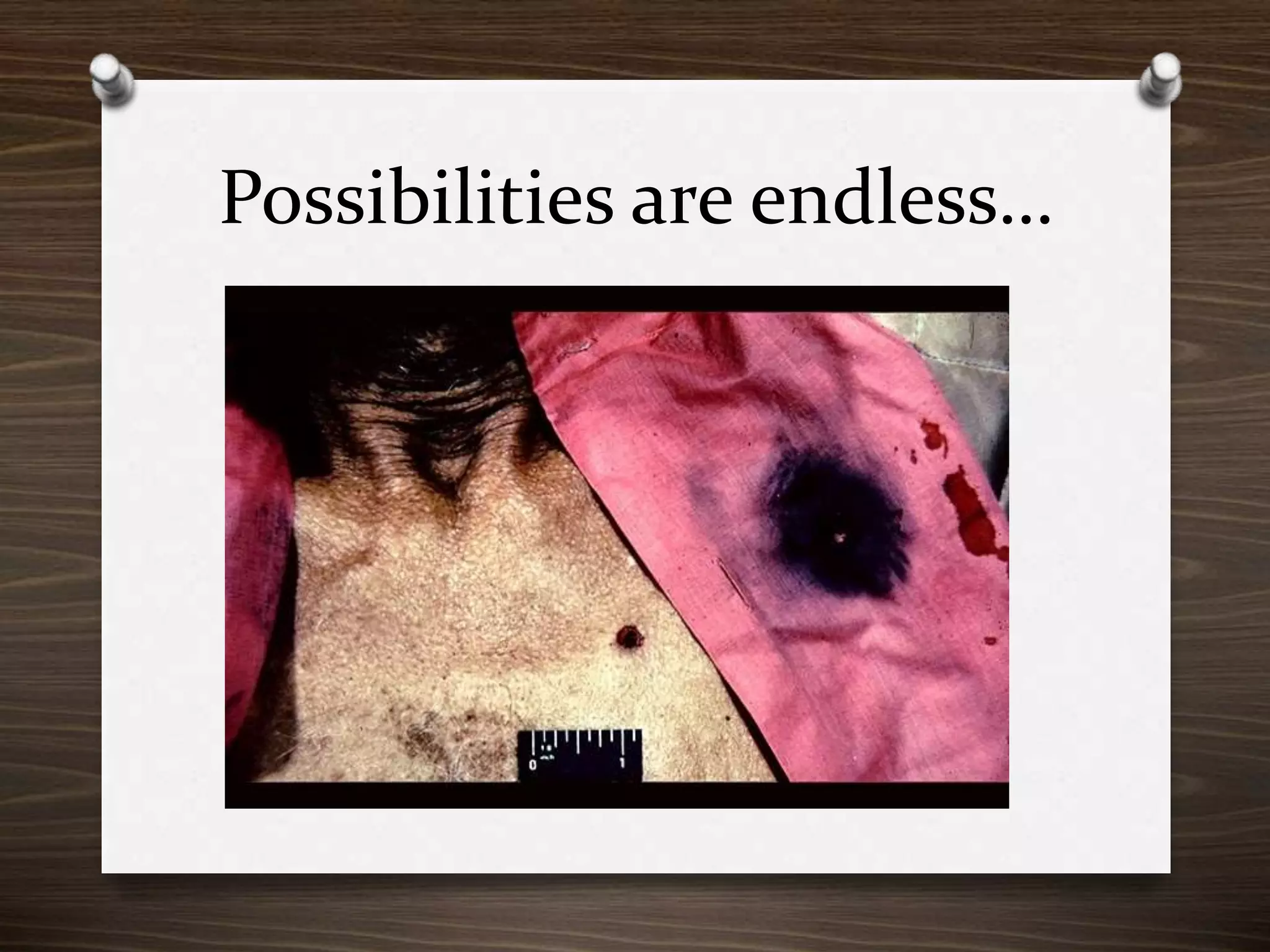
Possibilities are endless…
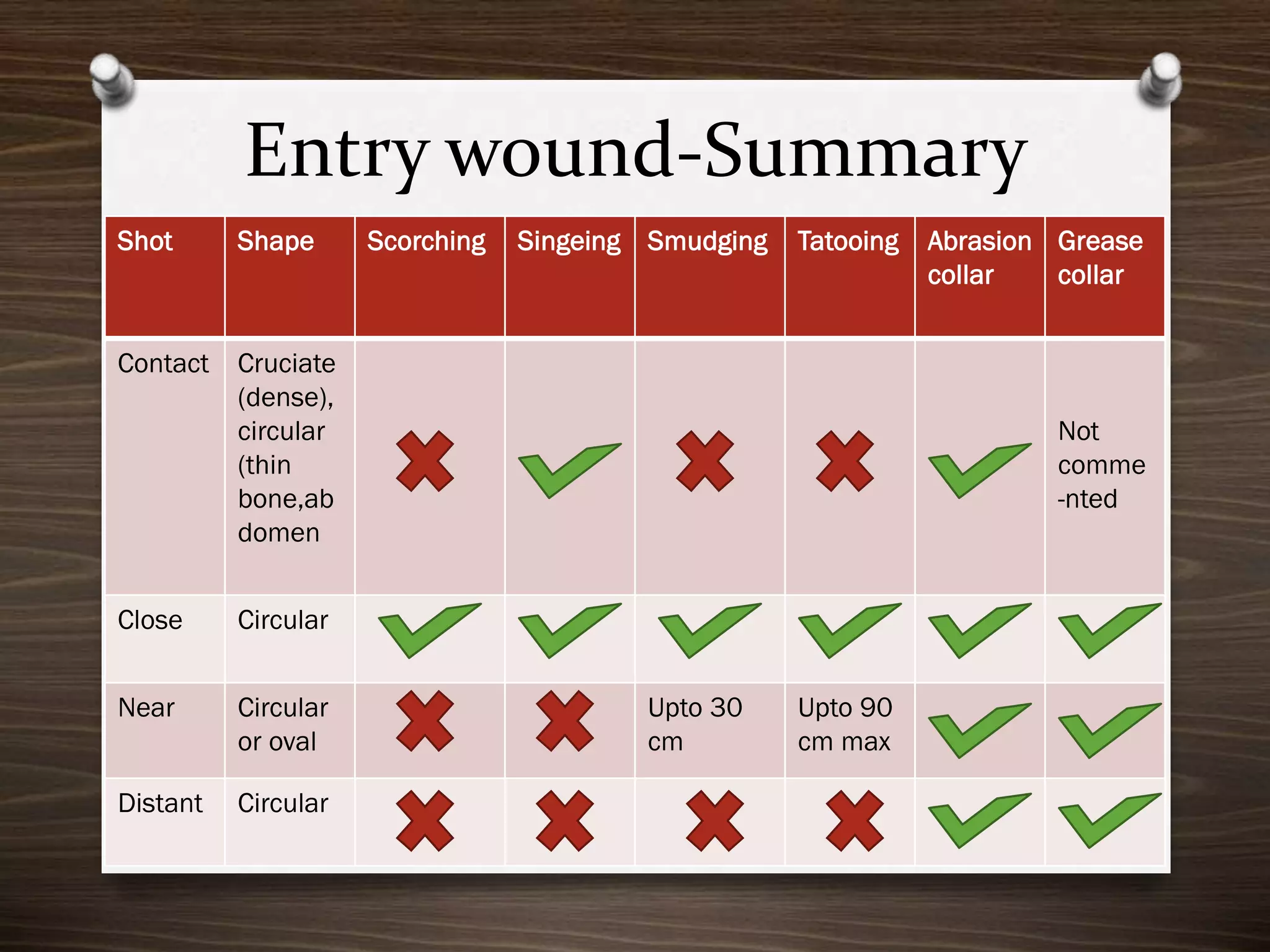
Entry wound-Summary
Shot

Shape

Contact

Cruciate
(dense),
circular
(thin
bone,ab
domen

Close

Circular
or oval

Distant

Circular

Singeing Smudging

Tatooing

Abrasion Grease
collar
collar

Not
comme
-nted

Circular

Near

Scorching

Upto 30
cm

Upto 90
cm max
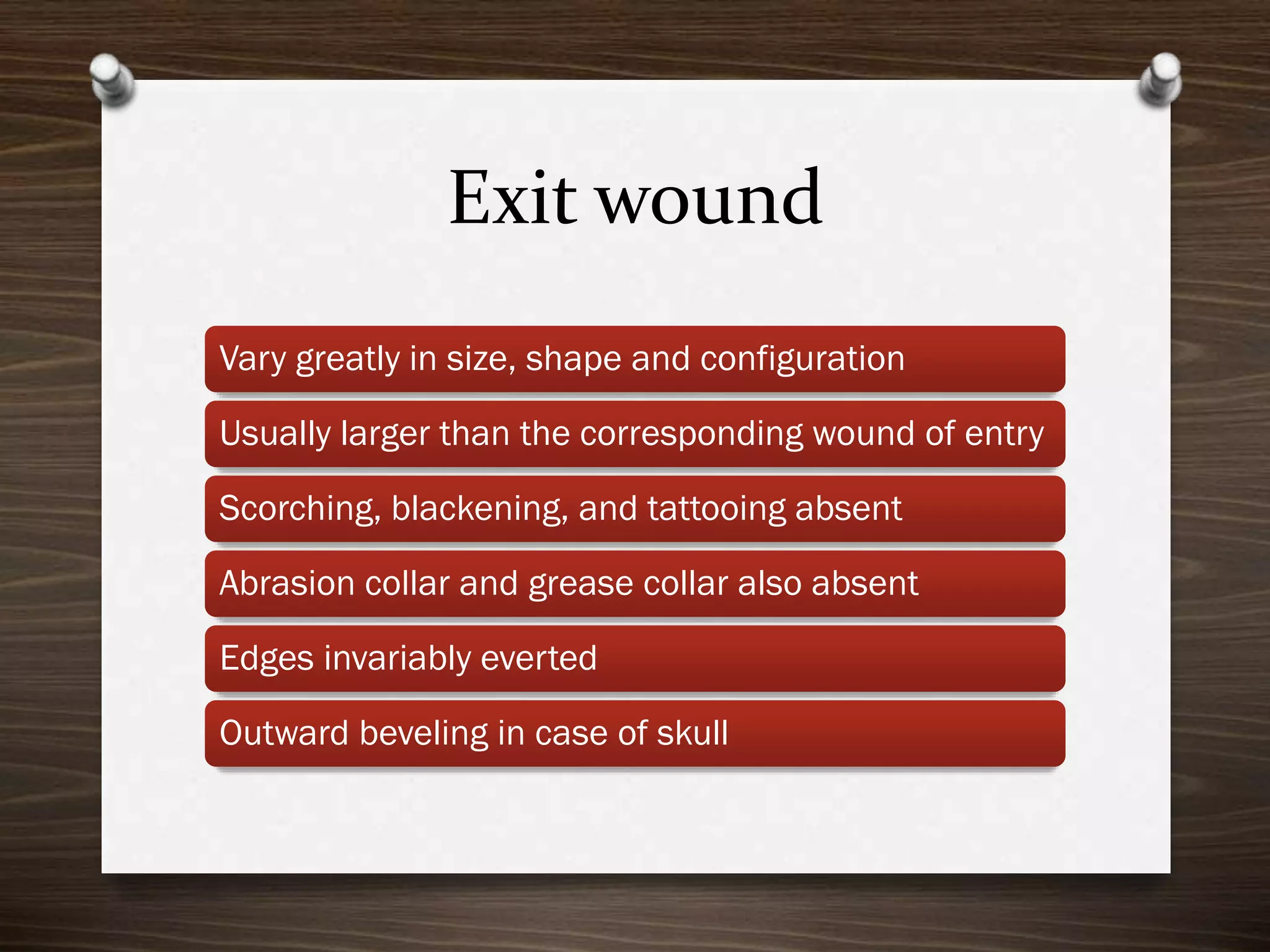
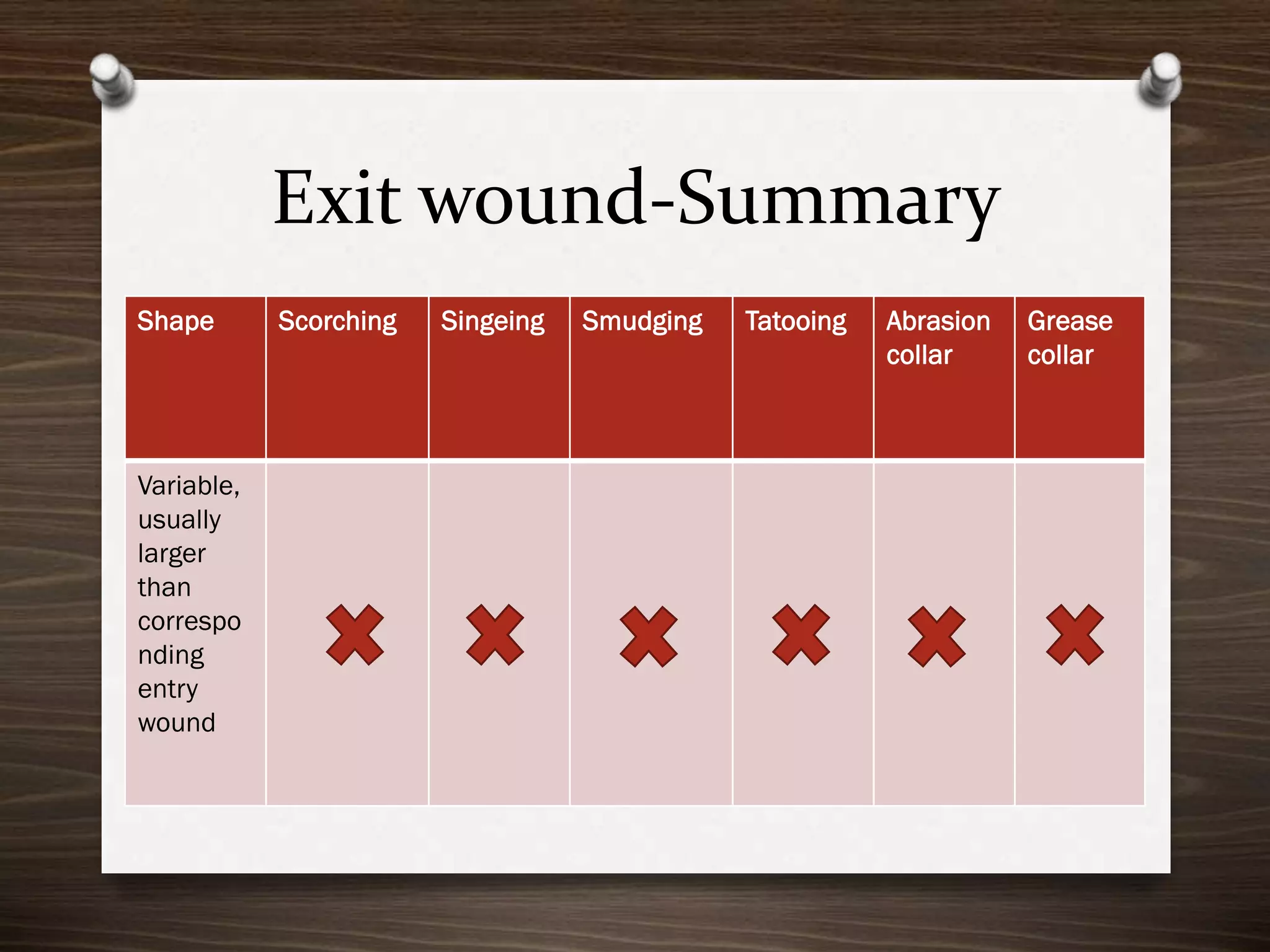
Exit wound
Vary greatly in size, shape and configuration

Usually larger than the corresponding wound of entry
Scorching, blackening, and tattooing absent
Abrasion collar and grease collar also absent

Edges invariably everted
Outward beveling in case of skull
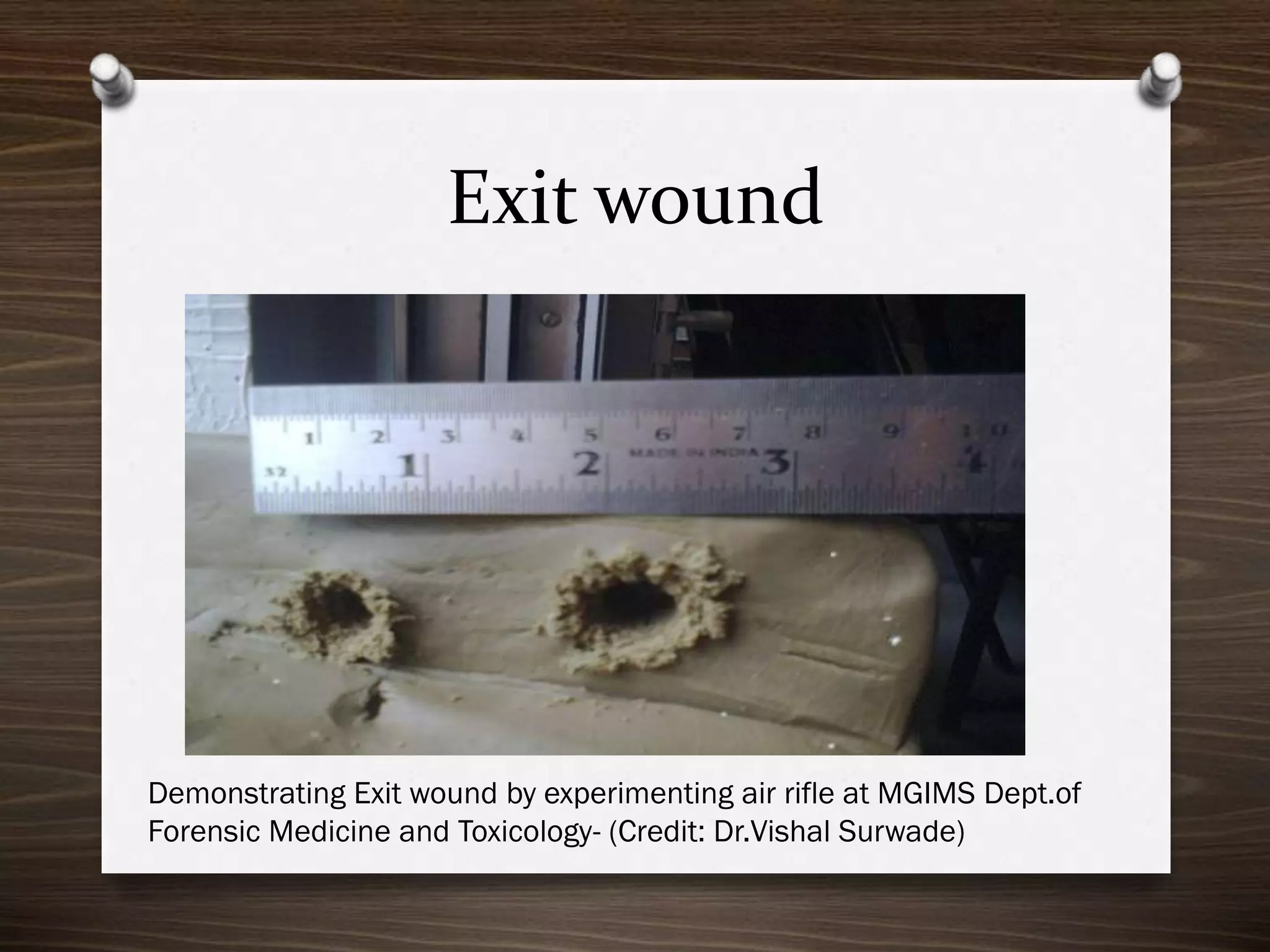
Exit wound

Demonstrating Exit wound by experimenting air rifle at MGIMS Dept.of
Forensic Medicine and Toxicology- (Credit: Dr.Vishal Surwade)
Exit wound-Summary
Shape

Variable,
usually
larger
than
correspo
nding
entry
wound

Scorching

Singeing

Smudging

Tatooing

Abrasion
collar

Grease
collar
Difference between
Entry wound and Exit
wound
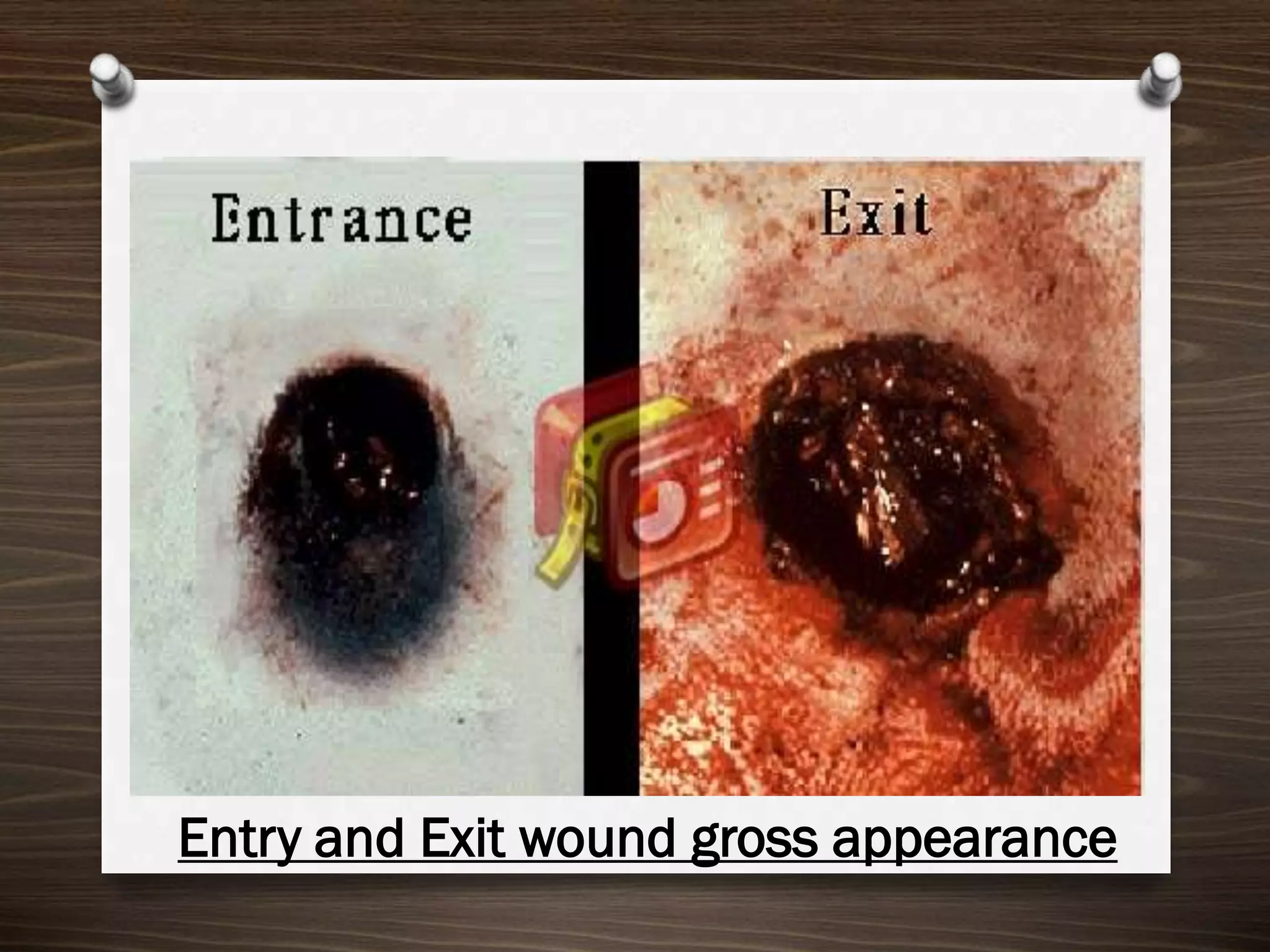
Entry and Exit wound gross appearance
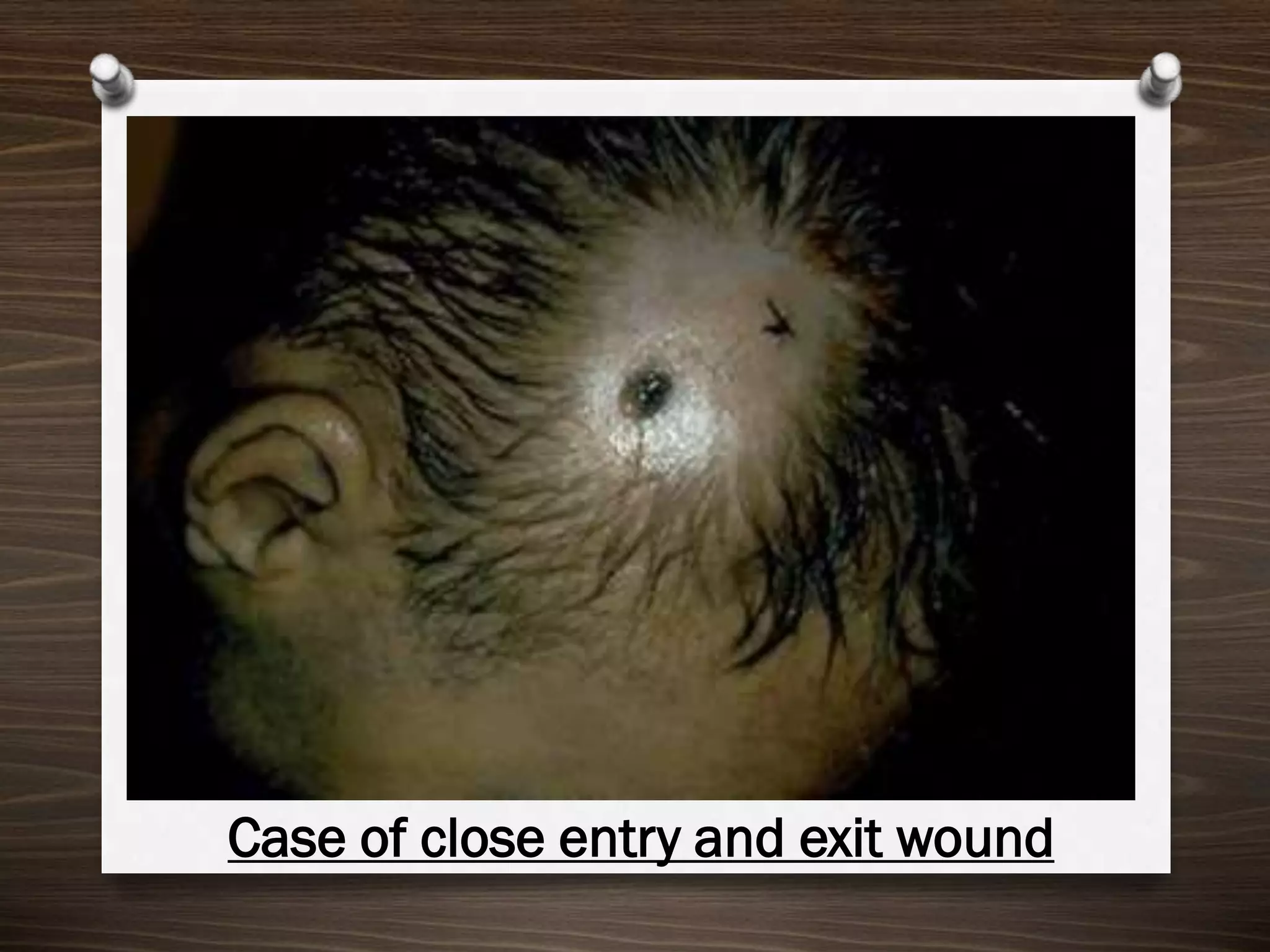
Case of close entry and exit wound
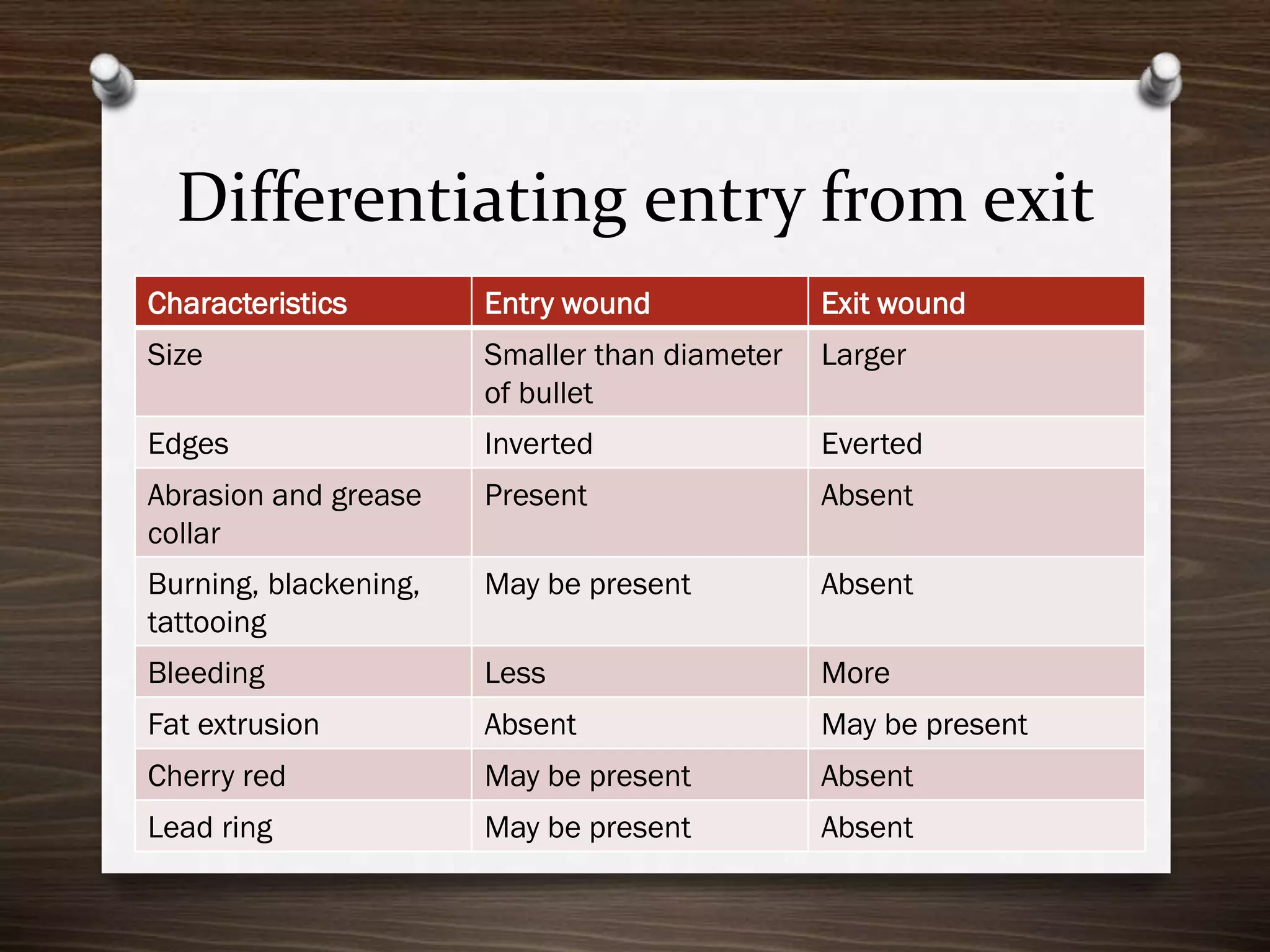
Differentiating entry from exit
Characteristics

Entry wound

Exit wound

Size

Smaller than diameter
of bullet

Larger

Edges

Inverted

Everted

Abrasion and grease
collar

Present

Absent

Burning, blackening,
tattooing

May be present

Absent

Bleeding

Less

More

Fat extrusion

Absent

May be present

Cherry red

May be present

Absent

Lead ring

May be present

Absent
Smooth-bore
firearm injury
Entry wound and Exit wound
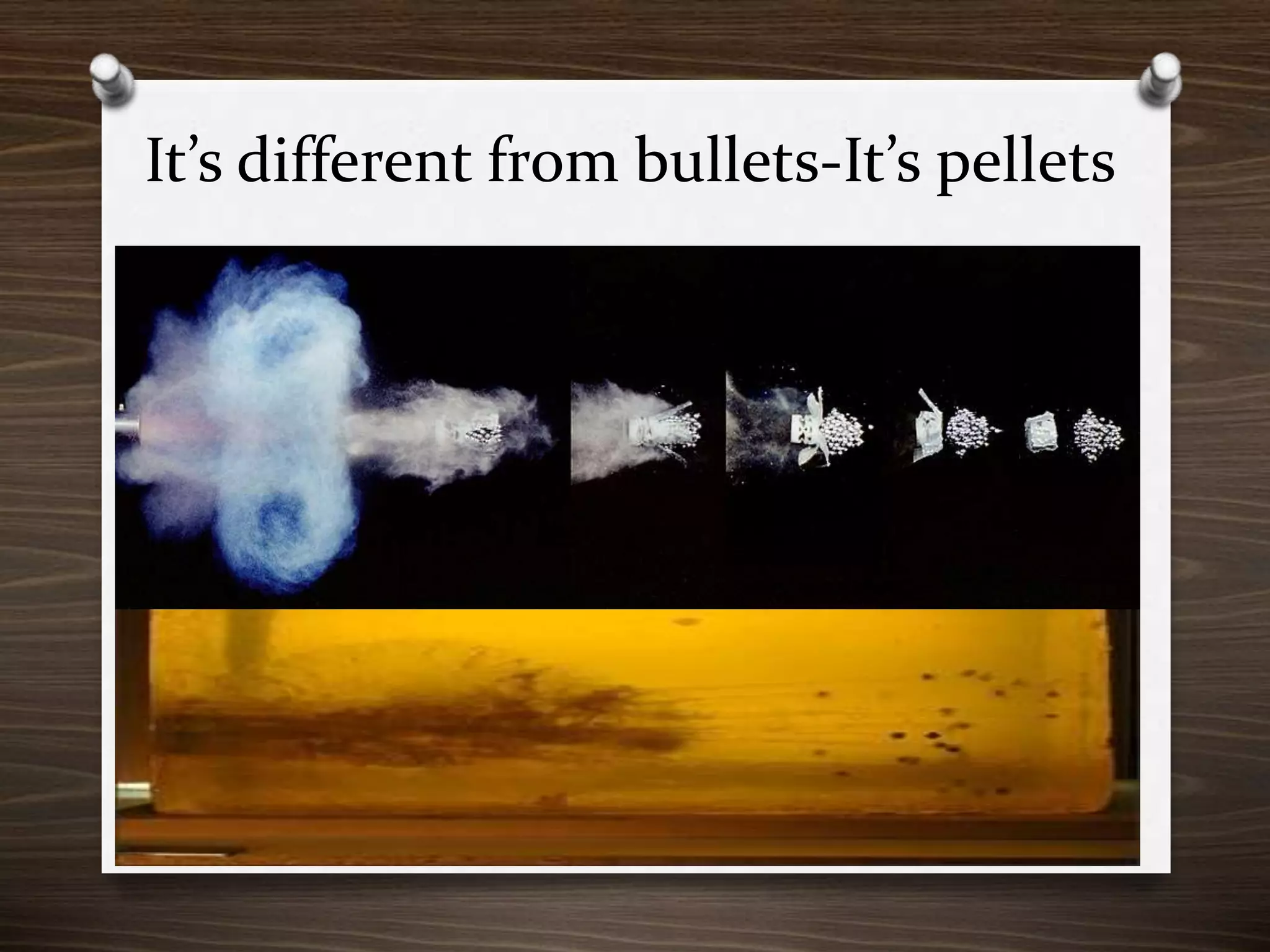
It’s different from bullets-It’s pellets
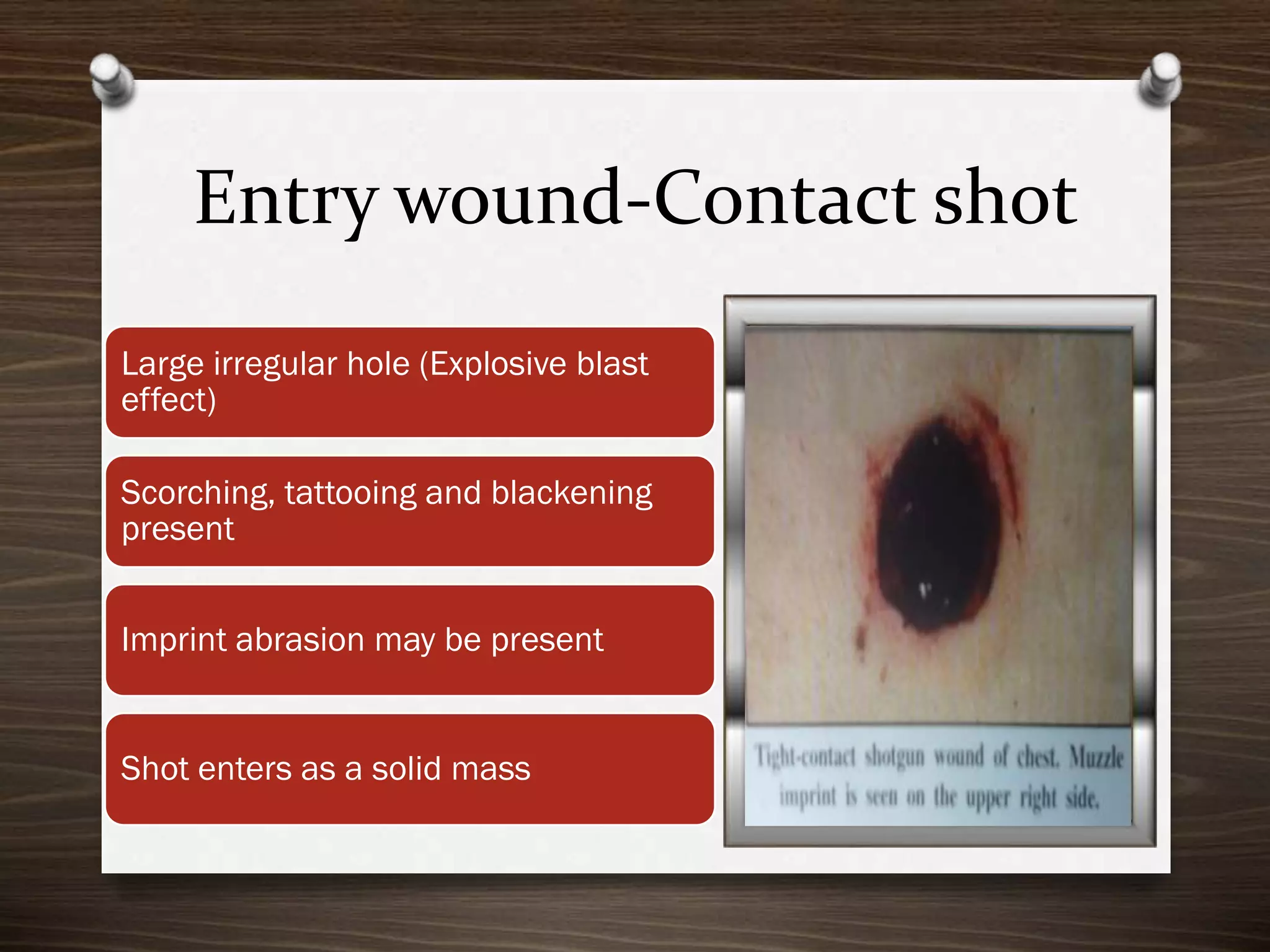
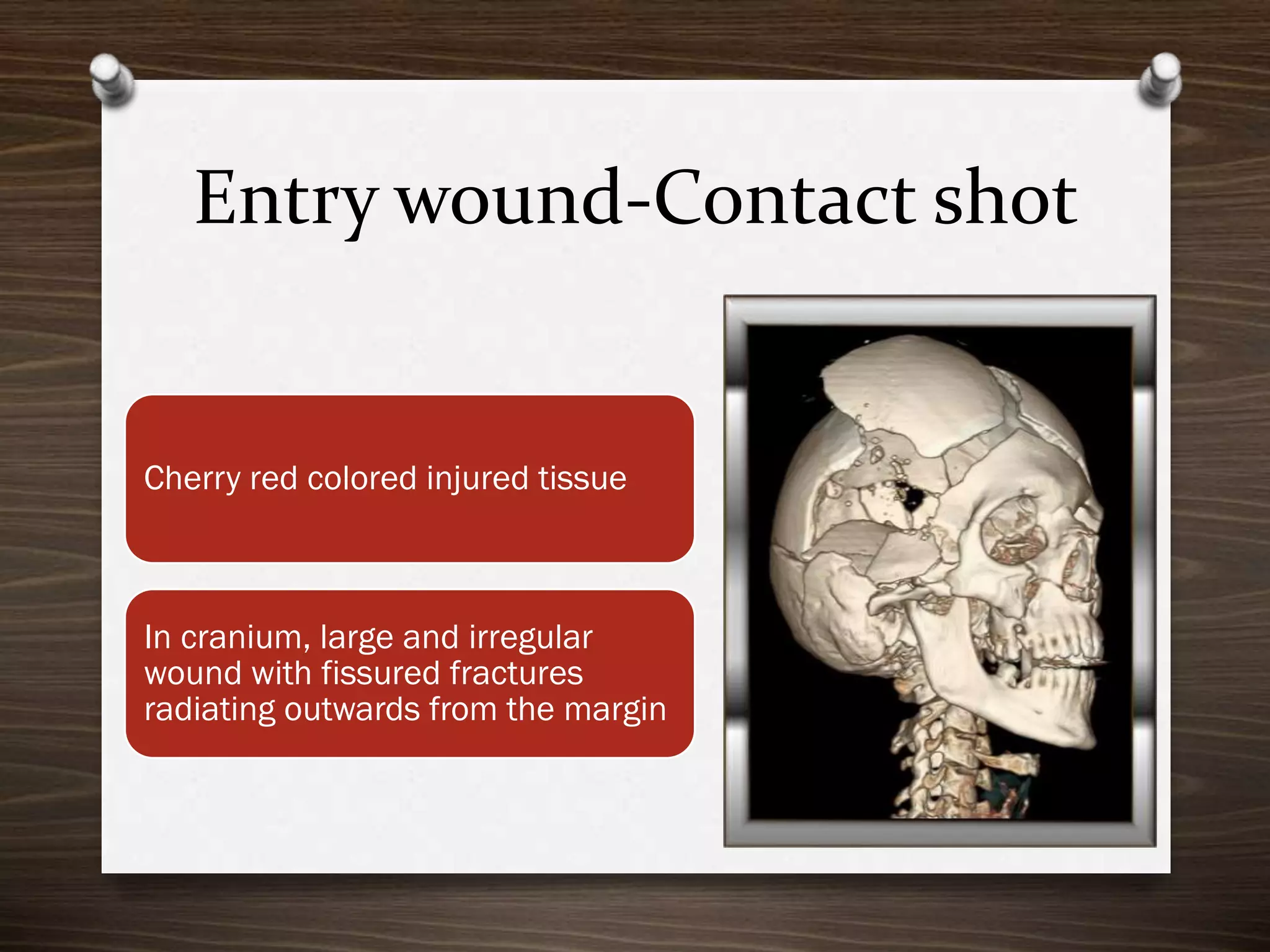
Entry wound-Contact shot
Large irregular hole (Explosive blast
effect)
Scorching, tattooing and blackening
present
Imprint abrasion may be present

Shot enters as a solid mass
Entry wound-Contact shot

Cherry red colored injured tissue

In cranium, large and irregular
wound with fissured fractures
radiating outwards from the margin
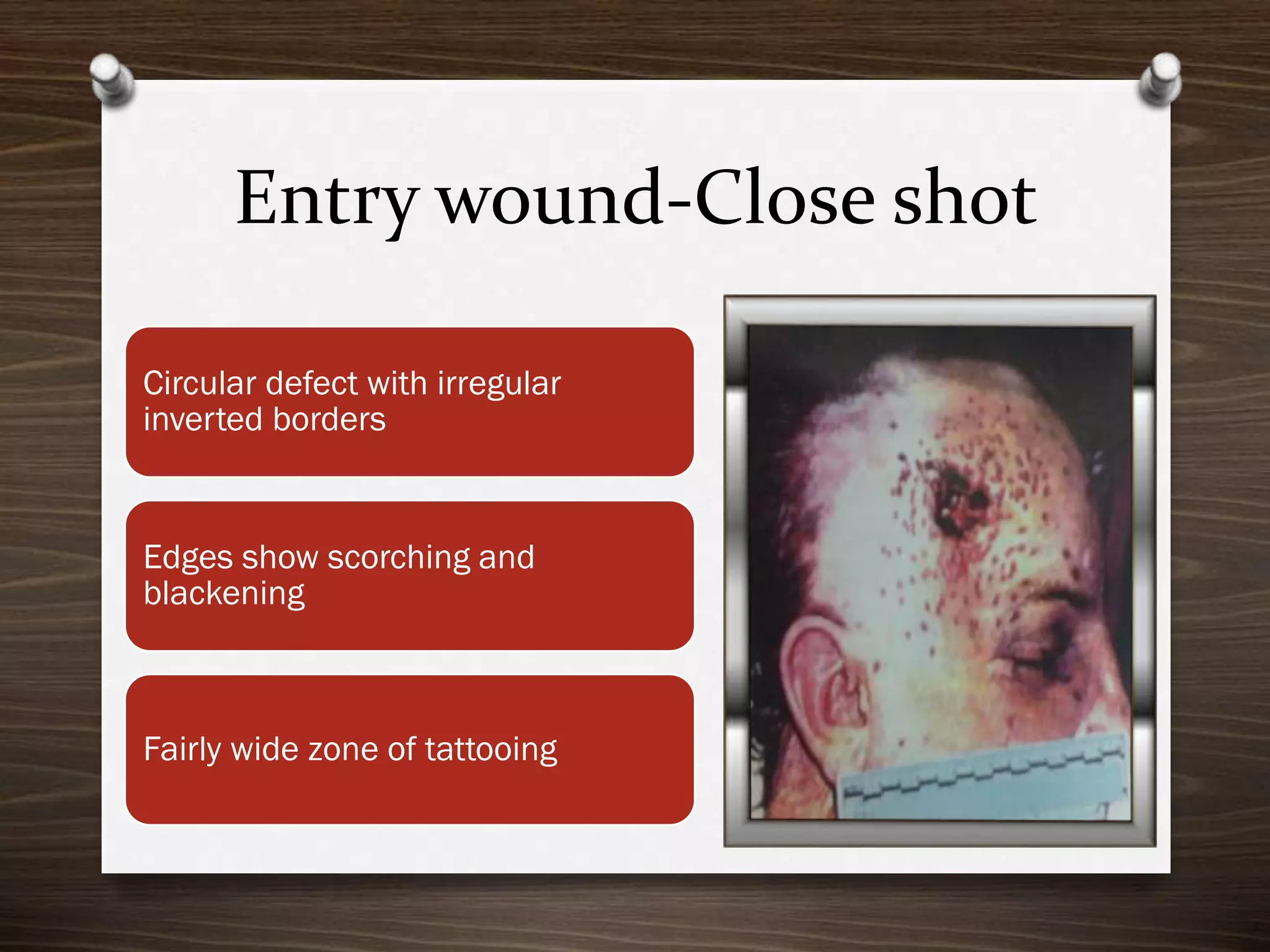
Entry wound-Close shot
Circular defect with irregular
inverted borders

Edges show scorching and
blackening

Fairly wide zone of tattooing
Entry wound-Close shot
Cherry red appearance of tissues

Pellets enter enmasse

Wads and cartridge parts may contribute to the wound
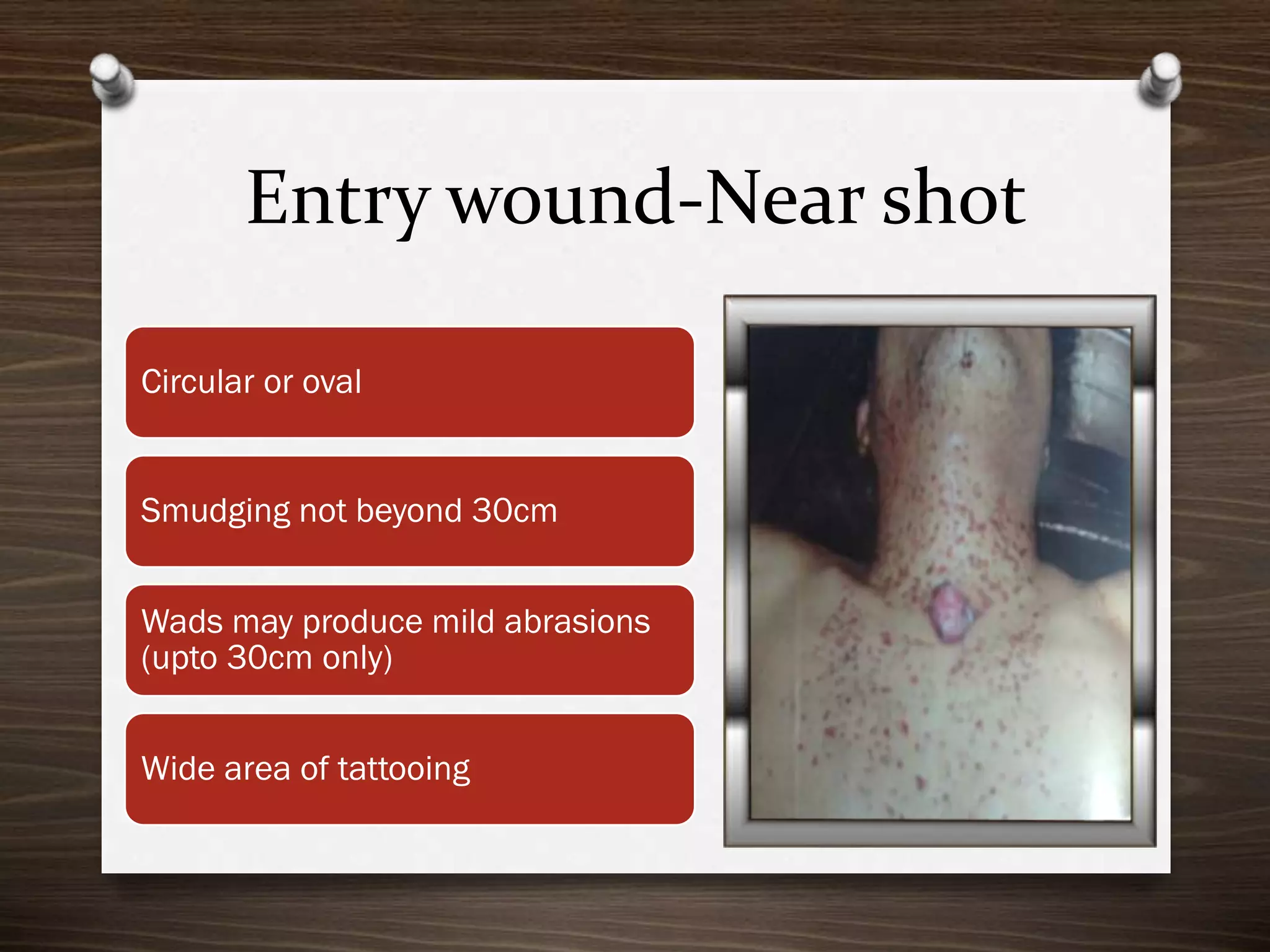
Entry wound-Near shot
Circular or oval

Smudging not beyond 30cm
Wads may produce mild abrasions
(upto 30cm only)
Wide area of tattooing
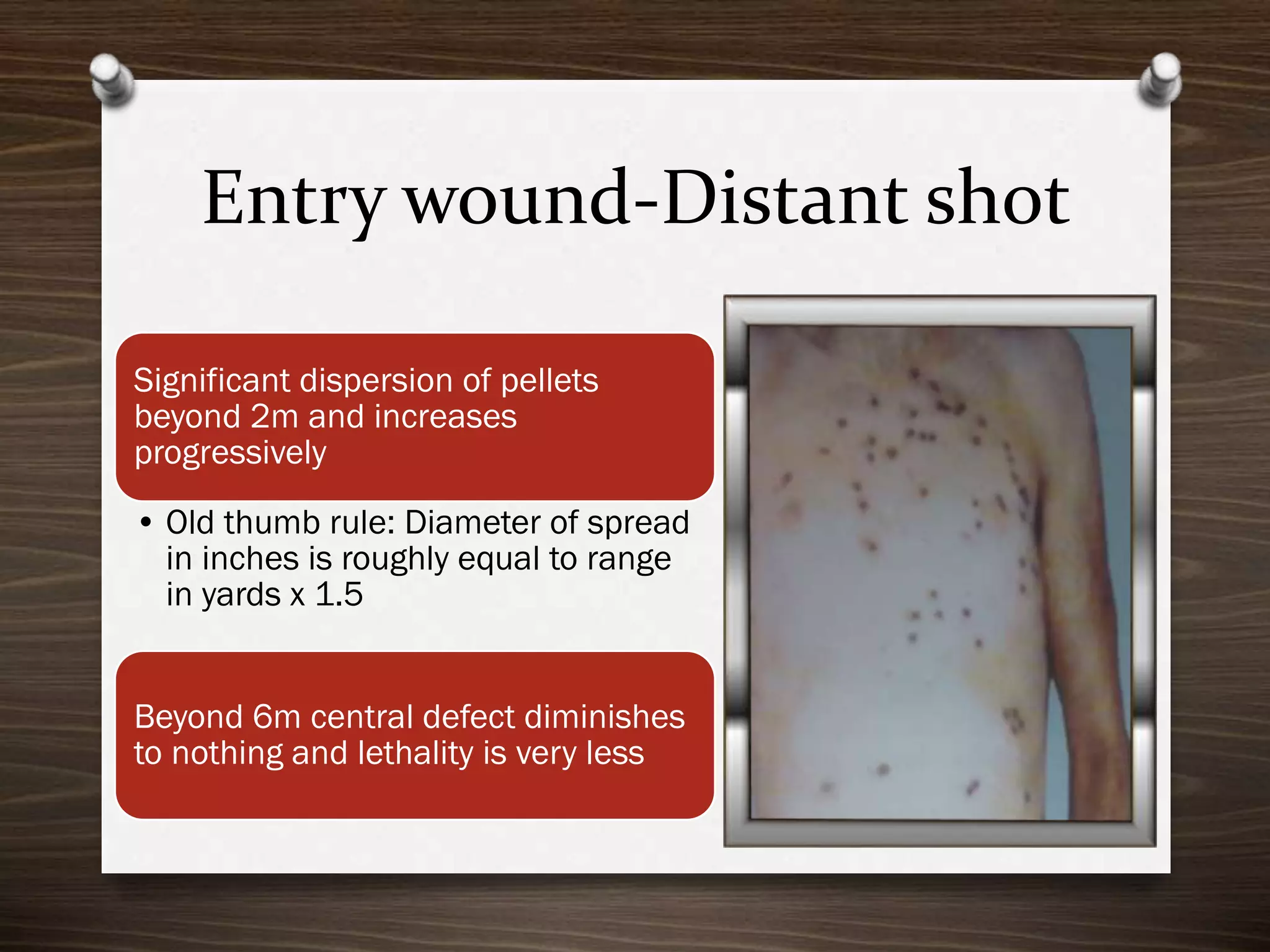
Entry wound-Distant shot
Beyond 2m, no burning or blackening

Tattooing is rare

Wads may contribute upto 5m
Entry wound-Distant shot
Significant dispersion of pellets
beyond 2m and increases
progressively
• Old thumb rule: Diameter of spread
in inches is roughly equal to range
in yards x 1.5
Beyond 6m central defect diminishes
to nothing and lethality is very less
Medicolegal aspects
Firearm injuries
MLA Firearm injuries
1

Nature of firearm

2

Range of fire

3

Direction of fire

4

Place from where firing took place

5

6

Cause of death

Manner of death-Accidental, suicidal or homicidal
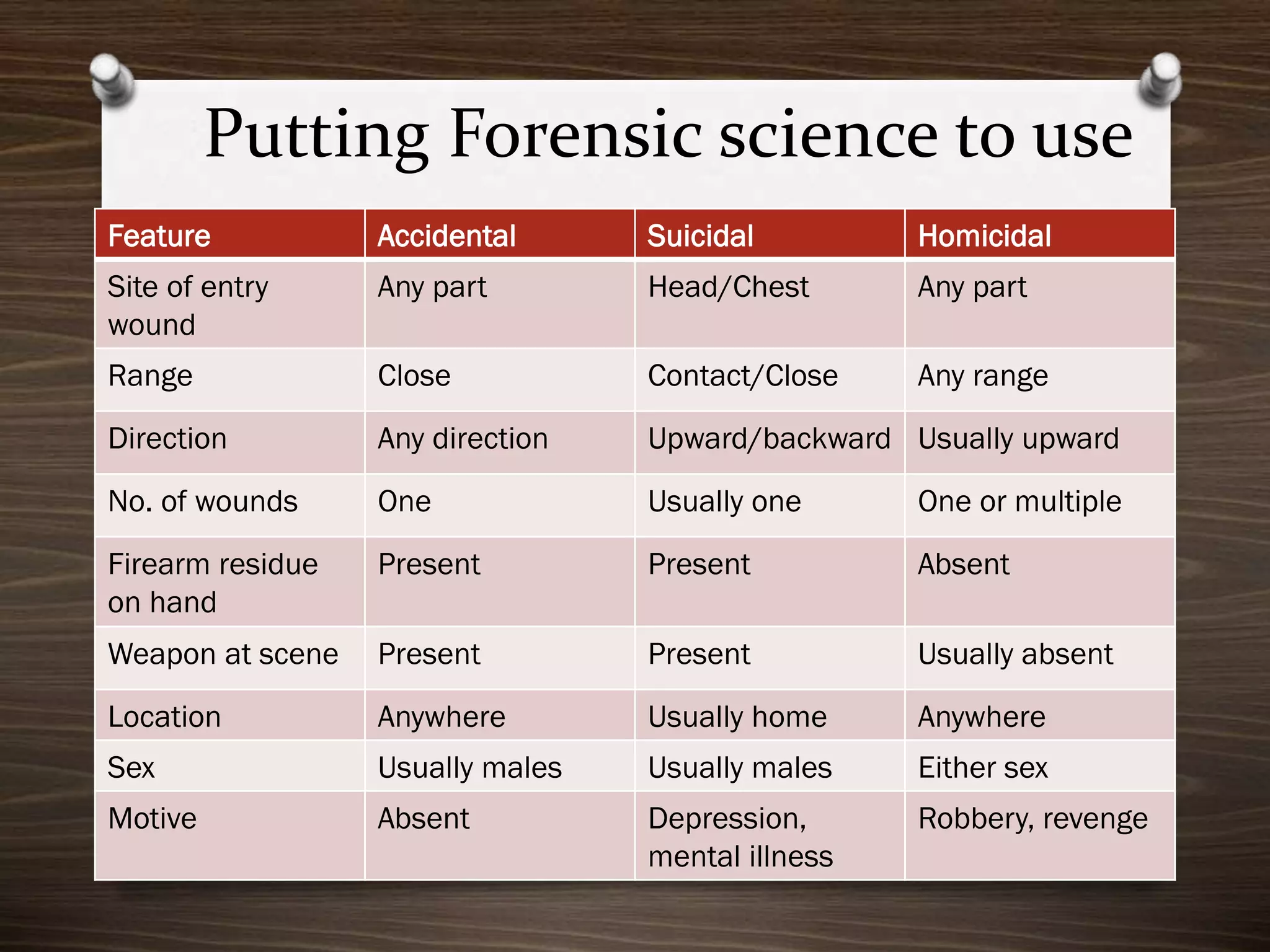
Putting Forensic science to use
Feature

Accidental

Suicidal

Homicidal

Site of entry
wound

Any part

Head/Chest

Any part

Range

Close

Contact/Close

Any range

Direction

Any direction

Upward/backward Usually upward

No. of wounds

One

Usually one

One or multiple

Firearm residue
on hand

Present

Present

Absent

Weapon at scene

Present

Present

Usually absent

Location

Anywhere

Usually home

Anywhere

Sex

Usually males

Usually males

Either sex

Motive

Absent

Depression,
mental illness

Robbery, revenge
Ballistic Trivia
Just fun to know…
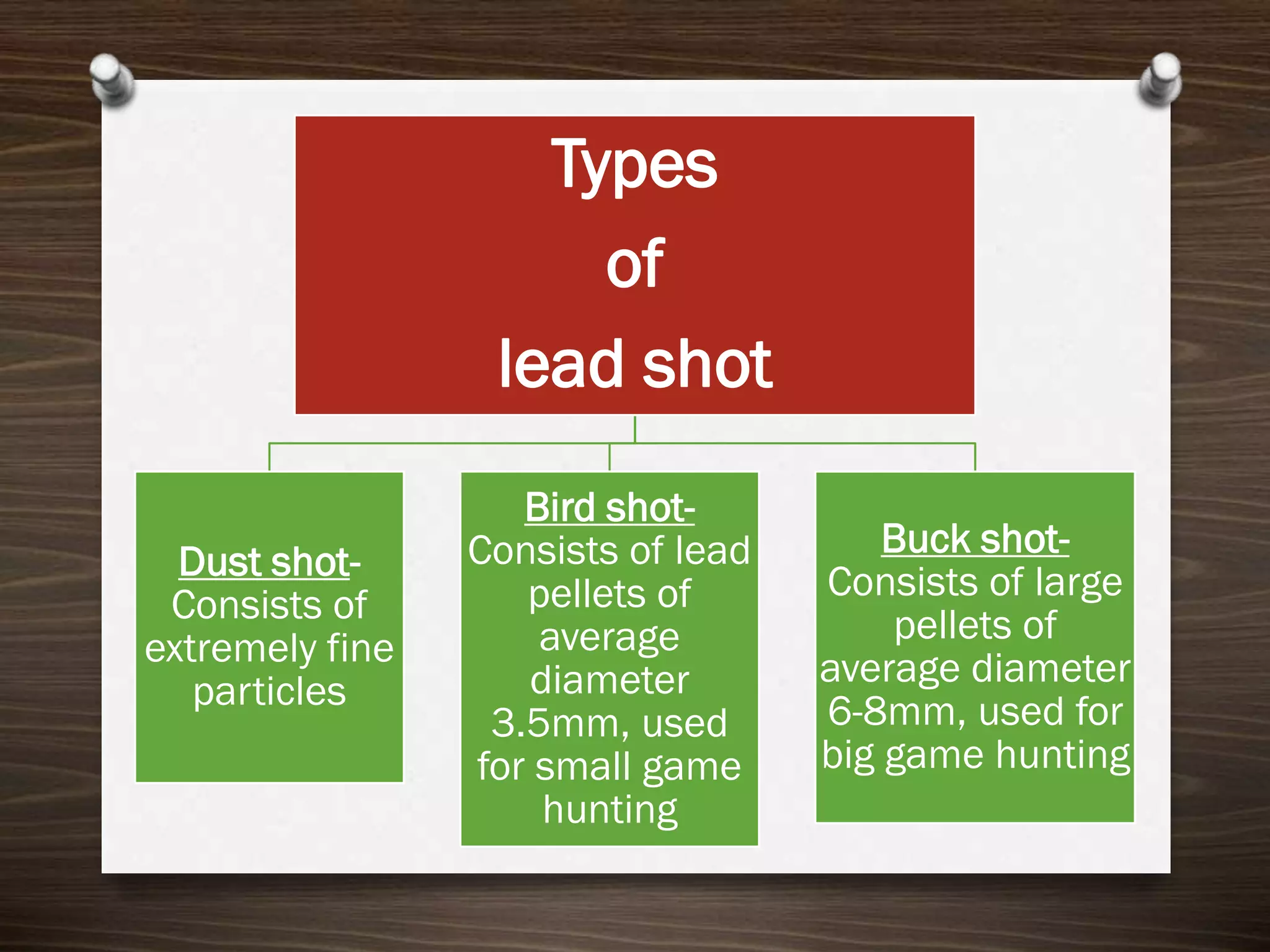
Types
of
lead shot
Dust shotConsists of
extremely fine
particles

Bird shotConsists of lead
pellets of
average
diameter
3.5mm, used
for small game
hunting

Buck shotConsists of large
pellets of
average diameter
6-8mm, used for
big game hunting
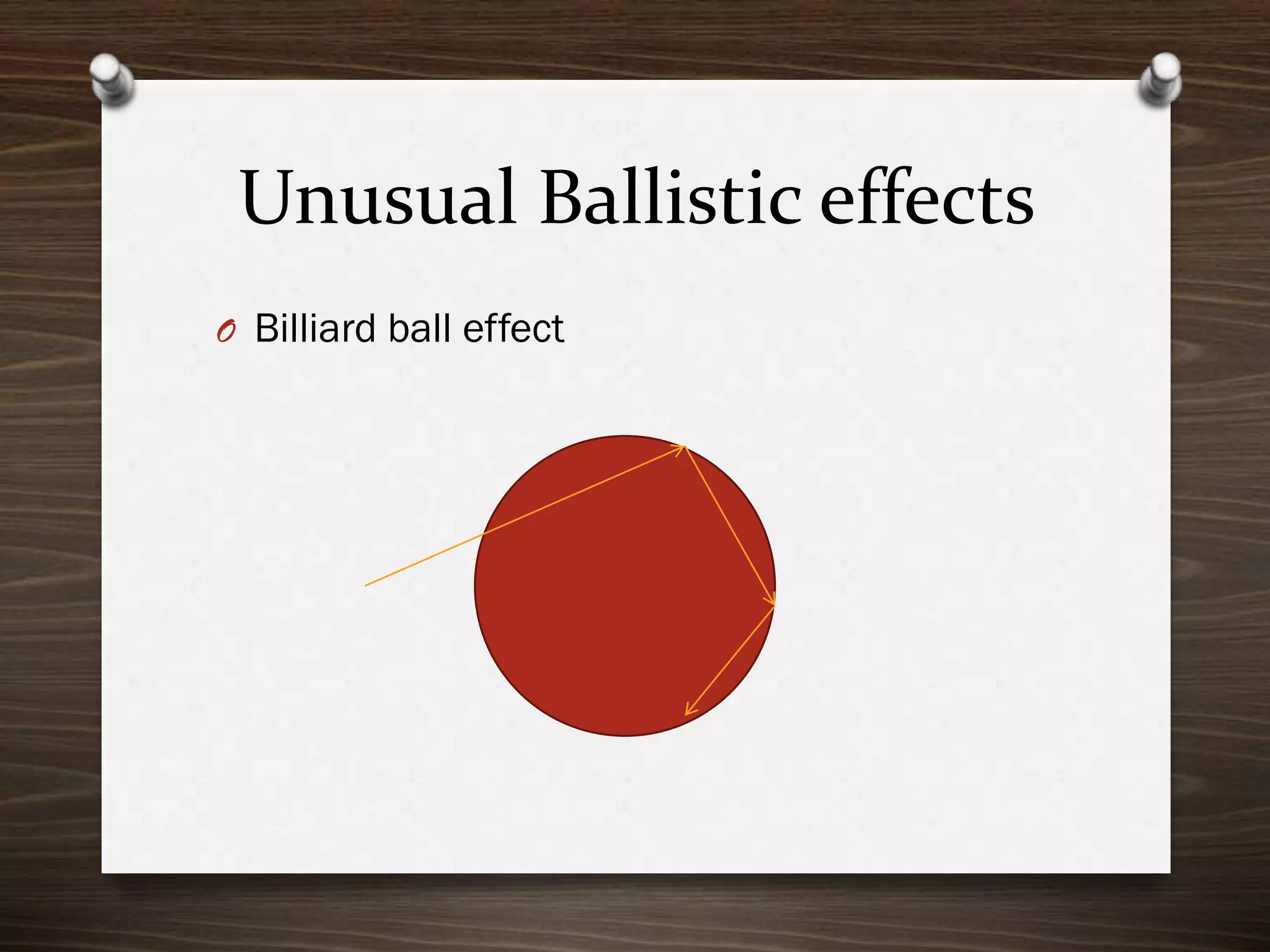
Unusual Ballistic effects
O Billiard ball effect
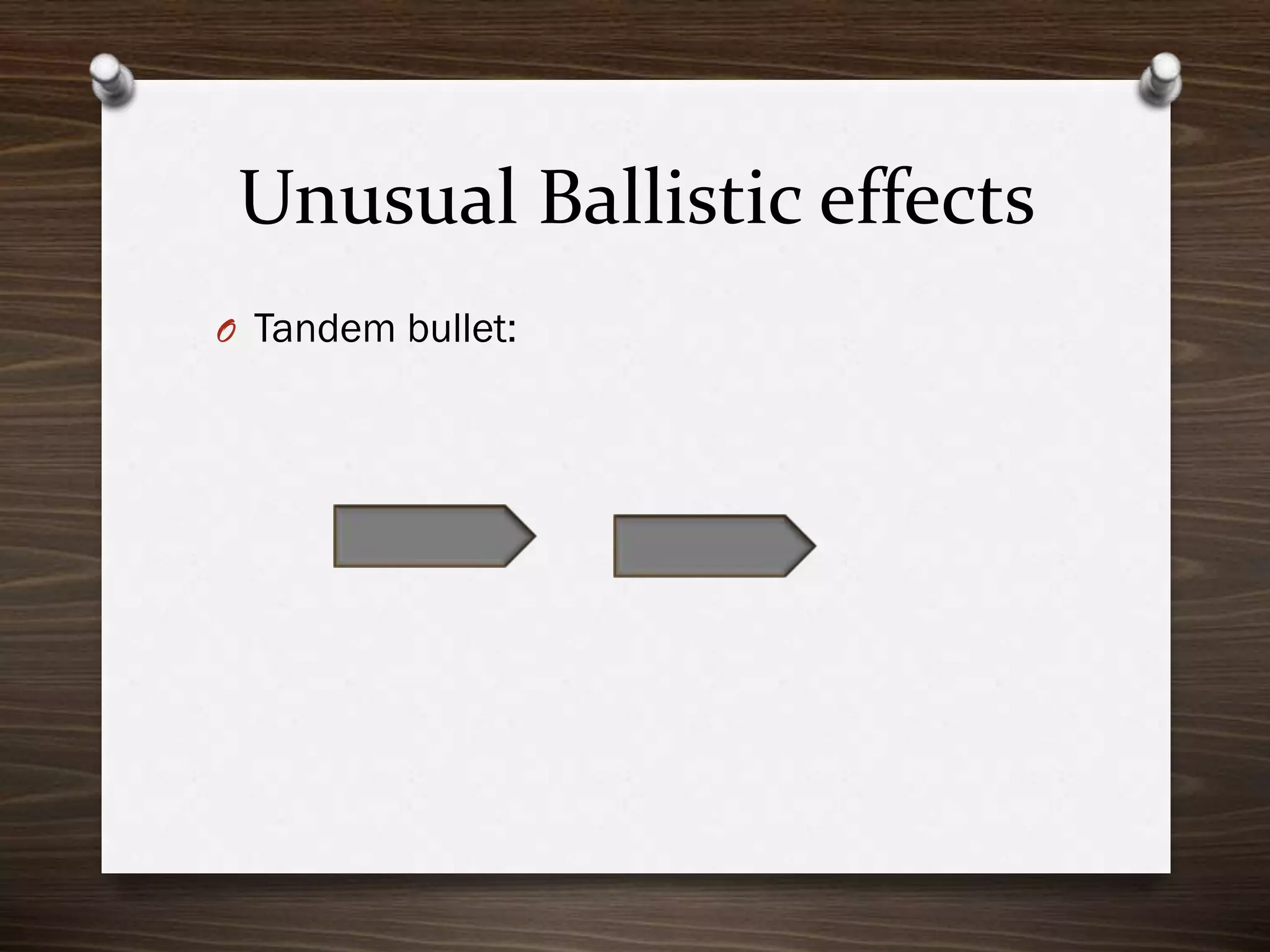
Unusual Ballistic effects
O Tandem bullet:
Unusual Ballistic effects
O Shored exit wound
Unusual Ballistic effects
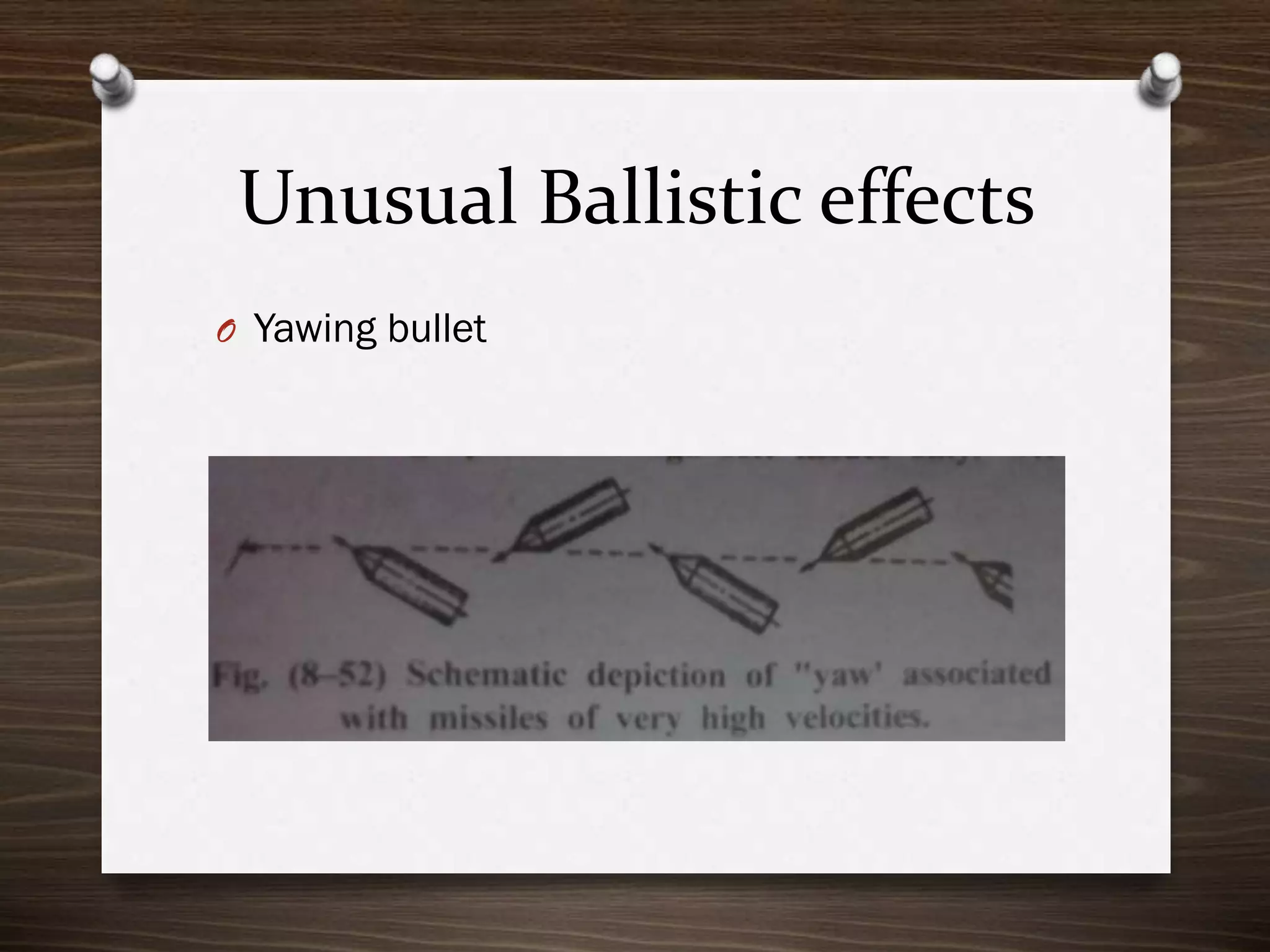
O Yawing bullet
Unusual Ballistic effects
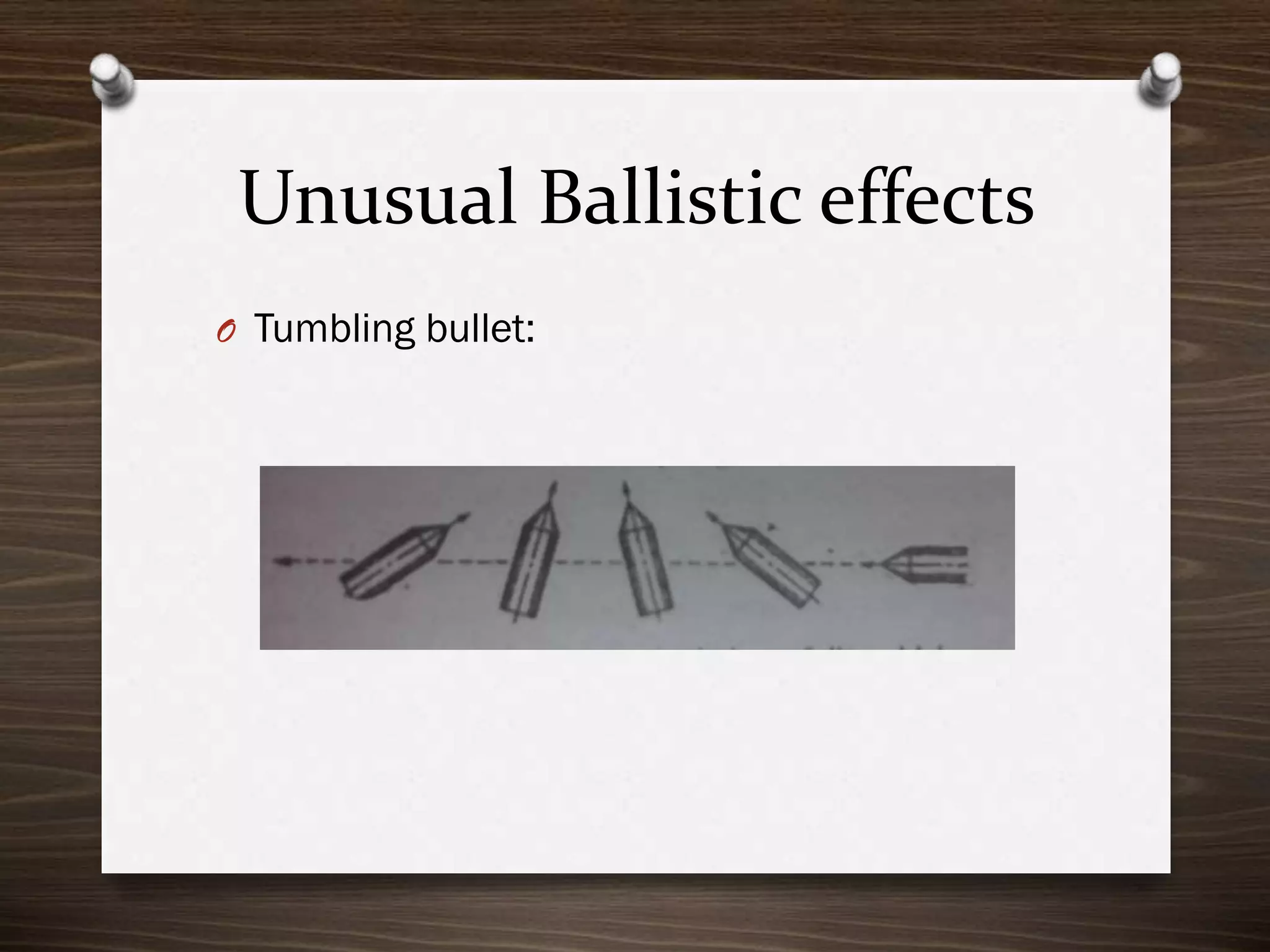
O Tumbling bullet:
Unusual Ballistic effects
O Souvenir bullet: A bullet remaining from a

long time in the body without invoking any
certain discomfort or visible damage.
Unusual Ballistic effects
O Kennedy phenomenon: Alteration of firearm

wound due to surgical intervention
He fired a GUN, I’m sure
O Dermal Nitrate test:
O Cloth dipped in molten paraffin is wrapped on

the hands of the accused
O Then, cloth is removed and is treated with
diphenylamine reagent on its internal surface
O Appearance of blue color indicates positive
test
O More specific and sensitive tests: Harrison

and Gilroy’s test, Neutron activation analysis
and atomic absorption spectroscopy
One of the most
sensational cases of
assassination by firearm
That is mired in controversy EVEN TODAY
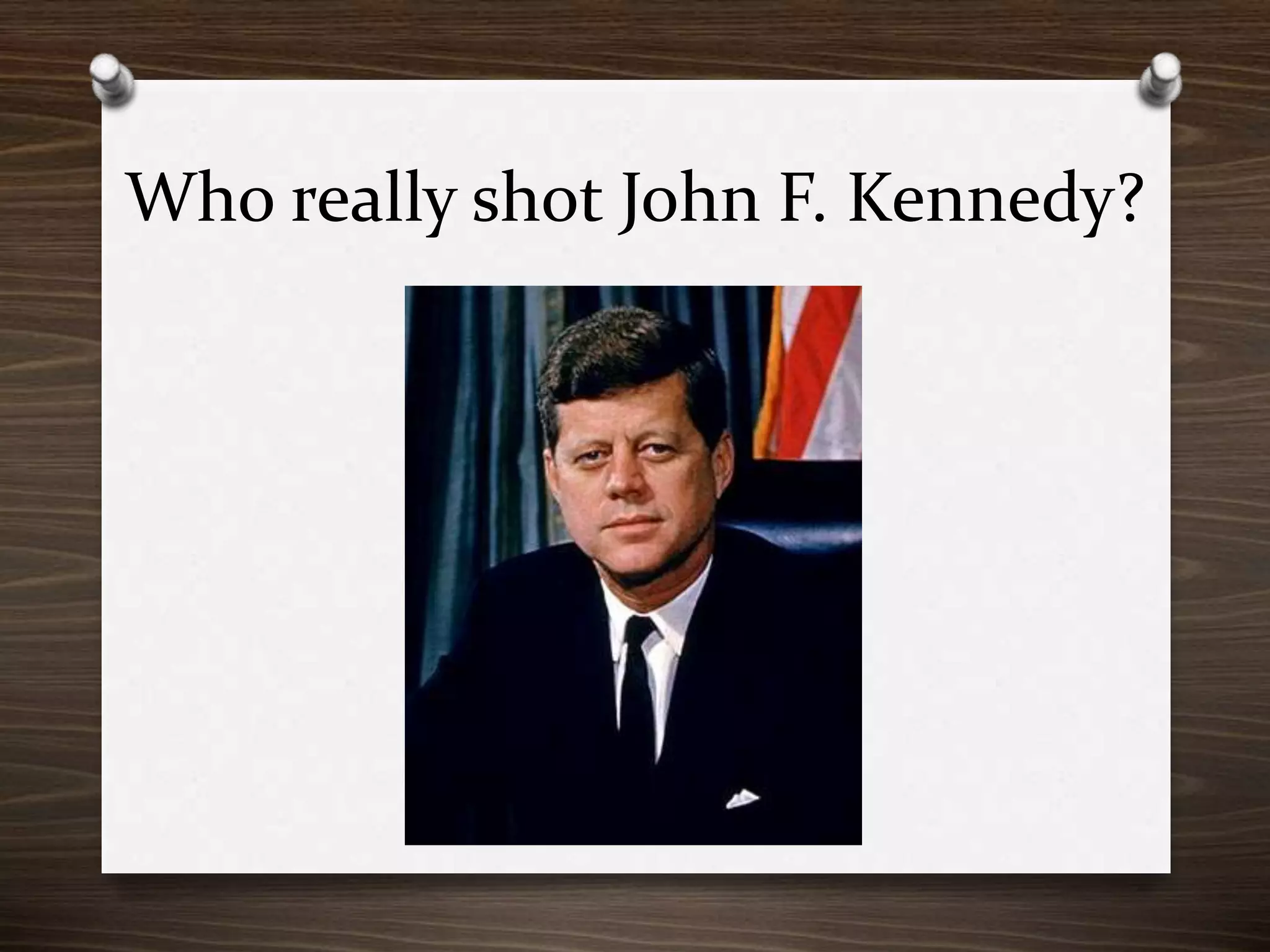
Who really shot John F. Kennedy?
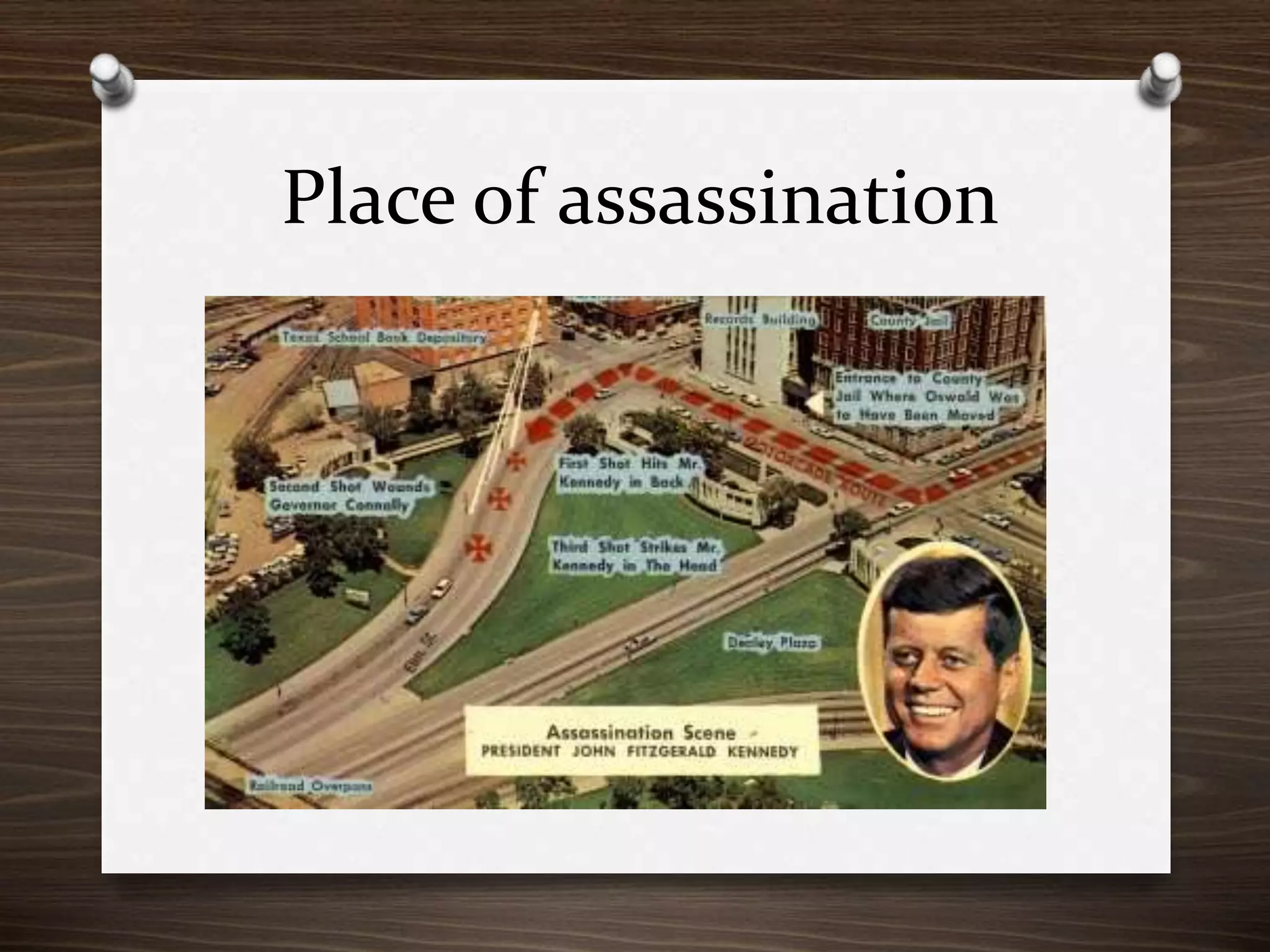
Place of assassination
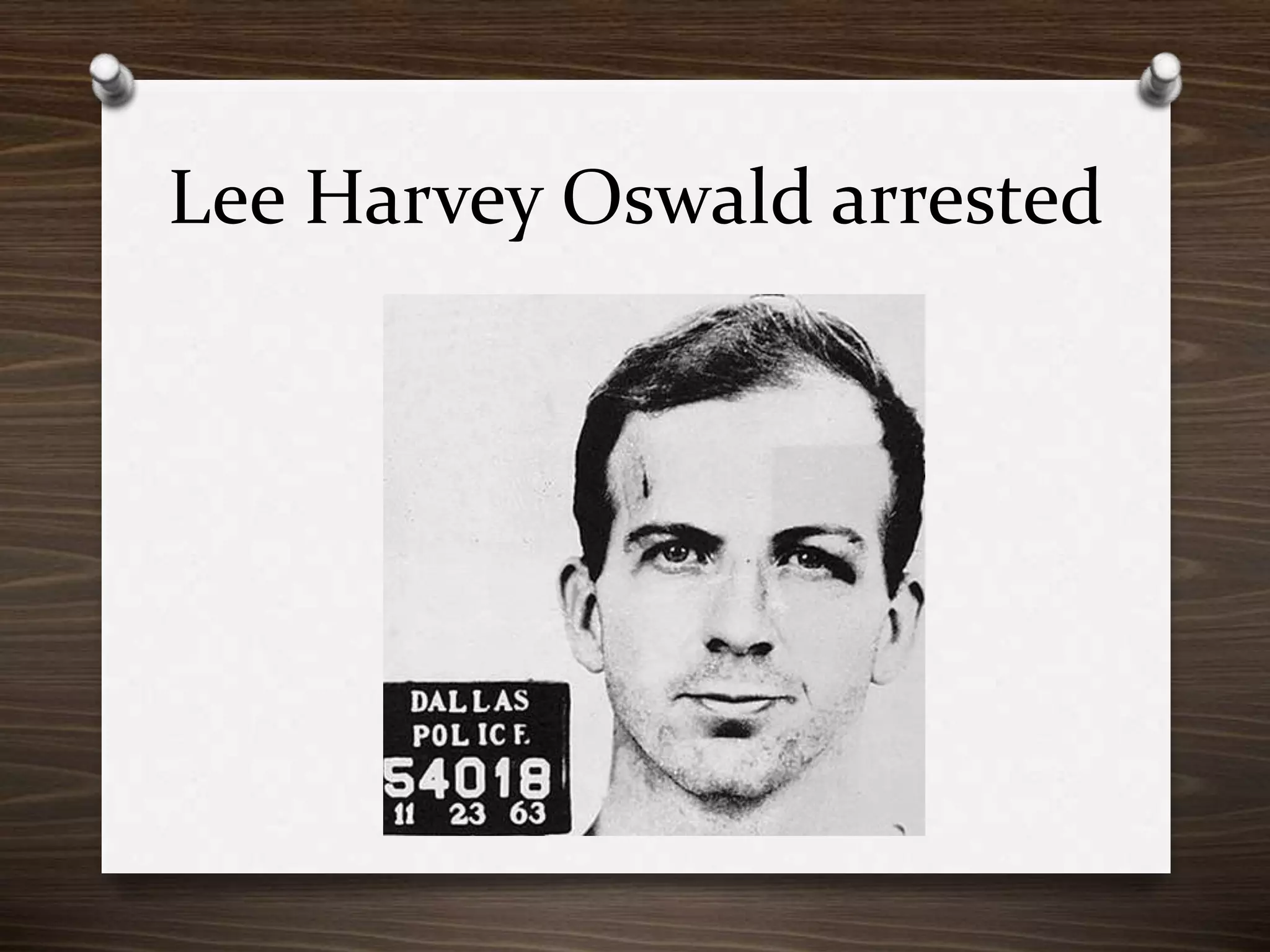
Lee Harvey Oswald arrested
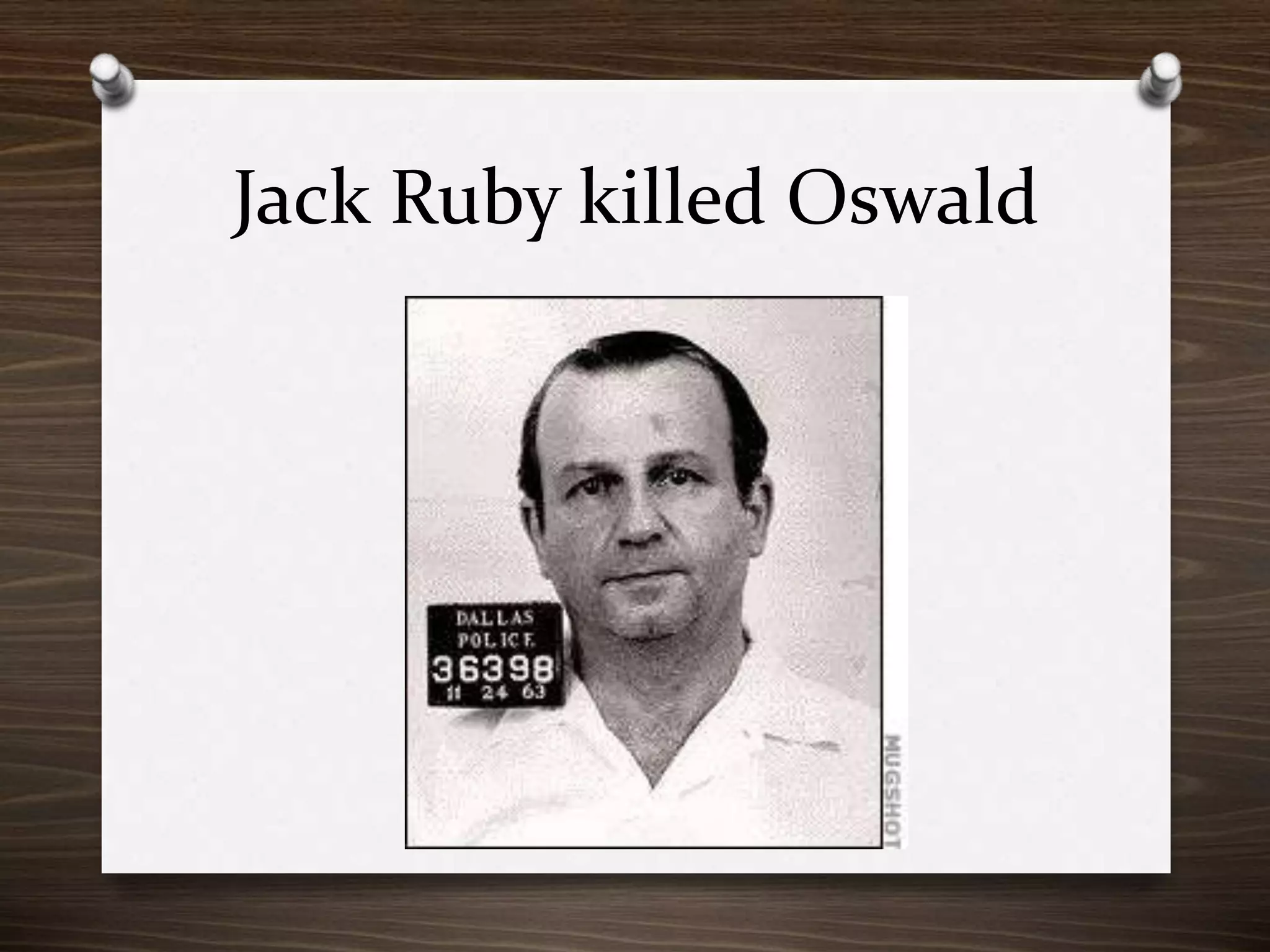
Jack Ruby killed Oswald
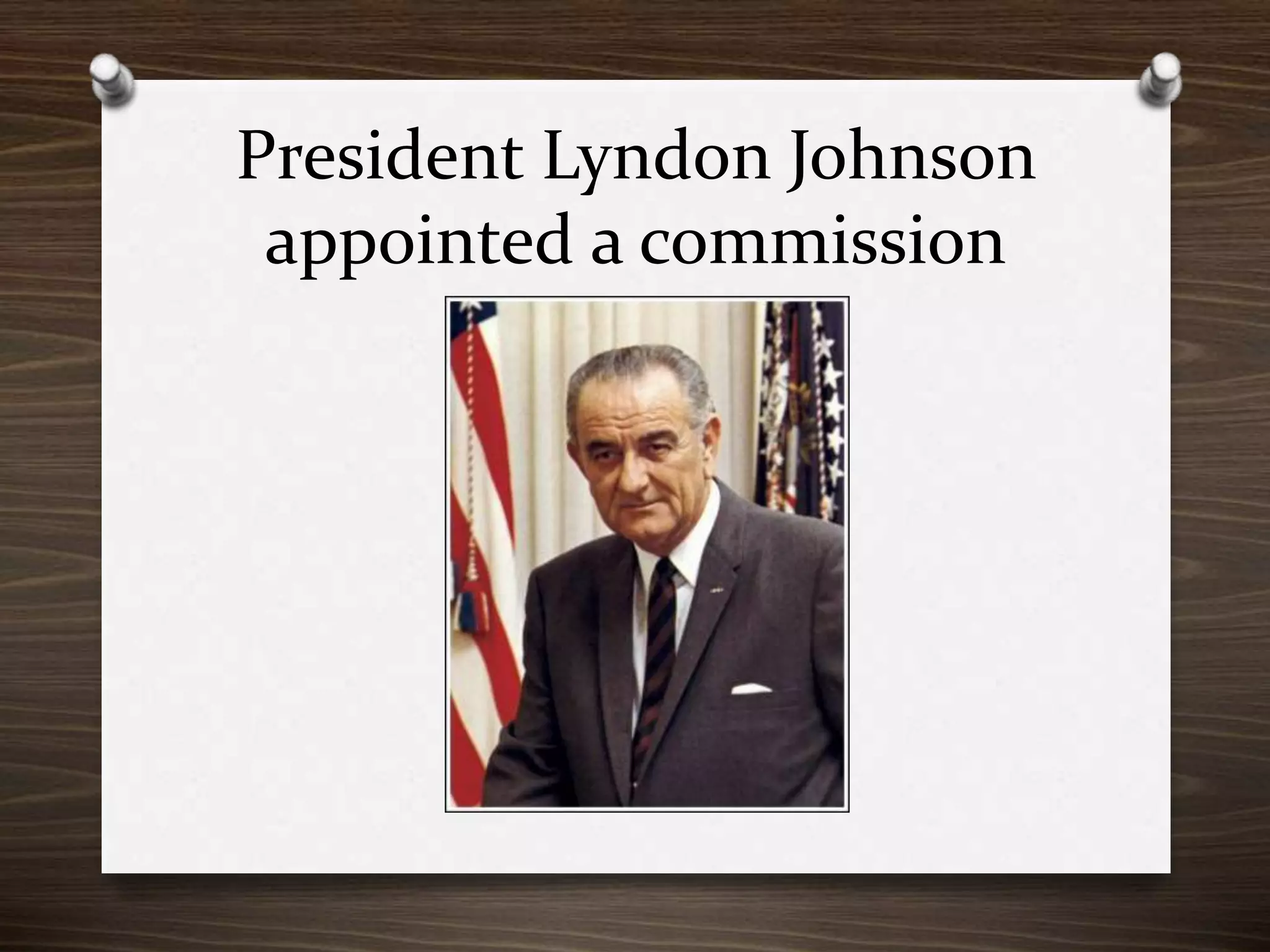
President Lyndon Johnson
appointed a commission
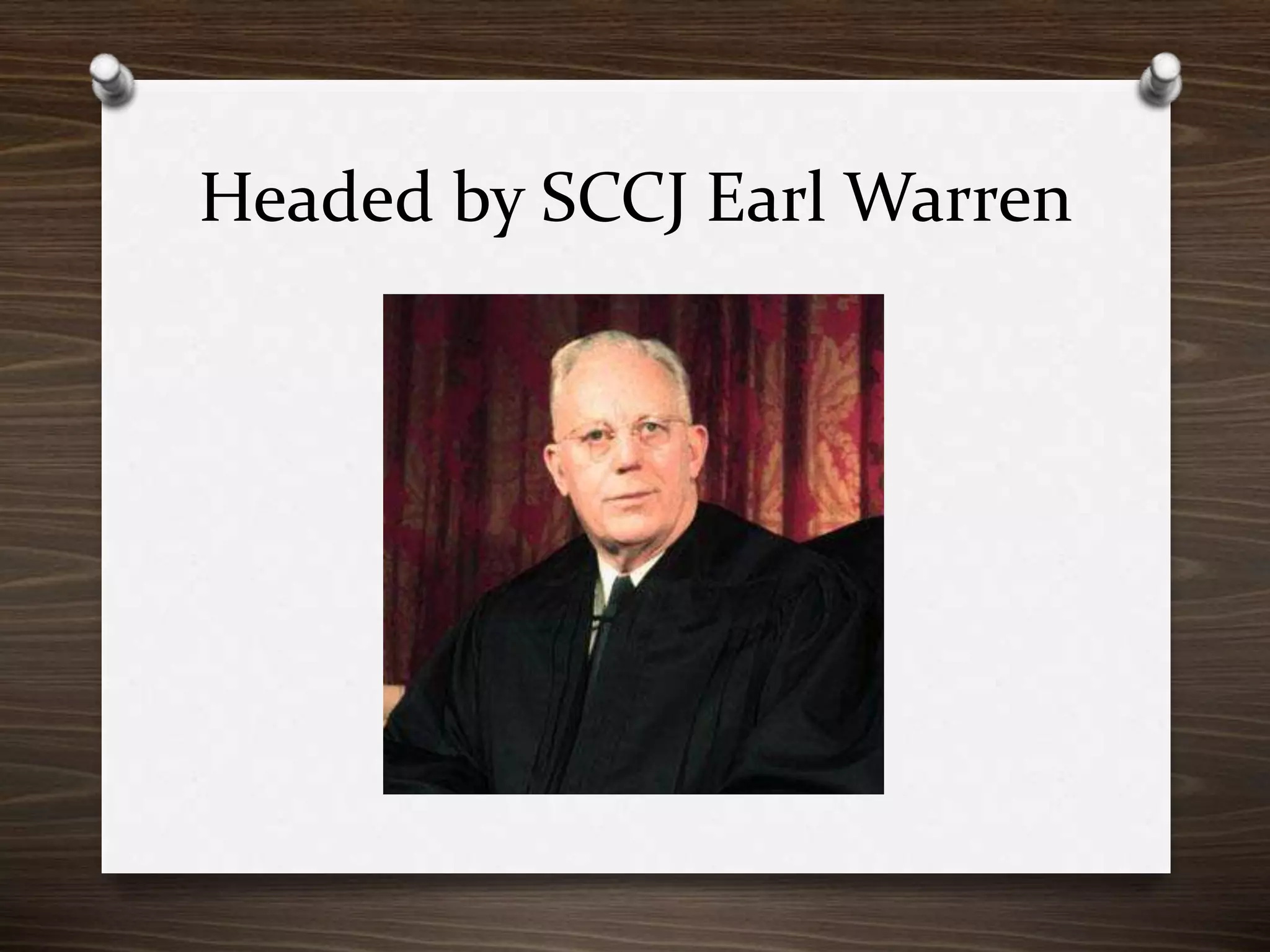
Headed by SCCJ Earl Warren
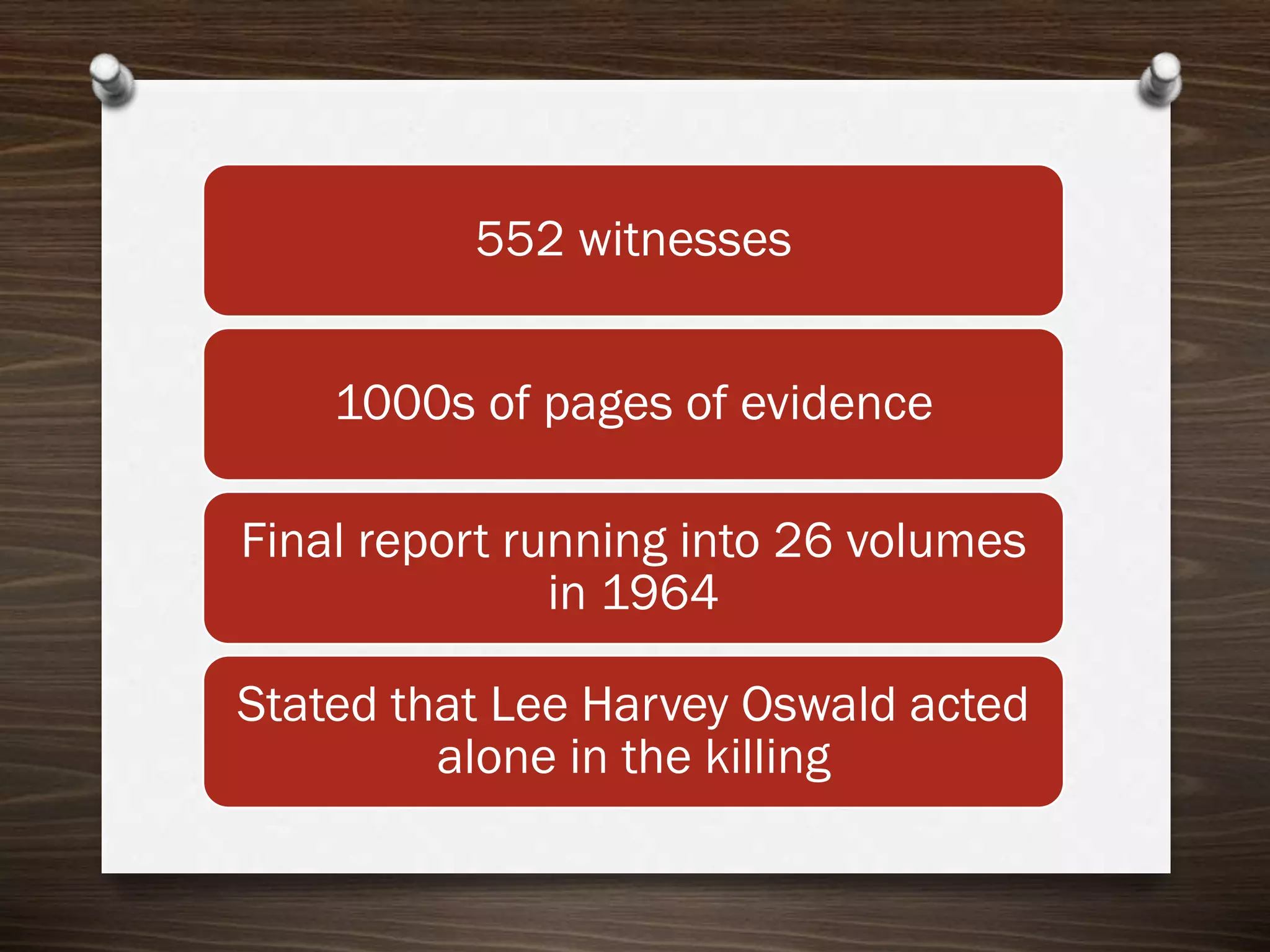
552 witnesses
1000s of pages of evidence
Final report running into 26 volumes
in 1964
Stated that Lee Harvey Oswald acted
alone in the killing
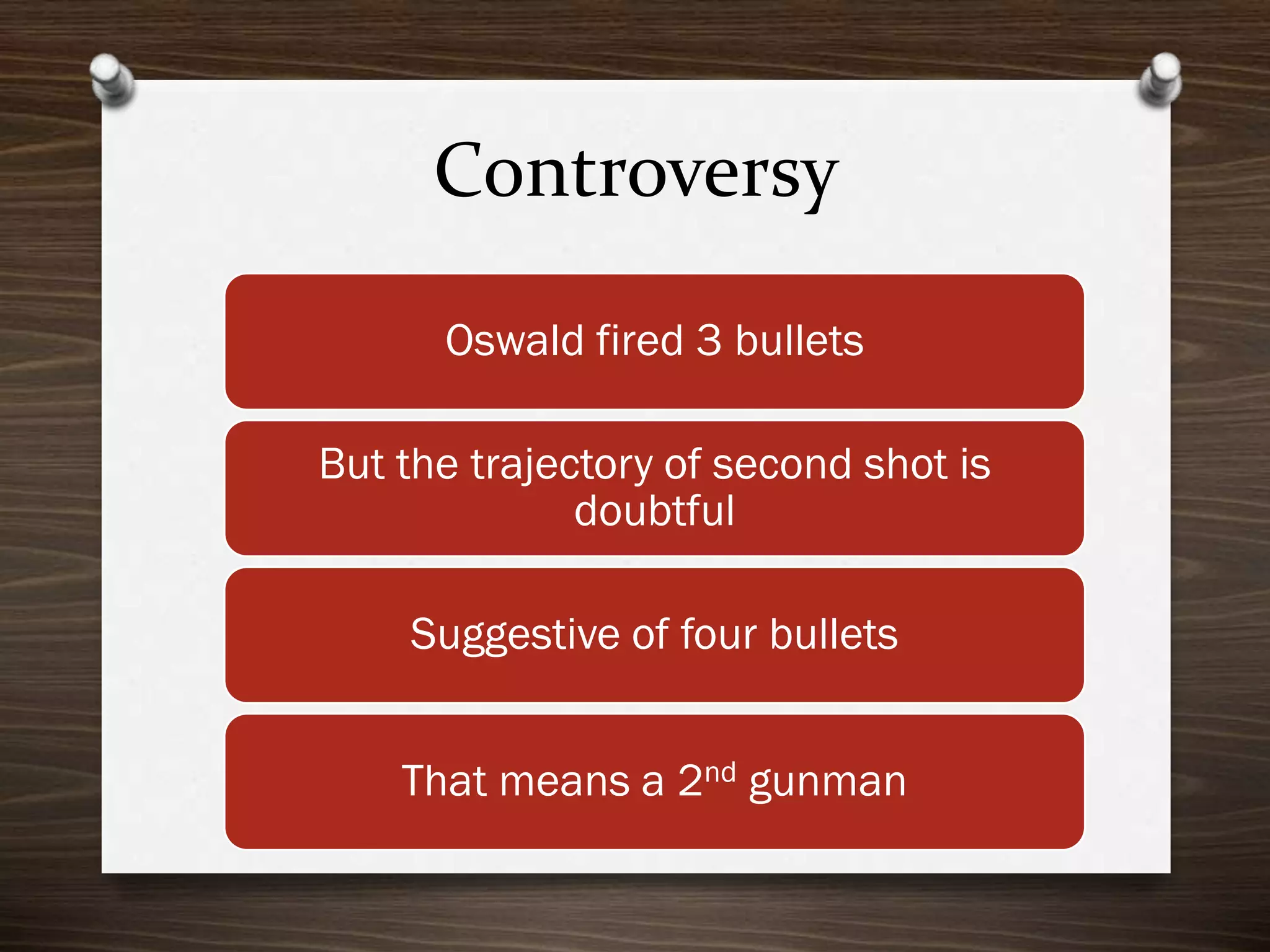
Controversy
Oswald fired 3 bullets
But the trajectory of second shot is
doubtful
Suggestive of four bullets
That means a 2nd gunman
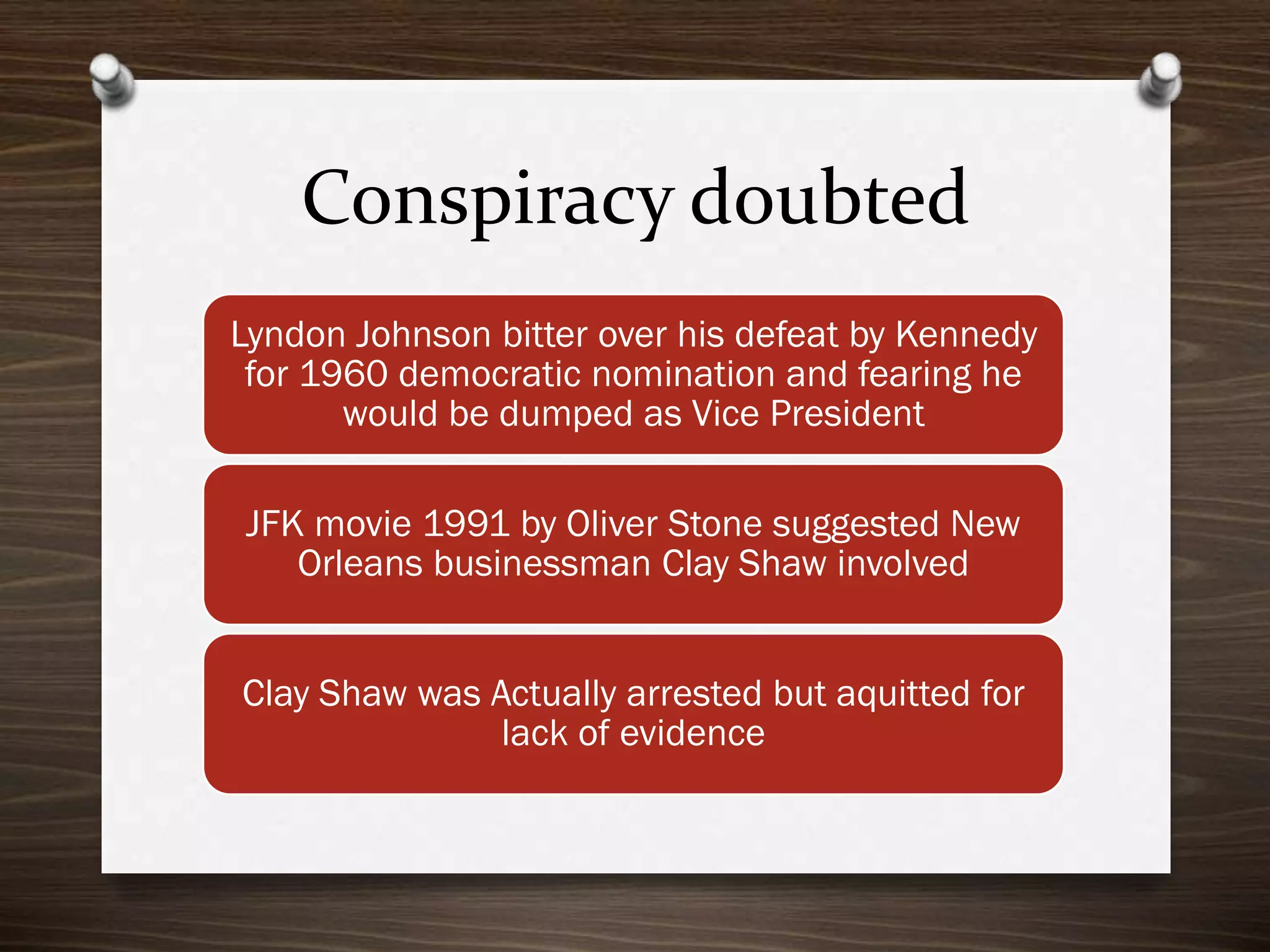
Conspiracy doubted
Lyndon Johnson bitter over his defeat by Kennedy
for 1960 democratic nomination and fearing he
would be dumped as Vice President
JFK movie 1991 by Oliver Stone suggested New
Orleans businessman Clay Shaw involved
Clay Shaw was Actually arrested but aquitted for
lack of evidence
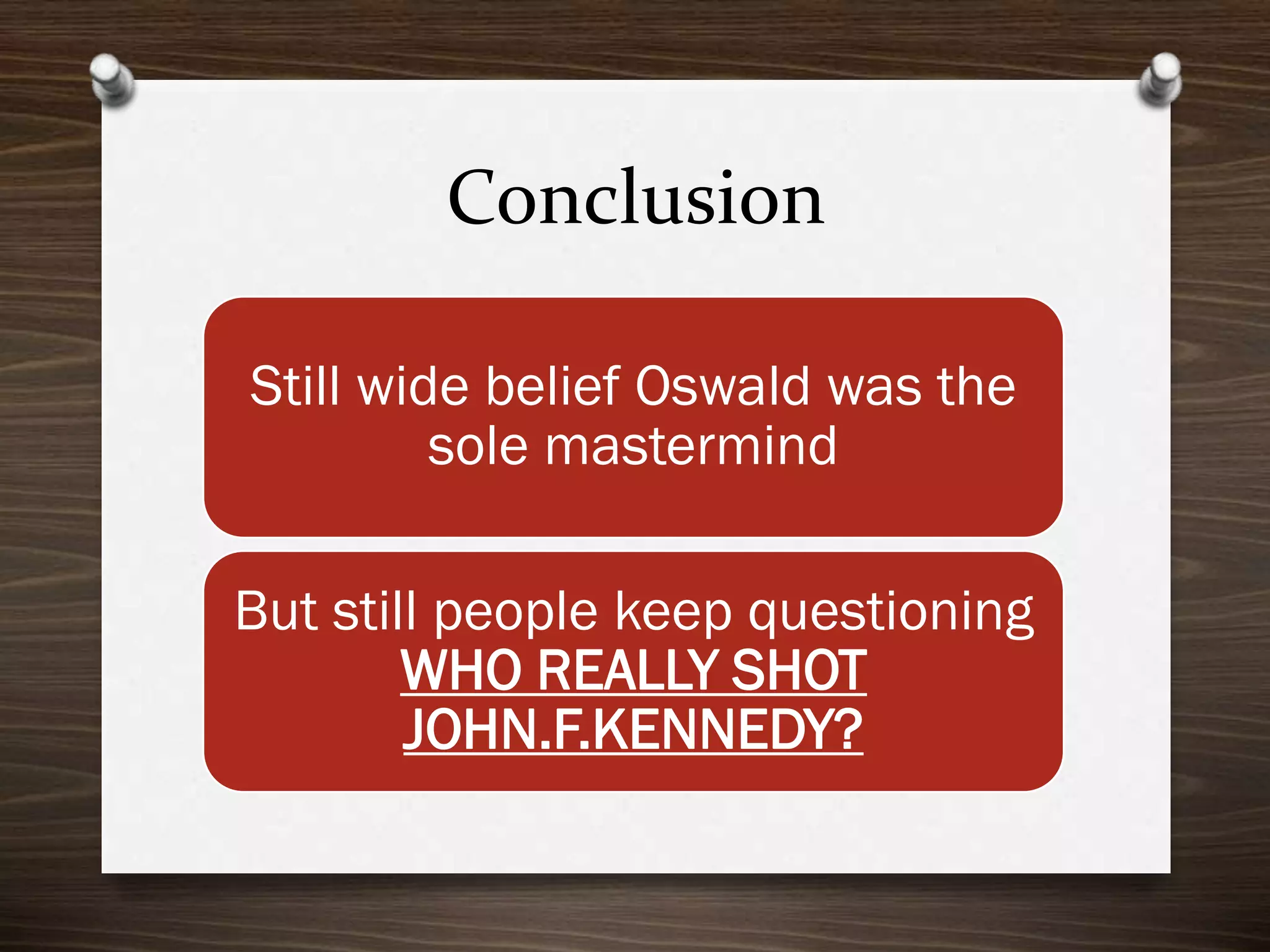
Conclusion
Still wide belief Oswald was the
sole mastermind
But still people keep questioning
WHO REALLY SHOT
JOHN.F.KENNEDY?
All the text is from Textbook of FMT- Dr.V.V Pillay, images taken
from K.S.N. Reddy, www.lib.med.utah, relentless defence.com,
google images and edited in paint, photoshop, powerpoint and
movie maker, Adobe capture

Firearm injuries_Forensics